THE FADED SPOTLIGHT

by Michael Lawrence

List of "C" Movies


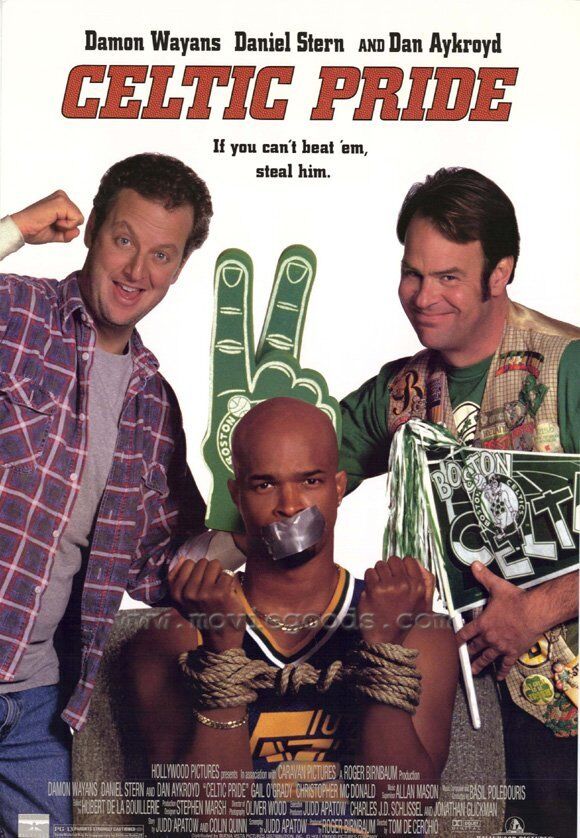
Celtic Pride (1996) Poster
CELTIC PRIDE (1996) B
dir. Tom DeCerchio

It’s a movie with such an absurd premise that by all rights it should topple like a house of cards. Amazingly, Celtic Pride not only remains standing, but it’s good for a few laughs as well. Daniel Stern and Dan Aykroyd play a pair of rabid Boston Celtics fans. So devoted to their team that their devotion bulldozes clear through common sense. The script is sharp and mean-spirited—happy to push its own ridiculousness right up to the edge. But what I enjoy most about the film is that raw “bro energy” radiating from every scene, as if the film itself is running on beer, nachos, and blind sports devotion. You get the sense that these two have been an odd couple, brethren-in-sports since they were teenagers.

Mike (Stern) and Jimmy (Aykroyd) aren’t just Celtics fans. They take every loss as a personal insult. Every win as proof of divine order. Boston is trailing in the NBA Finals. They decide to intervene. Get Lewis Scott (Damon Wayans), the Utah Jazz’s star player, blackout drunk the night before Game 7. One thing leads to another. By morning, Scott isn’t just hungover. He’s tied up in Mike’s apartment. They’ve kidnapped him. Not for ransom. Not out of cruelty. Because, in their warped sense of logic, this is what being a real fan requires of them.

Stern, all mouth and zero impulse control, plays Mike like a guy who thinks he understands the game better than the coach, the players, and probably God. Jimmy treats sports as ritual. Superstitions, routines, beliefs that dictate how he eats, breathes, and bets.

Wayans, caught in the middle of their fanboy hostage situation, reacts to them with a mix of irritation and disbelief. Never quite sure whether they’re dangerous or just profoundly stupid.

A highlight comes with real superstar Larry Bird—their hero—who has a terrific cameo, eviscerating the duo so ruthlessly that, by comparison, kidnapping a human being almost feels like the least humiliating thing they’ve done that week.

While this movie is pure ridiculousness, it never pretends otherwise. Consider this a portrait of sports obsession pushed past reason. And if you’ve ever yelled at a TV over a bad call or refused to wash a “lucky” jersey, you’re already halfway there. This isn’t a smart movie. It’s a cringe comedy. Some viewers will just cringe. While others will find themselves, against their best judgment, eagerly lapping up all the delectable bits.

Starring: Damon Wayans, Daniel Stern, Dan Aykroyd, Gail O’Grady, Christopher McDonald, Paul Guilfoyle, Adam Hendershott, Scott Lawrence, Deion Sanders, Vladimir Cuk, Bill Walton, Darrell Hammond, Larry Bird, Marv Albert, Bob Cousy.
Rated PG-13. Buena Vista Pictures Distribution. USA. 90 mins.
The Center of the World (2001) Poster
THE CENTER OF THE WORLD (2001) B−
dir. Wayne Wang

Sex is everywhere in The Center of the World, just not the kind that anyone dreams about. The film takes place in Vegas hotel rooms and strip clubs, spaces designed for transactions rather than intimacy.

Wayne Wang shoots in grainy handheld fragments. Almost documentary style, keeping the camera close but never tender. Nothing here is dressed up. It’s about a fantasy that thins and then disappears without anyone calling attention to it.

Peter Sarsgaard plays a dot-com millionaire who’s solved money and stalled everywhere else. He meets Florence (Molly Parker), a stripper with no confusion about what’s being sold—or what it costs. He proposes they spend a weekend in Vegas. She agrees. But only with conditions. Four hours a night. No sex. Rules meant to keep it from turning into something that might hurt later. And yet, they spend their days together too. Talking, eating, sightseeing, playing at something closer to romance. Though neither one admits it.

Richard, clearly believing that enough money and enough time will turn this into something real, even offers financial help to Florence’s friend (Carla Gugino), under the pretense of generosity. What he’s really offering is himself. No strings. No expectations. No pressure. Or at least without the pretense of those things. He plays it less like a villain than someone attempting to buy his way into feeling decent.

The film aims for heavy themes about alienation, but it keeps getting caught on the act of watching. Sometimes to the point of stalling. Parker and Sarsgaard help carry it through the stretches, at least. They play the push and pull between control and exposure so directly that the film occasionally feels like it’s running on their presence alone.

The Center of the World is uncomfortable and frustrating. But it’s oddly absorbing. It isn’t an erotic film as much as it’s procedural. Desire getting reduced to mechanics—terms being understood by both sides, rarely spoken out loud. Nobody seduces. Nobody wins. Nobody gets in the end what they were reaching for.

Starring: Peter Sarsgaard, Molly Parker, Carla Gugino, Balthazar Getty.
Rated R. Artisan Entertainment. USA. 88 mins.
Chain Reaction (1996) Poster
CHAIN REACTION (1996) C
dir. Andrew Davis

A science thriller that looks slick and busy and has some base entertainment value. But then you squint just a little bit and notice that, at its core, there’s just one big, well-polished void. Chain Reaction is a movie that moves fast and sounds important. But then it thins out almost immediately—after you realize how few ideas it has beyond its opening setup.

Keanu Reeves, speaking in his usual breathy exasperations, stars as Eddie Kasalivich, a Chicago lab tech and brainy Ph.D. student who looks like he could also have a secret life playing drums in an alt-rock band. He’s messing around with water, pressure, energy, and bubbles and whatnot when he hits upon a certain combination, and—blammo!—cold fusion is invented. Something that in one fell swoop could solve all the world’s energy problems. It also happens to be the kind of discovery that would immediately ruin your life.

Some bigwigs are very interested in making sure this technology doesn’t escape the lab. The next thing Eddie knows, his mentor turns up dead. The lab is wrecked, helicopters come swooping after him. And he’s the one framed for the whole thing.

Rachel Weisz plays Eddie’s scientist colleague and fellow escapee. Attractive, too, so also a possible romantic pairing. But otherwise, she’s mostly there to be someone other than Eddie on screen who knows what all the big words mean. (Measured Prosaic Didactic Girl?)

Morgan Freeman turns up briefly. Highly billed but lightly used. He plays Paul Shannon, head of the whole cold fusion operation. He’s not sure who to trust. Which reduces his job pretty much to watching events unfold and then deciding later what it all meant.

Chain Reaction comes across as little more than a prefab, mid-’90s Keanu Reeves thriller. Parts slotted in where they’re meant to go. Big sciency ideas name-checked and left behind. Nothing poked at too hard. The machines whirling in the background let you know that we probably wouldn’t understand any of it anyway.

From there, it’s calisthenics. Running through Chicago. Running through rural Wisconsin. Surveillance feeds. Shouted explanations. An action thriller that is polished, professional popcorn fodder. It looks expensive. People talk in gravely serious proclamations. But none of it ever heats up. A movie powered by momentum alone, hoping you don’t notice that underneath the hood, there’s nothing there but the hum of the engine itself.

Starring: Keanu Reeves, Morgan Freeman, Rachel Weisz, Fred Ward, Brian Cox.
Rated PG-13. 20th Century Fox. USA. 107 mins.
Chaos Walking (2021) Poster
CHAOS WALKING (2021) C−
dir. Doug Liman

Chaos Walking begins with a smart, volatile idea and spends the rest of its runtime neutralizing it. Adapted from a young adult novel by Patrick Ness, this film imagines a distant planet where a small human colony tried to settle, in which every man’s thoughts are projected into the open air. Like thought bubbles from the Funny Pages, except they play videos. That makes privacy an extinct concept—deception requires an iron will.

And by the way, this phenomenon only affects men. Only women in this society get to live in silence. Not that it matters much, anyway, since there are no women left. The planet’s native inhabitants, known as the Spackle, wiped them all out years ago—leaving behind a town of men slowly drowning in each other’s unfiltered thoughts.

Then there’s a new interruption. A ship crashes. Viola (Daisy Ridley) emerges. This makes her the first woman Todd (Tom Holland) has seen since his mother was killed years ago. And her presence is not considered a “hurrah for the continuation of the human species.” It’s treated as a threat. An inhabitant who can keep her thoughts hidden from the town’s muckety-mucks. The town’s leader (Mads Mikkelsen, wrapped in furs like a Scandinavian warlord) takes an immediate interest in her. Which in this kind of movie means she needs to run.

An idea like this should unravel into something terrifying. It should be a slow-burn examination of paranoia and power. A dystopia where thought itself is a weapon. But instead, Chaos Walking is a wildly original concept reduced to a limp chase movie.

Holland and Ridley, inspired casting choices, try their best with what they’re given. He gives Todd a wide-eyed puppy-dog quality—someone still figuring out how his own paws work. She plays Viola with a guarded, measured intelligence. They have enough natural chemistry that they could have been developed into something—electric, awkward, anything. But the script gives them nothing beyond basic hurried exchanges with a vague suggestion of romance.

The premise deserved sharper writing and a wilder narrative imagination. There should at least have been a willingness to push its own ideas further. Instead, Chaos Walking pulls back. Too timid to take real risks. Too safe to be truly memorable. While this movie doesn’t quite collapse, it just trudges forward, head down. At a certain point, the movie isn’t unfolding anymore. You’re just enduring it. I wouldn’t call this a disaster, at least. It’s more like a wasted shot at something better.

Starring: Tom Holland, Daisy Ridley, Mads Mikkelsen, Demián Bichir, Cynthia Erivo, Bethany Anne Lind, Nick Jonas, David Oyelowo, Kurt Sutter, Ray McKinnon.
Rated PG-13. Lionsgate. USA. 109 mins.
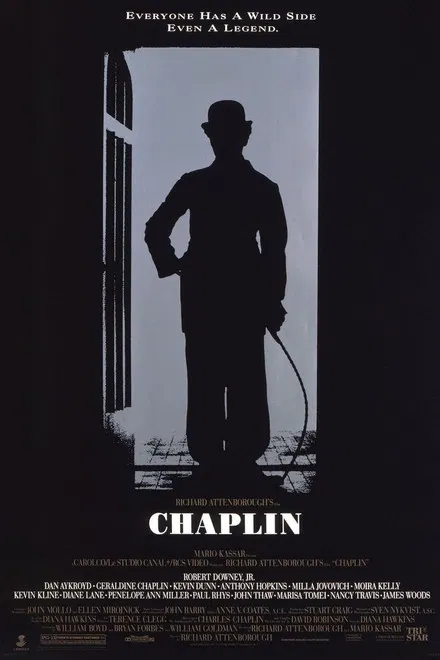
Chaplin (1992) Poster
CHAPLIN (1992) C
dir. Richard Attenborough

Robert Downey Jr. doesn’t just impersonate Chaplin. He channels him. That walk, the flinchy grace, the elastic grin. All of that is here, and it’s so uncanny that it’s like he’s been possessed by nitrate stock. A performance so finely tuned that you end up laughing at Downey the way you used to laugh at Chaplin. That’s its own kind of magic.

Unfortunately, it was all in vain—in service of a biopic that is lavishly produced but thinks small. Director Richard Attenborough ticks off the major events from Chaplin’s life, playing more like a guided tour through a wax museum. We see the poverty. The sudden ascent. The marriages. The scandal that led to exile. The redemption. It’s all here, and none of it is illuminated. His predominant contribution to our society was his filmmaking—and all that gets is a footnote, while his romances (some of which, granted, were controversial) get entire chapters devoted to them. Even Chaplin’s unofficial exile from the United States in 1952 (due to the anti-Communist hysteria of the time) is brushed aside like a canceled vacation.

Downey is magnetic, but he’s performing in dimensions the script doesn’t even recognize. He’s expressive and reactive—not just mimicking Chaplin. Everyone else is stuck in historical cosplay. Dan Aykroyd is excitable as director Mack Sennett. Kevin Kline coasts as Douglas Fairbanks with familiar posture and polish. Geraldine Chaplin plays her own mentally unstable grandmother—which ought to add a shiver of something uncanny to the film—but she doesn’t get much space to let it settle.

There’s no shortage of material to draw from in Chaplin’s life. But this film seems content to settle on the least interesting bits. Or things you could have looked up in an encyclopedia. What’s missing is the itch. What drove him to carve comedy from deprivation. What made a silent man able to say more than most people can with three hours and a microphone. All we get here, unfortunately, is the silhouette. The mind, the mischief, the meaning—that’s been left offscreen.

Starring: Robert Downey Jr., Geraldine Chaplin, Paul Rhys, John Thaw, Moira Kelly, Anthony Hopkins, Dan Aykroyd, Marisa Tomei, Penelope Ann Miller, Kevin Kline, Milla Jovovich, Kevin Dunn, Diane Lane, Nancy Travis, James Woods, David Duchovny, Peter Cook.
Rated PG-13. TriStar Pictures. UK/USA. 145 mins.
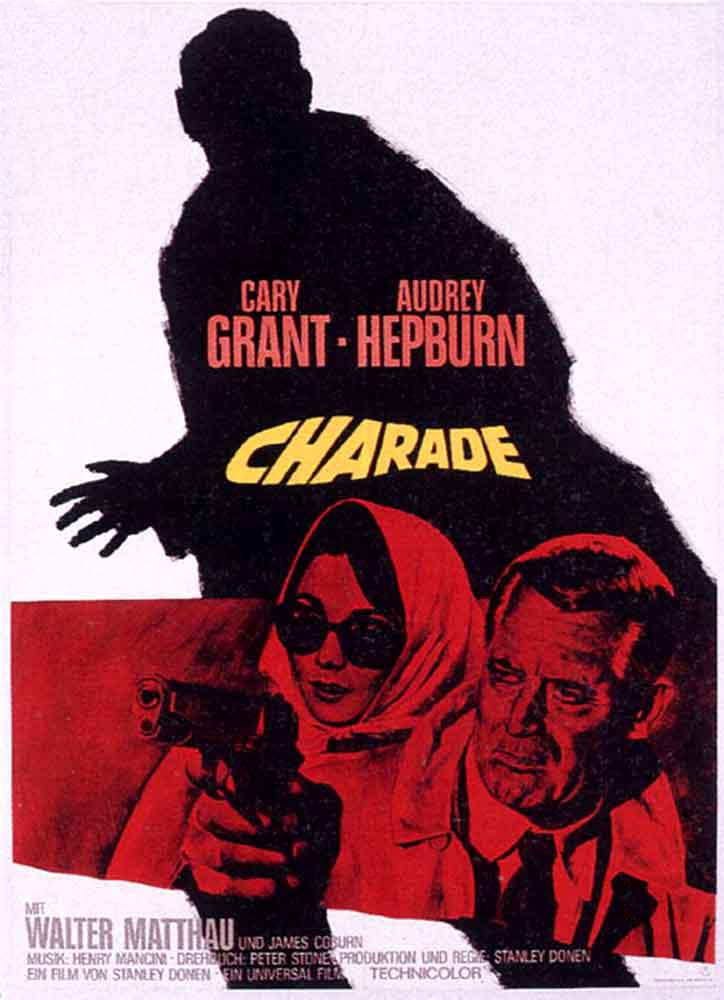
Charade (1963) Poster
CHARADE (1963) A−
dir. Stanley Donen

A Hitchcock setup on a screwball bender. A twisted mystery with banter, murder, and Audrey Hepburn in Givenchy.

Hepburn plays Reggie Lampert. She comes home from vacation ready to divorce her husband. Instead, she’s planning his funeral. It doesn’t take long to learn he wasn’t just unfaithful or careless. He was crooked. A fortune has vanished, and everyone seems convinced that Reggie knows where it is. She doesn’t. That doesn’t stop strangers from circling.

Enter Cary Grant, who introduces himself as one man, then another. Each name comes with a different story, and none of them quite adds up. Grant plays him as charming but evasive. He doesn’t lie outright. He just changes the subject when she presses further. He earns her trust anyway—if tentative. Not by explaining himself, but by showing up when things start to get dangerous.

Around them, the heavies keep turning up: James Coburn, George Kennedy, and Ned Glass, each circling Reggie with a different kind of threat, bringing with them a flurry of menace and oddball energy. Never quite in sync with each other, but always on the same trail. All trying to get their hands on the same vanished stash. Walter Matthau is the movie’s wild card—in a film where nearly everyone qualifies as a wild card—playing a CIA man who mostly stands off to the side, letting others move pieces around while he takes notes.

Strip the film down and it’s classic noir. A wartime heist. A hidden stash. A trio of men willing to kill for it. But the tone’s more confection than noir. A crisp mix of thriller, comedy, and romance—all handled with enough confidence not to overplay any of it.

Grant and Hepburn are, of course, the ones who carry the thing. Their characters are brilliantly drawn. He’s smooth, slippery, clearly enjoying the game. She’s quick and suspicious. Not nearly as naïve as everyone assumes. Their chemistry crackles as the subtext between them is continually shifting. Their romance undercut by doubt. The danger softened by wit.

The plot’s a nest of reversals. Every time you think you’ve got a handle on where this might all be going, it shifts. Often right along with one of Cary Grant’s name changes. A wonderful movie that works as both a romance and a thriller, with crisp lines and a mean little grin. The jokes stay light. Paris looks good. Mancini’s score keeps things moving. And the ending is actually surprising.

Charade knows the game and plays it cleanly. It never once looks nervous. And most importantly, it just comes off like it’s having a damn good time.

Starring: Audrey Hepburn, Cary Grant, Walter Matthau, James Coburn, George Kennedy.
Rated PG. Universal Pictures. USA. 113 mins.
Chariots of Fire (1981) Poster
CHARIOTS OF FIRE (1981) A
dir. Hugh Hudson

This film about British Olympic runners in the 1920s has a reputation for being respectable. So respectable it should be a death knell. Respectability suggests something people praise carefully and admire, rather than something you sit with and experience. But Chariots of Fire hangs around—cool and patient. After a while, you’re not really watching it anymore. You’re keeping pace.

For a movie about runners, it never seems to be in much of a hurry. Photographed in soft light, with outdoor scenes that are nothing but green, damp hills. But it draws you in all the same. Into the cloisters. Into a world where effort itself feels ceremonial.

Ben Cross plays Harold Abrahams, a runner who’s brilliant and Jewish—driven in a way that never seems to rest. We see his insatiable drive early on here, when he takes on the Cambridge quad. A mad sprint through stone corridors across campus. A race that starts with the first chime of noon and ends as the final stroke fades. A feat no one in the school’s history (at least according to this film’s own mythology) has completed until he did. He’s a man who doesn’t prove to himself that he belongs here. That he deserves to compete in these races. And he desperately wants institutions to notice him. Cambridge. England. That invisible panel of judges that he’s always imagining judging him.

Eric Liddell (Ian Charleson) is Abrahams’s chief “rival” and something else entirely. (Though “rival” here is in the most gentlemanly, British sense you can imagine.) He’s a deeply religious man. To the extent that he refuses to race on Sundays—even when that means disqualification from major competitions down the line. To him, running is an expression of his faith. Not a test of it.

And thus, the core tension of the film. One man runs to quiet his doubts. The other runs because he has none. The movie never feels the need to make a case out of that difference. It just trusts you to notice it.

The now-iconic Vangelis score should feel like a mistake. It’s electronic, repetitive, and clearly out of the early ’80s. Certainly nothing anyone in the 1920s would have recognized. And yet it works. Unexpectedly well. Pulling the film out of the museum and into the present tense. The score is most striking over the opening scene, depicting a compact group of runners moving against the surf. Not competing, but committing. Bodies set into motion. Effort finding rhythm. Even the sheer pleasure of what they’re doing. Even if no one is particularly sure why they’re doing it. The music locks onto that pulse and propels it forward.

There’s still some resentment toward this picture for beating out Raging Bull for Best Picture. One film is brutal, modern, flayed open. The other is stately, restrained, classically composed. But comparisons only get you so far. Chariots of Fire isn’t trying to punch you into submission. It’s doing something quieter—and arguably more difficult. Finding poetry in discipline. Grace in persistence. Emotion in the act of moving forward even when the finish line doesn’t promise clarity.

This isn’t just a sports movie, or even just a historical one. This is a movie about belief in all its inconvenient forms. Religious belief. Belief in oneself. Belief in flags, institutions, and rules. Those beliefs that shape people. And then quietly fence them in.

Starring: Ben Cross, Ian Charleson, Nigel Havers, Nicholas Farrell, Ian Holm, John Gielgud, Lindsay Anderson, Cheryl Campbell, Alice Krige, Struan Rodger, Nigel Davenport.
Rated PG. 20th Century Fox. UK/USA. 124 mins.
Charlie Wilson’s War (2007) Poster
CHARLIE WILSON’S WAR (2007) B
dir. Mike Nichols

Charlie Wilson was a hard-drinking, womanizing congressman from Texas who, in the ’70s and ’80s, helped bankroll a proxy war in Afghanistan. This movie really shouldn’t feel as sprightly as it does, but it makes politics go down with the ease of a cocktail. It moreover shows us what there is about a proxy war in Afghanistan that’s worth caring about.

Tom Hanks is perfect for the part. He can play charm and moral drift with the same glint in his eye. He smiles, lets things slide, knows when to look harmless. And his constituents let him get away with it. He coasts through reelection cycles. He prefers open bars to town halls. Hot tubs to congressional hearings.

And yet, somehow, he stumbles into consequence. Nudged along by Joanne Herring (Julia Roberts), a Houston socialite who developed a fixation on Afghanistan. A place she talks about in blunt, alarming terms. Soviet tanks rolling roughshod, land mines disguised as toys—the kind of cruelty that doesn’t need much embellishment. She keeps at it. And the conviction wears him down.

That’s how Wilson winds up alongside CIA operative Gust Avrakotos (Philip Seymour Hoffman). Bridges don’t last long around him. He blows them up, then goes right back to convincing the rubble to rebuild itself. Hoffman is electric. He barges through every interaction like a man who assumes he’s smarter than everyone else in the room and rarely gets proven wrong.

The operation itself is treated something like a caper and a cautionary tale. Millions get funneled to the mujahideen. American weapons are shipped in silence. Soviet aircraft suddenly start tumbling from Afghan skies. The movie stops short of the fallout. Taliban rule. Al-Qaeda. The mess that keeps getting handed off to the next decade. But it does nod to Wilson’s final, futile push. To rebuild the country with schools, infrastructure. Something to bind the place back together. But just as soon as the Soviets were pushed back, Washington lost interest in the region. And so the money dried up. Afghanistan ultimately left to fend for itself.

Wilson is framed as a roguish hero, which sidesteps broader implications of this foreign-policy cycle that the U.S. keeps repeating. While that same instinct keeps the film from turning into a civics lecture, it also dulls the edge. Not quite tipping into a satire that might have suited the subject better.

But Charlie Wilson’s War moves fast and it looks good. For a movie built out of committee rooms and budget appropriations, it goes down easy. An entertaining film. Even if you’re not entirely convinced that the spotlight landed on the right guy for the right reason.

Starring: Tom Hanks, Julia Roberts, Philip Seymour Hoffman, Amy Adams, Ned Beatty, Om Puri.
Rated R. Universal Pictures. USA. 102 mins.
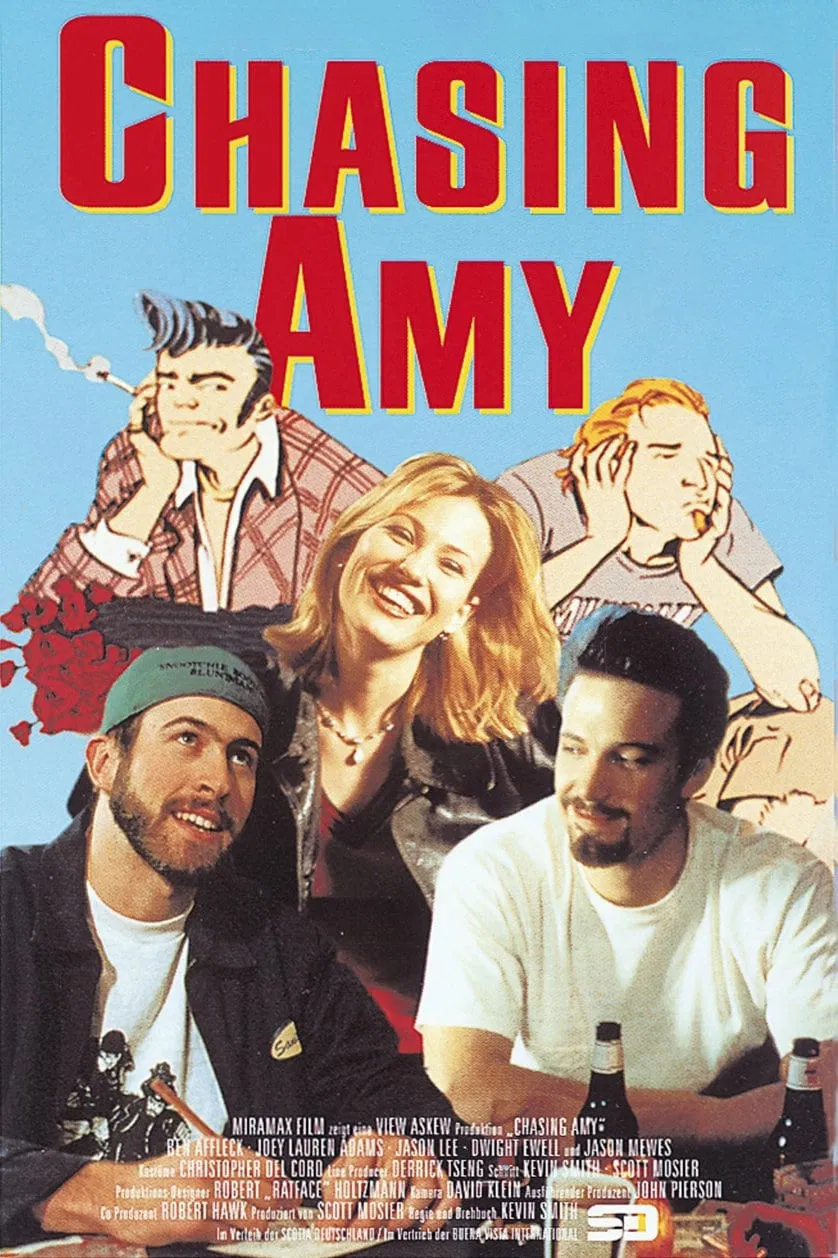
Chasing Amy (1997) Poster
CHASING AMY (1997) B+
dir. Kevin Smith

Chasing Amy starts loud. Comic shop rants, dick jokes, Star Wars metaphors. Pop culture combined with blunt honesty and shock-oriented profanity. In other words, Kevin Smith in his comfort zone.

But then the movie turns into something knottier. It slows down and looks inward—not afraid of being uncomfortable. Dwelling on subjects like desire, identity, and the limits of the straight male perspective. The whole thing is handled clumsily at times—especially since the prime purpose of this film is to provide shock laughs. The reach is real.

Ben Affleck plays Holden McNeil. He and his partner Banky (Jason Lee) coast on their cannabis-based underground comic, Bluntman and Chronic, which is a modest hit. Holden’s routine cracks when he meets Alyssa (Joey Lauren Adams)—sharp, funny, a fellow artist, easy to talk to. He falls for her fast. One complication, though. She isn’t into men. But maybe, Holden reasons, that is negotiable.

Banky, whose opinions arrive without subtlety or restraint, warns him off. But Holden ignores him. He believes sincerity should count for something. That wanting it badly enough can rewrite the rules. The movie doesn’t so much indulge that belief as it lets him embarrass himself with it.

What follows isn’t really a romance. It plays more like a look at projection, entitlement, and selective listening. Smith wanders into territory his earlier films tended to avoid, especially around sexuality and control. He doesn’t always know what to do once he’s there, but the movie never turns those subjects into a joke. Or at least not jokes that mock non-heteronormative sexuality.

When the film does go for laughs, they’re aimed straight at male cluelessness. For example, Jason Lee asking whether lesbians get turned on when they look at themselves in the mirror. I cracked up—mainly because I could recognize that it’s exactly the sort of thing an immature, straight guy would toss out without thinking.

Holden stays at the center longer than he should. The film is far more interested in reckoning with his confusion than in Alyssa’s interior life, with Alyssa far too often framed as less of a person than as a problem to be worked through.

But Joey Lauren Adams does what she can—which turns out to be quite a bit—to push back against that framing. She brings more to the role than the movie seems prepared to hold. Affleck scales himself back, playing Holden with a passive, wounded self-importance that feels right for the character. Jason Lee lets Banky’s bitterness harden into something more revealing, hinting at motives the film only half-articulates.

Chasing Amy stumbles over its own good intentions. But it’s curious in a way that doesn’t quite let go. Smith reaches beyond his usual habits, and even when the movie strains or missteps, the effort matters quite a bit—especially for the late ’90s, when approaching such matters with any degree of maturity was taboo, even for crude comedies. Messy, overreaching, and still the most interesting thing he’s made.

Starring: Ben Affleck, Joey Lauren Adams, Jason Lee, Dwight Ewell, Ben Indra.
Rated R. Miramax Films. USA. 113 mins.
Cheers for Miss Bishop (1941) Poster
CHEERS FOR MISS BISHOP (1941) C+
dir. Tay Garnett

Pleasant, in the way a long gray afternoon can be pleasant. It’s polite. Agreeable. Nothing you’ll probably remember. Cheers for Miss Bishop is an “inspiring teacher” picture that goes about its business, hoping decency alone will do the work. And for the most part, it does. Even if it comes up considerably short of similar films—the gargantuan one being Goodbye, Mr. Chips.

This movie works from a familiar playbook. Decades pass, and she’s still at the front of the room. Students cycle through. Generations start stacking up. Her influence is measured in testimonials rather than events. Where Mr. Chips lets those years quietly pile up, this one arranges them neatly. Like a scrapbook you’re encouraged to admire page by page.

Ella Bishop (Martha Scott) begins teaching in the late 1880s, uncertain and ill at ease, and carries on into what appears to be the 1920s, by which point she’s acquired a reputation for discipline and fairness. The framing device—a medical emergency—opens the door for memory to step in and start organizing. Students current and from earlier generations come to visit at the hospital, giving the movie plenty of excuses for flashbacks. We watch her age into the job—her hair getting whiter, her voice getting sharper. What we don’t feel is the grind.

Her private life is treated with the same careful discretion. She has one promising romance, but hopes of it getting to the marriage phase evaporate when he chooses someone else. He leaves Ella pregnant, raising a daughter on her own. Quite an unusual plot point for a studio picture operating under the Production Code. The pregnancy is never spelled out. Merely implied. On screen, Ella simply shows up with a child, leaving the audience to piece together how that came to be. And then perhaps to scratch their heads trying to remember the last time a respectable, non-widowed single mother turned up in a Hollywood film.

By the time the movie steps back to the present day, it reaches for the usual reassurance. Old faces Ella half-remembers now attached to grown bodies. A tally of students. A suggestion that the years must have counted for something after all.

The film admires the life it’s been tracing. The discipline. The sacrifice. The long years spent shaping other people’s children. What never quite comes through isn’t that she gave things up, but how living with those choices shaped her day-to-day experience. Or why she became sterner over the years. Showing these developments is what Goodbye, Mr. Chips did so brilliantly.

Cheers for Miss Bishop behaves itself, though. Watchable. Knows its job. You respect the life it honors, because you know you should. But was it enough?

Starring: Martha Scott, William Gargan, Edmund Gwenn, Sterling Holloway, Donald Douglas, Mary Anderson, Sidney Blackmer.
Not Rated. United Artists. USA. 94 mins.
Chestnut: Hero of Central Park (2004) Poster
CHESTNUT: HERO OF CENTRAL PARK (2004) B−
dir. Robert Vince

Two orphaned sisters hide a Great Dane in their new, affluent Manhattan foster home and somehow no one notices. That’s the plot. Or most of it. Chestnut: Hero of Central Park is a movie that runs almost entirely on improbability and sentiment—both qualities not without their uses, chief among them a pre–Little Miss Sunshine Abigail Breslin, already showing a knack for being adorable on cue.

Breslin and Makenzie Vega play the sisters, fresh out of an orphanage that appears to operate on rules last updated during the Roosevelt administration. They’re adopted by kindly Manhattanites and, within minutes, have smuggled their dog into the building. This particular high-rise has a strict no-dogs policy. A Great Dane is not the sort of dog you bend rules around. It’s enormous. You might as well be trying to smuggle a grand piano into a convenience store.

Whatever planning these girls do to get their scheme to work is not something this movie dwells on. And why should it be? Realism isn’t the point here. You’re meant to show up for the kids, the dog, and whatever passes for gentle comedy. Though the film doesn’t have a perfect track record on that front either. While the dog is certainly cute and the kids are adorable, the comedy is the big stumbling block.

Most jokes are reduced to adults losing control of their bodies. A man sneezes himself across a room in a rolling chair. Someone else ends up spinning for dear life on a ceiling fan. About halfway through the movie, two would-be burglars wander in—the Wet Bandits’ lesser cousins—only to be undone by the dog’s improvised booby traps. Mercifully, the movie doesn’t spend more time on this than it has to.

The film is, of course, squarely aimed at young children. Especially those susceptible to cooing at puppies and who find stories about sisterly bonding endearing. Within that narrow lane, this movie mostly works. You do sense something genuine beneath the synthetic storyline and pratfalls. The girls’ attachment to the dog feels like an actual relationship. And I found myself hoping that they make it. I just wish everything else about it felt richer and less throwaway.

Though the ending takes a curiously somber turn—more restrained than you’d expect from a movie in which pratfall-prone criminals at one point find themselves outsmarted by a dog. In the end, Chestnut might not amount to much, but it’s fine overall. A children’s film that knows its audience and plays to them without talking down to them. In this corner of the genre, that might just be enough to call it a win.

Starring: Abigail Breslin, Makenzie Vega, Christine Tucci, Barry Bostwick, Irene Olga López, Justin Louis, Maurice Godin.
Rated G. Miramax Films. USA. 87 mins.
Child’s Play (1988) Poster
CHILD’S PLAY (1988) C–
dir. Tom Holland

There’s inherent novelty in a horror movie about a freckled, two-and-a-half-foot doll with a sinister little plastic smile and an insatiable desire to stab people. But Child’s Play never truly figures out how to use it. You laugh, sometimes. Whether that’s in the way the movie is intending is left up to the audience to decide. But for horror fans, this film also comes up short, as it’s never especially scary, either. But there is one thing that’s undeniable: it did hand pop culture an instantly recognizable mascot. That Chucky Doll. The mop-haired menace with two voices—one chirpy and canned and the other snarling and profane.

Brad Dourif kicks things off like he’s auditioning for Scarface but got lost in the toy aisle. The next thing he knows, he’s in a shootout with a detective (Chris Sarandon). Cornered, he chants some voodoo gobbledygook before zapping his soul into a plastic body. Specifically a “Good Guy” doll. The next day, single mom Catherine Hicks gifts the possessed “Good Guy” doll to her young son (Alex Vincent), who beams as it blinks and squeaks: “Hi, I’m Chucky! I’m your friend to the end!” The kid is delighted, of course. That is, until Chucky starts whispering things that weren’t in the manual. He tries telling Mom, who—as any self-respecting ‘80s mom does—naturally dismisses it as overactive imagination.

The film might have been a little cleverer if it toyed with ambiguity. If we hadn’t already seen the possession, the audience might have been strung along with disbelief along with the mother. Doubt might have been a solid hook to keep the audience glued to the screen. But the film prefers to eschew what might have been a slow, sick build of paranoia and instead just have the doll wrack up the kills. Which are never terribly believable, by the way.

The murders themselves defy physics. Chucky grips a hammer in his toddler hands, whacks someone on the head, and sends them flying ten feet out a high-rise window. As soon as we see things like this, it’s clear Chucky isn’t bound by any limits, and therefore nothing feels dangerous.

What stuck wasn’t the suspense, or the plotting, or even the kills. It was the spectacle of a toddler-sized doll with a sailor’s mouth. Chucky became the brand, the icon. The movie itself was just his packaging.

Starring: Catherine Hicks, Chris Sarandon, Alex Vincent, Brad Dourif, Dinah Manoff, Tommy Swerdlow.
Rated R. United Artists. USA. 87 mins.
Chinatown (1974) Poster
CHINATOWN (1974) A
dir. Roman Polanski

Forget shadows and rain-soaked alleys. Chinatown plants noir in the blinding Los Angeles sun, where rot doesn’t hide as much as it grins back at you through mirrored sunglasses. Jake Gittes (Jack Nicholson, never more gorgeously smug) is a private detective who makes his living trailing adulterers for L.A. high society. Then a blonde walks in his dinky office, claiming to be Evelyn Mulwray, and hires him to follow her husband, Hollis (Darrell Zwerling).

Jake delivers the dirt and pockets the check. But then the real Evelyn (Faye Dunaway) shows up with a lawsuit, and suddenly Jake realizes that he’s been used. The next thing he knows, Hollis is face-down in an aqueduct. And suddenly what was originally supposed to be a simple adultery case has mutated into a civic nightmare about stolen water and stolen lives.

Jake does what any self-respecting noir detective would do and continue to dig, ignoring warning signs not to. What he finds is a city built on fraud and desert thirst—land grabs, dam projects, and family fortunes older than the skyline. His nose also meets the wrong end of a switchblade in a gruesome scene that redefines “keep your nose clean.” (This tiny, rat-faced thug played by none other than director Roman Polanski himself.)

By the time the ending arrives—pitiless and reeking of decades’ old rot—you realize what makes Chinatown so devastating: that even if you’re able to piece together every lie, you can still lose.

Nicholson portrays Jake as bravado with blinders. He’s sharp and quick enough to follow the clues, but too cocky to notice where the traps are. Dunaway disguises porcelain fragility as cast iron, and when her secrets finally crack, it’s unbearable. John Huston, as her father, is the embodiment of corruption. He’s genial, patient, and obscene.

This is noir as it should be. Bitter, merciless, and truer than we’d like. If you’re looking for a moral, try children’s books. Chinatown is only interested in giving you the truth—and it burns.

Starring: Jack Nicholson, Faye Dunaway, John Huston, John Hillerman, Perry Lopez, Darrell Zwerling.
Rated R. Paramount Pictures. USA. 130 mins.