THE FADED SPOTLIGHT

by Michael Lawrence

List of "C" Movies


Caddyshack (1980) Poster
CADDYSHACK (1980) B+
dir. Harold Ramis

A country club comedy, technically. A sports movie, if you insist. Caddyshack has no patience for structure. No use for decorum. No obligation to respect the game of golf. Golf is just the cover story—an expensive alibi for grown men behaving badly in public.

There is a narrative. Barely. It exists mostly as a clothesline to hang jokes on. It technically belongs to a main character, who is, strangely, the least interesting person in the movie. Lose track of him entirely and you’d barely notice the change. But Danny Noonan (Michael O’Keefe) remains in motion anyway. A lowly caddy carrying bags, running errands, fading into the background while his much goofier clients take center stage.

But Danny still keeps himself within the orbit of Judge Smails (Ted Knight)—an old-money type who gets to decide which caddie receives the lucrative scholarship the institution offers every year. Danny wants the prize. It’s for his future and whatnot. So he keeps himself in line. Even when Smails is insufferable. What keeps the movie funny is watching how angry Smails gets at everything.

The real thorn in Smails’ side is Rodney Dangerfield as Al Czervik—a human air horn with a bank account who doesn’t challenge the rules so much as he ignores them. He sprays insults without bothering to gauge how they land. Chevy Chase also drifts through the film, his golf game just as loose as his vague, unhurried smile. The movie bends around him anyway.

Then Bill Murray—who quietly walks away with the whole movie—starts tunneling. He plays Carl Spackler—groundskeeper, zealot, amateur extermination theorist. His war with the gopher isn’t comic relief. It’s like theology. He talks past people. Plans obsessively. Narrates a life out loud no one else is watching. His scenes carry a faint sense of risk, as if the movie itself is unsure whether he’s about to spill over and take the whole thing with him.

Not every joke works. The story isn’t interesting so much as it is a veneer over controlled anarchy. But I can’t help laughing myself silly through much of this—especially when Murray or Dangerfield is on screen. Their scenes have unstoppable momentum.

Caddyshack is loud, crude, and openly indifferent to refinement. It boils down to defying authority figures—who don’t get corrected or improved here. But they do get annoyed. Interrupted. Left standing there, clenched and sputtering. A movie that keeps poking at the people who think they’re in charge. Then it lets the anger do the rest.

Starring: Chevy Chase, Rodney Dangerfield, Ted Knight, Michael O’Keefe, Bill Murray, Sarah Holcomb, Scott Colomby, Cindy Morgan, Dan Resin, Henry Wilcoxon.
Rated R. Warner Bros. USA. 98 mins.
Cadillac Man (1990) Poster
CADILLAC MAN (1990) C
dir. Roger Donaldson

Cadillac Man is a comedy that can’t decide if it wants to sweat or smirk. It also wants to extract everything it can from its star, Robin Williams, but gives him precious little to work with. He can play desperation, wit, pathos, charm, and laughs—but the movie seems to expect him to pull all of that out of a magic hat. Sure, it works to a degree. Williams has the ability to keep firing off one-liners as though he’s trying to keep the air circulating. But you can still feel the air thinning around him anyway.

He plays Joey O’Brien, a slick-talking Queens car salesman drowning in debt and ex-wives. To further his troubles, even his teenage daughter is on the outs with him. Just as it seems his life couldn’t possibly unravel any further, a jealous biker with a machine gun (Tim Robbins) storms the showroom, convinced that someone there is sleeping with his wife. What follows is a discount Dog Day Afternoon that’s supposed to be played for laughs. Williams slips into accidental negotiator mode, trying to soothe his captor with the reflexes of a man who’s been living or dying by the seat of his pants for decades.

The setup isn’t bad, and Williams’ verbal ricochet certainly fits his character. He’s a kind of hustler-slash-empath. But the film never finds a tone for him to juggle. Whether he’s supposed to be in a satire, a jagged black comedy, or just a broadly drawn farce, it doesn’t find a clear track. If there was supposed to be tension, it never builds. And the characters hardly even seem like people—or at least not like anyone you’d ever meet outside a sitcom that didn’t make it past the pilot stage.

This is a film with clumsy logic and clumsier reversals. The other problem is Tim Robbins’ character—you can’t tell if he knows he’s in over his head or if he’s just too far gone to notice. The ending feels particularly egregious—it’s lazy, as if it were pulled from a file labeled “reasonable resolutions: insert here.” Cadillac Man seems like it might have had original ambitions of being a dark workplace satire with real stakes. But all it ends up being is a loud stall, idling in neutral, hoping that Robin Williams’ presence alone is enough to distract you from the fumes.

Starring: Robin Williams, Tim Robbins, Pamela Reed, Fran Drescher, Zack Norman, Annabella Sciorra, Lori Petty, Paul Guilfoyle.
Rated R. Orion Pictures. USA. 97 mins.
Cadillac Records (2008) Poster
CADILLAC RECORDS (2008) C
dir. Darnell Martin

This movie doesn’t wait around, just like the Chess Records story it’s trying to cover. Leonard Chess (Adrien Brody) is running a club when Muddy Waters comes through. That’s when something becomes obvious to Chess: the big record labels aren’t capturing his sound. So he starts a label of his own, along with his brother Phil.

Things rush past from there. Muddy Waters, Little Walter, Chuck Berry, Howlin’ Wolf, Etta James. The movie functions like a who’s who. These characters are introduced and then immediately moved past. That’s where everything starts to slip. There isn’t much room left for the stories underneath to take shape.

You can’t entirely fault the film for that. It’s about a record label, after all. Turnover is baked in. But Cadillac Records never quite figures out what to do with the sprawl. History doesn’t get shaped here so much as moved along. Business is conducted while tempers spike, addiction creeps in, and careers slide out from under people. The movie reaches for the whole legend, but nothing is given much time before it’s replaced by the next thing.

It can still be well worth it for blues fans, though, for the faithful renditions of so many greats. Jeffrey Wright lets Muddy Waters sit heavy in the frame. Columbus Short’s Little Walter yanks sound from the harmonica like he’s paying dearly for it. Mos Def plays Chuck Berry carefully, performing as if the act has already been standardized. Eamonn Walker’s Howlin’ Wolf fills rooms on entry. Beyoncé’s Etta James swings between control and collapse. Her voice remains intact even when the film doesn’t stray far into the fallout from her heroin addiction. A sharper version of this movie might have centered on her arc and let the rest of the icons pass through as background noise.

Cadillac Records is undone by preferring sweep over weight. Important things happen, but almost nothing sticks. The blues sound great. History moves. But it all feels more like flipping through a record catalogue than watching a movie.

Starring: Adrien Brody, Beyoncé, Cedric the Entertainer, Gabrielle Union, Columbus Short, Emmanuelle Chriqui, Eamonn Walker, Mos Def, Shiloh Fernandez, Jay O. Sanders.
Rated R. Sony Pictures Releasing. USA. 98 mins.
California Dreaming (2007) Poster
CALIFORNIA DREAMING (2007) C+
dir. Linda Vorhees

A film as homegrown as a church potluck. Heavy on well-meaning, Midwestern earnestness—enough that it’s easy to forgive its multitude of sins. Including a clunky opening and a finale that leans heavily on goodwill rather than resolution.

California Dreaming is a small-scale film. It seems almost like a backyard production, even with the presence of a handful of recognizable stars. It centers on the Gainors, an Omaha family with a standing RV plan. Branson is the destination, year after year, until Ginger (Lea Thompson) decides turning forty is reason enough to point the RV somewhere else. Point the RV west. Toward a California beach she visited in her teens. And because Mom is Mom, Mom gets what she wants—begrudgingly.

Stu (Dave Foley) accepts the change, keeping his thoughts to himself. Cookie (Lindsay Seim) treats it more like a bad reroute. They’re not thrilled with the idea, but the RV still gets packed anyway.

The problems start piling up almost immediately. They aren’t even outside the city limits before the trip starts coming apart in small, irritating ways. Mechanical problems, awkward encounters with strangers, squabbles. Nothing catastrophic. Just enough mishaps to sap momentum and test patience.

The opening stretch moves like a church fundraiser raffle. Slow, awkward, and vaguely apologetic for asking so much attention. But stick with it, and the movie eventually relaxes into a kind of helium-huffing goofiness. Nothing too clever or even that well-written, but it proves easier to sit with than expected—especially if you don’t mind dousing yourself in the cinematic equivalent of bland potato soup. Much of the dialogue consists of gamely bickering—stretched out and passed around. But it’s familiar bickering. The kind that has powered cross-country vacations for decades. Snippy without cruelty. Petty without poison. Classic passive-aggressive backseat commentary.

For a fleeting moment, the lightness gives way to something sturdier. A bout of old resentment carried by Ginger and her sister-in-law (Patricia Richardson). But the movie pulls away before any of it is allowed to get uncomfortable. The movie knows its limits. This isn’t the kind of trip meant to crack anyone open.

It loses track again in the final act, which gets bogged down in forced sentimentality. The movie hits its required “family bonding” stops without a whole lot of deviation. Still, Lea Thompson and Dave Foley hold the movie together just on the basis of likability. Even in something as rickety as California Dreaming, they make the trip bearable.

The film itself is a harmless diversion. Like the central prop itself. An RV spinning its wheels. A vacation that probably sounded more exciting before it started.

Starring: Dave Foley, Lea Thompson, Vicki Lewis, Ethan Phillips, Patricia Richardson, Lindsay Seim.
Rated PG. Ammo Content. USA. 86 mins.
California Suite (1978) Poster
CALIFORNIA SUITE (1978) B
dir. Herbert Ross

Neil Simon writes like a man who never lost an argument. California Suite is proof. Four segmented stories—an anthology centered on one luxury hotel that becomes a revolving door of verbal warfare. Some guests arrive with flair. Others stumble through the lobby. But every one of them is there to bicker, snipe, and unravel under the California sun.

It begins with the film’s worst segment, belonging to Jane Fonda and Alan Alda, cast as a divorced couple who are supposedly arguing about their daughter’s future. Supposedly, because what they’re really doing is trading immaculate lines that sound like they’ve been buffed backstage. Alda tosses quips. Fonda returns them crisply—never breaking the surface tension, but never deepening it either. The rhythm stays perfectly intact. That turns out to be the problem. A full twenty minutes the movie can barely survive. But then it moves on, and thank God it does.

Next come Maggie Smith and Michael Caine, arriving brittle and a little boozy. Smith plays a British actress up for an Oscar that she resents wanting at all—awards being meaningless, except for the fact that she very much wants the thing. Caine plays her closeted husband as a man constantly dodging complaints and confrontations—including his own. Care slipping out only when he’s not paying attention. The scenes build momentum from that imbalance, each exchange tightening the screw.

Walter Matthau’s segment is next. He wakes up beside an unconscious prostitute just as his wife (Elaine May) arrives at the hotel. From there, it’s sweat and stammering, and then a bedsheet pulled hastily over the sleeping “evidence.” Matthau keeps panicking forward, each move digging himself deeper in the hole. And May barely reacts to any of this, staying almost perfectly still. A stance that only accelerates his unraveling until, finally, the whole thing snaps shut on a punchline waiting for him.

Pryor and Cosby close things out. They get a few laughs out, but the segment never develops much of a shape—just bickering pushed louder and padded with slapstick. They play old friends who are out on vacation. But it all soon starts to sour when they step into the hotel lobby. They are at their throats in the beginning and it only gets worse from there. Their wives watch, already carrying the look of people who know this trip won’t be repeated.

California Suite isn’t Simon at his sharpest, but when it connects, it cracks me up. Some segments do drag. The payoff comes from the highs—Smith, Caine, Matthau—each squirming under the weight of their own bad decisions. All in all, it’s enough reason to make this California layover worthwhile.

Starring: Michael Caine, Maggie Smith, Walter Matthau, Elaine May, Jane Fonda, Alan Alda, Richard Pryor, Bill Cosby, Gloria Gifford, Sheila Frazier, Herb Edelman, Denise Galik.
Rated PG. Columbia Pictures. USA. 103 mins.
Call Me Miss Cleo (2022) Poster
CALL ME MISS CLEO (2022) D+
dir. Celia Aniskovich & Jennifer Brea

Cable after midnight in the late ’90s and early ’00s, you couldn’t miss her. Miss Cleo. Colorful head wraps, eyes blazing at you through the screen. Jamaican accent that somehow sounded both comforting and authoritative. The pitch was simple. Psychic readings for anyone still awake. And it was free. Unless, that is, you stayed on the line. Then it would cost you three dollars a minute.

There was a big problem with it, though. None of it was real. You weren’t calling a single clairvoyant. You were calling a whole phone-room operation. They had scripts, supervisors, and training to keep you on the line for as long as possible. The goal wasn’t insight. It was stall tactics.

But maybe that part of Miss Cleo’s story wouldn’t surprise you. She can’t be expected to take everyone who calls her, after all. And of course she needed to make money. Those late-night cable slots weren’t cheap.

But even those who did actually get to talk to Miss Cleo herself were also getting scammed. She was no psychic. She wasn’t even Jamaican. Her accent: fake. That bubbly persona: fake as well. Miss Cleo was raised in New York City. As Youree Dell Harris.

The problem with Call Me Miss Cleo is nothing ever comes into focus. One minute Cleo is framed as fully complicit—cashing checks and enjoying the spotlight. The next she’s softened into a disposable face—the one left holding the blame when all the money dried up. Whoever she was supposed to be, don’t expect to find answers here.

Cleo is kept mainly abstract. As if getting closer might require someone to say something uncomfortable. The movie sticks with it up until Cleo’s disappearance from the public eye and her death from cancer in 2016. But it doesn’t come with a reckoning. It’s like the film simply decides it’s all done and stops.

Miss Cleo should be an easy subject for a documentary to tear into. She was a pop spectacle, a scam hiding in plain sight, belief turned into a revenue stream. But this film ends up doing the worst thing a documentary like this could possibly do. It allows its most compelling subject to walk away without ever being cornered.

Starring: Miss Cleo, Raven-Symoné, Debra Wilson, Jerry Springer.
Rated TV-14. HBO Max. USA. 90 mins.
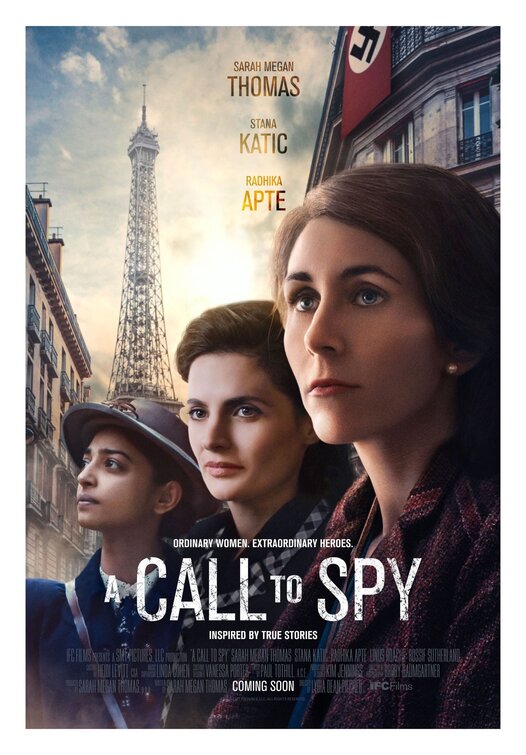
A Call to Spy (2019) Poster
A CALL TO SPY (2019) C
dir. Lydia Dean Pilcher

Respectable and well-researched, A Call to Spy doesn’t play like a thriller so much as a history lesson. That isn’t really a flaw so much as a ceiling. Stately to a fault. Something you sit through quietly, absorbing information if you’re already studying the subject for a history class.

At the center is Virginia Hall (Sarah Megan Thomas). An American sent into occupied France to organize the resistance and move information back to London. The work is dangerous, but the film handles it with such composure that the tension never has a chance to form.

The best espionage movies run on pressure. The wrong glance. A pause that lasts too long. A door that doesn’t open when it should. This film prefers to run on calm. With tidy safe houses and meetings that feel scripted. A potentially dangerous moment—when Hall is nearly discovered—the scene simply moves on without tightening. There’s little sense the room might suddenly turn hostile, or that the floor could drop out—literally or metaphorically. Danger is implied and rarely felt.

The atmosphere is also tidy to a fault. Occupied France feels more curated than oppressive. Interiors clean. Streets lightly dressed. Surveillance feels theoretical. The world never presses in. Even encounters with Nazis seem scheduled. No paranoia or claustrophobia or even that low-grade fear that should hang over every exchange.

A Call to Spy does mean well, at least. It honors its subjects and behaves itself impeccably. What it never quite does is generate urgency. It takes the tension out of espionage and leaves us with documentation. Like paperwork carried out bravely in a trench coat.

Starring: Sarah Megan Thomas, Stana Katic, Radhika Apte, Linus Roache, Rossif Sutherland, Samuel Roukin, Andrew Richardson, Laila Robins, Marc Rissmann, Mathilde Oliver.
Rated PG-13. IFC Films. USA. 124 mins.
Camp Hell (2010) Poster
CAMP HELL (2010) C+
dir. George VanBuskirk

Camp Hell sells itself as a teen horror movie with demons, nightmares, and a possessed boy who has something clawing at his soul. But strangely, this works better as a teen melodrama. The kids of the so-called “Camp Hell” are already trapped long before anything supernatural shows up.

Case in point: A priest catches a girl chatting with a boy. It’s against the rules. The priest calls the girl a whore. There’s also something demonic lurking in the woods near the camp, but the clergy itself does so much psychological damage on its own that you wonder why the demon would even bother with these guys.

Even on those (accidental?) terms, this isn’t a terribly good movie. It’s too rough around the edges. The editing is erratic. Performances vary wildly from scene to scene. The tone swerves too wildly—between camp sermons, possession theatrics, moral panic.

But as an accidental exposé on religious overreach, this is strangely effective. Sure, demons are scary and whatnot—but the real horror show is how easily authority, especially when it claims to have moral certainty, can get its hooks into you.

Starring: Will Denton, Dana Delany, Andrew McCarthy, Bruce Davison, Valentina de Angelis.
Not Rated. Lionsgate. USA. 91 mins.
Canadian Bacon (1995) Poster
CANADIAN BACON (1995) B
dir. Michael Moore

Canadian Bacon came out in 1995 with a premise that sounded disposable at the time. It’s about a U.S. president with bad poll numbers who goes shopping for an enemy to distract the populace. Thirty years later, that just sounds like Tuesday.

Alan Alda plays the president, who first considers reviving the Cold War—once a reliable ratings booster for presidents in the past. But with Russia no longer available as a default enemy, he settles on a scapegoat much closer to home: Canada. Not because it makes sense but because it’s there. They share a massive border, after all. They even speak the same language. (Except for the Frogs. But we would just assume they had nothing to do with it.) The decision is cosmetic rather than ideological. He just needs a threat that photographs well. One that people might remember.

The setup is ridiculous, and the whole thing is played so much like a broad comedy that it’s easy to overlook how blunt and clean the satire lands. Just the idea of the president phoning Russia to bluntly float the idea of a Cold War reboot tickles me. (Russia politely declines the offer. Don’t be such a sore winner, they say.)

John Candy is seen here in one of his final screen roles as a small-town sheriff who rallies his friends (including Rhea Perlman and Kevin J. O’Connor) into a folksy, half-clueless “invasion” of Canada. Candy plays it straight. Big, chest-out patriotism. No irony. No apology. He’s warm, genial, and reassuring. The kind of guy you’d follow without stopping to think much about it. Which is unfortunate, because he’s an idiot. And so are you.

Canadian Bacon only stumbles when it doesn’t trust its own edge. Some jokes strain for emphasis when they don’t need to. But otherwise the movie is surprisingly astute. In how fast patriotism turns theatrical. How easily noise replaces substance once there’s a crowd that’s whipped up enough to play along.

Call it messy. Uneven. Smarter than it looks. A comedy that’s aged into relevance without trying very hard. Moore had a knack for poking at soft spots. It’s just that in 1995, no one expected it to cave in quite this completely.

Starring: John Candy, Alan Alda, Rhea Perlman, Kevin Pollak, Rip Torn, Bill Nunn.
Rated PG. Gramercy Pictures. USA. 91 mins.
Can’t Buy Me Love (1987) Poster
CAN’T BUY ME LOVE (1987) C+
dir. Steve Rash

A social experiment drowned in hairspray. Ronald (Patrick Dempsey) is a nerd—a gangly kid who mows lawns. He enjoys nerd things, such as gazing at stars. But then he decides to make a play for a completely different path. One where he isn’t such a nerd. So, he cuts a deal with Cindy (Amanda Peterson), the Queen Bee of his high school.

Cindy finds herself in a jam after she annihilates her mother’s $1,000 white suede outfit. By sheer happenstance, Ronald happens to have that exact amount in cash. Money raised through sweat and lawn clippings, earmarked for a telescope. But the money suddenly looks like leverage.

His proposal: she pretends to be his girlfriend for a month, and in return, her financial crisis disappears. Popularity, as his theory goes, is a matter of optics. If Cindy presents Ronald as worthy, the school will fall in line. And fall in line they do. Ronald used to fade in the background in the halls of his school. Now he’s the center of attention. No more baggy sweaters or horn-rimmed specs. In its place—sunglasses and attitude.

The trouble is, it works. Too well. He becomes drunk on status. He dumps his old friends, goes strutting around like some discount Tom Cruise, and adopts such a condescending smirk that makes you root for his downfall.

His social power even manifests in accidental ways. Eager to impress at a dance, he unknowingly lifts moves from an anthropology documentary instead of American Bandstand, flailing and stomping like a man with full-body magnetic wave interference. High school runs on unearned confidence. The crowd cheers it on and then eventually joins in. Cultural appropriation as cutting-edge choreography.

The film fumbles when it backs off the satire and reaches late for a tidy moral lesson. About popularity being no substitution for self-respect. Everything gets smoothed over and tied up with a bow—all before the prom photographer even has a chance to arrive.

This isn’t a particularly well-written film. Still, it refuses to disappear. I remember it looping endlessly on cable in the 1990s, and it hasn’t entirely stopped floating around since. The ’80s time-capsule elements do some of the work there. Dempsey is amiable even at his most oblivious. Peterson does what she can with a script that treats her like a plot device.

It’s a teen movie that’s watchable. Maybe even likable. It’s just frustrating how close Can’t Buy Me Love comes to being something smarter than it was before ultimately settling for less.

Starring: Patrick Dempsey, Amanda Peterson, Courtney Gains, Tina Caspary, Seth Green, Sharon Farrell, Darcey DeMoss, Dennis Dugan, Cloyce Morrow, Cort McCown.
Rated PG-13. Buena Vista Pictures Distribution. USA. 94 mins.
Capote (2005) Poster
CAPOTE (2005) A
dir. Bennett Miller

A true-crime story about what it took to write a true-crime story. Capote isn’t just about the making of In Cold Blood—it’s about what that making cost. While this film might be initially dismissed as just another Hollywood biopic, they hardly ever run this deep.

For Truman Capote, In Cold Blood wasn’t just a book. It was a six-year descent into performance, persuasion, and quiet emotional blackmail. And you can see every bit of it in this brilliant performance from Philip Seymour Hoffman. Every wince, every calculation flickering across his face like he’s trying to hold the story together through sheer force of charm and nerve.

Hoffman completely disappears into the role—even if he does come off a bit more physically bulky than the real Capote. The voice is there, the affect, the theatrical drawl. But the performance goes deeper. He plays Capote as both puppeteer and prisoner. He’s brilliant, deeply wounded, and fatally curious.

Capote sees a brief headline and bolts to Holcomb, Kansas, dragging the serene and watchful Harper Lee (Catherine Keener) along for credibility—and cover. In Holcomb, four members of a farming family were shot point-blank. It was horrifying enough, even if Capote initially approached the story from a knee-jerk moral stance—that what happened was awful and the killers were monsters. But Capote’s interest isn’t justice. It’s narrative. Character. Pathos. He finds all of it in Perry Smith (Clifton Collins Jr.), one of the two killers: a man with a broken childhood and a poet’s vocabulary. Capote reads him as a tragic antihero—and a bestselling payday.

As the appeals drag on, Capote grows more conflicted. He continues to visit Perry, collecting material for his book, while quietly needing his execution. Empathy becomes performance. Kindness becomes currency. It’s not just morally queasy—it’s devastating. Worst of all, Capote may actually be developing feelings for the man.

Bennett Miller directs with eerie control. There’s no flash or fuss—just mood, patience, and mounting dread. Capote got the ending he wanted, but it hollowed him out. He was wrecked. And as the film tells us, he never wrote another book.

Capote is a film that neither lionizes nor scolds. It simply observes. And what it sees is a man undone by his own genius—unraveling thread by thread, sentence by sentence.

Starring: Philip Seymour Hoffman, Catherine Keener, Clifton Collins Jr., Chris Cooper, Bruce Greenwood, Bob Balaban.
Rated R. Sony Pictures Classics. USA. 114 mins.
Captain America: The Winter Soldier (2014) Poster
CAPTAIN AMERICA: THE WINTER SOLDIER (2014) B
dir. Anthony & Joe Russo

There’s nothing new about this second standalone Captain America film. Unless you want to count how carefully it avoids drawing attention to itself. The First Avenger had a look to it. War-poster colors and museum-grade displays of patriotism.

But The Winter Soldier tosses Captain America into modern Washington and drains the color out. Concrete, glass, and bureaucratic gloom. Visually, this film could have been anything. It just happens to be a Captain America film. Still, it moves like a polished action thriller—even with a bit of paranoid ’70s-style, political-tinged energy thrown in for good measure. And it rarely drags.

This time Captain America’s existential threat isn’t foreign. It isn’t even a stranger. He’s Bucky Barnes, Steve Rogers’ old friend—long assumed dead. Resurfaced now but not as Rogers knew him. He’s been brainwashed, rendered mostly silent, operating under the name the Winter Soldier. He is working for a semi-secret entity known as Hydra, run covertly by Alexander Pierce, the Secretary of Defense. Hydra finally has the power to start taking over the mechanics of S.H.I.E.L.D., and the first order of business isn’t conquest so much as removal. Those threats to a sense of order, as he sees it, are eliminated early. Captain America is one of these threats.

The connection to ’70s political thrillers is not just in Redford’s casting—whose All the President’s Men still remains a cultural touchstone. It’s in how this movie frames institutional rot against individual conviction. Steve Rogers grew up on war bonds and clearly defined moral boundaries. Now he’s working for an organization that he barely recognizes. He missed Vietnam, Watergate, and everything else that followed. His Greatest Generation trust in the government has become passé. But Rogers is quick to catch up.

The plot moves well enough, even if it never really tightens its grip. The moral questions are present. Doing well enough that they don’t get buried. But they do get crowded. Wedged between shootouts, fireballs, and the usual digital noise. Still, there are some surprisingly mature ideas in here. Themes about disillusionment and loyalty. What it costs to stay principled when the system around you isn’t.

This probably isn’t anybody’s favorite Marvel film. It’s not especially enthralling in any single moment. It’s slick and easy to watch. Smart and savvy enough that—despite having taken things away—it manages to stand out in the crowded field of MCU films.

Starring: Chris Evans, Scarlett Johansson, Sebastian Stan, Anthony Mackie, Robert Redford, Samuel L. Jackson, Frank Grillo, Cobie Smulders, Emily VanCamp, Maximiliano Hernández.
Rated PG-13. Marvel Studios. USA. 136 mins.
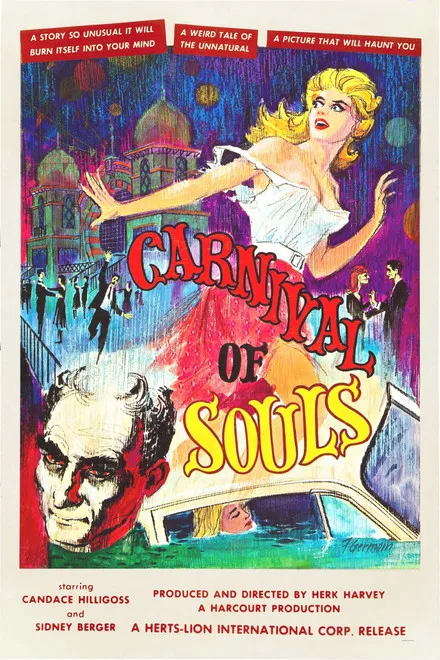
Carnival of Souls (1962) Poster
CARNIVAL OF SOULS (1962) A−
dir. Herk Harvey

Carnival of Souls floats in an eerie state of suspension. It’s governed by a detached sense of dream logic—the kind of dream that isn’t interested in reassuring anyone.

It begins with a crash. A car goes off a bridge with three women inside. It doesn’t resurfaces. Hours later, Mary Henry (Candace Hilligoss) re-emerges. Shaken but intact. Whatever happened beneath the water, the film won’t tell us, even as everything that follows seems to orbit that very question.

Mary heads to Utah for a job as a church organist, but there is something off about her journey almost right away. Specifically, a man with hollow eyes who seems to keep turning up. In mirrors, in bus windows, in dark corners. He smiles at her like he knows her.

Strangers speak to Mary, but their words seem to just pass through her. She plays the organ while the congregants sit perfectly still—their faces holding a blissful calm that’s strangely difficult to look at.

The film’s visual and temporal style might be its most distinguished feature. Shadows stretch. Reality doesn’t behave the way it should. The tension just hangs there. The effect feels closer to old German Expressionist horror than anything modern. This is horror that doesn’t rely on jump scares or lunging monsters. Just the sense that Mary is slipping out of the world, beyond the reach of effort, logic, or willpower.

Carnival of Souls is the kind of film that waits and creeps up on you, while scenes stall and images repeat. This is a movie that lets silence do the work that most other horror films would leave to noise. It is spare and unconcerned with polish—partly on purpose, but also by necessity, given its shoestring budget. It’s timeless in a way that feels cut loose from the familiar world, where nothing quite behaves as it should, and all we’re left with are images that aren’t overtly frightening—but stick.

Starring: Candace Hilligoss, Frances Feist, Sidney Berger, Art Ellison, Stan Levitt, Tom McGinnis, Forbes Caldwell, Herk Harvey.
Not Rated. Herts-Lion International Corp. USA. 80 mins.