THE FADED SPOTLIGHT

by Michael Lawrence

List of "A" Movies


Abandon (2002) Poster
ABANDON (2002) D+
dir. Stephen Gaghan

A thriller that doesn’t thrill. A 99-minute heel-dragger that’s glossy, atmospheric, and slick, but its pacing is so half-baked and its pulse so inert that all we get in the end is a stylish husk.

Katie Holmes plays Katie, a graduate student who is supposedly buckling under intense academic pressure—though you’d never guess that based on the film’s glassy tone and Holmes’ underplayed performance. Her breakdown takes the form of visions of her vanished ex-boyfriend Embry (Charlie Hunnam)—a smug golden boy who disappeared without a trace years earlier. Now he suddenly appears to her in fleeting visions—in corridors, cafeterias, lecture halls. She has no time to react. As soon as she blinks, he’s gone.

That’s a fine set-up—eerie enough. But all we get is a film that staggers from scene to scene, searching for suspense the way a drunk searches for his keys—blindly, aimlessly, and with little hope. Of course, there’s the inevitable twist, but it feels so flimsy and inane that you can’t even be bothered to laugh at it. It’s the same way you wouldn’t laugh at someone trying to shoot a bullet through a sheet of toilet paper, convinced that it won’t just tear right through.

The detective assigned to investigate the case is played by Benjamin Bratt with about as much urgency as a man waiting for his coffee to cool. He eventually pieces together that maybe Katie isn’t imagining all this after all. While Katie Holmes’ performance leaves much to be desired, I’d blame the script for that much sooner than Holmes herself. She projects a sort of natural nervous energy, but the film has no idea what to do with it. The supporting players—Zooey Deschanel shows up as (what else?) a sardonic classmate—aren’t much better off. They’re left stranded, floating around a story that can’t figure out how to use them.

While there’s some slick cinematography here—streets glowing under silvery dusk, fluorescent lights blanketing the library’s interior with an eerie hum—this beauty without tension ultimately leaves me empty. It’s like being stuck inside a designer showroom. Plenty to look at, but nothing for sale.

Starring: Katie Holmes, Benjamin Bratt, Charlie Hunnam, Zooey Deschanel, Gabriel Mann, Gabrielle Union, Mark Feuerstein, Melanie Lynskey, Will McCormack, Philip Bosco, Tony Goldwyn, Fred Ward.
Rated PG-13. Paramount Pictures. USA. 99 mins.
Abbott and Costello Meet Frankenstein (1948) Poster
ABBOTT AND COSTELLO MEET FRANKENSTEIN
(1948) B+
dir. Charles Barton

Abbott and Costello make comedies. Dracula, the Wolf Man, and Frankenstein’s Monster belong to horror. Put them in the same movie and the result is hysterical because neither side changes. Abbott and Costello keep doing their routines, and the monsters act no different than in their old films. The result is—at times—comedy magic.

Bela Lugosi, back in the cape for the first time since the 1930s, is like he never left. He continues to play Dracula as a solemn aristocrat who savors a dramatic pause just as much as a juicy neck. Lon Chaney Jr. is fully game, sweating through another round of tortured lycanthropy. Glenn Strange clomps in heavy platform shoes as Frankenstein’s Monster, blank-faced and unstoppable. They all play it perfectly straight. Which is to say, they play it deadly.

The plot, at best, is perfunctory. It’s like a conveyor belt that shuttles monsters from set piece to set piece. But at least it’s an efficient conveyor belt and knows when to duck out for a comedy routine or a scary scene. What matters in this film is its tone. The film isn’t parodying horror so much as letting comedy crash into it. Costello plays a delivery man who discovers that his latest shipment includes Dracula’s coffin. When he catches the ghoul wandering outside it, he screams for his colleague Abbott. By the time Abbott arrives, Dracula is gone. Abbott, forever the procedural voice, insists Costello is imagining things. But of course he isn’t.

Another crate holds Frankenstein’s Monster, shipped under the guise of a wax museum exhibit. It turns out Dracula himself is behind these shipments and has nefarious plans to reboot the Monster with a new brain—Costello’s, preferably. (Though Dracula might want to reconsider unless he really wants a Monster that spends eternity yelling “Hey Abbott!”)

Expect the familiar rhythms. Abbott shouts, Costello sputters and double-takes—their civilian panic colliding with Gothic solemnity. Not every gag works. Some sketches repeat like hand-me-down burlesque routines, and a few stall out entirely. The comedy has a vaudevillian flavor that doesn’t translate for everyone. You have to tune yourself to its frequency. But if you’re on its wavelength—or a fan of the Universal monsters—this is a lively blend. The comedians get their panic, the monsters keep their shadows. The result is a film that pulls off the rare trick of honoring both.

Starring: Bud Abbott, Lou Costello, Bela Lugosi, Lon Chaney Jr., Glenn Strange, Lenore Aubert, Jane Randolph.
Not Rated. Universal Pictures. USA. 83 mins.
Abner, the Invisible Dog (2013) Poster
ABNER, THE INVISIBLE DOG (2013) D-
dir. Fred Olen Ray

You don’t need to press play to know what you’re getting here. Just look at the thumbnail. The sitcom-ready parents, the blank-slate kids, the strangely airbrushed sheepdog. If you into this expecting quality you’re basically the same as a shopper who grabs a plastic toy at the dollar-store and looks betrayed when it breaks on the walk back to the car. Even in the anything-goes kingdom of talking-dog movies, this one still finds a way to nose-dive toward the bottom of the bowl.

The plot: a brainy kid stumbles onto a secret chemical swiped from his uncle’s lab. He decides to mess with it. Because that’s what brainy kids do when they run across anonymous substances. And sure enough, whatever this stuff is, it made his dog Abner go invisible. It also grants Abner a telepathic abilities such that’s it’s able to pump out English one-liners. Because why not? And before long, the same clowns who bungled the chemical the first time are back, sniffing around for a do-over. They are the familiar species of bumblers. The type of guys who take spills, let out loud, juicy farts, and even pratfall via the classic banana peel slip.

The rest of the movie noodles around with basic bully subplots. Then come the chase scenes—long, limp, and visibly irritated to be included. The only thing approaching novelty arrives in the cast list. American Office fans might do a double take. Yes, that’s Robert R. Shafer—Bob Vance himself—roaming the suburbs. Stepping out of his walk-in freezers so that he could chase after a CGI dog.

There are plenty of ways for you to lose an entire afternoon. But this one is so tedious that you might just want to workshop a few other methods. Or maybe do yourself the ultimate favor. Hide the remote and hand the kid a book.

Starring: Daniel Zykov, Molly Morgen Lamont, David DeLuise, David Chokachi, Ben Giroux, Robert R. Shafer, Nancy Sullivan, Ted Monte. Voice of: Mark Lindsay Chapman.
Not Rated. Phase 4 Films. USA. 89 mins.
About a Boy (2002) Poster
ABOUT A BOY (2002) A-
dir. Chris Weitz, Paul Weitz

It shouldn’t work as convincingly as it does. This film has a premise that should be running on rails. That is, until the movie starts bending it in clever, surprising ways. Other films might have tried to glaze over all this so much that you wouldn’t be able to taste anything else. This one skips the usual hand-holding and lets the scenes sort out their own pacing. It circles two lives. A man untouched by consequences. A kid bruised by all of them. And there’s such a natural and easy chemistry between them that the tone of the film feels far more personal than manufactured. The movie hits you with its wry beats, with its belly laughs, stays just rough enough to avoid turning sweet. And at some point you start to notice that a bit of warmth had drifted through a side door.

Hugh Grant might be at his career-best here as Will Freeman—a man whose whole lifestyle rests on a hit Christmas tune his father dashed off decades ago. The father’s gone now, but the song still pays his rent and then some. Work never made it into Will’s vocabulary. Neither did commitment. And he dodges feelings like they’re falling debris.

And then Marcus shows up—twelve, painfully earnest, a kid with no safe place to stand. Nicholas Hoult plays him like a kid whose whole face gives him away. He’s too odd to disappear into the crowd. Too sincere to fake his way through it. They cross paths on a lie. Will fakes being a dad to date single mothers, and Marcus makes a convenient prop. Marcus mistakes Will for someone who might help steady his household—given that his mother (Toni Collette) has some psychological issues. But once things get real between Will and Marcus, neither of their ideas hold together for long. At least in the way they originally intended.

What they get instead is a friendship that lurches into place, piece by piece. The school-day wreckage piles up, and Will keeps steering Marcus around it. And Marcus gives Will in return, bit by bit, an actual life to stand in. They keep edging in, not gracefully, just gradually, and before long they’re sharing the same patch of earth. Not that they know how they reached that part. Or how to keep going once they’ve got there.

The supporting cast settles in nicely. Collette plays the anxious, well-meaning mother who is barely keeping things afloat. Weisz is the first woman who might actually hold Will’s attention for more than ten minutes. But the real magic is in the interplay between Grant and Hoult. Their bond begins in manipulation and mild desperation, but it somehow settles into something honest. Even touching.

About a Boy works its way under your guard. Not with tricks. But with steady humor, a light hand with the sentiment, and honesty about how crooked growing up can feel. The emotion rings true because the film doesn’t strain for it. It just throws two sharply drawn people into the same space and lets whatever happens between them happen.

Starring: Hugh Grant, Nicholas Hoult, Toni Collette, Rachel Weisz.
Rated PG-13. Universal Pictures. UK/USA. 101 mins.
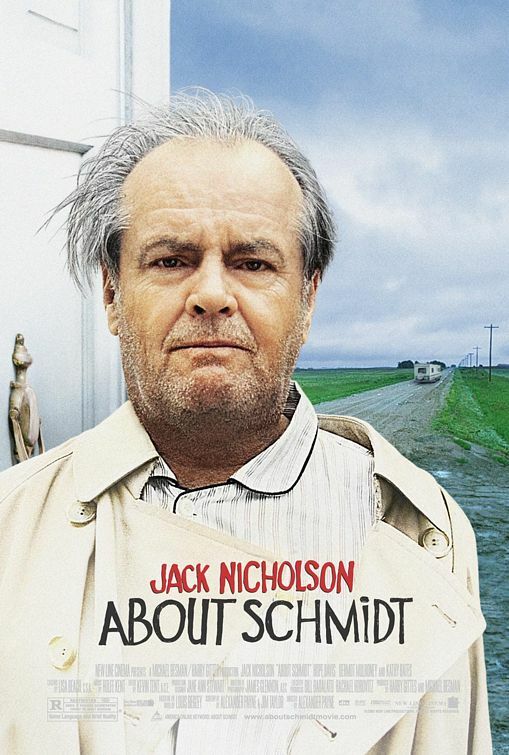
About Schmidt (2002) Poster
ABOUT SCHMIDT (2002) A
dir. Alexander Payne

Most films talk their way through endings. Very few know when to shut up and just trust the moment. About Schmidt has what seems like an abrupt ending, but it leaves you gutted. I won’t give you more details about it. Just know that it’s wordless and it floors you. It’s a single moment where the entire movie falls into place. It answers who this man Schmidt is, what he’s been storing in his chest, and why it aches.

Jack Nicholson, stripped of all his usual voltage, plays Warren Schmidt. A man freshly retired and already disappearing. One early scene catches him alone in a fluorescent-lit office sitting in an office chair that might as well have his replacement’s imprint already on it. The room feels emptied of oxygen as he watches the second hand drag itself toward five. His retirement is merely minutes away. Four decades at that desk—same chair, same recycled air—almost over. And the farewell he gets is a cardboard box and a limp handshake.

Home doesn’t offer much for him either. His wife talks too much. His grown daughter (Hope Davis) keeps him at a measured distance. Retirement reveals itself as an endless stretch of beige nothing. Out of boredom—or inertia—he signs up to sponsor a child in Africa after seeing a TV ad. They tell him to write letters. So he does. Pages of regret, complaints, and half-memories, addressed to a six-year-old who probably can’t read them and certainly won’t care.

He writes about his wife, who just bought an RV he didn’t want. Then, suddenly, she dies. The camper then becomes his escape plan. He gets in and starts driving—toward a wedding he disapproves of. His daughter’s fiancé (Dermot Mulroney, spectacularly repellent) sells waterbeds and sports a mullet. His daughter doesn’t want Schmidt there. He shows up anyway.

The road trip doesn’t offer clarity. Doesn’t heal him. It gives him motel carpets, tourist traps, and a visit to his childhood home—which is now a tire shop. At one point he wanders back to his old workplace. They’ve already forgotten him.

The film doesn’t pity him or scold him. It just watches him wander, not quite landing anywhere. He doesn’t transform. Doesn’t open up. Doesn’t break down in some showy moment of self-awareness. He just keeps going. What else is he supposed to do?

Nicholson gives him a muted presence, steering clear of any move that might look like a plea for sympathy. The humor throughout the film runs dry and offbeat—even a little surreal at times, but never soft. Nothing gets glossed over, including the jokes which tend to crack open their scenes instead of numbing them. Payne, who co-wrote and directed, knows this terrain. That emotional dead zone where life keeps going, but the center of it has already gone sour.

About Schmidt is sad, meticulously observed, a bit cruel, and strange in its gentleness. And then the movie ends. Not with a speech or a flourish. With something small. Something innocent. But also something profound. If you’re not ready for it, the moment takes the wind right out of you.

Starring: Jack Nicholson, Hope Davis, Dermot Mulroney, Kathy Bates.
Rated R. New Line Cinema. USA. 125 mins.
Abraham Lincoln: Vampire Hunter (2012) Poster
ABRAHAM LINCOLN: VAMPIRE HUNTER (2012) C–
dir. Timur Bekmambetov

The possibilities were not only endless but uncontainable. I could just imagine a scene with Abraham Lincoln, mid-Gettysburg Address, being forced to launch himself into the air to hack a vampire clean in half. Or why not a scene in Ford’s Theatre where John Wilkes Booth reveals himself to be a vampire onstage and Lincoln turns the corner on his own assassination. But unfortunately, none of this stuff happens.

What we get instead is oddly dutiful. As if the movie is afraid to admit the premise is supposed to be fun. It starts with young Abe watching his mother die—poisoned, he’s told, by something with fangs. Years pass. Abe grows taller, angrier. Vengeance hardens. Before long he’s wrapped up with Henry Sturges (Dominic Cooper), a vampire saddled with a curse that shuts him out of indulging in human blood entirely. Whatever energy he has left goes into thinning out his own kind. It’s strange company for Abe, but not a bad arrangement. Their grudges just happen to run in the same direction. Henry brings the knowledge; Abe brings the muscle. Cue the training sessions—silver blades and a steadily increasing mound of bodies.

Abe then winds up in Springfield, trying out law, inching into politics, getting close to Mary Todd (Mary Elizabeth Winstead). Off to the side, the vampires—run by plantation tyrant Adam (Rufus Sewell)—are feeding on the enslaved and quietly steering the country toward a war they’d very much like to profit from.

You’re waiting for a healthy bit of historical blasphemy done with a wicked grin. Or at least some sign that this movie knows how silly it all is. Instead you get a sepia-toned Lincoln in a trench coat, jumping off trains like he strayed in from Zack Snyder’s Little Women.

The tone never finds itself. The quiet moments play like prestige drama. Except how can it, because this is a movie about Abraham Lincoln hunting vampires? You get some action—axe tricks on horseback, a trestle fire that eats its way through a set piece, vampires collapsing into ash—but that’s all just basic action-film momentum. No spark. You wait for the movie to acknowledge its own absurdity. To crack a grin. Or anything. But all we get is nothing. To the extent that maybe this movie didn’t need to be about Lincoln at all.

Abraham Lincoln: Vampire Hunter has the right ingredients for a cult oddity, but it can’t even be bothered to crack an egg. All it does is stand there. Shiny on top, rigid underneath, a premise that backs itself into a kind of ceremonial stiffness. A pity, really.

Starring: Benjamin Walker, Dominic Cooper, Mary Elizabeth Winstead, Rufus Sewell, Anthony Mackie, Jimmi Simpson, Marton Csokas, Erin Wasson, Robin McLeavy.
Rated R. 20th Century Fox. USA. 105 mins.
Absolute Beginners (1986) Poster
ABSOLUTE BEGINNERS (1986) B
dir. Julien Temple

An over-the-top carnival of a movie. One that includes, among other miracles, David Bowie singing and dancing atop a giant typewriter. Saying the movie is stylish is an understatement. Director Julien Temple keeps heaping style onto the frame until it starts to feel like you’re being force-fed the décor. The sets aren’t merely bright—they’re bursting. Stuffed with color. And the props crowd the sets so much that they look ready to vibrate themselves apart. Everything about this movie dazzles, absolutely, but the visual noise also has a cost. Throw in Julien Temple’s restless camera into the mix and you wind up feeling woozy. Like you’ve been spun one turn past your limit on a whirly carnival ride.

Then, every so often, the film stops whirling. Plants its feet. Holds still for half a beat. And in that tiny pocket of calm, it builds back up into a riot again. And honestly, the real gravitational pull here isn’t the story or even the spectacle. It’s the trio waiting in the wings: Bowie, Ray Davies, Sade. They don’t just make glorified appearances. They take possession of the movie, lighting up whatever scenes they’re in.

And once you fold in the rest of the soundtrack—a glossy rock-jazz alloy, with some tracks written for the film and others borrowed. Songs by such artists The Style Council, Charles Mingus, Miles Davis, and Eighth Wonder (Kensit’s band). The soundtrack alone starts making its own loud, persuasive case for why the movie exists at all.

For my jukebox dime, though, the music hits its peak with Bowie’s title track—a joyous, wonderfully bent anthem. Bowie also takes on a crucial role as a devil-may-care advertising executive, a seductive mentor to Colin (Eddie O’Connell), the young photographer he lures into the glittering, soul-sucking world of commercial work. Champagne in one hand, spiritual bankruptcy in the other.

Colin barely resists because he’s besotted with Crepe (Patsy Kensit), a stunning muse whose affections hinge entirely on what he can purchase. Materialism becomes the tollbooth to romance, and Colin sprints to keep pace. The romantic thread is easy to follow, but it never really deepens past the outlines. O’Connell and Kensit look right together, no question, but nothing between them ever warms up, no matter how close the movie pushes them. They move through the scenes with the right poses, the right glances. But you keep waiting for some kind of charge to appear between them, and it doesn’t.

That soft patch in the center doesn’t blunt it. The film charges ahead nevertheless with this wild, unruly confidence. It’s so intoxicating that it has a funny tendency to cling with you afterward. Absolute Beginners is a strange and gaudy film. Part spectacle, part vertigo, never dull. You might roll your eyes at parts of it, sure. But forgetting it? Not a chance.

Starring: Eddie O’Connell, Patsy Kensit, David Bowie, James Fox, Ray Davies, Sade, Edward Tudor-Pole, Anita Morris, Graham Fletcher-Cook, Tony Hippolyte, Bruce Payne, Paul Rhys.
Rated PG. Palace Pictures. UK. 108 mins.
Absolute Power (1997) Poster
ABSOLUTE POWER (1997) B–
dir. Clint Eastwood

Those opening ten minutes snap. There’s real tension there, even the ghost of Hitchcock can be felt there, and you start to think the film’s got something dangerous tucked away for later. But then—almost immediately—it goes slack. Not a meteoric drop. Just enough give in the line that you can feel it. Eastwood holds the whole thing together by just being there. He gives off that familiar, hard, weathered, carved-from-oak stillness that could sand a doorframe. Here he is, aiming that directly towards the Oval Office.

Eastwood plays Luther Whitney, an older, high-tech burglar moving through the mansion of billionaire Walter Sullivan (E.G. Marshall’s last screen appearance). He’s mid-job, crouched over a safe, working it open. Nerves quiet, hands doing what they’ve done a hundred times. Then suddenly the room isn’t empty anymore. The President of the United States himself (Gene Hackman) staggers in—drunk and hanging off Sullivan’s much younger wife (Melora Hardin). Their giddy flirtation suddenly turns rough. Then it gets worse. Before Luther can even process what he’s seeing, the Secret Service bursts in and cuts her down. She dies.

A moment later the Chief of Staff (Judy Davis) walks in, takes in the damage. She makes the cold calculation right there. The reality of what just happened can never go public. The scene will need a new story. A burglary gone wrong will do. And the bizarre coincidence that an actual break-in happened to be occurring at the same time as the killing hands them a ready-made excuse. Only, they didn’t count on the burglar already out the door, carrying evidence that could sink them.

The rest of the story moves between the hunt and the man being hunted. The feds try to frame Luther. Luther keeps slipping away. He keeps drifting toward his daughter, Kate (Laura Linney), hoping to reconnect but careful not to let any of this touch her.

It’s a wild setup, even for a story built on hunters and prey. But it’s also the kind that goes down easy. There’s just enough plausibility to hold it together, and just enough fantasy to make the game between one practiced burglar and a whole political apparatus feel like something worth watching. The problem with the movie really is the tempo. Some passages tighten like a snare drum. But then the rest of it unwinds and lulls enough to where you can tell the movie’s filling space instead of turning the screws. Not a fatal problem, but you do notice it.

Still, the cast is so good that it often pulls attention away from the plot and saggy tone on its own merits. Hackman has that smooth, unhurried way about him—looks harmless at first, but then a glint in his eyes gives away that he has a nasty bite. Davis barely has to open her mouth—one steely glance from her can change the temperature of a whole scene. Linney gives Kate this wary warmth—gentle but clearly shaped by old scars.

The film wavers, sure, but you hang on. And every now and then it lands that charge these stories live on. The most powerful people in the world hiding something unthinkable, and one crusty lone wolf who can expose it all.

Starring: Clint Eastwood, Gene Hackman, Ed Harris, Laura Linney, Judy Davis, Scott Glenn, Dennis Haysbert, Melora Hardin, E.G. Marshall.
Rated R. Castle Rock Entertainment / Columbia Pictures. USA. 121 mins.
Accepted (2006) Poster
ACCEPTED (2006) C
dir. Steve Pink

Amiable enough, but pretty slight as these things go. A college-themed sex comedy that’s forgettable—although it might feel a bit cathartic if you’ve ever found yourself steamrolled by the whole college-admissions circus.

The premise has a mischievous snap to it: Bartleby Gaines (Justin Long), resourceful but chronically underachieving, gets rejected by every college on his list. Rather than face his overbearing parents, he cooks up a workaround—he invents a college. The South Harmon Institute of Technology. He even manages to get his hands on a crumbling old mental hospital to turn into a makeshift campus. He then talks his friend Sherman (Jonah Hill) into throwing together a website. But what he doesn’t expect is for this to catch fire and draw in hundreds of kids who show up for the first day of class.

With a premise like this, the film could’ve gone for some sharp commentary about what young adults are expected to be. Instead, it goes for the easy stuff. Loose gags, fast laughs, bits that barely touch the screen before they’re gone. The film itself ends up underachieving just as Bartleby himself does.

Justin Long’s laid-back charm keeps Bartleby buoyant enough to root for. Jonah Hill, still in his warm-up phase, gets some of the movie’s actual laughs with a jittery energy that ricochets nicely off Long’s smoothness. And Lewis Black storms through as the fake college’s dean with his trademark volcanic rants, which at least give the movie a little snap.

The rest of the cast doesn’t get much to play with. Blake Lively is boxed into the love-interest role. Maria Thayer is left to prop up the quirky-friend routine as best she can. While there’s nothing too unique or infectious about the film, it does go down light. The tempo is easy, and there’s nothing it tries too hard to sell. It’ll make you smile politely long before it makes you laugh, but sometimes a smile is its own victory.

Starring: Justin Long, Jonah Hill, Adam Herschman, Columbus Short, Maria Thayer, Lewis Black, Blake Lively, Mark Derwin, Ann Cusack, Hanna Marks, Robin Lord Taylor.
Rated PG-13. Universal Pictures. USA. 92 mins.
The Accidental Spy (2001) Poster
THE ACCIDENTAL SPY (2001) B–
dir. Teddy Chan

Jackie Chan movies have never been especially concerned with plot. The Accidental Spy doesn’t suddenly change the arrangement. The story works when Chan stays in motion. Running here. Vaulting there. Smacking into whatever’s nearby.

He plays Buck, an exercise-equipment salesman who wanders into espionage without the skills or instincts for it. But he knows kung fu, and he has incredible luck. So there’s that. The film hops continents with a cheerful kind of indifference. Hong Kong giving way to Istanbul, then South Korea. Spy business follows. Drug lords, henchmen. The usual stuff.

What still works is Chan’s physical intelligence, even if by 2001 the stunts have gotten noticeably safer. Fewer moments that make you worry about permanent damage. But his timing remains precise, and the fights still feel improvised. Chan was never the strongest one fighting on screen. He just steps aside and lets momentum do something ugly to the other guy.

A highlight finds Buck stranded naked in the streets of Istanbul. He has to outrun attackers while protecting his modesty, grabbing coverage from whatever’s nearby. Trash can lids, hanging laundry, bits of architecture with crack timing. It’s an old joke, and Austin Powers got there first. But Chan plays it with total commitment. The same kind of timing that he brings to any other fight.

There’s an easygoing self-awareness to The Accidental Spy. It never reaches the inventiveness of Chan’s best work. The energy’s lighter, the danger mostly kept in check. But Chan stays alert onscreen, responding to one inconvenience after another, and as long as his knees are still good, so is he.

This isn’t a classic. It’s content to move along without pretending to be more than it is. The villains blur together. The conspiracy evaporates the moment it’s no longer useful. But it all holds together just enough to please the people who came for him.

Starring: Jackie Chan, Eric Tsang, Vivian Hsu, Kim Min, Wu Hsing-Kuo, Alfred Cheung.
Rated PG-13. Golden Harvest. Hong Kong. 108 mins.
Ace Ventura: Pet Detective (1994) Poster
ACE VENTURA: PET DETECTIVE (1994) C
dir. Tom Shadyac

Jim Carrey is the human embodiment of a noise complaint. He plays Ace Ventura. A pet detective working out of Miami. If that’s a profession you didn’t know could exist, or should exist, you’re not alone. But he is weirdly effective at it—even if it’s hard to imagine anyone hiring the guy twice.

Ace can’t bear to walk into a room without staging a one-man show for whoever happens to be there. He is constantly testing the limits of the frame. Stretching, squawking, ricocheting, talking out of the side of his face. He is a human cartoon. It’s a great amount of fun for some of us in the audience, but for the poor actors around him, they have no idea what to make of it. They mostly just freeze around him, bracing themselves until he finishes whatever he’s doing so the plot can inch forward again. As far as I’m concerned, as funny and animated as Carrey is, he alone can only do half the work. It’s equally important that the people on screen with him react rationally to it all.

That’s the rhythm for nearly the entire film. Ace detonates. Everyone else absorbs it. Courteney Cox plays Melissa Robinson, a straight-faced reporter. Sean Young plays Lt. Lois Einhorn, a police officer wound so tight she seems permanently offended by Ace’s continued presence.

It all technically revolves around Snowflake, the Miami Dolphins’ kidnapped mascot. After that, it’s just Ace getting shuffled between suspects and chases whenever the movie needs interrupting. The setup and atmosphere even hint at a noir parody—private eye, absurd case, everything treated with total seriousness apart from the detective himself. But that would require trusting the idea more than this film ultimately does. Scenes exist to be sidetracked. Clues show up just long enough to be mugged at.

When Carrey’s allowed to work physically, there are real laughs. His control is uncanny. He distorts scenes until they barely function. Time slows. Questioning becomes a siege. Of course audiences noticed. You can see why they latched onto him so quickly. This kind of commitment is rare. It’s also—as I mentioned earlier—unsustainable on its own.

The ending is particularly problematic—an extended trans panic gag that didn’t float well in 1994 (even when I was “non-woke” and in middle school, it didn’t sit well with me). It fares worse today.

To the extent that Ace Ventura: Pet Detective survives, it’s on Carrey’s effort alone. He gives it everything. Energy. Invention. Complete disregard for dignity. The movie figured well enough that this was going to be the appeal, and it gives him space. The problem is it gives him little else. That works for a while. But then it becomes an endurance test. One where you’re trapped with someone in an empty room who can’t stop jabbering.

Starring: Jim Carrey, Courteney Cox, Sean Young, Tone Loc, Dan Marino, Noble Willingham, Troy Evans, Randall "Tex" Cobb.
Rated PG-13. Warner Bros. USA. 86 mins.
Ace Ventura: When Nature Calls (1995) Poster
ACE VENTURA: WHEN NATURE CALLS (1995) C+
dir. Steve Oedekerk

This sequel edges out the original, which mostly says more about the original than it does about this one. It opens with a Cliffhanger parody, where Ace Ventura (Jim Carrey) bumbles his way into dropping a raccoon off a mountain—a gag so misjudged it’s hard to imagine anyone signing off on it. A raccoon dropping to its death in this film isn’t any funnier than a human in Cliffhanger.

Once that opener is out of the way, things improve somewhat. There are laughs here. Just not enough of them. And just like its predecessor, the film has the problem with the comedy remains completely lopsided.

The supporting cast exists solely as set dressing, their main function to stand aside while Carrey barrels through the film with his rubber-faced, whirlwind antics. Once again, this is a one-man show. And without anyone pushing back, the jokes don’t escalate—they just repeat at higher volume. Carrey is a dynamo, but the lack of balance makes the humor feel thin.

There’s one exception. Really the only stretch in either Ace Ventura film that made me laugh uncontrollably. The mechanical rhinoceros scene. Ace gets trapped inside the metallic beast and has to escape, which means clawing his way out through the rear end. What follows is a spectacle so deranged it might as well be called inspired—Carrey shrieking, spasming, and contorting his way through the rhinoceros’s narrow “birth canal.” What seals it is the family of tourists who wander in mid-escape, mistaking the whole thing for a live rhino birth. The timing is perfect. The misunderstanding does the work. For once, the movie lets something build.

But that one scene is all too little, too late. In the end, this one’s for fans of Carrey’s boundless energy. Everyone else will feel the strain. A frenzied ride, wobbling along on legs that were never very steady to begin with.

Starring: Jim Carrey, Ian McNeice, Simon Callow, Maynard Eziashi, Bob Gunton, Sophie Okonedo, Tommy Davidson, Adewalé.
Rated PG-13. Warner Bros. USA. 94 mins.