THE FADED SPOTLIGHT

by Michael Lawrence

List of "L" Movies


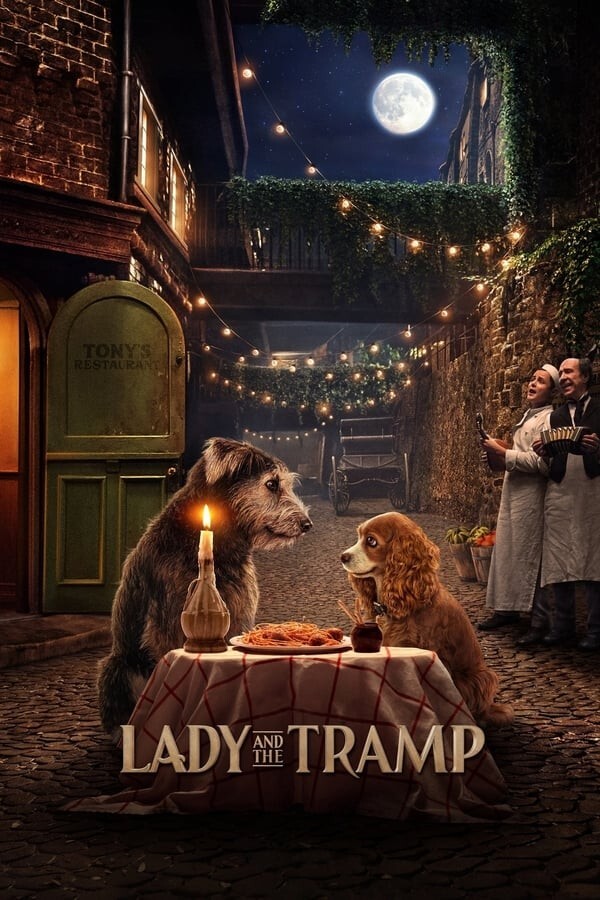
Lady and the Tramp (2019) Poster
LADY AND THE TRAMP (2019) C+
dir. Charlie Bean

Disney tosses in yet another mid-tier classic through their live action remake meat grinder and comes out with something that might as well not exist at all. Though, to be fair, this isn’t as bad as I thought it would be. It’s polished, easy on the eyes. But underneath the gloss it feels cautious, muted, and dutiful—recreating the characters and plot points without much conviction. Of course the iconic spaghetti kiss scene is dutifully recreated here, but it feels more like a resuscitation and doesn’t capture the magic behind what made people care about the scene in the first place.

Lady is a cocker spaniel living the good life with a posh existence—polished silverware, premium dog chow, and doting owners. But then her world undergoes a sideways turn when a baby arrives. Gone is the pedestal. She’s no longer the fur baby and just a pet. Already demoted and dejected, Lady’s last straw is courtesy of a dog-hating relative who’s been babysitting and has her fitted for a muzzle. She flees into the streets and quickly falls into the orbit of Tramp—a mutt and scruffy drifter who swears by the open road and treats domesticity like a cage. Together they make like two semi-anthropomorphic dogs: wander the streets, dodge the pound, steal dinners in an alley, and—of course—stumble toward that inevitable romance.

The problem with this film isn’t fidelity to the source material (the only major substitution being a more politically correct song in place of “We are Siamese”)—it’s temperament. The film knows well enough to look good, draping itself in soft lighting, but the pacing feels padded. And worse, the tone is so morose that it smothers its own charm. A prime example being the dog pound sequences. In the original film, those moments felt dark and jagged. Here, they feel gray and heavy. That grayness more or less permeates the entire film to produce such a mediocre experience that I doubt it will do much to thrill anyone. For kids, this lacks that cartoonish punch. For adults, it all just feels a little too thin.

And yet, it isn’t without appeal. The dogs—real animals supplied with digital lip-syncing—carry a tactile warmth that’s sometimes missing from Disney’s other animal CGI outings. The voice cast also does what it can. Tessa Thompson gives Lady a certain poise. Justin Theroux voices Tramp with a raspy weariness. Sam Elliott rumbles his way through Trusty.

But all in all, this version of Lady and the Tramp is less reimagining and more polite reenactment. The original had some bite, swing, and a sense of play. This one feels declawed. It does its job alright as an elegant title that looked attractive on the Disney+ Home Screen (and I’m sure a good chunk of the viewership clicked on it), but this is the sort of film you just consume and forget.
Voices of: Tessa Thompson, Justin Theroux, Sam Elliott, Janelle Monáe, Benedict Wong, Ashley Jensen. Starring: Kiersey Clemons, Thomas Mann, Yvette Nicole Brown, Adrian Martinez.
Rated PG. Walt Disney Studios. USA. 103 mins.
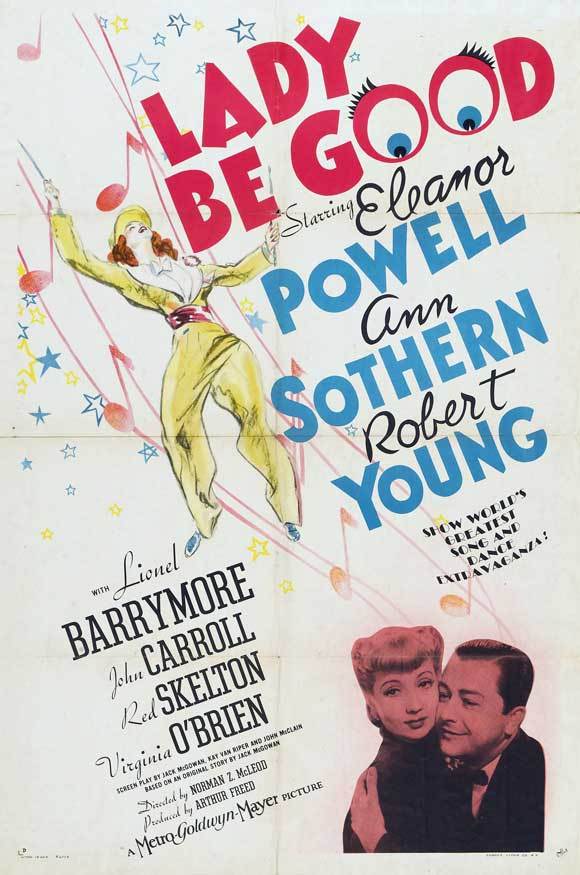
Lady Be Good (1941) Poster
LADY BE GOOD (1941) B
dir. Norman Z. McLeod

A glossy relic from the MGM musical-comedy assembly line. It’s only half-remembered these days, but devotees of musicals from this era should find themselves ecstatic with it—if only for one reason: it introduced the Academy Award–winning Kern and Hammerstein ballad “The Last Time I Saw Paris.” It’s also interesting in a historical sense, as a bit of propaganda—performed over a montage of prewar Paris that, to audiences in 1941, would have carried the sting of fresh loss, the city having fallen to the Nazis barely a year earlier. The United States had yet to enter the war (Pearl Harbor was still months away), though pro-war sentiment was already stirring.

But of course these musical gems are just little pocket oases within a rather dull storyline and an even duller framing device. The story is told in flashbacks from the witness stand in divorce court, presided over by Lionel Barrymore doing his best impression of a marble bust. They recount the history of the divorcing couple, a husband-and-wife songwriting duo—Dixie (Ann Sothern) and Eddie (Robert Young). Their songwriting chemistry makes them a match made in heaven, but they drift apart when he prefers nightclubs and shallow luxuries while she wants a more modest and quiet life at home.

Eleanor Powell gets top billing even though her character has bupkis to do with the story. She’s mainly there for the musical set pieces, playing Marilyn, a Broadway starlet. And of course she’s the highlight of the film—particularly in Busby Berkeley’s “Fascinatin’ Rhythm,” a fantasia of shadows that climb the walls like giants. She also delivers the film’s most endearing turn, a tap routine set to “Oh, Lady Be Good,” partnered with a scene-stealing terrier named Button. At one point, this all gives way to another scene-stealer: the Berry Brothers, a trio of dancers with spring-loaded, rubber-jointed limbs.

The romance meant to carry the story feels stagy and half-formed, but MGM musicals were generally not films that relied on dramatic depth. They thrived on how far the camera could glide, how high the choreography could vault, and whether the songs stayed in your head. On those terms, Lady Be Good holds up. Hardly perfect and hardly essential, but when the music and dancing are this good, it’s a Golden Age diversion worth taking.

Starring: Eleanor Powell, Ann Sothern, Robert Young, Lionel Barrymore, Red Skelton, Virginia O’Brien, John Carroll, Dan Dailey, Tom Conway, Rose Hobart, Phil Silvers, The Berry Brothers.
Not Rated. MGM. USA. 112 min.
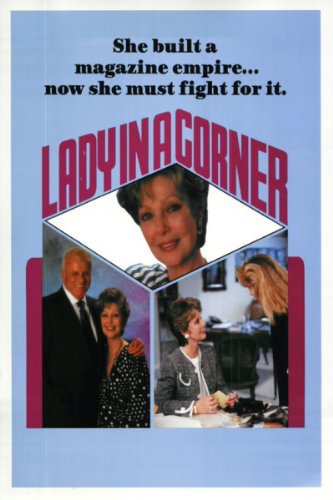
Lady in a Corner (1989) Poster
LADY IN A CORNER (1989) C
dir. Peter Levin

Loretta Young, whose screen career started in the silent era when she was just four years old, takes her final bow in this made-for-TV movie as Grace Guthrie. She’s the imperious editor-in-chief of her namesake fashion magazine Grace—polished, respectable, and with a storied history—though its relevance is starting to sag. Now it’s being swallowed by the company that owns its much flashier rival, Foxy Girl.

Grace sees the merger as desecration. She considers Foxy Girl obscene. But Susan (Lindsay Frost), the younger co-editor brought in to share power, calls it progress. The longtime publisher of Grace magazine, Philip (Brian Keith)—also Grace Guthrie’s old flame—calls it survival.

What follows is mostly meetings: Grace thumbing through mock-ups with surgical detachment, asking Susan not to forget what made her magazine the institution that it is. Susan in turn implores Grace to bring a little more modern pizazz into the spreads. They pause longest at a fashion spread of a ten-year-old in a provocative pose. That is handily the most tone-deaf moment of the film, a moment where I winced just to think how anyone could have photographed such a session. The ensuing argument over whether it should be printed isn’t focused on the exploitation of a girl as much as it’s about the raciness of the image. Can’t we just automatically agree not to publish such things?

Overall, the script plays its morality-versus-modernity premise with a straight face, but it plays too much like a courtroom transcript. It’s flat, drained of pulse, and paced like a soap opera minus the cliffhangers. But where the movie works, it’s because it is fueled by Young, who carries herself like the grande dame she is with her posture erect, her diction clipped, and her gaze unbroken. She even won a Golden Globe for this performance, though it feels more like a parting tribute to her career than a prize for a role that gives her so little to do. But even within the sterile environment of this film, she holds the line.

Starring: Loretta Young, Lindsay Frost, Brian Keith, Jessica Walter, Linda Purl, Deborah Adair, Grant Goodeve.
Rated TV-PG. NBC. USA. 95 mins.
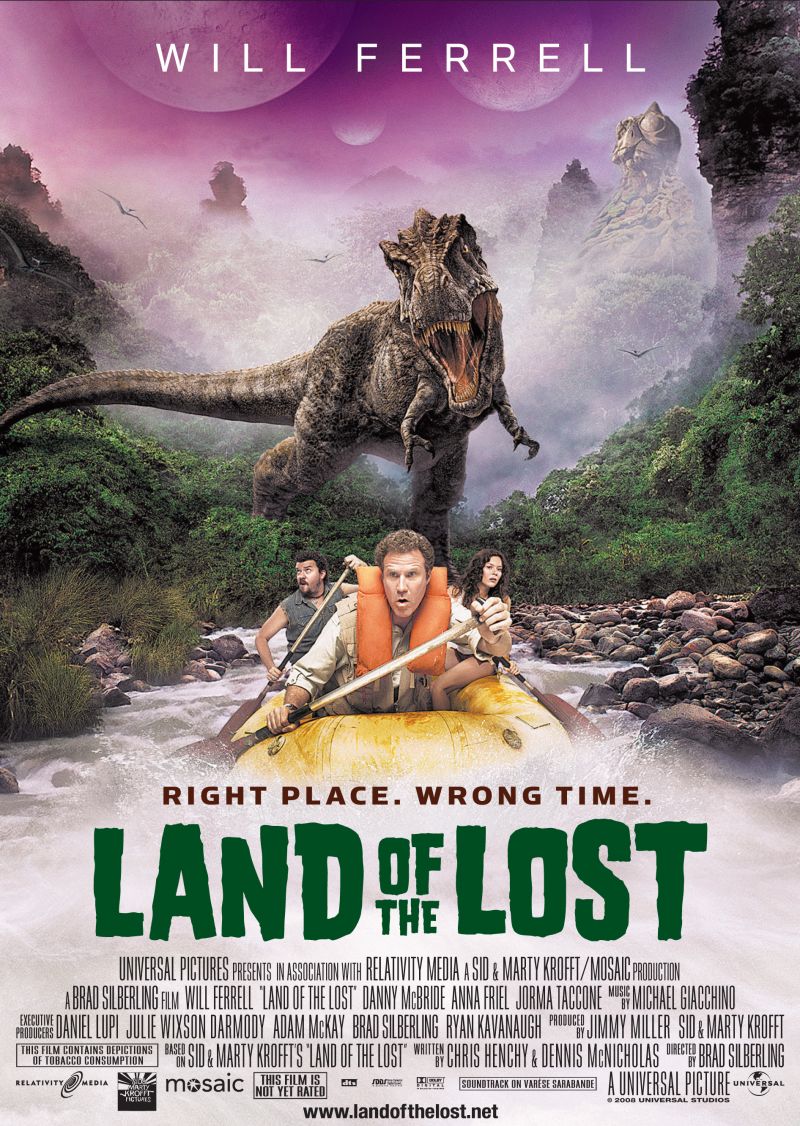
Land of the Lost (2009) Poster
LAND OF THE LOST (2009) C−
dir. Brad Silberling

I’m hardly what you would call a card-carrying Ferrellist, but his movies tend to work on me far more often than they don’t. I’m usually drawn to his sense of unhinged invention—his daffy commitment to nonsense that he delivers with such convincing sincerity he can make even the flimsiest premise take flight. Which makes it odd I wasn’t able to get into the spirit of this film at all. The Land of the Lost should be precisely at my speed. It’s a genre mash-up rife with sci-fi gobbledygook, a ridiculous plot involving a wormhole, a desert hellscape, and dinosaurs. This is mainstream cinema’s brain fried sunny-side up. But it’s a mess. It never catches its groove, despite Ferrell’s best efforts.

He plays Dr. Rick Marshall, a disgraced paleontologist who believes in something called tachyon energy. He becomes something of a talk-show fixture and national joke for espousing these beliefs. Anna Friel is Holly Cantrell, a disgraced grad student who was expelled from her program for backing his theories. Of course, what else is there to do for them but team up? They manage to trace a tachyon hole to a roadside attraction and tourist trap owned by an unhinged redneck (played by—who else?—Danny McBride). And together, they all fall through the multiverse.

Where they land can only be described as an aggressively curated landscape. Deserts that border jungles that border volcanoes. In between, haunted strip malls. It’s said to be the place where every wayward object Earth ever misplaced—airplanes, Big Boy statues, neon signs—has washed ashore in the vast inter-dimensional ocean. It begs the question: where does one misplace a volcano? But that’s a thought exercise for another time.

There are also creatures unfamiliar to us. Particularly the Sleestaks—glacial lizard monks who hiss like they’re part of some bronchial choir. There’s also a monkey-boy named Cha-Ka (Jorma Taccone), who attaches himself to these new explorers like an unwanted roommate. And then there are dinosaurs, whose intelligence seems to flicker on and off like a dying light bulb. Don’t ask it to make any kind of logical sense, because it won’t.

Some of this film works in small, twitchy doses, and I wouldn’t call it entirely bereft of laughs. Ferrell could be shackled to a dungeon with a burlap sack around his head, allowed to say nothing but “Uncle,” and I’m confident he’d eke out a few. There’s a moment here where he ingests a hallucinogenic fruit that gave me some giggles, and another where he rattles off an unhinged rant inside a desert gift shop. But these flashes are scattered, resulting in a film that lurches more than anything else. It’s a movie that tries to throw everything and anything at the wall and hope something sticks. Sometimes that approach works. Here, even the stickiest bits feel like fragments of ideas too half-baked to make it out of workshop.

Even movies, like this one, about being lost shouldn’t feel quite this aimless.

Starring: Will Ferrell, Anna Friel, Danny McBride, Jorma Taccone.
Rated PG-13. Universal Pictures. USA. 102 mins.
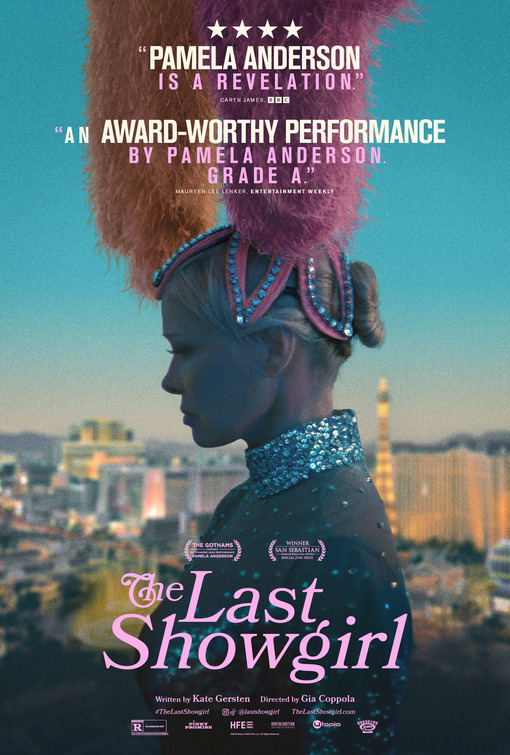
The Last Showgirl (2024) Poster
THE LAST SHOWGIRL (2024) B+
dir. Gia Coppola

A glitter-dusted cousin to The Wrestler, The Last Showgirl follows the final act of Shelly Gardner (Pamela Anderson), a Vegas showgirl well past her prime but trying to hold it together anyhow. Once a headliner at Le Razzle Dazzle, a French-style topless revue that glittered with old-school glamour, she’s now 57—a relic of another era but not ready to move on. But she has no choice. Ticket sales shrank. Burlesque and Cirque gobbled the empire territory. Le Razzle Dazzle was the final rhinestone holdout.

Most of her old colleagues have long since swapped sequins for service aprons. Her friend Annette (a deliciously vinegar-soaked Jamie Lee Curtis) once danced beside her but now slings cocktails. Shelly resists that path—partly out of pride. But it’s mostly because she doesn’t know anything else. Or, for that matter, care to know anything else.

Orbiting around her final appearance are people torn between support and resentment. Hannah (Billie Lourd), her daughter, has little patience for her. Too much pent-up resentment from childhood years spent in backstage corridors and parking lots, orbiting a profession she never wanted. Jodie (Kiernan Shipka), a younger dancer, sees Shelly not just as a mentor but as a substitute mother. But Shelly doesn’t know exactly what to do with this daughter, either.

The film never quite delivers the emotional punch it seems to be circling. It’s tender, but the tenderness is more ambient than piercing. Still, the film is compulsively watchable and even quietly absorbing. Anderson gives a surprising performance completely stripped of irony and vanity—wholly absent that high-gloss persona that defined her in her Baywatch heyday. Here, she’s unvarnished, emotionally direct, and quietly disarming. The kind of turn that just a year before this film came out would have seemed unthinkable, but now feels like a long-delayed reveal.

Other than that, The Last Showgirl isn’t much we haven’t seen before. But it’s worth watching again here—it’s smart and well-tuned to the disorientation that comes when relevance runs out. When the spotlight moves on, and you’re left standing in the afterglow, wondering where to turn next.

Starring: Pamela Anderson, Kiernan Shipka, Brenda Song, Jamie Lee Curtis, Billie Lourd, Dave Bautista.
Rated R. Roadside Attractions. USA. 89 mins.