THE FADED SPOTLIGHT

by Michael Lawrence

List of "F" Movies


The Faculty (1998) Poster
THE FACULTY (1998) B
dir. Robert Rodriguez

High school’s a horror story enough as it is. The Faculty adds body-snatching extraterrestrials on top of it. This is a throwback to mid-century sci-fi. Whispers, bright lights, bad intentions. It wants to do for alien invasions what Scream did for slashers—and it almost gets there. It twists the tropes with its tongue firmly in cheek, but it also has a little fun while it’s bleeding out.

Herrington High looks normal enough. Ohio, flat as a chalkboard. Marching band on the field, soda machines humming. But something’s off. The gym coach (Robert Patrick) barks orders at the kids like he’s been possessed by a deranged drill sergeant. The principal (Bebe Neuwirth) starts beaming with a stiff, Stepford kind of cheer—smile too wide, blinking too slow. The nurse twitches and fidgets, like her eardrums are picking up radio from Mars. One night, a teacher finds herself cornered, and something slimy and disgusting crawls into her ear canal. By morning, she’s fine again. Too fine. A few students finally realize what’s going on. But by that time, the infiltration has gone too deep. The faculty’s still with them—but what’s pulling the levers and pushing the buttons inside them is no longer exactly human.

A mismatched bunch of teenagers pulls together. They’ve never had much reason to trust each other before. Now there’s no choice. Elijah Wood plays the timid kid who’s perceptive enough to actually pay attention. Josh Hartnett’s the burnout chemist whose (illegal) side hustle turns out to be their only shot at fighting back. Clea DuVall, Jordana Brewster, Laura Harris, and Shawn Hatosy fill out the roster—outcast, queen bee, skeptic, jock. Even Jon Stewart makes an appearance as a science teacher who’s already lost a fair handful of his marbles. He loses the rest when he starts to poke at the alien goo.

Rodriguez shoots the movie fast and glossy. This is Z-grade pulp, except it’s shot with a studio budget. The humor’s sly, the gore gleeful. The pacing’s borderline hyperactive—it keeps things moving with a certain verve. Some of the CGI looks dated now—video-game plastic—but the movie doesn’t run out of nerve. Invasion of the Body Snatchers in letterman jackets—a teenage conspiracy thriller with caffeine jitters and attitude to spare. Some genre fans might wish the film didn’t adhere so strictly to the tropes. Others will find it too irresistible—the way it plays with them like a cat batting a strand of ribbon.

There’s nothing underneath the slime. Smart enough to know what it’s doing, not quite smart enough to surprise you. Funny enough to grin at, but not enough to remember later. And that’s all fine. This movie moves fast, plays fun, and never runs out of nerve. Popcorn and paranoia. The Faculty is too loud to take seriously. Too entertaining to resist.

Starring: Elijah Wood, Josh Hartnett, Clea DuVall, Jordana Brewster, Laura Harris, Robert Patrick, Jon Stewart, Famke Janssen, Piper Laurie.
Rated R. Dimension Films. USA. 104 mins.
Fahrenheit 9/11 (2004) Poster
FAHRENHEIT 9/11 (2004) A–
dir. Michael Moore

Michael Moore had one goal. To stop Bush from winning again. History didn’t listen. While Fahrenheit 9/11 is far from being a current event, this movie remains reasonably popular. Now, it’s just less a strategy and more of snapshot. That is, this is a wild, electric record of what America was stumbling through in the early 2000s. Watch it now, decades later, and what jumps isn’t the outrage. It’s that leftover energy underneath everything. The kind that slipped out of one debate and straight into another.

While Fahrenheit 9/11 is no longer current affairs, it still hits like a thrown brick. Flashy. Blunt. Loud. The editing’s sharp. The humor’s pointed. The gallows wit hasn’t dulled a bit. (Though full discretion: I came of age under Bush, so I can’t say how it plays to younger eyes.) Yes, Moore grandstands. Yes, he pokes where it’s convenient. And of course he frames everything to flatter his thesis. None of this should surprise anyone. Whether he tried for objectivity or not, his critics would criticize, his choir would sing. Best to forget all that, sit back, and enjoy the squirm.

There’s a much-criticized bit where Moore confronts members of Congress and asks them to enlist their children in the Iraq War. Pure performance. Everyone knows how this works. None of those senators’ kids are getting shipped out, unless of course they volunteered. But Moore isn’t really after debate here. He’s waiting to capture the moment the senators’ faces harden, their eyes drop, and the thought flickers past their mind that the war they sold to the American people from podiums could one day show up at their own door and ask for the sacrifice of someone they love. It’s easy to send someone else’s kids. Sending your own (whether or not you actually can)? Whole different story.

The film moves from there like it’s running on adrenaline. One accusation bleeds into the next—Bush’s contested 2000 win, the alleged Bin Laden connections, the fear that sold a war. He’s not arguing a case so much as unloading the evidence. He jumps from Afghanistan to Iraq without blinking, showing just how flimsy the justification was—and how quickly the public nodded along.

The Patriot Act gets its moment too. A blinking red warning sign that hardly anyone heeded. Decades later, we sigh as we continue to watch this same law continue to chip away at our rights, piece by piece.

This isn’t a balanced film, but the idea of balance in media was always an illusion anyway. It delivers its point with a forceful brazenness that’s convincing, coherent, and funny—in the bleakest sense. And if Moore doesn’t leave you convinced, he’ll likely leave you rattled. That alone makes the film invaluable. Along with Bowling for Columbine, this is Moore near the peak of his powers.

Starring: Michael Moore.
Rated R. Lions Gate Films. USA. 122 mins.
Fairy Tale: A True Story (1997) Poster
FAIRY TALE: A TRUE STORY (1997) B–
dir. Charles Sturridge

A charming, slippery little film about one of history’s strangest flirtations with the supernatural.

Florence Hoath and Elizabeth Earl play two Yorkshire girls who are bright, solemn, and just mischievous enough to be dangerous. It was 1917 when they pointed a camera toward the garden and fairies showed up. Or at least that’s what they said. But lo and behold, when their film was developed, there they were—scenes of the girls sitting in the garden while fairies frolicked and floated around them.

It was all a hoax, of course. Or maybe just a misunderstanding. Or a game that ran too far. Or maybe it was all real—too perfect, too meticulous for it to have been faked. The movie leaves it ambiguous. But the news of the girls’ discovery spread fast. Newspapers printed the photos. Academics argued over them. England split in two: believers and scoffers. And even Arthur Conan Doyle—played here with twinkling conviction by Peter O’Toole—declared the photographs to be real. What started as two kids playing outside became a national fixation, and soon the whole thing ran away from them.

The trick these girls pulled off is curious enough, but the movie dodges a better question—why people needed to believe it. The movie prefers to wallow in coziness and whimsy, between Yorkshire realism and glowing, early-CGI shots of actual fairies pirouetting through the air and the foliage. The film itself isn’t telling us what to believe, or even seems to have an opinion, though it also depicts the girls creating the fairy paper cutouts they used to stage the photos.

What’s left is a soft-edged fable that doesn’t mean a whole lot, but the film itself seems fine with that. It’s lovely—a little blurred, too sophisticated to be syrupy. The Edwardian countryside is made of mist and meadow, with a light soft enough to forgive everything it touches. A movie for children, but also for adults, and an easy watch. You sense it’s holding itself back from being something deeper. Something deeper would have been more fulfilling, but this is good-natured enough to pass an afternoon.

Starring: Florence Hoath, Elizabeth Earl, Paul McGann, Phoebe Nicholls, Bill Nighy, Harvey Keitel, Peter O’Toole.
Rated PG. Paramount Pictures. UK/USA. 99 mins.
Fallen Angels (1995) Poster
FALLEN ANGELS (1995) A−
dir. Wong Kar-wai

Neon drips down the walls of Hong Kong at night like a recent rain that never dried. The city doesn’t sleep. It probably couldn’t if it tried. Instead, it fidgets and mutters to itself. Fallen Angels drops us into that insomnia and follows whoever happens to be awake. Here, it happens to be a hitman (Leon Lai) who’s burned out. His handler (Michelle Reis), who can’t stop loving him from a distance. A prostitute (Karen Mok) who cuts through his night like heat lightning. Across town, there’s a mute ex-con (Takeshi Kaneshiro) who just keeps walking, like he wants to prove to himself that he still exists.

The hitman is worn down. The jobs, the routine, the silence that follows. His handler won’t let him off the hook—personally or professionally. She keeps the jobs coming. She keeps her longing for him close. Some nights she’ll slip inside his apartment. She’ll finger the clothes he left behind. She’ll listen to his tape recordings, rewind, then listen again. She’s not spying; she’s keeping his ghost alive in her memory. But then her world of fantasy goes awry when another woman suddenly enters the frame—a prostitute. Then she starts drinking too fast, dancing too close, smoking like she’s feeding a fire from the inside out.

Across the city, a mute ex-con moves through the night. He exists somewhere between waking and dreaming. He doesn’t speak, but we hear what’s going on inside—his internal voice narrates with jokes, thought fragments, and small stories. Sometimes he’ll break into shops—not to rob anything in particular, but to wake up their owners. He just wants to share the air with someone else. Then he meets a woman (Charlie Yeung) who has a tenderness about her, still aching from a recent breakup. Something faint and wordless flares between them. Not love, exactly. Not even longing. More like recognition—two people who recognize the same kind of emptiness in each other.

Christopher Doyle shoots this movie like he’s chasing lightning. The camera doesn’t settle. Fish-eye lenses turn tiny rooms into dream distortions. There are time jumps that lurch scenes ahead. Then time might stall for a bit before picking up again. Time often bends—fast, slow, backward—almost like it’s breathing. The camera spins. It floats overhead like surveillance footage. One moment the image is black-and-white, the next it’s shaking and bursting like handheld video. Then we’re watching the tired glow of a TV playing to an empty room. Each shift feels loose and deliberate. A style that isn’t here to decorate or disorient as much as to reveal different currents of the same bloodstream. It comes back to one thing. In Hong Kong, where you’re shoulder to shoulder surrounded by people, the hardest thing to find is the one that never really leaves you. Closeness.

Fallen Angels is not a movie chasing redemption. It’s not even particularly interested in chasing resolution. It simply watches as people try—desperately, hopelessly—to reach for things. And slowly unravel when they realize they can’t even touch them.

Starring: Leon Lai, Michelle Reis, Takeshi Kaneshiro, Karen Mok, Charlie Yeung.
Rated R. Golden Harvest. Hong Kong. 99 mins.
Falling in Love (1984) Poster
FALLING IN LOVE (1984) C
dir. Ulu Grosbard

Meryl Streep and Robert De Niro can scorch a screen when the material deserves it. But they aren’t able to manage it with this beige romance film. The best they can do is make it lukewarm. Falling in Love wants to be a story about temptation, restraint, and quiet transgression. But the way this movie pulls it off, it feels like air conditioning. Steady, cool, and unchanging.

They play two New Yorkers. Married. Not to each other, obviously. Their meet-cute happens in a bookstore. A glance, a word. Then there’s another chance encounter, and another. Soon familiarity starts to impersonate destiny, and they fall into an affair. Though “fall” might be overstating it. It’s more like an affair by controlled descent. Careful. Rote. Passionless. Their spouses show up on the screen from time to time when the plot remembers that it owes morality a scene. But if Streep or De Niro were meant to express serious pangs of guilt about any of this, I must’ve missed it. But maybe it’s there—buried underneath the stale crust.

Still, there’s craft. The dialogue sounds like real people talking. Not like actors reciting syntax. The direction’s steady. The pacing tidy. The photography flatters everything in sight. This is competent filmmaking from beginning till end. But it’s also tranquilizing. To the extent that even the affair’s inevitable unraveling feels procedural. Not an unspooling so much as quiet hands straightening a sheet that wasn’t that wrinkled to begin with.

Streep and De Niro move through the film like technicians. They’re skilled enough to finish the job but too aware of the blueprints. The movie is controlled and precise, correct to a fault. There’s chemistry between the leads but no oxygen to detonate it. The movie’s restraint doesn’t reveal much either. These are two people breaking one of the sacred commandments. But they’re behaving like all they did was misuse the salad fork.

The movie calls itself Falling in Love. It really should have been called Balancing the Emotional Checkbook. These are two great actors trying to spark friction in airless space, but all we get from that effort, in the end, is a crackle.

Starring: Meryl Streep, Robert De Niro, Harvey Keitel, Jane Kaczmarek, George Martin, David Clennon, Dianne Wiest, Barry Smith, Sonny Abagnale, Richard Giza, Yanni Sfinias.
Rated PG-13. Paramount Pictures. USA. 106 mins.
The Fallout (2021) Poster
THE FALLOUT (2021) B+
dir. Megan Park

Before the gunfire, it’s just another morning at Jefferson High. Bells, chatter, nothing special. The most interesting thing happening might be with Vada (Jenna Ortega). Her little sister (Lumi Pollack) is panicking over getting her first period. Vada ducks out of class and heads to the restroom for privacy so she can coach her through it on the phone. That’s when the shots start. One moment she’s whispering into her phone; the next, her world splits open.

For the people in charge of our national firearm policy, it’s another day, another school shooting. Thoughts’n’prayers. Finish your coffee. Maybe another will happen tomorrow. Let the emotional fallout keep rolling downhill, carried by the children alone.

Vada never sees the shooter. She only hears it happen. When the shooting stops, she stumbles into the hallway. She’s half moving, half stunned as she walks the blood-streaked hallway to safety. Everything’s too bright, too quiet. The air feels wrong, somehow. Like it’s stretched too thin around her. She’s not a student anymore. She’s just a girl who made it out.

What comes next for Vada isn’t recovery. It’s suspension. The quiet stays with her for months, thick and endless. The air feels packed tight. Every sound feels out of place. Guilt stays close. Maybe if she hadn’t taken that call, it would’ve been her. A trade she keeps replaying in her head.

Vada tries therapy but barely speaks. She offers only fragments of what she’s thinking. She skips class. She ignores her mother’s calls. She comes and goes among circles of friends who never seem to know what to say to her. Her sister tries to reach out, but Vada would rather chase distractions—music, pills, nights that don’t end soon enough. But they’re all temporary fixes. They just push off the moment she’ll have to start feeling again.

Ortega plays Vada like she’s learning how to live inside her own skin. Fragile in form, unreadable in function. The tears stay locked away. The rage evaporates before it can ignite. What’s left is residue—survival stripped bare, an ache that never really leaves. Megan Park keeps the camera still and the light clean—no sermon, no villain, no grandstanding. But the system keeps turning—cold, procedural, untouched, the same as ever.

If this film falters anywhere, it’s in its caution. It hesitates where it could cut deeper. It’s more polished than raw, as if it’s afraid to depress the audience too much. You feel this film, but from the outside. Even so, this is a strong piece of work. It’s sharp, empathetic, and honest about who in our society is left to carry the grief. The kids. And all the adults ever seem to do about it is keep handing them more.

Starring: Jenna Ortega, Maddie Ziegler, Niles Fitch, Will Ropp, Lumi Pollack, John Ortiz, Julie Bowen, Shailene Woodley.
Rated R. Warner Bros. USA. 96 mins.
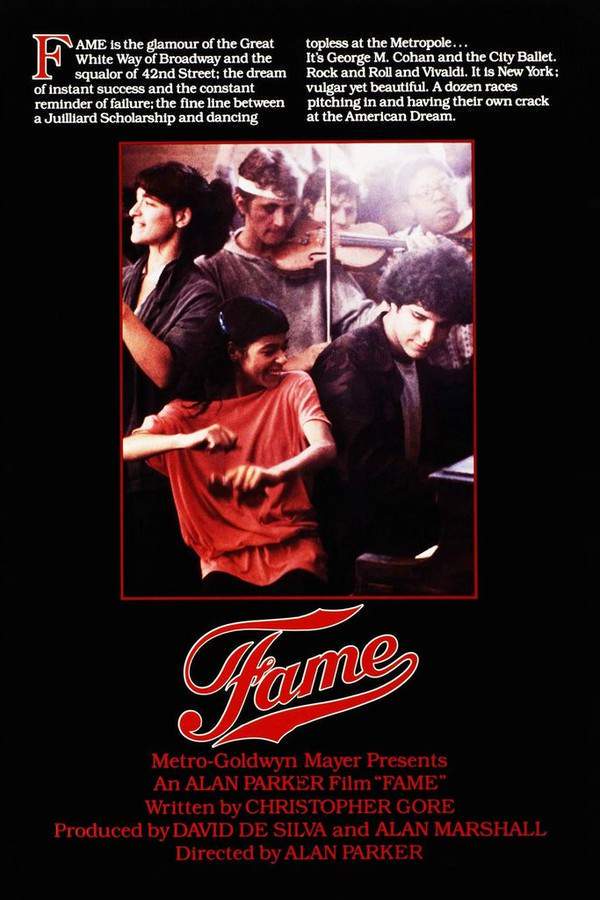
Fame (1980) Poster
FAME (1980) B+
dir. Alan Parker

New York buzzes like a power line in Fame. Everyone’s wired in, a few are already short-circuiting. Alan Parker catches that current and turns it loose in motion in this musical drama that might be best described as dazzling and intoxicating.

The film follows one class through New York’s High School of Performing Arts. The place is an ecosystem of noise—hallways jammed with kids singing, dancing, competing for air. Clawing toward the spotlight like it’s the only thing keeping them alive. Underneath it, there’s also a low thrum of dread. The quiet understanding that most of them are simply not going to make it.

One of the movie’s characteristic scenes happens early on, the cafeteria sequence called “Hot Lunch Jam,” that turns noise into liftoff. It starts with drumsticks pattering on a lunch tray. Someone catches the rhythm and passes it along. In seconds, the entire cafeteria’s pulsing—kids crowding on tables, pianos pounding, the sound tearing down the walls. It’s a musical number, but it feels like it rose out of instinct rather than staging. This is the movie staking its claim. That it’s going to move. That it isn’t going to slow down for anyone. And I haven’t even mentioned the title song yet. It’s pure disco adrenaline. Too wild to stay put within the confines of the school that it literally spills out into the streets of Manhattan. Even if it’s been years since you’ve heard the song, the beat’s probably still ping-ponging through your head right now. As you read this sentence, even.

The cast moves the same way as the movie does—fast, loud, restless. Coco (Irene Cara) sings like she’s already selling out Madison Square Garden. Leroy (Gene Anthony Ray) dances like the world’s balance depends on each step. Montgomery (Paul McCrane) acts through loneliness. Doris (Maureen Teefy) sings her way through fear. They overlap more than they connect. These students are bound more by proximity than friendship.

The cast gives it everything, but the movie’s real magic was made in the editing booth. This film seems afraid to pause, as if stillness might somehow break the spell. The movie jerks forward, changes tempo. Close-ups, crowded hallway shots, tense evaluations. Some of its threads fray, while others never quite meet, but that’s the shape of this movie. Careening from hallway to subway to rooftop as the camera pulls toward whoever or whatever’s making the most noise or most elaborate motion that second. One moment, a student nails a monologue. The next, someone’s crying in a stairwell.

Fame isn’t necessarily about talent. It’s about endurance—and how ambition can wear thin. It’s about how the spotlight flatters one moment and blinds the next. The kind of truth you only learn by refusing to quit. These are kids who come into this school wanting to be noticed. What the movie chronicles is their slow realization of what that really costs.

Starring: Irene Cara, Lee Curreri, Laura Dean, Antonia Franceschi, Paul McCrane, Barry Miller, Gene Anthony Ray, Maureen Teefy, Albert Hague, Anne Meara, Joanna Merlin, Jim Moody.
Rated R. Metro-Goldwyn-Mayer. USA. 133 mins.
The Family Man (2000) Poster
THE FAMILY MAN (2000) B−
dir. Brett Ratner

Jack Campbell (Nicolas Cage) lives like every choice he’s ever made was pre-approved by the universe. And maybe he has a point. He’s a Wall Street dealmaker who lives in a giant penthouse with a view and a calendar booked two months out. He treats time, people, and affection like investments—with returns he can calculate.

He wasn’t always this way. Thirteen years ago, there was Kate (Téa Leoni), his college sweetheart. They were set to marry until Jack was offered a job that promised everything—except he’d have to leave Kate behind. He took it. Moved to New York, built himself a life made of glass and chrome, and never looked back. Love traded for wealth, warmth for control.

Then Christmas Eve intervenes. He ducks into a corner bodega one night and finds Cash (Don Cheadle), a hustler mid-argument with the clerk. Cash is waving a fake lottery ticket. The clerk isn’t buying it. Jack steps in before the situation explodes. But it turns out to be a setup of sorts. Cash isn’t really a con man. He’s an angel—but not the guardian kind. More like a celestial caseworker. He decides to play a trick on Jack, yanking him out of his carefully managed existence and dropping him into an alternate timeline. The one where he didn’t leave Kate thirteen years ago.

He wakes up the next morning in New Jersey. No skyline. No perks. That is, unless you count two kids, a dog, and a closet full of dad jeans as perks. He was once a man who closed million-dollar deals. Now he’s selling tires, living in a suburban dream—or a nightmare, as Jack would call it.

Cage goes all in on Jack’s unraveling. Gawking at the minivan, counting his paychecks like losses, treating domestic life like a problem to be optimized. As he flails against his new life’s smallness, there’s only one person who seems to have him figured out—his daughter. Right away she can tell this man isn’t really her father, and she keeps watching him carefully. Her calm is a mirror to his panic.

If nothing else, it goes down easy. Sometimes it’s funny, sometimes touching, but always careful—smooth, safe, unwilling to risk anything real. Even the premise feels like an extraction, freely borrowing elements from It’s a Wonderful Life and A Christmas Carol. Except this one doesn’t replicate the ache or the bite. Nothing revolutionary—just something that feels right.

Starring: Nicolas Cage, Téa Leoni, Don Cheadle, Jeremy Piven, Saul Rubinek, Josef Sommer, Makenzie Vega, Jake Milkovich, Ryan Milkovich, Lisa Thornhill, Harve Presnell, Mary Beth Hurt.
Rated PG-13. Universal Pictures. USA. 125 mins.
Family Plot (1976) Poster
FAMILY PLOT (1976) B
dir. Alfred Hitchcock

After fifty years of control, Hitchcock lets the air out. Family Plot looks like a thriller, but it moves more like a practical joke—light, open, and just a little too pleased with its own sleight of hand. Barbara Harris plays Blanche, a storefront psychic who runs her séances like neighborhood theater—with a mix of improv, instinct, and quiet fraud. Bruce Dern is utterly terrific as George—a cabbie and Blanche’s boyfriend who also moonlights as her research department, acting like a reluctant dime-store detective as he digs up harmless dirt from her clients, all to be used as content for her séances.

Their latest job comes from an aging widow—eyes still sharp, mind starting to wander—played with brittle grace by Cathleen Nesbitt. She’s dying and hires Blanche to find her sister’s long-lost son—given up for adoption long ago and now heir to her estate. What Blanche doesn’t realize is that the missing heir (William Devane) has a racket of his own. One that is much more illegal. By day, he passes for respectability in a suit. By night, he and his partner (Karen Black—stylish, detached, and a little sharper) run a quiet diamond racket that doesn’t need a psychic and her boyfriend nosing in.

Two cons run side by side—Blanche and George chasing a fortune, while the real crooks are sitting on a completely different one. Eventually, the lines blur. Soon enough the cons collide, and Hitchcock turns the wreck into sly, comic suspense. Then comes the signature touch—a car with no brakes, spinning down a mountain road. Speed rising, sharp turns, clenched teeth (with some mildly acrobatic, comic writhing from Harris in the passenger seat). It’s silly in a way but also had me gripping my metaphorical armchair. Proof that Hitchcock could still wind an audience tight while also clearly having fun with it.

The film takes its time—mostly relaxed and self-assured. Suspense turns to play, danger to formality. Hitchcock digs through his usual obsessions—blondes, doubles, mistaken motives. They don’t have quite the same chill, but Family Plot isn’t a serious movie. Clearly not one of Hitchcock’s great films, but consider it a relatively calm exit from a man who built his name on panic.

Starring: Barbara Harris, Bruce Dern, William Devane, Karen Black, Cathleen Nesbitt, Ed Lauter, Katherine Helmond.
Rated PG. Universal Pictures. USA. 121 mins.
The Family Stone (2005) Poster
THE FAMILY STONE (2005) B−
dir. Thomas Bezucha

The Stones talk the way prizefighters move—in measured punches, feeling for range. They call it honesty. It’s something closer to pastime. Expect old grudges to rise from the ether at every family gathering—dusty, indestructible ones, like family heirlooms no one remembers acquiring or why. But even in their oldest chestnuts, there’s a pulse beneath the noise. Something in the way they frame things suggests they don’t really care about the words—only the charge that passes between them. A feeling that might look something like love.

Diane Keaton plays Sybil—the matriarch and de facto referee. She doesn’t need to yell. She just sets down her mug in a certain way, and the room knows well enough to shut itself up. Craig T. Nelson is Kelly, her husband. Steady and decent—the kind of man who thinks composure is control, and maybe he isn’t wrong with this family. Luke Wilson wafts in as Ben, a philosopher in flannel—half-baked and half-wise. He seems tuned to a frequency that the rest of them can’t quite hear. And then there’s Rachel McAdams as Amy. She’s youngest in the pack—dripping with sarcasm and side-eye. She looks like a lamb but is vicious and merciless—will scorch anyone who steps wrongly on her turf at a moment’s notice.

This family is going to have a new thing to talk about this Christmas when the clan’s golden boy, Everett (Dermot Mulroney), brings home a new fiancée. Her name is Meredith (Sarah Jessica Parker). She arrives at the Stone stead, heels clicking like warning shots across the floor. She’s polite, careful, tense—no idea what she’s in for. Because for the Stones, she’s the kind of guest who makes everyone meaner.

From there, the movie falls into cringe—but the funny kind. The kind that keeps you watching. Meredith proves again and again that she’s exactly the wrong person for their precious Everett. The family makes sure she knows it. He begs them to behave. She accuses him of betrayal if he thinks his family has a point. This is all pretty standard meet-the-family warfare—except admittedly more sharply written than average.

Then the movie decides it needs pathos. Someone falls terminally ill. And it’s revealed this Christmas might be the last they spend together. What we get next is the whole sentimental buffet. Tears, embraces, revelations. It’s reaching—perhaps nobly so—for catharsis. It ends up grabbing something much closer to plain old melodrama instead, but at least it tried. Through all of the unevenness, the characters do remain intelligent and interesting. It can make an exhausting watch, but I still enjoyed the sensation of rubbernecking at this family’s private fallout.

Starring: Sarah Jessica Parker, Dermot Mulroney, Diane Keaton, Luke Wilson, Craig T. Nelson, Claire Danes, Rachel McAdams, Tyrone Giordano.
Rated PG-13. 20th Century Fox. USA. 103 mins.
Fantasia (1940) Poster
FANTASIA (1940) A
dir. Samuel Armstrong, James Algar, Bill Roberts, Paul Satterfield, Ben Sharpsteen, David D. Hand, Hamilton Luske, Jim Handley, Ford Beebe, T. Hee, Norman Ferguson, Wilfred Jackson

A concert hall in Technicolor. A ballet of ink and imagination. A movie that doesn’t tell a story so much as conducts one. Fantasia was Walt Disney’s gamble on the idea that children and classical music could get along just fine—even without talking animals to explain the plot. That Beethoven and Stravinsky could do the work of narration. And that animation—utterly magnificent here—could exist in more abstract forms.

The film opens in silhouette. Musicians, instruments, everything sharply contrasted against rich color. Then they start in on Bach—Toccata and Fugue in D Minor—the first notes feeling like a door opening somewhere. Cellos first. Then violins. Woodwinds, brass, percussion following close behind. Real instruments, real people, the room filling with sound. And then it slips. The world around them starts to fade, turning into shapes and color, like sound trying to dream. Like the mind trying to draw sound.

The next part starts to feel like a story—sort of. The imagination’s still there, just focused differently. You won’t find any of Tchaikovsky’s toy soldiers in The Nutcracker Suite. Instead we get waltzing blossoms, flittering fairies, and mushrooms that twirl and bow. Then comes the film’s most famous spell: The Sorcerer’s Apprentice, featuring none other than Mickey Mouse—the one familiar face in a film otherwise lost in dreams. He plays the title character who conjures a broom to grow limbs and fetch water to fill a cauldron. He’s proud for a moment but the spell outgrows him. The broom doesn’t stop filling the cauldron. Then it starts multiplying. One broom becomes two, then twenty. The water keeps rising until the Sorcerer’s lair is more like a tiny ocean.

After that comes Beethoven’s Pastoral Symphony. Everything turns soft and pastel, calm as the air after thunder. There’s a meadow, sun-drunk and full of centaurs and winged horses. Then The Rite of Spring crashes in—lava, thunder, dinosaurs clawing their way through creation. Finally, Night on Bald Mountain. With Mussorgsky’s devil—winged, massive, gleaming like hot coals. Sitting on a mountain top commanding a night of writhing spirits until dawn sends them crawling back underground.

And this was 1940. Nobody else was thinking about animation—or cinema—in this way: that a movie could be a concert as much as a film. Fantasia may be Disney’s most sophisticated gamble—innovative, artful, even a little highbrow (Mickey Mouse sequence notwithstanding)—but it never forgets its audience. Between segments, Deems Taylor—the composer and critic—appears between worlds, guiding the audience from one vision to the next.

I must’ve been one of them. Whatever it stirred then, it hasn’t really left. I walked out hearing music differently. Seeing it differently too, maybe—like something had cracked open in my head. I still watch it now, and the feeling hasn’t changed. Fantasia isn’t just a masterpiece. It’s a gateway. A reminder that there’s a universe of symphonies out there for all of us to discover. And while we don’t have the prestige Disney-animated sequences to accompany them, we can still close our eyes and make up our own. And with our imaginations, they could look like anything.

Not Rated. RKO Radio Pictures. USA. 126 mins.