THE FADED SPOTLIGHT

by Michael Lawrence

List of "D" Movies


Days of Wine and Roses (1962) Poster
DAYS OF WINE AND ROSES (1962) B+
dir. Blake Edwards

It starts like a romance. Two people, a few jokes, a splash of something golden that catches the light in an enthralling way. It’s innocent, even sweet. But then somewhere between that first toast and the final hangover, the bottle becomes the only thing that’s holding them together. That is, until it becomes the thing that’s tearing them apart.

Joe Clay (Jack Lemmon) sells charm and keeps a bottle close to fake it. Kirsten Arnesen (Lee Remick) is careful, gentle, curious. She tries a sip—a brandy Alexander. “It’s chocolate,” he says. She believes him. That’s all it takes.

For a while, they sparkle. Love and liquor make quick friends. They marry. They drink. The world turns gauzy, every emotion answered by another glass. Then come the longer nights, the blurred mornings. The laughter dulls. The collection of empty bottles seems to multiply. The marriage begins to rot like fruit left out on the counter too long.

Joe sinks first. The office suit turns damp, the grin goes slack. He drinks through the day, sweats through the night, and loses the job that kept the illusion going. Kirsten trails behind—less visibly, more gracefully—but her drop is steeper. Her sweetness fades into vacancy. Her gaze drifts. And when either of them realizes what’s happened, the damage is done. The drinking that had once bound them together has become what’s tearing them apart.

Lemmon’s performance is so raw it almost feels like trespassing. Late in the film, Joe tears through a greenhouse. He thinks he hid a bottle into one of the dozens of potted plants that are there. One by one he claws frantically through them, through soil and foliage, like he’s trying to unearth the last piece of whatever was left of his soul. What a difficult scene to watch. Especially if you’ve ever seen yourself—or anyone you love—in such a low place. Remick’s fall is quieter. Somehow that makes it worse. He wears the madness on his skin for everyone to see, but she swallows the grief whole.

Jack Klugman shows up as Joe’s AA sponsor, a man who’s seen too many wrecks to mistake survival for redemption. Charles Bickford, as Kirsten’s father, gives the film its backbone as a man left to watch helplessly as his daughter drifts into a fog he can’t clear.

Blake Edwards, known more for letting Peter Sellers trip over furniture in his comedies, moves differently here. There’s no reach for humor. He even avoids sermonizing or letting this slip into melodrama. He stages addiction such that it feels routine. And the effect is rough and even vaguely documentary-like. Ultimately, this is a film that understands how easy the slide can feel at first and how impossible the climb back becomes.
Starring: Jack Lemmon, Lee Remick, Charles Bickford, Jack Klugman, Alan Hewitt, Tom Palmer, Debbie Megowan.
Not Rated. Warner Bros. USA. 117 mins.
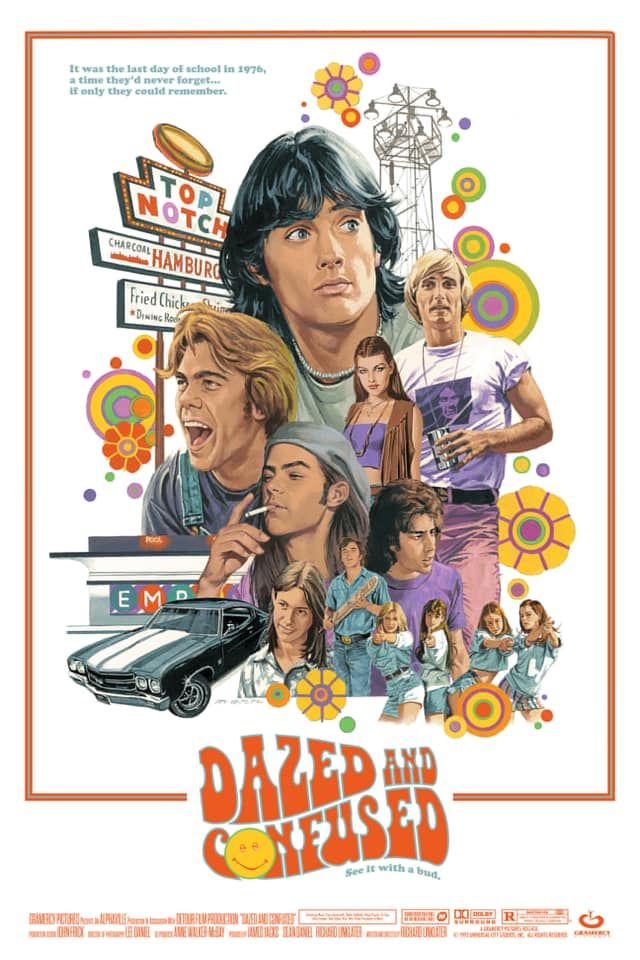
Dazed and Confused (1993) Poster
DAZED AND CONFUSED (1993) A−
dir. Richard Linklater

A movie about nothing in particular. But also about that age when everything feels enormous and every night threatens to go on forever. The setting is Texas, 1976, somewhere near Austin. The last day of school and the air’s thick and hot. The music is loud. No one’s thinking past tonight. Except to ask where the party is and who’s bringing the keg. Unless you’re an incoming freshman. Then you’re thinking about where to hide.

The incoming seniors are already waiting outside of the middle school, paddles in hand, grinning like it’s a civic duty. Tradition, they say. They had to endure this four years ago, and what goes around comes around—with splinters.

The girls have their own brand of hazing. Crawling on asphalt, drenched in mustard, screamed at through megaphones, made to suck pacifiers. It’s a sick sort of welcome. But once they survive it, they’re in.

Mitch Kramer (Wiley Wiggins) might be the most memorable of this sprawling cast. He starts the night on the run—freshman target practice. But by midnight, he’s drinking with them, face flushed, disbelief still clinging to him. That’s when he realizes that sometimes the best way out is to just straight through. You might get bruised, but bruises fade.

McConaughey shows up as Wooderson—older, smooth, faintly pickled in beer and Marlboros. He prowls the high school lot with kids who should know better, like a ghost of graduation day that never quite took. The kids think he represents freedom in a Camaro. But he’s really what happens when you let your best years be your high school years. They’ll figure out later that they want to be nothing like Wooderson.

When this movie came out in ’93, barely anyone noticed. It just sat there. But a few years later, it became gospel—posters on dorm walls, kids quoting lines. Everyone I knew swore it was their favorite movie, which always baffled me. So much hazing, so much cruelty. Not my cup of tea. (Then again, I was the one bragging that Ben-Hur was my favorite film—more violence, fewer jeans, twice the sweating. Maybe I needed a good thwack of the paddle.)

The ensemble cast is full of bold, brilliantly realized characters with no clichés in sight. Also a beautiful-looking film. Linklater lets his camera drift through parking lots and backyards, air full of engine noise and laughter, catching that liminal stretch between freedom and whatever comes next. The movie’s stamped 1976, but anyone can see their own past in it. Youth always finds a way to reset itself.

What holds this film together isn’t the plot. It’s more the texture and the atmosphere of a half-remembered youth. I can’t recall much detail from my own summer nights, either. I only get flashes. The idle gatherings in shopping centers, public parks, the smell of cut grass, talks about where we were going and where we’d been, that flutter in your chest when you meet someone new, the perpetual excitement at the back of my throat at the feeling my best days were still ahead of me. That’s what Linklater gets right. Memory isn’t neat. It’s blurred. It’s sticky. And whatever you still remember are the things that matter.

Starring: Jason London, Joey Lauren Adams, Milla Jovovich, Shawn Andrews, Rory Cochrane, Adam Goldberg, Anthony Rapp, Sasha Jenson, Marissa Ribisi, Deena Martin, Michelle Burke, Cole Hauser, Christine Harnos, Wiley Wiggins, Mark Vandermeulen.
Rated R. Gramercy Pictures. USA. 102 mins.
DC League of Super-Pets (2022) Poster
DC LEAGUE OF SUPER-PETS (2022) C−
dir. Jared Stern

A Superman movie with talking animals sounds ridiculous enough that it might be fun. The problem is, it isn’t. DC League of Super-Pets throws superheroes and talking animals into a bowl like cereal and milk. But then it leaves it out till mid-afternoon when what you’re left with is some kind of fruity mush.

Superman’s got a dog—Krypto (Dwayne Johnson). They save the day together, eat breakfast together, probably brush their teeth together. Manicures? (Pet-icures?) It’s cute. Man’s best friend and sidekick—two roles, one leash. But then Lois Lane starts to cut in, and Krypto spirals. He gets jealous. Lonely. He paces the apartment like a Greek dog-god waiting for someone to throw the ball.

Before he can sulk any further, disaster strikes. The whole Justice League gets kidnapped by Lulu (Kate McKinnon), a hairless guinea pig escapee from Lex Luthor’s lab—juiced on a substance called orange kryptonite that gives her superpowers and a thirst for world domination. And maybe some veggies.

Without the grown-up Justice League around to stop the rogue rodent, Krypto teams up with the pet version of it—a pack of shelter animals who’ve also been zapped by orange kryptonite and have developed powers. There’s a pig that can balloon or shrink. A neurotic turtle with speed issues. A squirrel who shoots lightning. A rescue mutt (Kevin Hart) who’s indestructible and perpetually done with everyone else’s drama. They argue, they train, they save the world. Then, when it’s all over, they group-hug.

The movie never stops moving. Bright, noisy, frictionless. Every frame feels baby-proofed—padded and tested for maximum safety. Think of it as a squeaky toy with a studio budget. Bright, noisy, impossible to break. The DC heroes make their obligatory cameos. They pass through like mascots at a pep rally. Batman! Wonder Woman! Aquaman! The Flash! They wave. Maybe they wink. They crack a joke or two, or something like it. It’s nothing even close to the quick, anarchic wit of the LEGO movies. These jokes just flicker by—tidy and toothless.

The voice cast plays like an algorithm’s dream journal: Dwayne Johnson and Kevin Hart, together again, this time with tails. Kate McKinnon turns Lulu into a tiny maniac. The rest sound like they recorded between other gigs.

This is a superhero movie scared of comic books and a kids’ movie that doesn’t quite trust kids to keep up. As comedy, it’s forgettable but harmless—amiable and polished enough to be inoffensive. The kids might like it, but I doubt they’ll carry this one far into nostalgia in their adult years. (Though who knows?) It’s an airplane movie. A waiting-room movie. You can watch it, ignore it, miss a line or two, and feel nothing either way.

Voices of: Dwayne Johnson, Kevin Hart, Kate McKinnon, Vanessa Bayer, Natasha Lyonne, Diego Luna, Marc Maron, Thomas Middleditch, Ben Schwartz, Olivia Wilde, Jemaine Clement, Keanu Reeves, John Krasinski.
Rated PG. Warner Bros. Pictures. USA. 106 mins.
Dead Again (1991) Poster
DEAD AGAIN (1991) B+
dir. Kenneth Branagh

It starts like noir, talks like a ghost story, and flickers like Hitchcock himself lit the match. Dead Again is where murder and metaphysics share the same cigarette. The result is an opulent riddle with elements of reincarnation, hypnosis, and homicide waltzing in circles—each pretending to lead.

The film tells two parallel stories. Both tied to a single obsession. Both couples played by Branagh and Emma Thompson. In the present, he’s Mike Church, an L.A. private eye with a busted Saab and an accent that keeps switching passports. (Just stick to your British one, my man.) He gets a phone call. It’s from the Catholic orphanage where he grew up. There’s a situation. A woman has shown up at their doorstep. She has no name, no memory, and eyes wide with fear. She’s also mute and dressed like she took a wrong turn out of another decade. Beautiful, too, which, for Mike, makes this seem less like a case and more like a compulsion.

To crack the mystery, he drags her to a hypnotist (Derek Jacobi—voice like velvet, posture like a cat). And she speaks. Only it’s not her life she remembers. It’s someone else’s—another name, another decade. The 1940s. Cigarette smoke curling through piano light. Grace (Thompson again) plays the keys and Roman (Branagh again) writes the notes. They’re rich, married, and doomed. Soon, she’s found dead—stabbed with scissors. He’s left shouting his innocence into a courtroom that doesn’t care.

Back in the present, Mike and the mysterious woman he’s started to call Grace begin to sync themselves with the lives that she’s describing. It’s little things at first. A gesture. A glance. The rhythm of something they’ve already done—maybe more than once. They start to kindle a posture together that feels like romance, but it isn’t. It’s recognition—déjà vu with a grudge.

Branagh shoots this film like a man who was finally handed the keys to his own obsessions—staircases that twist like moral puzzles, light carving through rooms like blades. The film looks and sounds glorious: Gothic, expressionist, drenched in strings that swell until they start to ache. Light and shadow slice through rooms with noir tones so heightened they start to flirt with parody. Or maybe it’s just Branagh having the time of his life—stacking style on top of style like a kid who just found out his Lego box refills itself. It’s big, gaudy, and somehow still sincere enough to cast its spell.

The film’s biggest flaw is with the resolution. The plot’s so busy tying itself in knots that you’re expecting it to lead to a shock conclusion that ties everything together. But that never quite manifests. You get something more like an exhale when you were expecting more of an explosion. But what makes this movie stick isn’t in the twist—it’s the afterglow. That strange, Vertigo-tinted mix of desire and dread as one lifetime smudges into another. This movie might not find the truth, but it makes the search feel epic.

Starring: Kenneth Branagh, Emma Thompson, Derek Jacobi, Andy Garcia, Wayne Knight, Robin Williams.
Rated R. Paramount Pictures. USA. 107 mins.
Dead Sound (2018) Poster
DEAD SOUND (2018) D
dir. Tony Glazer

It’s after dark, and four college kids have missed the last ferry to Block Island—a little slice of paradise (read: tourist trap) off the coast of Rhode Island. Waiting till morning isn’t their style, so they flag down a fisherman, hand over a wad of cash, and call it problem solved. Bad idea. Because in horror movies, any transportation arranged after dark comes with a body count.

They ignore all the warning signs. The fisherman they hire looks like a hangover in human form, and his crew doesn’t exactly scream “legit,” either. They seem less used to hauling fish out of the water than depositing people into it.

Of course, the ride goes south fast. Turns out this crew isn’t actually a bunch of fishermen moonlighting as water taxis—they’re smugglers with an agenda. And that agenda doesn’t include letting these college kids ever see dry land again.

A movie like this should go for broke. Crank up the hysteria. Let the villains chew the scenery. Stage the kills so over-the-top or disgusting they earn a laugh, a wince—something. It’s a shoestring movie, sure, and who knows where they found these actors, but low budget and terrible acting aren’t always known for hindering the entertainment value of a horror movie.

Instead, Dead Sound just drifts—like its boat. It’s never wild enough to be fun, never sharp enough to be tense. The villains, supposedly hardened criminals, act like they’re running a scam they’re already bored with. The victims don’t scream so much as sigh—like this whole kidnapping thing is less a reason to be terrified than to be mildly inconvenienced. The kind of panic you might save for realizing your phone’s still at the restaurant, as opposed to running for your life. (Though, to be fair, some of us might still hit similar levels of panic.)

There’s one moment, though, that deserves a nod. A guy’s bleeding out, floating in the ocean, gasping his last words before he’s supposed to sink. Except he doesn’t—he’s clearly pushing himself underwater, like he’s diving for quarters.

That’s Dead Sound in a nutshell. No urgency to speak of, no real horror either—just a movie that looks like it gave up somewhere around page ten. The premise is fine; the effort isn’t. The tension never builds, the danger never tightens, and even the boat looks like it’s champing at the bit to call it a night so it can drink away what little it made at the pub—along with the rest of the cast.

Starring: Jeff Kober, Matty Cardarople, Caroline Day, Matthew Gumley, Brett Azar, Ashley Austin Morris, John Behlmann, Eric Tabach.
Not Rated. Uncork’d Entertainment. USA. 82 mins.
The Dead Zone (1983) Poster
THE DEAD ZONE (1983) B+
dir. David Cronenberg

Movies love to tell us we only use ten percent of our brains. Total myth, of course—but the kind of nonsense pulp writers can’t resist. Stephen King took the bait with The Dead Zone. Then David Cronenberg got hold of it and froze it. Made it quieter. Sadder.

Johnny Smith (Christopher Walken) is a schoolteacher who drives off the road one wet night and wakes up five years later—older, weaker, off somehow. The world’s moved on. He hasn’t. He’s come back with something new. A gift, maybe. Or a curse. One handshake—or even a brush of skin—and it all starts flooding in. He’ll see that person’s past, present, future—all of it rushing through him at once.

The first time it hits, it’s bad. He grabs a nurse’s hand and suddenly he’s not there in the hospital room anymore. He’s somewhere else entirely. He sees a house on fire. A child screaming. It’s the nurse’s child. He comes to and frantically tells her how to save her. She believes him, and the child lives.

Despite having saved a life, Johnny doesn’t necessarily walk away from this feeling lucky. You can see that it affects him. How every vision he experiences costs him something. How his body stiffens, like he’s carrying the aftershock in his bones. Over time, Johnny looks emptied out. Thinner, slower, worn to the thread.

And the rest of his life doesn’t make it easier. While he was under, his fiancée (Brooke Adams) moved on. She married someone else. That finality sits on him. An exhaustion on top of exhaustion that Walken plays beautifully. Of course Walken—the man, the actor, the character—couldn’t hide his oddness even if he tried. It’s part of his wiring. But here, that weirdness isn’t just quirky. It aches.

Cronenberg directs this film like he’s handling something fragile—maybe radioactive. It’s controlled, but you can also sense the tension behind every shot. The camera stays calm but the violence comes fast—though clean. It’ll still jolt you. Johnny’s visions flare like migraines: bright, sharp, and gone before you can blink. But what really defines the film isn’t the jolts, although those are expertly done here. It’s that slow, creeping fear that seems to lurk underneath. Like rot creeping under paint.

Cronenberg keeps a lid on his impulses this time. None of the squirming body horror of Videodrome or The Fly (which he’d do a couple years after this). Maybe he wanted a hit for a change. In all fairness, this film deserved it, even if he ultimately didn’t get it. But the restraint pays off anyway. This is one of his most elegant films. And maybe also one of his saddest.

This is also one of the rare Stephen King adaptations that remembers people come before the premise. Of course this is a movie about horrors, but we aren’t really watching the horrors manifest in front of people like specters. This is the internalized horror of watching someone slowly wither away until he is a dried-out husk.

Starring: Christopher Walken, Brooke Adams, Tom Skerritt, Herbert Lom, Anthony Zerbe, Colleen Dewhurst, Martin Sheen, Nicholas Campbell.
Rated R. Paramount Pictures. USA. 103 mins.
Deal of the Century (1983) Poster
DEAL OF THE CENTURY (1983) C–
dir. William Friedkin

You’d think William Friedkin—the guy who made The Exorcist and The French Connection—would know exactly what he’s doing with a satire about Reagan-era arms dealers. But instead of coming in fanged and ready, he kind of stumbles in like he’s half-awake and looking for a nap. Deal of the Century turns slaughter into salesmanship and death into a tax write-off. And yet, it still doesn’t seem to realize it was supposed to make a point. Or at least be funny.

Chevy Chase plays Eddie Muntz, a bargain-bin arms dealer who sells death the way some men would sell Buicks—with talk as slick as oil and a stare as cold and vacant as deep space. He drifts through war zones, boardrooms, and moral crises on autopilot, smiling just enough to prove he’s technically awake.

That’s the kind of detachment that the movie mistakes for wit. And while that detachment might have been a crucial element of the satire, the film doesn’t offer anything else behind it. And without that substance, it’s nothing but empty.

The film kicks off when Muntz’s partner dies in a midair demo that’s gone wrong. But instead of mourning, he heads straight back home and headfirst into the next big hustle. That is, hawking an unmanned fighter jet known (ironically) as the Peacemaker. It’s a sleek, expensive killing machine that’s built to fail in the right direction. That is, in any way that’ll make someone rich. The CEO who fronts the company sells it with the same kind of hollow enthusiasm as a preacher who doesn’t believe in the gospel. He tosses out slogans like “defensive deterrence.” That Orwellian promise that insists more weapons mean less war. This might be the closest the satire gets to finding any real traction, but this is only preamble—an idea that’s brushed at but never dug into.

Sigourney Weaver drifts in as the widow of Muntz’s late partner—too smart for the men around her, too underwritten to matter. She does get one scene that actually made me laugh, though. Muntz, already limping in a cast from a previous gunshot, takes another bullet in the same foot, and blood starts gushing through the plaster. Weaver, unfazed, grabs a wine cork and plugs it up.

Gregory Hines turns up with something close to a conscience, which in this business makes him the weakest man in the room. His character might’ve been meant to ground the story against Chase’s blankness. But the film really offers him no solid ground to land. He’s playing against a man who not only doesn’t care what he thinks but whose thoughts don’t even seem to register with him.

Somewhere in all this is the outline of a savage comedy about the marriage of capitalism and carnage. But the movie never gives itself enough propellant to reach it. The tone never locks in. It’s not angry enough to sting, not loose enough to be funny. You keep waiting for the movie to bare its teeth. You want it to take a real swing at something—anything. This was the era, after all, that brought us the Iran-Contra scandal. That target being the proverbial broad side of a barn. But all it does is stand there, glassy-eyed, staring up at the behemoth that is the military-industrial complex—and shrugs.

Starring: Chevy Chase, Sigourney Weaver, Gregory Hines, Wallace Shawn.
Rated PG. Warner Bros. USA. 99 min.
Death Becomes Her (1992) Poster
DEATH BECOMES HER (1992) B+
dir. Robert Zemeckis

Meryl Streep is radiant—even when she’s rotting. She’s Madeline Ashton. Once radiant, now watching her career, her marriage, and her reflection collapse in lockstep. Enter Isabella Rossellini, glittering and dangerous, a walking temptation who claims to have the cure. A vial of eternal life and youth. Damnation in a crystal bottle. The deal’s simple: drink it, and stay young forever. As you might expect, Madeline doesn’t hesitate. It just comes with one warning: take good care of her body. It’s the only one she’ll ever get.

She barely gets time to process that warning before she takes a swan dive down a giant marble staircase. She lands in a heap that looks less human and more like a clump of laundry. Her husband Ernest (Bruce Willis) who is meek, sweaty, and dresses up corpses for a living, witnesses this scene with a sequence of emotions. First, it’s shock. Then relief. Then shock again. And then finally settles on dread.

Shock—because he’s the one who pushed her. Not on purpose, but he can’t quite say he regrets it. Relief—because maybe this means he’s finally free. Shock again—because Madeline stands up with her head turned backward and her spine is screwed up and contorted like a twisty boa constrictor. And then dread—because if Madeline’s immortal, that means he’s going to be stuck with her forever.

Then Helen (Goldie Hawn) turns up. She’s still seething fourteen years after Madeline had stolen Ernest right out from under her. She’s taken the potion too and is learning the same hard lesson about immortality. Especially once she and Madeline start to swing shovels at each other and use shotguns to blast giant holes through their torsos.

Robert Zemeckis shoots this movie like a gothic funhouse. It’s gaudy, baroque, and gleefully cruel. Madeline and Helen aren’t just rivals. They circle each other like vipers. They fight at first out of spite. Then out of habit. And then they stop once they finally realize they have no one else in this world other than each other. Vanity made them enemies. Immortality is what ultimately makes them inseparable.

The special effects were astonishing for their time, all in aid of creating this seamless blend of satire and spectacle. Zemeckis pushes the grotesqueness right to the brink of what a mainstream PG-13 studio comedy could feasibly get away with. The madness sustained all the way to a finale that can only be described as talking confetti.

It works because Streep, Hawn, and Willis don’t flinch. They throw themselves into the absurdity and somehow make it look effortless. The timing’s razor-sharp; the cartoon violence feels rehearsed to perfection. Streep’s Madeline could be a prototype for her Devil Wears Prada role—same ego, more dead. This is a deliriously funny film, built for anyone who likes their laughs sharp and a little bit decomposed.

Starring: Meryl Streep, Goldie Hawn, Bruce Willis, Isabella Rossellini, Ian Ogilvy, Adam Stroke, Alaina Reed Hall, Michelle Johnson, Mary Ellen Trainor, Susan Kellermann.
Rated R. Universal Pictures. USA. 104 mins.