THE FADED SPOTLIGHT

by Michael Lawrence

List of "B" Movies


Babel (2006) Poster
BABEL (2006) C+
dir. Alejandro González Iñárritu

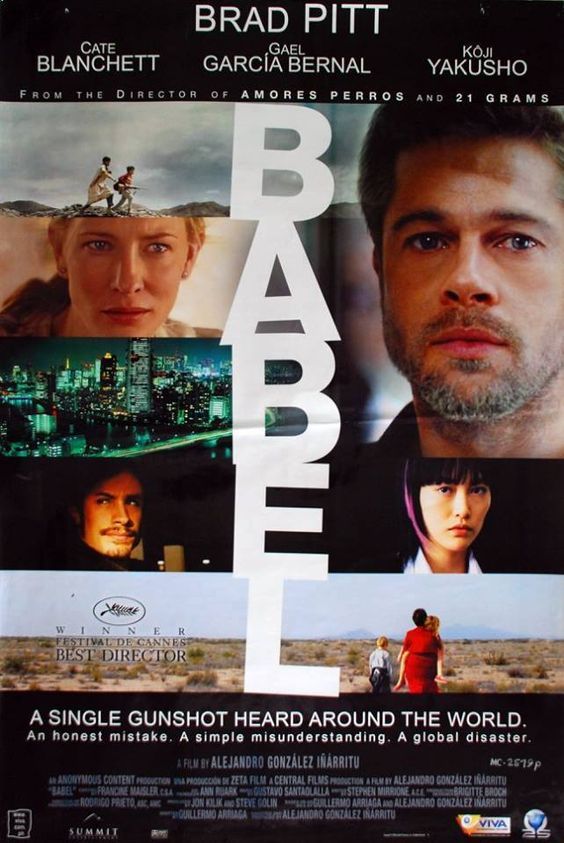
Babel stretches across continents. Morocco, Mexico, Japan. California, in a small dose. Four stories. Each circling its own tragedy—each one connected by a rifle. Each of the interweaving stories functions well enough on its own. The tension’s there. The acting’s strong. A few moments might even jolt you awake. But stack the stories together, and it doesn’t loosen up. It stiffens instead. It doesn’t feel so much like a movie as it does a demonstration. Something more interested in reach than meaning.

The Morocco story comes through with the most clarity and punch. Two young brothers fooling around with a rifle take a shot at a tourist bus. One bullet hits. Cate Blanchett ends up on a blanket in a villager’s home, bleeding fast. Brad Pitt steps outside, trying to find anyone who can help. The village barely has anything.

Meanwhile, back in California, their housekeeper Amelia (Adriana Barraza, heartbreaking even when she’s just thinking) gets pressed into an impossible situation. The parents are overseas and nowhere close to returning. The kids still need looking after. Her ride to her son’s wedding in Mexico is already set, and the person she hoped could watch the children cancels at the last second. So she takes the kids with her. The wedding goes fine. The trip back doesn’t.

For Chieko (Rinko Kikuchi), Tokyo feels provisional. Somewhere she moves through, not into. She’s deaf, exhausted, and done with walking past people who don’t even look up. She ends up exposing herself to a cop just to be seen for a second. The rifle has nothing to do with what she’s going through. The only link being that her father owned it once.

The movie never sits still. Police raids, scratchy news footage, and calls bouncing across time zones keep piling up. But the stories feel less connected than they do simply adjacent. There’s urgency, but the relevance these stories have by being in proximity to each other feels arbitrary at best. By the time the film has spent more than two hours bouncing between disasters, the “big idea” that’s supposed to tie it together feels surprisingly small. The notion that people misread each other. Panic at the wrong moment. Break things that they never meant to touch. Which, yes, all of that is true. But Babel announces that like it’s some kind of revelation.
Starring: Brad Pitt, Cate Blanchett, Gael García Bernal, Rinko Kikuchi, Adriana Barraza.
Rated R. Paramount Vantage. USA–Mexico. 143 mins.
Baby Boom (1987) Poster
BABY BOOM (1987) B
dir. Charles Shyer

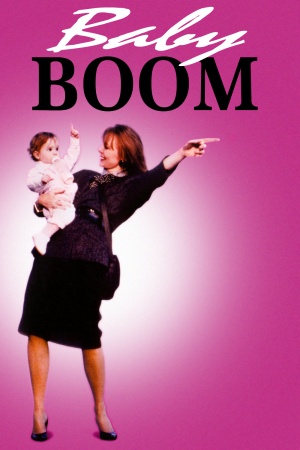
Diane Keaton charges through Baby Boom on that familiar voltage of hers. She’s sharp, fast on her feet, and already three thoughts ahead of everyone else. She plays J.C. Wiatt, the kind of New York executive who gets powered by instinct and whatever’s in her coffee cup. Her creed is efficiency. Anything slower counts as nuisance.

But then the universe hands her something unexpected. An inheritance. But it isn’t cash, an estate, priceless artwork, or anything useful. It’s a baby. A breathing, blinking, crying, pooping baby. And the baby has a name: Elizabeth. She is handed over by a courier with papers attached—proof that someone out there thought that J.C. would be a dependable pair of hands. At first, she makes a go at returning the bundle. She talks like she’s negotiating a contract—opposed to a warm object with limbs. But her words are wasted. Both the rules and the cosmos are telling her that she’s stuck with it.

This ruins her life and career as she knows it. Her boyfriend (Harold Ramis) evaporates the moment it stops being convenient. Then, the office sharks start circling. One bad week later, and she’s punted straight out of corporate paradise and into rural Vermont, where she suffers through a few snowbound humiliations. But then, through it all, she accidentally turns herself into a baby-food mogul. This is the part of the film that plays like a fantasy dreamed up by someone who thinks capitalism is adorable. But Diane Keaton, certainly to her credit, sells the whole arc with a certain pinball-machine energy.

This could easily have been a film that dissolves into pure puff, but it never does. There’s a quiet wit at work beneath the sillier bits—shaping things beneath the surface. Keaton moves through the film like she’s revising herself scene by scene.

Her character transformation is palpable. She walks back into that boardroom that had unceremoniously dismissed her, now a veteran of motherhood, recalibrated. No blazer or polished armor this time. Just her being herself. And with that, a new confidence. One that shows that she hasn’t softened but sharpened. She spent years trimming and adjusting, squeezing herself into whatever outline someone else drew for her. Now that era’s over. Permanently.

Starring: Diane Keaton, Harold Ramis, Sam Shepard, Sam Wanamaker, James Spader, Pat Hingle, Britt Leack, Mary Gross.
Rated PG. MGM/UA Communications Co. USA. 103 mins.
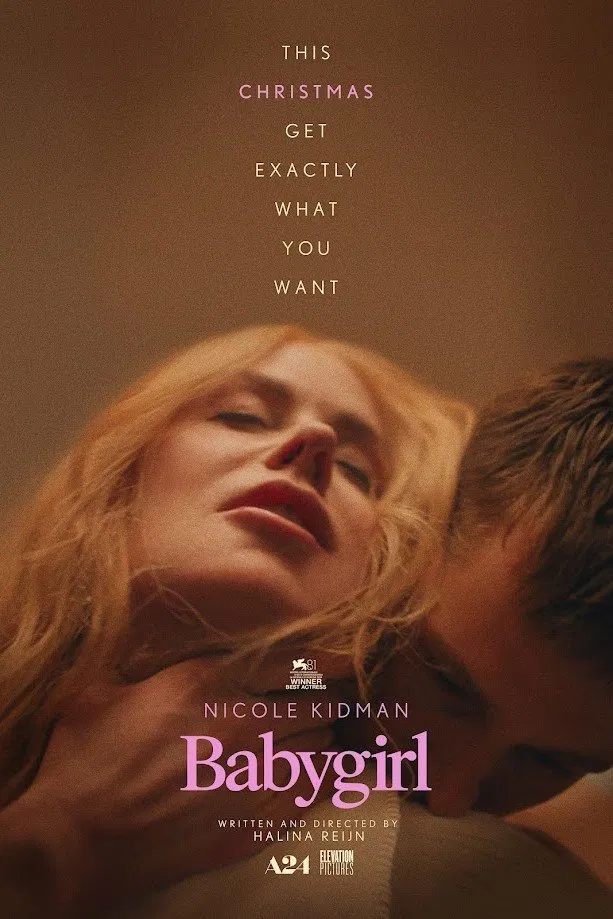
Babygirl (2024) Poster
BABYGIRL (2024) A–
dir. Rebecca Miller

Nicole Kidman turns in a fierce performance as Romy Mathis. A robotics executive who runs her life like a system that can’t afford errors. She’s the kind of high-powered executive who doesn’t need to command a room. People instinctively bend to her will. Outwardly, smooth and steely. Inside, she’s been hollowing out for a while now.

Antonio Banderas shows up as Jacob. Romy’s husband. A theater director. A man who knows how to say the right things but still misses the moments when they’re needed. He’s as perpetually occupied as his wife, and about as emotionally unavailable as he is physically. Their marriage follows a pattern. Cordial. Competent. Quietly stalled out.

But then something about the balance in Romy’s workspace starts to slip. And the source of it couldn’t possibly be smaller. It’s an intern. Samuel (Harris Dickinson). She’s used to interns melting into puddles, but Samuel looks at her without even a pause. As though the introductions already happened somewhere else. There’s something uncanny about him. The way he doesn’t seem impressed. No nerves in him either. She should register him as a minor irritation and move on. But instead, he sticks to her.

What follows isn’t seduction so much as an axis shift. And it happens quietly. Romy, who is used to giving directions and having them followed, is suddenly left powerless when she is alone with him. She just lets the space sit. And he isn’t exactly rushing to fill it, either. That patience disorients her faster than any overt move could. And then what takes shape afterward is far more primal than strategic. There’s sex, but that isn’t the point. It’s an internal free fall. One that Romy knows exactly what it will cost. Abstractly, her authority, her emotional distance, her control. But more tangibly, her marriage and her job. But she keeps it going anyway.

Babygirl flirts with scandal, but that’s not what it’s truly after. This is a movie about the way desire cuts across authority instead of lining up with it. Romy, who’s spent years being excellent at every part of her life, suddenly finds herself wanting the one thing that threatens to pull that order apart. A contradiction that Kidman carries, showing the nuanced struggle of trying to keep two versions of herself alive at once. A performance that lets the pressure show. Even when there’s nothing being said. A performance that puts the strain right out in the open where you can see it. While this film isn’t exactly comforting, what it gives back, it does in clarity and force.

Starring: Nicole Kidman, Harris Dickinson, Antonio Banderas, Zoë Winters, Griffin Dunne, Lily McInerny, James Scully, Ismael Cruz Córdova.
Rated R. A24. USA. 117 mins.
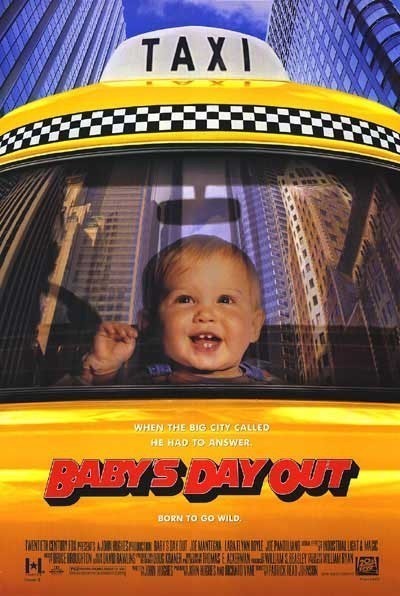
Baby’s Day Out (1994) Poster
BABY’S DAY OUT (1994) D
dir. Patrick Read Johnson

By 1994, it would have been difficult to imagine John Hughes sinking worse than he already had. Baby’s Day Out hits the bottom of the barrel so hard that it gives way.

This movie follows a baby on a slow crawl across Chicago. Unsupervised. Unbothered. Serene like a little Buddha. He’s kidnapped. Not for long. Joe Mantegna, Joe Pantoliano, and Brian Haley play the kidnappers left chasing after him, from one bad location to the next. They suffer various stages of physical collapse in the process—often face-first into steel beams. It’s like Home Alone crossed with The Incredible Journey, except the pet’s furless, the booby traps are accidental, and the wandering creature runs purely on whim.

Well, almost on a whim. This is a particularly affluent baby who has a nanny played by Cynthia Nixon. Because wealth requires you to outsource childcare from the Mary Poppins district of London, she’s doing a vague approximating of a British accent. She reads the baby his favorite picture book, and the rest of the movie runs on whatever stuck in his memory. A pigeon on a rooftop was in the book. It sends him climbing. There’s a bus in the book, so baby boards the bus. Baby even goes into a gorilla cage at one point.

Mantegna, outfitted with an East Coast accent despite the whole thing being set in Chicago, takes the brunt of the punishment. He gets electrocuted, trampled, smashed, bitten. Whatever crime his groin committed in a past life, the film makes sure it pays in full. His accomplices fare worse.

The movie doesn’t worry. The violence plays for laughs. Child endangerment is something you’re expected to not even think about. But watching a real baby—however staged—crawl through construction sites, crowds, and traffic (where bystanders somehow never notice there’s an infant in distress) doesn’t exactly play as harmless. This is pure anxiety disguised as whimsy. Child endangerment scored like a lark. And it never lets up.

There’s an idea in there somewhere. Innocence outpacing stupidity. A live-action cartoon about a baby crawling through a city of idiots. But there’s no invention here—just pratfalls and sugar, caught between wanting laughs and wanting comfort. A movie that drifts by like a paper boat. Fine from a distance. Bottom dissolved out. The baby’s cute. The movie isn’t.

Starring: Joe Mantegna, Lara Flynn Boyle, Joe Pantoliano, Brian Haley, Cynthia Nixon.
Rated PG. 20th Century Fox. USA. 99 mins.
The Babysitter (2017) Poster
THE BABYSITTER (2017) B
dir. McG

Adolescence already comes with enough humiliations baked in. Panic. Hormones. The feeling that everyone else has things figured out and you don’t. But for Cole (Judah Lewis), age twelve, there’s also the tiny matter of a satanic cult operating inside his living room.

Even before stumbling upon the cult, Cole was wound tight. Startling easily. Flinching at noises. Keeping to his room at night. But when he’s with his babysitter, Bee (Samara Weaving), the world seems right somehow. She’s a steady presence. She talks to him. Jokes with him. Never puts him on the spot. She can even keep up with his preferred way of communication. Through movie quotes and idle sci-fi chatter. No condescension. When his parents are out, the house feels safe. But that’s about to end.

One night, Cole sneaks out of his room. He looks downstairs. Bee is in the living room with people he doesn’t recognize. She’s straddling one of them—some guy—kissing him. But then moments later, she’s driving two knives straight into his skull.

Bee’s fellow cult members—confident and attractive, just like Bee—catch Cole immediately. Whatever’s happening, he shouldn’t have seen it. Which makes him a problem. Also—conveniently enough for the cult members—it makes Cole their ready-made next sacrifice victim.

From that point on, it’s grisly slapstick. Blood flying in thick arcs, spraying on walls, furniture—whatever’s in the room. Very Pollock-friendly. He could have just held up a blank canvas anywhere and made himself a masterpiece. McG pushes that violence hard and then just keeps pushing. People don’t simply die in this movie. They rupture. In ways that are loud, messy, and deliberately excessive.

Weaving makes Bee dangerously likable, relaxed in a way that disarms you. You understand how someone could follow her without asking questions. Lewis keeps Cole scared and reactive, without undercutting it for laughs. His survival instincts arrive rough, unpolished, and straightforward. Which is exactly right.

The violence is broad and jokey. The danger is treated like decoration. But watching a kid sprint from one threat to the next doesn’t stay funny for long. Even wrapped in cartoon exaggeration, the anxiety keeps bleeding through. A movie that just keeps piling on stylized excess—gore, speed, attitude—and campy humor. It’s played for fun, and nothing more than that.

Starring: Samara Weaving, Judah Lewis, Hana Mae Lee, Robbie Amell, Bella Thorne, Andrew Bachelor, Emily Alyn Lind, Leslie Bibb, Ken Marino, Doug Haley, Miles J. Harvey, Chris Wylde.
Rated TV-MA. Netflix. USA. 85 mins.
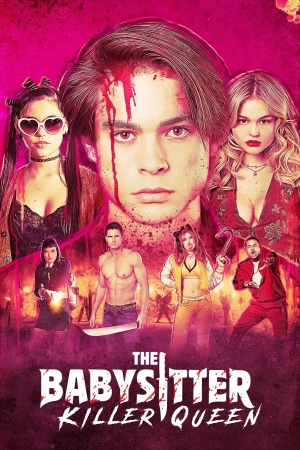
The Babysitter: Killer Queen (2020) Poster
THE BABYSITTER: KILLER QUEEN (2020) C−
dir. McG

Two years on, Cole (Judah Lewis) is still carrying it. He talks about what happened. People don’t engage. His parents watch him closely. His classmates treat him like someone you give extra room to. Even Melanie (Emily Alyn Lind), who knows exactly what went down that night, sticks to the version where nothing unusual ever occurred. Guilt, convenience—who knows why she’s denying their shared history. But in the end, Cole just winds up carrying it alone.

But then the truth resurfaces at a party where he finds out that Melanie isn’t hiding ignorance. She’s hiding enthusiasm. She’s fully involved in the cult herself now, and things unravel quickly from there. Familiar faces from the original cult suddenly resurface, with a few new ones folded in. All ready to pick up where things left off. Cole doesn’t stick around to watch it happen. He bolts into the woods—this time with Phoebe (Jenna Ortega), a transfer student who believes him and moves fast.

What made the original film work—when it did—was Samara Weaving. With her mostly sidelined here, the sequel loses its center. Killer Queen circles familiar gags, familiar splatter, familiar winks, but never quite finds its rhythm. The timing drags. The jokes stall. Buckets of blood spray, but the wild flavor that carried the first film never really shows up.

Jenna Ortega helps. She brings some snap and a sense of newness the movie badly needs, and she’s the closest thing it has to a steady presence. It still isn’t enough. It’s too busy replaying scenes from the first film to do much of anything with her. And Cole’s whole arc worked better the first time around, when he didn’t see the betrayal coming. Here, he mostly expects the cult to come after him, and it’s no surprise to him or to us when they do.

This isn’t a step forward. It’s a rerun. Not so much a killer queen as it is a cover band that shows up late and runs through the hits without much conviction.

Starring: Judah Lewis, Emily Alyn Lind, Jenna Ortega, Robbie Amell, Andrew Bachelor, Hana Mae Lee, Bella Thorne, Samara Weaving, Ken Marino, Leslie Bibb, Chris Wylde.
Rated TV-MA. Netflix. USA. 101 mins.
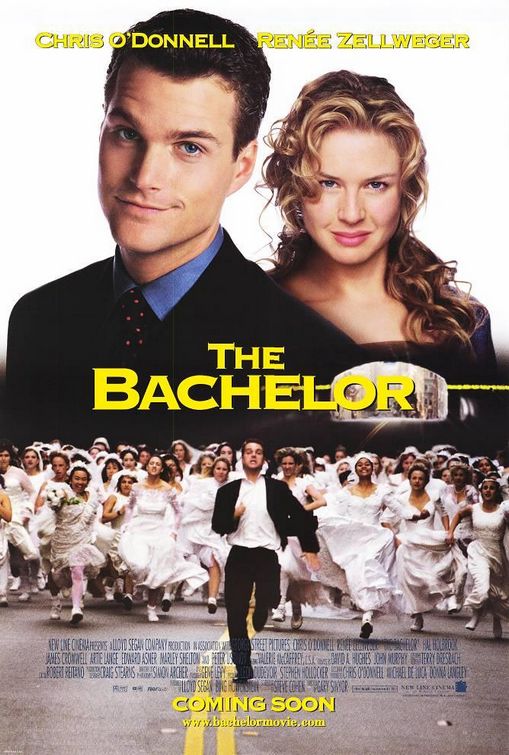
The Bachelor (1999) Poster
THE BACHELOR (1999) C–
dir. Gary Sinyor

The Bachelor has a perfectly workable screwball premise and absolutely no idea what to do with it. A romantic comedy built around panic, deadlines, and bad decisions, instead it moves ahead without much sense of urgency or comic pressure.

Chris O’Donnell plays Jimmie, a pleasant, unremarkable man edging toward thirty who suddenly learns that his recently deceased, perpetually irritable grandfather has left him a fortune. (Peter Ustinov plays the grandfather in a brief but easily the film’s funniest performance). The inheritance comes with a deadline: Jimmie has to be married before his thirtieth birthday.

Of course that’s only days away, which makes you wonder what would have happened, legally speaking, if the old geezer would have hung on for a few more days. Jimmie rather liked the bachelor life, but he has a longtime girlfriend Anne (Renée Zellweger) who is just itching to marry him. Should be easy enough. But when his hasty proposal to her is capped with a blurted-out “you win,” she’s out the door.

With Anne gone and the clock running, Jimmie starts retracing his own history. He starts retracing his past, moving from one ex to the next. The movie settles into a pattern: short lunches, strained conversations, rushed reunions. Scenes acknowledge their own discomfort, smooth it over, and move on. Nothing accumulates. Nothing escalates.

There is one memorable scene, though—O’Donnell sprinting through the streets of San Francisco as a swarm of women in wedding dresses pours after him. You might not remember why it happened as much as you just remember it happening. But hey, there’s the one and only impression that this can leave you with.

The Bachelor doesn’t collapse so much as quietly fail to engage. A madcap countdown by way of romance under duress that reaches for screwball fun but ends up about as interesting as a styrofoam cup. O’Donnell is stiff, Zellweger is sidelined, the supporting players register as nothing more stock figures. This is a movie about romantic desperation that never comes across desperate, funny, or convincing. All it does is reach the finish line and call that good enough for love.

Starring: Chris O’Donnell, Renée Zellweger, Peter Ustinov, Artie Lange, James Cromwell, Brooke Shields, Mariah Carey.
Rated PG-13. New Line Cinema. USA. 101 mins.
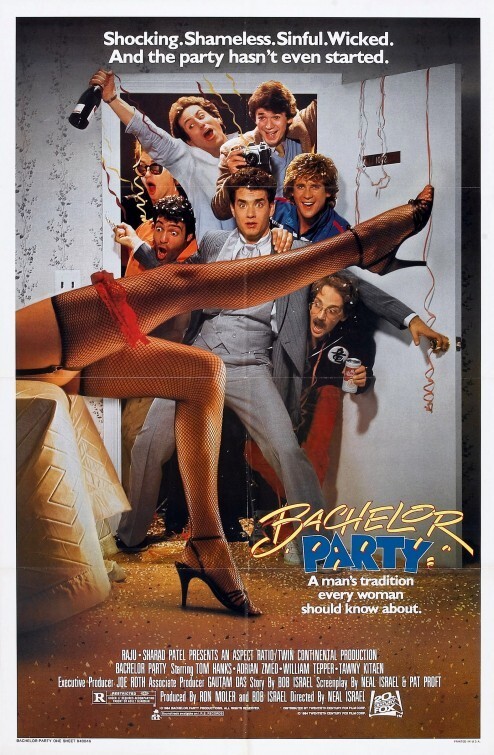
Bachelor Party (1984) Poster
BACHELOR PARTY (1984) C
dir. Neal Israel

Studio executives in the 1980s must have been eager to greenlight anything that involved Tom Hanks and a beer tab, because this movie otherwise doesn’t add up to much. Hanks plays a motormouthed class clown, engaged to the love of his life (Tawny Kitaen). Her upright, upper-crust parents make it so transparent they’re against this union that they try to bribe him to call the whole thing off. But he not only laughs it off, he mercilessly mocks them like it’s his own private sport—poking, smirking, and torpedoing their sense of order with smug, wiseass precision. And I won’t lie: these are by far the best moments of the film. Whether or not these were improvised or just throwaway character-establishing scenes, they made me laugh far more than anything else here.

Because when the film launches into its namesake bachelor party, it disintegrates into a buffet of gags that play like a handful of cheap fireworks tossed into a trash can and expected to dazzle. It’s frat-house noise littered with strippers, barnyard animals, invited guests, uninvited guests, more strippers, and lots and lots of booze. There’s not really any structure to any of this. Nobody bothered to write down ideas and pick from the best ones. They just shoved in everything and anything it seemed like the budget could half afford.

Hanks, at least to his credit, remains a charming lead force—even as the film is ripping its seams around him. But arguably what keeps this movie bouncing along more than anything else is the fizzy soundtrack that’s pure 1980s pop excess. The Fleshtones, Oingo Boingo, The Police, The Alarm. It’s a crying shame the movie drinks itself stupid long before it can remember to be funny again. Chalk this up as a party that shows up sharp, blacks out early, and wakes up wondering where all the fun went.

Starring: Tom Hanks, Tawny Kitaen, Adrian Zmed, George Grizzard, Barbara Stuart, Robert Prescott, William Tepper, Wendie Jo Sperber.
Rated R. 20th Century Fox. USA. 105 mins.
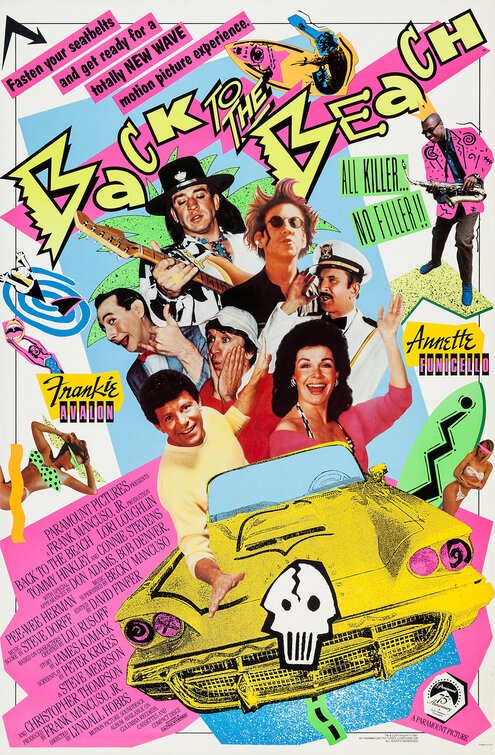
Back to the Beach (1987) Poster
BACK TO THE BEACH (1987) B−
dir. Lyndall Hobbs

Pastel, overlit, aggressively coiffed—Back to the Beach takes the look and rhythms of the old beach party movies and runs them through full ’80s gloss. The opening needle drop tells you exactly what kind of fusion this is: Dick Dale and Stevie Ray Vaughan covering “Pipeline.” Surf rock all goofed up in a Members Only jacket.

Frankie Avalon and Annette are older now. The teen-idol years are behind them. He’s selling cars. She’s running a suburban household. He’s still vain, still proud, still guarding his hair like it’s a priceless museum piece. She’s chipper, patient, and holding the household together in a way that suggests the Donna Reed universe never stopped making sense.

The film’s structure is loose to the point of indifference. It trots out surfboards like genre furniture, with jealous boyfriends and musical numbers following closely in tow. Everything kept recognizable—agreeable, mostly inert. Avalon and Funicello coast. Which is no criticism of them, by the way, quite the opposite. They know exactly what movie they’re in, and it wouldn’t make sense to push against it now. The movie picks a goofy lane and stays there. Broad jokes. Easy affection. No real urge to complicate matters.

The ’60s party aesthetic gets a cosmetic update, but the fantasy stays the same. Frankie and Annette on the beach, singing about things like puppy love, keeping everything else at a distance.

Not all of it works, but plenty does. Avalon gets the best laughs, especially when he taps into his own fossilized cool. He drops lines with the confidence of a man who’s been playing “Frankie Avalon” for decades and sees no reason to stop. Paul Reubens appearing in full Pee-wee Herman regalia to perform “Surfin’ Bird” is impossible to resist. The kind of movie moment you don’t analyze. You wait for it to end so that you can catch your breath.

Plot is treated as a suggestion. Musical numbers matter more than momentum. That’s faithful to the original beach movies, which never pretended to be about much of anything. The difference here is that Back to the Beach knows how silly the whole enterprise looked like in retrospect and isn’t shy about pressing its tongue firmly in its cheek.

It’s not sharp. It’s not ambitious. That doesn’t seem to bother it. The movie stays cheerful and a little anarchic. It has its limits, but it’s content to stay there. Chalk this up as a movie for people who remember when tans, harmonies, and a drum break passed for a worldview.

Starring: Frankie Avalon, Annette Funicello, Lori Loughlin, Connie Stevens, Bob Denver, Don Adams, Jerry Mathers, Paul Reubens.
Rated PG. Paramount Pictures. USA. 92 mins.
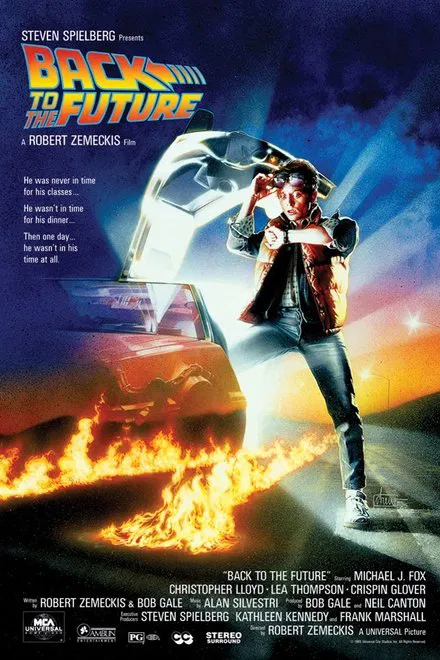
Back to the Future (1985) Poster
BACK TO THE FUTURE (1985) A
dir. Robert Zemeckis

A movie about time travel that begins, fittingly, with a kid who can’t make it to school on time. But give him a few hours and he’ll be arriving to school thirty years too early.

Marty McFly (Michael J. Fox) is a teenager in a denim jacket and a red puffer vest whose main ride is a skateboard, and his main motivation is a girl (Claudia Wells). His best friend (for reasons the movie leaves unexamined) is Doc Brown (Christopher Lloyd), a wild-haired, permanently frazzled inventor whose career has been one long string of mishaps. Except this time. This time he’s actually done it—turned a stainless-steel DeLorean into a time machine. Something about 1.21 gigawatts and a “flux capacitor.” But don’t get hung up on the specifics—what really matters is that the time travel element is kicked in when the car hits eighty-eight miles an hour. Call it breakthrough—by way of genius and drag race.

It would be tough to say anyone could hit that kind of speed by accident—but Marty does. Doc is demonstrating the machine in an empty mall parking lot when it’s revealed that the car runs on plutonium, and the only way for Doc to acquire it was to steal it from Libyans. And the Libyans found him. They shoot Doc, then tear after Marty, who flees by hopping into the time machine and flooring it. That’s when his world tears open. What was once the mall parking lot dissolves into farmland, pavement giving way to dirt, and the night becomes 1955.

The past is picture-perfect. Diners and milkshakes. Poodle skirts. Gas for nineteen cents a gallon. There’s something else, too—Marty’s parents. He doesn’t even get to adjust before meeting his teenage father, George (Crispin Glover), a tangle of nerves in horn-rimmed glasses, and his mother, Lorraine (Lea Thompson), who takes one look at him and falls head over heels. (One imagines Freud’s ghost haunting quite a few of this movie’s screenings.) But the real problem isn’t simply that he caught a glimpse of his parents’ awkward years (that he’ll never be able to unsee). It’s that Marty’s wrecked their parents’ first meeting. Now he’s stranded in the past, juggling two impossible tasks: getting back to 1985 and also convincing his parents—who have roughly the chemistry of broccoli and bologna—to fall in love so that he can exist.

There’s so much that happens in this movie that it feels like it was made for a second viewing. Or in my case hundreds of viewings. Zemeckis and writer Bob Gale keep the story tuned tight—every piece seems to click exactly where it should. They even add Biff (Thomas F. Wilson), the resident bully—loud, mean, and just unpredictable enough to keep the whole thing off balance. Maybe that’s why it all works so well.

The film works like that, too: every setup finds its echo, every joke comes back around, and nothing ever feels accidental. This is a dense movie, but it also moves quickly, breathes easy, and never overexplains. Every scene hands the keys seamlessly to the next. As far as precision pop entertainment goes, this is about as good as it gets.

Fox and Lloyd charge this movie like twin currents. It never stops buzzing. Fox plays Marty with a mix of restless energy and offhand charm. You like him before you even realize why. Lloyd, meanwhile, makes Doc’s mania sing, and his eyes seem to bulge like he’s watching the future arrive just a little bit too soon.

This is a movie I watched so much I probably wore out my VHS copy as a kid. Watching it now, nothing’s faded. It’s fast, funny, and affecting—even when you know every scene by heart. (My heart still leaps out of its chest when George clean clocks Biff.) This is pure pop fantasy that’s built on timing, and time has yet figured out how to stamp it out.

Starring: Michael J. Fox, Christopher Lloyd, Lea Thompson, Crispin Glover, Thomas F. Wilson.
Rated PG. Universal Pictures. USA. 116 mins.
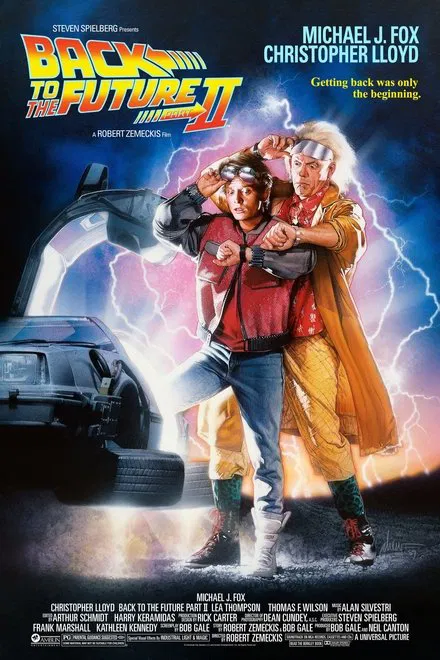
Back to the Future Part II (1989) Poster
BACK TO THE FUTURE PART II (1989) A–
dir. Robert Zemeckis

The first film tied everything up neatly. This one yanks the ribbon loose just to see what might fall out. Marty McFly (Michael J. Fox) and Doc Brown (Christopher Lloyd) rocket ahead to 2015, where cars actually fly, sneakers tighten themselves, and—believe it or not—the Cubs take the pennant. (Watching it now, that “future” feels less prophetic than the ’80s talking to itself in its sleep.)

Their mission seems straightforward. To stop Marty’s kid from getting thrown in jail. Nothing about a DeLorean ever stays simple.

It starts the way these stories usually do. With greed. Marty spots a sports almanac—fifty years of game results and a shortcut to fortune printed on glossy paper. But Doc doesn’t even let him finish the thought before book and the idea go straight into the trash can. But an older, creakier Biff Tannen (Thomas F. Wilson) overhears, and the next thing we know, he’s swiped the time machine and handed the book to his younger self. (Not coincidentally, right around the events of the first film—probably the moment his life went south, when George McFly decked him and walked away with the girl.)

Back in 1985, Hill Valley has gone toxic. The town’s been hollowed out by casinos and corruption, with Biff—rich, loud, basically Trump in a bolo tie—sitting smugly on top. To fix the damage, Marty has to slip back into 1955—all the while dodging the first film like it’s an obstacle course that he helped build. (If his earlier self sees his future self, the ensuing paradox might vaporize the entire universe. But that’s only worst-case scenario.)

It all sounds like too much movie when you try to map it out on paper: too many loops, too many Biffs, too little space for character. Zemeckis keeps the plates spinning, and somehow, none hit the ground.

The film works as both extension and replay of the original, but also as a sly satire of sequels themselves—how they can’t resist chasing their own tails. Most sequels just reheat the plot. This one literally watches the first movie play out again from the sidelines, and it feels like a brand new adventure. There’s something innovative in that.

Fox and Lloyd pick up like no time has passed. Fox is still a shining beacon of nervous charm. Lloyd’s a live wire, eyes bugging like he’s always looking three seconds into the future. But give this round to Thomas F. Wilson, who cycles through an entire gallery of Biffs and delivers one of the great comic villain performances of the decade.

This is a big, loopy, paradoxical pretzel—a dizzying funhouse that sends you out smiling while you turn over all its loops in your head.

Starring: Michael J. Fox, Christopher Lloyd, Thomas F. Wilson, Lea Thompson, Elisabeth Shue.
Rated PG. Universal Pictures. USA. 108 mins.
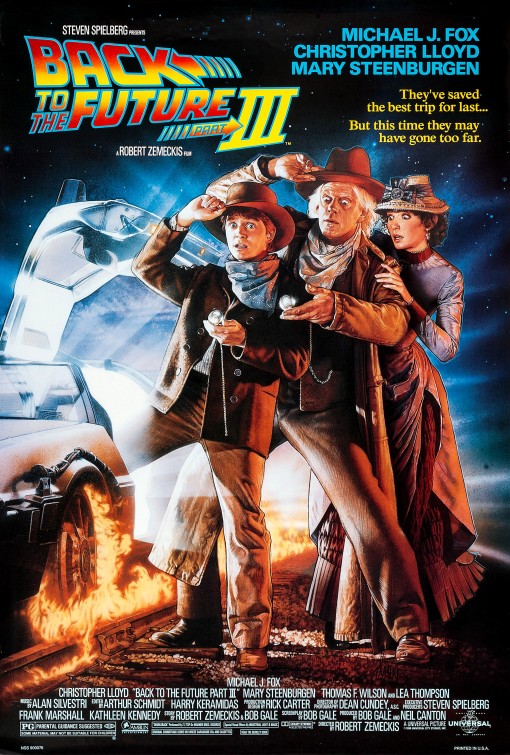
Back to the Future Part III (1990) Poster
BACK TO THE FUTURE PART III (1990) A–
dir. Robert Zemeckis

The future’s behind them now. This second and final sequel rides into 1885—into a world of dust, saloons, and suspicious stares. It’s not like the previous two films—not a strangely human drama or a delirious zigzag through alternate timelines. This one kicks back, relatively speaking. An affectionate nod to old Hollywood Westerns—except this time, the gunslingers share the frame with two endearing anachronisms and one beat-up DeLorean.

Doc Brown (Christopher Lloyd) has stranded himself in the Old West. Somewhere in the Hill Valley post office, a letter’s been waiting seventy years to tell Marty (Michael J. Fox) not to worry—that he’s happy, settled, ready to grow old among the tumbleweeds.

The trouble is, Marty’s got this photo: a tombstone with Doc’s name on it, clear as day. The date falls a week after the letter was written. That’s enough for him. He guns the DeLorean and sets its sights on 1885—a fine plan, until the century decides to push back. Where he’s going, the ground hasn’t even heard of pavement. The DeLorean hits the century like a bad landing—rattling over dirt and brush, coughing up sand. Somewhere behind the noise, hooves start to roll in. Native Americans fleeing the cavalry. One arrow punctures the gas tank, and fuel leaks into the sand. It’s 1885, decades before he’ll be able to drag the DeLorean to a gas station and fill it up.

Now both are stranded in the Old West, and Doc and Marty fall squarely in the sights of Buford “Mad Dog” Tannen (Thomas F. Wilson, hamming it up deliciously), an outlaw who’s never met a forehead he didn’t mistake for a bullseye. He thinks Doc owes him money, and he’s itching to collect it. Via the oldest method in town. Showdown.

In the midst of all the scheming and High Noon homage, the story turns. Doc gets a love story. Clara Clayton (Mary Steenburgen) rides into Hill Valley to teach school and nearly drives her wagon straight off a cliff. Into the same canyon that, in 1985, would bear her name. Not anymore, though. That fate rewrites itself the moment Doc pulls her to safety. What follows is a gentle, unforced romance between two sweet eccentrics. They’re bound by curiosity, Jules Verne, and the rare comfort of being understood.

It all builds to a high speed train finale, like a white-knuckle sprint straight out of an old runaway-train thriller, capped with one grand romantic gesture. It might not hit the pure catharsis of George clocking Biff in the first film, but it comes close. It’s the kind of ending that’ll knock the air right out of you.

The satisfaction isn’t just in the runaway train sequence, but in watching the characters finally become who they were always meant to be. Marty learns restraint. Doc finds wonder outside invention. And the future is finally their own. Doc’s departing thoughts to Marty and Jennifer certainly fall on the corny side of the spectrum, but they’re sincere and worth repeating: “Your future is whatever you make it. So make it a good one, both of you.”

Many call this the weakest entry in the trilogy, but don’t tell that to the part of my brain that lights up like Christmas lights whenever it’s put in front of films built on sheer, irrepressible fun. True, the film is a barrage of western clichés, but it has fun with it. I have fun with it. The runaway train sequence is a rush. The anachronisms are often funny. Call this a final burst of joy before everything goes quiet again.

Starring: Michael J. Fox, Christopher Lloyd, Mary Steenburgen, Thomas F. Wilson, Lea Thompson, Elisabeth Shue.
Rated PG. Universal Pictures. USA. 118 mins.
Backtrack (2015) Poster
BACKTRACK (2015) C+
dir. Michael Petroni

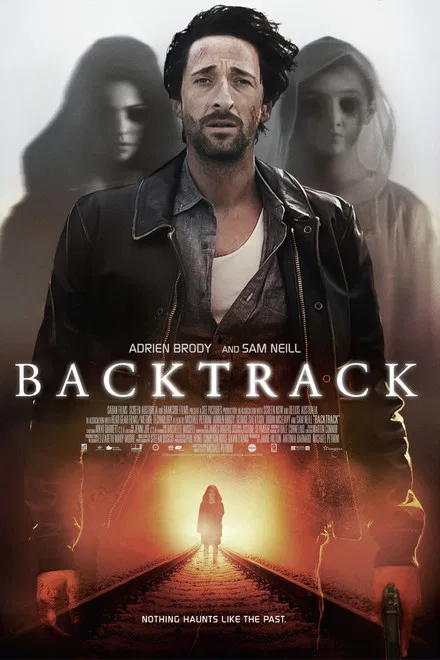
Peter Bower (Adrien Brody) is a psychotherapist who’s been working in a fogbank. The weight of his daughter’s death hasn’t lifted, and the new clients he’s been getting show up with faces that unsettle him for reasons he can’t explain. The moment they take the chair, there’s something that tightens in him. They are faces that he shouldn’t recognize but somehow—weirdly—he does. They’re like familiar faces that are attached to no memory.

Their stories don’t make it any less unsettling. They talk in ways that never quite add up. Details out of place, histories that feel wrong, conversations that seem to shift the longer they go on. Perhaps strangest of all is a young woman named Elizabeth Valentine, who shows up—small and pale—and simply writes “12787” on a piece of paper before she slips out again. (Be prepared for a prefab—and thoroughly ineffective—“wow” moment when the meaning of that number is finally revealed.)

Where Backtrack succeeds is in the unease. It’s the kind that leaks in slow and steady and gets darker and more mysterious as the oddities pile up. However, once the movie starts answering its own questions, it all of a sudden shrinks into something plain, almost ordinary. I would have much preferred a movie that offered no explanation at all to the one that this film eventually settles on. (Which I am not spoiling here, of course.)

Brody’s at least a prestige actor who keeps this rather middling thriller upright. He’s low and steady, and perfectly game to sit and stew into the weirdness without turning into a stunt. I would assume most actors would’ve tried to tidy their performance as soon as the film began explaining itself. But Brody doesn’t flinch. He keeps that dazed, haunted look—the expression of someone who knows better than to pretend the air around him hasn’t changed. It’s what gives the film—patchy as it often feels—a peculiar little charge underneath.

Call this a murky, sometimes striking little thriller, running on off-kilter rhythms and a sideways kind of dread that comes for you only after the scene has passed, like something brushing past you in the dark. There are moments in the buildup that actually glint with promise. But they dim fast when the movie starts connecting its own dots. It might’ve worked better if it had the nerve to leave a few threads dangling, rather than pulling every last one taut. While there are some scenes that are quite effective, what sticks afterward with me are merely pieces. Loose scraps of mood. Not so much the whole thing.

Starring: Adrien Brody, Sam Neill, Bruce Spence, Robin McLeavy, Jenni Baird, Anna Lise Phillips, Malcolm Kennard, Chloe Bayliss.
Rated R. Saban Films. Australia. 90 mins.
The Bad and the Beautiful (1952) Poster
THE BAD AND THE BEAUTIFUL (1952) A−
dir. Vincente Minnelli

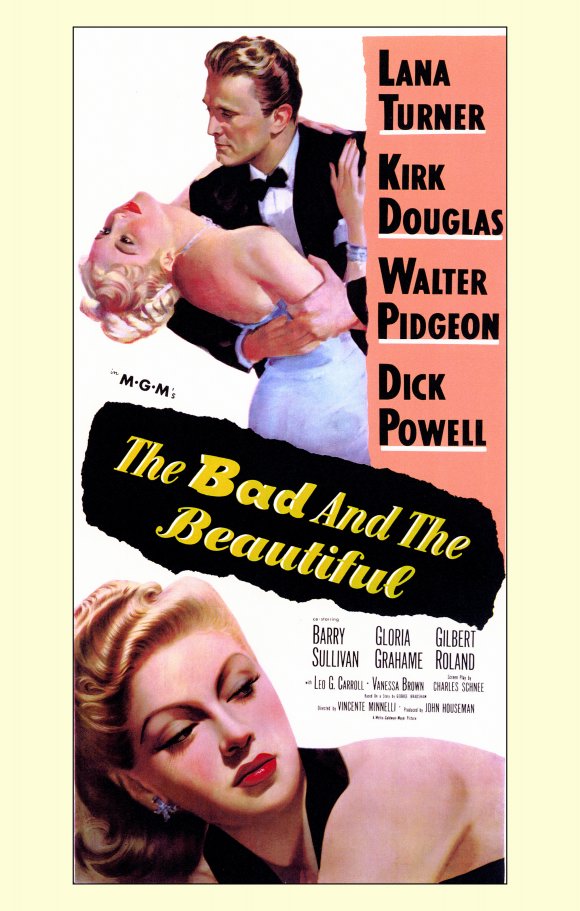
Hollywood is never happier than when it’s gossiping about itself, and The Bad and the Beautiful is among the juiciest the industry ever produced. This is prestige melodrama. An exposé that’s as mythologized as the myths it’s trying to puncture. Of course it’s fictional, but it doesn’t take a whole lot of imagination to see the shadows of real figures behind its inspiration. Director Vincente Minnelli knew this world inside and out and shoots the film like a confessional cocktail party—with every guest in whispers, eager to spill how they were betrayed, seduced, or trampled on in their sordid adventures through the industry. The central figure here is Kirk Douglas as Jonathan Shields—a producer with the vitality of a hustler and the conscience of a slot machine. He’s magnetic, he’s terrible, and he’s exactly the kind of man Hollywood has always been built on.

He’s introduced as the son of a disgraced mogul who was so hated that Jonathan had to pay extras to fill seats at the funeral. Shields is determined to make his own way, but still in his father’s footsteps—and to do better. Though “better,” it would seem, means more successful, more ruthless, and more charming in his betrayals. He scoops up a director, Fred Amiel (Barry Sullivan), who just happens to be one of the men he paid to stand graveside, and together they churn out low-budget programmers. They’re successful enough to start with, and then they start thinking bigger. A studio executive (Walter Pidgeon) supplies the money, but what Shields really trades in is people. There’s the fragile actress he romances and exploits (Lana Turner, in one of her least guarded performances), a writer he flatters into collaboration (Dick Powell), and that writer’s wife (Gloria Grahame), who strays into Shields’ orbit just long enough to be wrecked by it. (Grahame walked off with an Oscar for less than ten minutes of screen time—a brevity record that still holds.)

The film is structured as three bitter testimonials, each laying another brick in Shields’ reputation as both genius and vampire. Cinematographer Robert Surtees keeps the camera prowling through soundstages and dressing rooms as though hunting for skeletons. The result—or perhaps the residue—is a film that is both glossy and venomous. A celebration and an indictment. A movie about how movies get made—and about how people get broken in the process. MGM dressed it up as class, but really, underneath, it’s gossip with claws. Truly a must-watch (like, ASAP) for the Golden Age Hollywood aficionado.

Starring: Kirk Douglas, Lana Turner, Walter Pidgeon, Dick Powell, Barry Sullivan, Gloria Grahame, Gilbert Roland, Leo G. Carroll, Vanessa Brown, Paul Stewart.
Not Rated. MGM. USA. 118 mins.