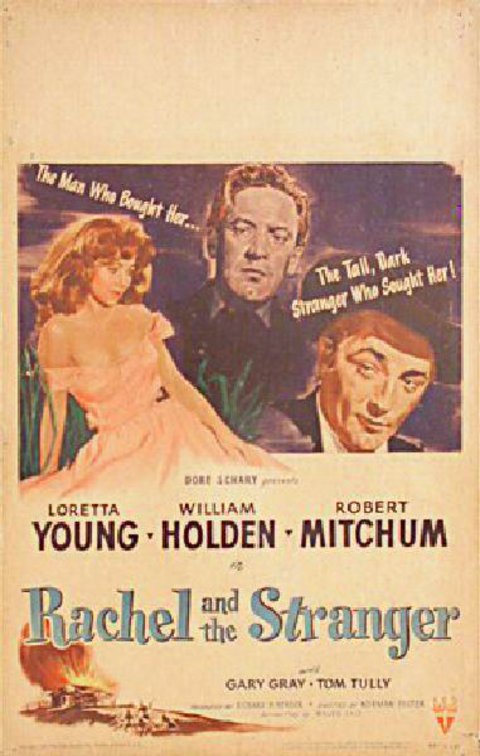
RKO wasn’t expecting much when they released Rachel and the Stranger. It’s a domestic frontier drama shot on a modest budget, adapted from a short story by Howard Fast. It was relegated to quiet programmer duty. But instead of simply slipping in and out of theaters with polite reviews and mildly satisfied audiences, it became the studio’s top-grossing release of 1948.
Credit the cast for this success. Robert Mitchum was red hot at the time, already having carved out his drifter persona—this film giving him another chance to flex his muscle as a mysterious outsider. Loretta Young was still at the height of her career, only a year away from her Oscar in The Farmer’s Daughter. Rounding out the love triangle was William Holden, still a few years shy of his star-making turn in Sunset Boulevard.
As this film is starting out, it feels like it’s going to play out as a traditional western. But it isn’t. It plays smaller and more intimate. It feels homespun and quietly charged. The love triangle premise feels less like a mechanical plot device and more like something that just happens when three people find themselves stuck under the same roof.
William Holden plays David Harvey, a recently widowed settler with one son (Gary Gray), who purchases the indenture of Rachel (Loretta Young). She is a soft-spoken woman working off her late father’s debts. David marries her—technically—but it’s more out of propriety than affection. Simply put, it wouldn’t seem proper if he were to share a cabin with a woman he wasn’t wed to. Rachel cooks, cleans, and schools the boy. Though the boy resents her presence. Of course, she’ll never be his mother, and he’s going to make sure that she knows it. Rachel finds that she doesn’t exactly relish this new role life handed her. But she doesn’t protest either. She shoulders it, quietly.
Then comes the disruptor: Jim Fairways (Robert Mitchum). He’s a scruffy, itinerant hunter who blows through their frontier homestead like wind through a smokehouse. He sizes up Rachel, flashes a grin, and makes himself very comfortable. David, predictably, stiffens. A triangle forms—hesitant, unspoken, but unmistakable. And just beyond the four walls of their cabin, another threat hangs in the air like dense moisture: the Shawnee. (Prepare yourself, of course, for more of Hollywood’s stock portraits of Native Americans.)
This isn’t a grand film—the modest budget makes sure of that—but it moves with the rhythm of a folktale. A frontier triangle pared to its essence: patience, pride, and desire circling one cabin by firelight.