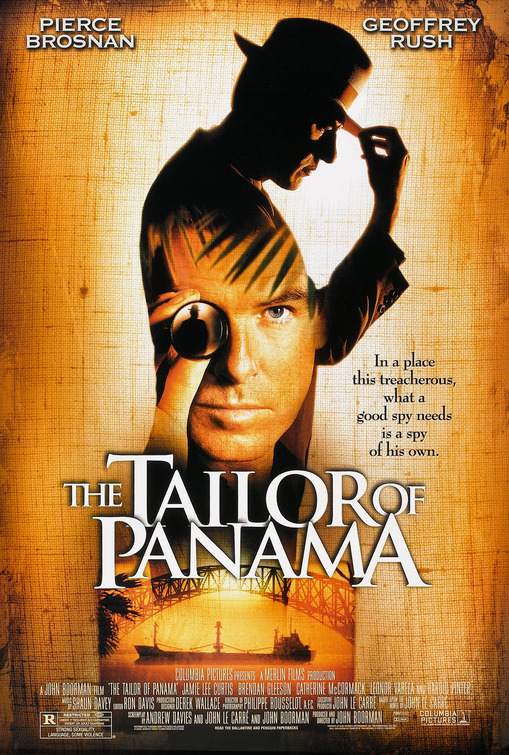
Some men lie to survive. Harry Pendel (Geoffrey Rush) lies because it’s something he’s good at. Pendel is a gifted tailor in Panama who made his name fitting power into silk. He also listens—to whisperings, to gossip, to state secrets he has no business knowing. He’s even known for passing that information along to other clients, though usually it’s been embellished as a way to flatter them. He’s a man who can’t stop talking, can’t stop fabricating, and can’t quite grasp what happens when a bedtime story lands in the wrong ear.
Then comes Pierce Brosnan, a British agent gone to seed—still in the suit, still selling the act. He eyes Pendel the same way a cat would eye a wounded bird: amused first, hungry second. He orders a few drinks, brings up a few debts, and suddenly Harry’s harmless gossip has become the subject of international intelligence. What began as bedtime stories for bureaucrats has swollen into a full-blown crisis. Pendel’s increasingly wild fantasies find themselves ricocheting through the Pentagon like bad wiring.
Rush gives Pendel the nervous charm of a man who bluffs on instinct. You can see how pleasure and panic often share the same spark—how each lie is a little victory and each truth a defeat. Brosnan seems to relish the opportunity to slice through his own Bond image. He’s charming, still lethal, but completely rotten underneath. A spy who’d sell out his own mother for an expense account.
Jamie Lee Curtis, as Pendel’s wife, brings a clean, no-nonsense intelligence to the domestic wreckage—watching, worrying, knowing exactly how far gone her husband already is. Brendan Gleeson drops in like trouble with a grin as Pendel’s alcoholic former revolutionary—many of his stories reappropriated by Pendel as his own. Even young Daniel Radcliffe—pre-wizard—wanders through as Pendel’s son. A small reminder of how easily the ordinary buckles once the lies start billing interest.
Boorman, who’s certainly no stranger to filming cinematic humidity (Deliverance, The Emerald Forest), shoots Panama like a city that has to exhale steam just to stay alive. The script, which he wrote with John le Carré, is cynical and well-plotted but just slightly on the dirty side of slick. The movie’s witty, tense, and brave in that rare way—unwilling to let anyone, or anything, off easy. Maybe it’s more brain than heart. But it’s sharp and close to top-shelf satire. When it laughs, it also bites. A political film that knows that truth doesn’t fade. It drowns. In paperwork.