This is a movie that prefers to speak in declarations instead of dialogue. Lines are spoken like they’re pounding on the table and throwing open the curtains. They feel like they’ve been waiting years to reach an audience. And maybe they have. After all, this is a movie about revolution, and revolutions usually take centuries to simmer before they ignite.
Britain is depicted here in full dictatorship mode. Its citizens are subjected to strict curfews, jackboot patrols, and a High Chancellor (John Hurt) who projects himself as a giant face across state-run broadcasts to bellow things about purity, order, and obedience. Every room is surveilled, torture is practically written in the law books—if they’re not outright written. In other words, this is a government that’s not subtle about its oppression. Freedoms must have been voted away long ago, bit by bit, until none remained.
This film is an adaptation of the Alan Moore comic, which had borrowed freely from George Orwell’s 1984. Then it added on top of that a decadent kind of theatricality and Victorian flourish—all spliced with the legend of Guy Fawkes. This film is a fable of masks, fire, and ritual cleansing.
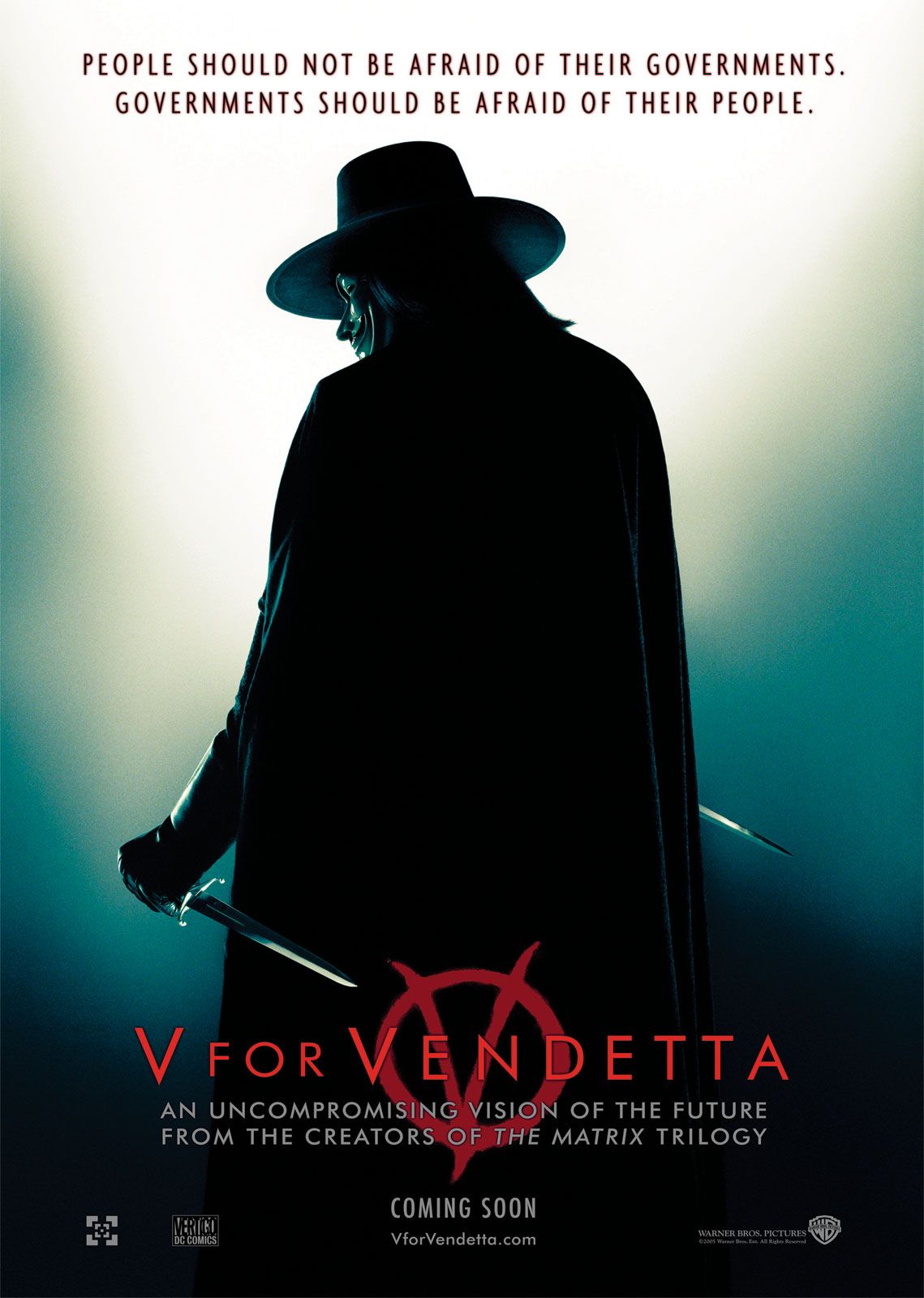
Hugo Weaving plays V, a caped phantom who adopts the Guy Fawkes mask—a fixed, porcelain face with pointed chin, curled mustache, and frozen smile. He behaves like a method stage actor. He remains fixed in a hyper-realistic character, romanticizing Fawkes and insisting with unsettling cheer that Parliament deserves nothing more than to be blown up.
Opposite him is Natalie Portman as Evey Hammond, a young woman who works at the state-run television network. She tries her best to keep her head down, but lapses when she is caught outside after curfew meeting with a coworker. She is about to be assaulted by secret police when V intervenes, dispatching them with knives and then sweeping her into his underground gallery. She’s not sure exactly what she’s stumbled into, and maybe V isn’t either, but she’s deep into it now. And there’s only going to be two outcomes: Either she breaks, or Parliament burns.
Visually, this film is composed and deliberate. Every frame is rich and feels designed to echo. The cast is great, particularly Portman, who tracks Evey’s hardening—going from timidity to resolve—and is extraordinarily convincing. Weaving makes even overwritten speeches ring. Stephen Fry, as a closeted talk-show host with an illegal taste for culture, brings warmth and spirit until his satire of the Chancellor seals his fate. And Hurt bellows tyranny so fiercely that it borders on horror.
If the movie has one flaw it’s that it hits the allegory too hard. If you’ll roll your eyes or be drawn into all of this, that’s up to you. The speeches often feel labored, the metaphors bright as floodlights, the ideas are repeated until they echo. But the commitment is total. V for Vendetta has conviction. It’s a movie that’s aiming for myth, not nuance—and more often than not, it hits its target.