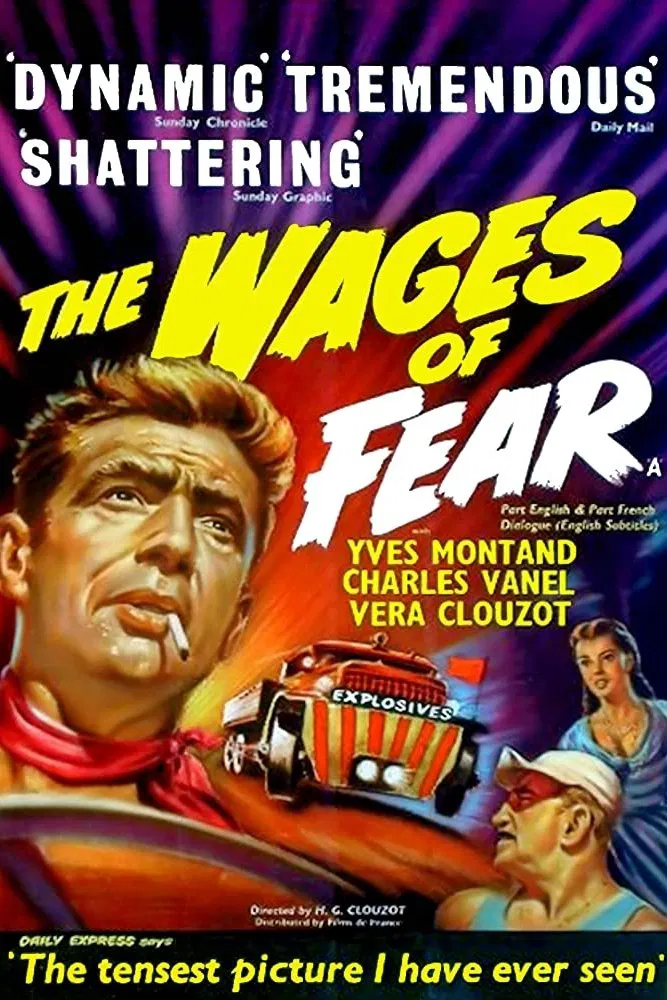
An existential thriller. A genre that by all reason shouldn’t even exist, but here it is. And maybe it's even the cleanest, purest screen representation of existentialism that was ever put to film. If that matters to you. If you were like me in high school and struggled to understand the concept. But if none of that matters to you, then that's fine as well. No question, this is among the most nerve-shattering thrillers you’ll ever see on your TV screen.
The setup takes its time. It takes place in a sweltering, dust-choked town somewhere in South America. A purgatorial company outpost where the flies buzz as part of the décor, and poverty wears through the seams of every shirt of the people sitting around in the bars and cafés, rotting in their own boredom, waiting for some excuse to be put to use. These people—mostly men, though a few women—are broken expatriates: French, Spanish, Italian. Whoever is willing to let the oil company use them for cheap.
Then there's an explosion at a distant oil field. The only way to put out the resulting fire is a bigger explosion. Enter four expendable men, two trucks, and enough nitroglycerin to wipe out the jungle. The money—$2,000 each—is almost insulting for a job no one is expected to survive. But it entices them. Some are thinking more about the payday than what it takes to earn it. Maybe some are thinking there might also be some kind of reward in a catastrophic failure. And the roads look designed to kill them. Hit a rock too hard and you're just a memory. Drive too slowly on corrugated ridges and the vibrations will cook you. There's one mountain pass so narrow that it feels like someone’s idea of a sick joke. And all this before you ever factor in suspicion, fear, the creeping sense that dignity and self-preservation rarely travel in tandem.
Mario (Yves Montand, confidence slowly hollowing out as his journey continues) teams with Jo (Charles Vanel), older, blustery, and with failing strength. Their odd-couple dynamic is almost as volatile as the cargo. One is driven by greed, the other oddly composed.
Once the drive begins, there's no music. All you get is engines, breath, and the sound of men realizing there's hardly room for any kind of error. Maybe no room even when doing everything correctly. Every scene feels like a test. And director Henri-Georges Clouzot offers no kind of relief. It starts as a simple job but becomes a slow, blistering unraveling of nerve and resolve—so relentless that even the prospect of success starts to feel like punishment. This is a film so tense that at times I caught myself forgetting how to breathe. And that's not because the suspense builds. It's because the suspense never lets go.