THE FADED SPOTLIGHT

by Michael Lawrence

List of "Q" Movies


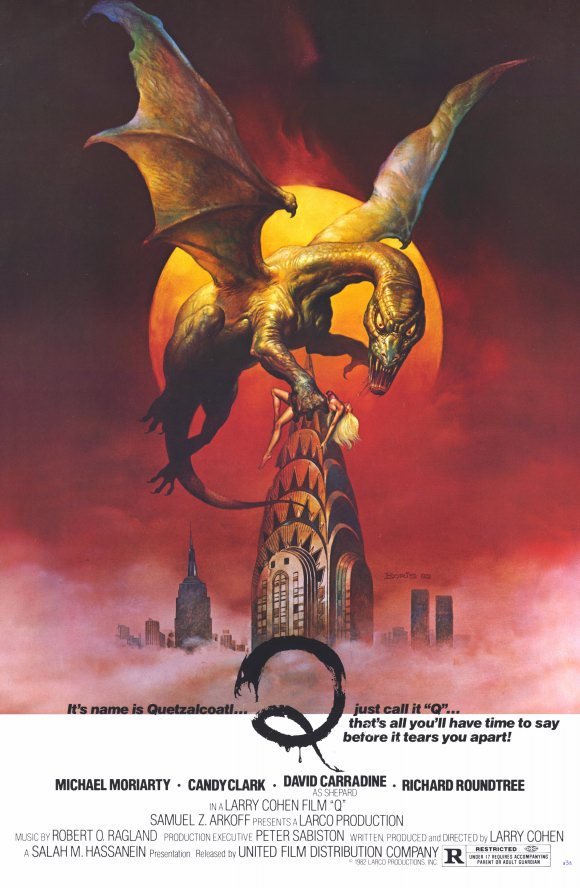
Q – The Winged Serpent (1982) Poster
Q – THE WINGED SERPENT (1982) B
dir. Larry Cohen

New York has survived blackouts, strikes, and serial killers many times over. But nothing can prepare it for the wrath of a clay pterodactyl that’s developed a taste for rooftop joggers. One minute you might be listening to the Bee Gees on your Walkman. The next, you’re nothing more than a blood spray and tomorrow’s headline. Imagine Toho by way of Times Square sleaze and you get Q – The Winged Serpent in a nutshell.

Jimmy Quinn (Michael Moriarty) is a two-bit hustler who—when he isn’t botching small-time jobs—moonlights as a jazz pianist. By dumb luck, he stumbles into the creature’s nest, high in the spire of the Chrysler Building. Most men in such a situation would panic, maybe even pray. But Jimmy sees opportunity. His plan: ransom the city. Trade silence for immunity. Maybe even secure a record deal as part of the agreement for spilling the beans on the creature’s hideout. Until then, let the god eat the joggers. Moriarty’s performance is quite funny—consisting of little more than babbles and sweat, like a man who just discovered booze and blackjack in the same afternoon. Nervous, wired-up, half in ecstasy and half in collapse.

Opposite Jimmy is David Carradine, who plays a detective tasked with keeping a straight face. Candy Clark turns up as his girlfriend, looking like she’s only hanging on in the relationship because she can’t find her favorite hairbrush and doesn’t want to lose it forever.

The monster is stop-motion, naturally. It’s herky-jerky and charmingly unconvincing. But the gore is surprisingly realistic, with victims flayed to the bone—sometimes mid-flight. One poor soul is discovered as nothing more than a meaty skeletal remnant and can only be identified by a charm bracelet. The special effects are crude but also weirdly effective. It all feels like a child’s nightmare filtered through a late-night cable haze.

Director Larry Cohen shoots this film fast and loose. This movie isn’t “good” in the conventional sense, but that’s also not the metric we’re working with. It’s a gleefully unpolished and unhinged throwback that works as an affectionate tongue-in-cheek take-off, but it’s also a pretty good monster movie in its own right. Genre fans—and anyone who’s ever wanted to see a clay pterodactyl terrorize Manhattan—will likely walk away from this satisfied.
Starring: Michael Moriarty, David Carradine, Candy Clark, Richard Roundtree.
Rated R. Larco Productions. USA. 93 mins.
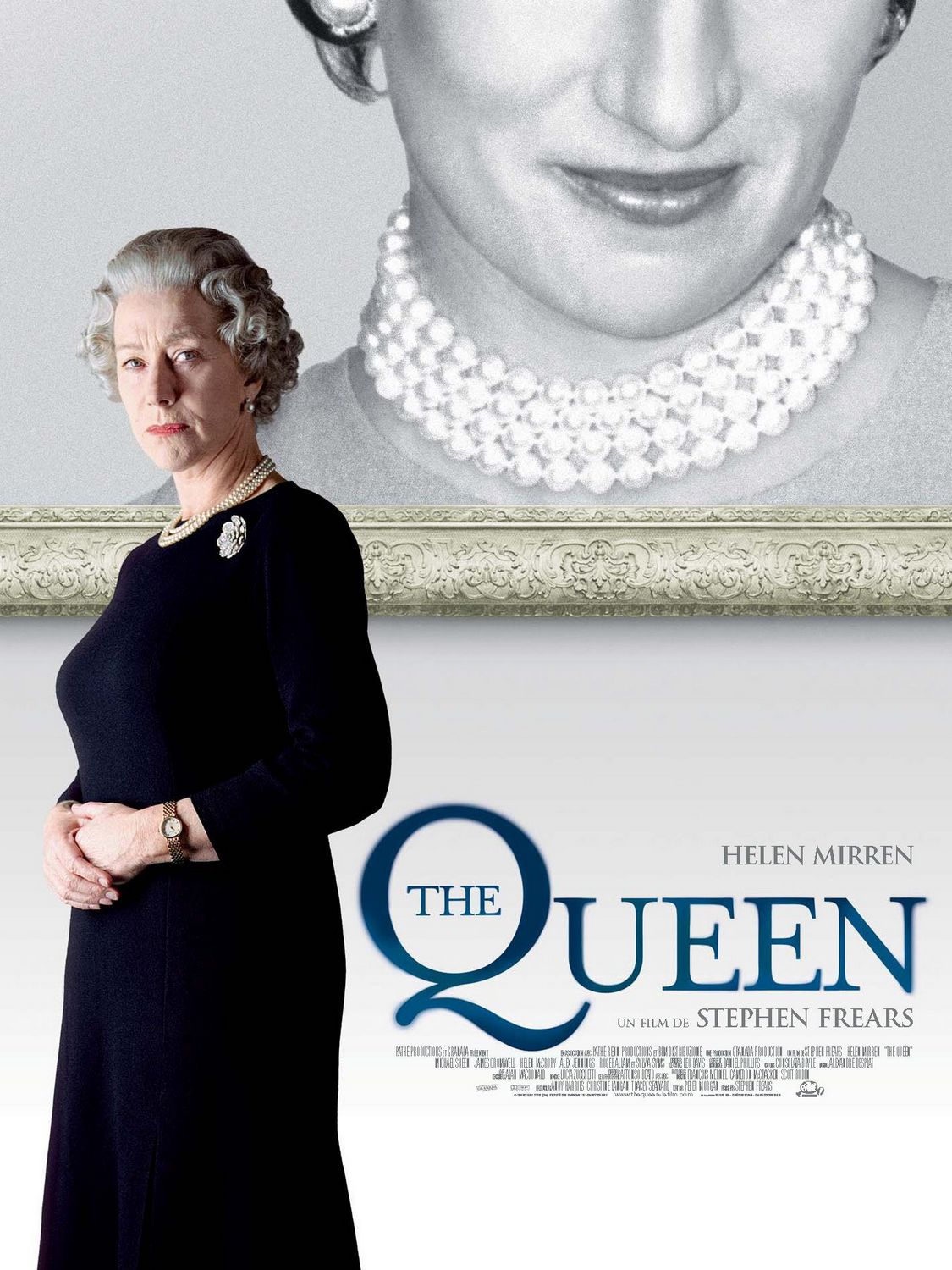
The Queen (2006) Poster
THE QUEEN (2006) B+
dir. Stephen Frears

The monarchy is designed for stasis—ritual, decorum, and the long game. That got turned on its side in the aftermath of Princess Diana’s 1997 death—an event that was sudden, messy, and uncontainable. When the news hit, the British people expected the monarchy to erupt in tears. What it got instead was silence. Not even a mention. There’s a good reason for that, of course. Diana—who was divorced from Prince Charles only a year prior—was no longer technically part of “the Firm.” And according to the rules of decorum, it would have been improper for the Crown to even mark her death—let alone publicly mourn it. But justifiable or not, such silence created a vacuum. And into that vacuum marched the tabloids and the anger. Even calls for the Crown to cease being altogether.

Helen Mirren is uncannily precise as Elizabeth II, playing the monarch as a woman bred to serve but allergic to spectacle. There was another reason she initially stayed quiet, having spent her life in uniform. She cut her teeth during World War II, having learned to suppress her personal feelings in the name of national resilience. But times changed. Her private instinct to retain that stiff upper lip now read as public indifference. And every minute she held out, the gulf between the Crown and country widened.

The counterpoint comes from an unlikely place: Tony Blair (Michael Sheen), the newly minted prime minister. He’s young, savvy, and not naturally sympathetic to the monarchy. But he’s nonetheless sharp enough to see what the Queen could not. That grief had to be staged. He had a proposal to dub Diana “the people’s princess.” The Queen stiffens. The public, of course, loves it.

Peter Morgan’s script is sly but reverent. It finds comedy in the Crown’s tight-lipped rituals, especially when it rubs up against tabloid frenzy. But it also doesn’t press too hard. There’s satire here, but it never cuts too deep. The film won’t exactly sanctify the monarchy, but it also can’t bring itself to dismantle it either. Perhaps out of admiration for Elizabeth herself. If there’s one impression I got from the film, it’s that everyone and their pet dog considers Elizabeth an admirable figure.

Mirren is the reason this all works as well as it does. She never lets her portrayal tip into caricature. You can see how Mirren is constantly micro-adjusting her performance—an arched brow, a pause before speaking, the smallest shift in posture. It all goes to subtly reveal the tension between the Queen’s instinct and obligation. Sheen, meanwhile, nails Blair’s blend of pragmatism and opportunism.

The Queen might ultimately be a film that feels a little too content to remain within the bounds of royalist empathy. But as a portrait of a monarchy that was forced—for once—to bend to public mood, it’s a fascinating piece. A well-made, absorbing, and remarkably entertaining biopic about silence, perception, and the curious theater of power.

Starring: Helen Mirren, Michael Sheen, James Cromwell, Sylvia Syms, Alex Jennings, Roger Allam, Helen McCrory.
Rated PG-13. Miramax. UK, France, US. 103 mins.
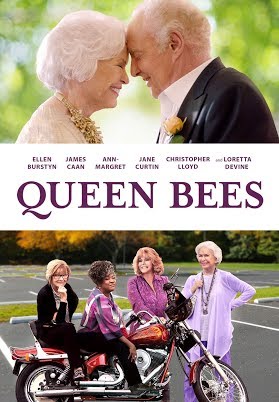
Queen Bees (2021) Poster
QUEEN BEES (2021) C
dir. Michael Lembeck

Mean Girls for the Medicare set. A good idea in spirit, but the comedy is so pudding-soft that it earns far more groans than smiles.

Ellen Burstyn plays Helen, a widow who still bristles at the word “retirement” and treats her daughter’s suggestion of her going into assisted living like it’s some form of elder abuse. But then Helen has to acquiesce that maybe her daughter has a point when she mistakenly sets her kitchen on fire. She manages to land a spot in a pleasant facility but only agrees to stay “just until the house is fixed.”

Despite her intention of not settling in, she ends up getting herself integrated into the facility’s ruling caste—three women with good hair, sharp card-playing skills, and selective displays of warmth. Jane Curtin is the de facto leader of the group and presides like a PTA president who never gave up her gavel. Tight-lipped, territorial, and allergic to nonsense. Rounding out the quartet are Loretta Devine, sweet and diplomatic, and Ann-Margret, who doesn’t flirt so much as emanate flirtation.

Then comes James Caan—here in his final screen appearance—looking slower now but still carrying himself like a man who once broke thumbs over gambling debts. He plays the love interest, though the courtship plays more like a game of tug of war between two lackadaisical fleas. That is, we see two grown-ups tiptoeing toward intimacy without so much as disturbing the furniture. Burstyn gives the thaw a lovely rhythm, but the film’s idea of emotional climax is a gentle squeeze of the hand and perhaps a shared scone. Christopher Lloyd shows up long enough to be confused, his character arc being his slow descent into memory loss. It’s briefly tender but ultimately unnecessary.

The movie is watchable, but it’s all too tame—aiming for easy resolutions and making sure that everyone has a tidy character arc. You watch the movie for the actors and not the story—and the film knows it. It keeps them moving, smiling, occasionally crying, but never far from a basic pastel tone. You watch that and feel glad these beloved actors got the work. You just wish the material had afforded them a little more bite.

Starring: Ellen Burstyn, James Caan, Ann-Margret, Jane Curtin, Loretta Devine, Christopher Lloyd, Elizabeth Mitchell, French Stewart.
Rated PG-13. Gravitas Ventures. USA. 100 mins.
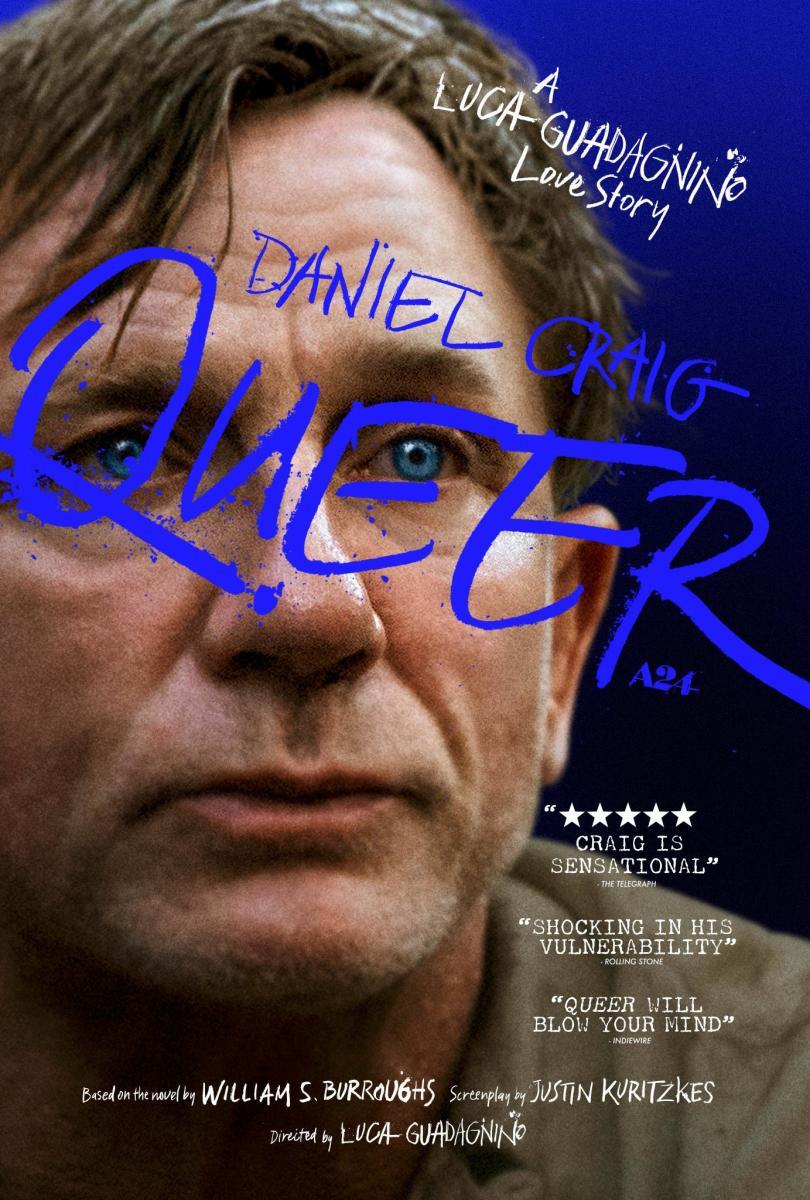
Queer (2024) Poster
QUEER (2024) B
dir. Luca Guadagnino

Like Naked Lunch before it, Queer takes a William S. Burroughs text that resists traditional storytelling and drapes it in dread, sweat, and fixation. The result isn’t a narrative so much as a compulsion. Daniel Craig plays William Lee, a fictionalized avatar of Burroughs himself. A poet (naturally) who is drifting through 1950s Mexico. His orbit: dim bars, rented beds, young men, and whatever hard drug he can get his hands on.

Lee becomes obsessed with Eugene Allerton (Drew Starkey), a handsome but aloof GI who gives just enough to keep him pulling. There’s sex, but little intimacy, which deepens Lee’s obsession. His drug addiction likewise accelerates, and he’s soon plunging into the South American jungle in search of yagé—a psychoactive vine rumored to grant telepathy. Or failing supernatural powers, perhaps at least it would obliterate whatever rational basis of perspective he still has left.

Craig is quietly terrific in this. Shambling and needled—a man trapped in heat and rot trying to convince himself that he doesn’t need other people. It’s a beautifully made film, even if it’s frequently difficult to look at. Cracked ceilings, dreary jungle mist, bodies filmed like oil paintings left too long in the sun.

Whether Queer works depends on your appetite for films that feel more like symptoms than stories. It’s not funny, not especially pleasant, and also doesn’t concern itself with charming its audience. But it’s also committed, and for those willing to tune into its wavelength, this can be a rewarding—albeit not one to take lightly—watch.

There’s artistry here, and a kind of grim poetry. A film to be admired more than embraced. It reaches your brain—but what you do with it from there is anybody’s guess. A movie for anyone who finds meaning in feverish depictions of self-destruction and unreciprocated desire.

Starring: Daniel Craig, Drew Starkey, Jason Schwartzman, Lesley Manville, Henry Zaga, Drew Droege, Ariel Schulman, Colin Bates, Ronia Ava, Omar Apollo.
Rated R. A24. USA/Italy. 137 mins.