THE FADED SPOTLIGHT

by Michael Lawrence

List of "E" Movies


Enchanted (2007) Poster
ENCHANTED (2007) B+
dir. Kevin Lima

The miracle of the Disney-produced fairytale parody Enchanted is that it has one joke and the sheer hubris to run it straight into the ground. By all accounts, it should have run out of steam by the 40-minute mark. Instead, it catches a second wind. Its secret must have been in the balance. On one hand, this is a relentless mocking of fairytales. On the other, it falls a little bit in love with them.

It all starts in a land called Andalasia—a pastel kingdom where woodland creatures do chores, songs erupt without warning, and marriage proposals are about as common as coffee refills. Basically, every Disney reflex crammed into one sugar rush. Giselle (Amy Adams) lives in a treehouse that looks like a vanilla cake exploded inside it. Her dream of marrying Prince Edward (James Marsden) comes easier for her than it is for most people buying a loaf of Wonder Bread. They meet. They sing. She doesn’t even check the expiration date. That’s love.

But there’s trouble. Their wedding’s minutes away when Edward’s stepmother, Queen Narissa (Susan Sarandon), decides that she’s not interested in surrendering her crown—or her magic—both of which will vanish as soon as he marries. So she does what any evil stepmother would: shove the bride down a wishing well that, for reasons best left unexamined, opens straight into Times Square.

Giselle bursts out of a manhole—flesh and blood now—in full wedding regalia, blinking at the neon lights like the city’s been cursed. Yet Giselle’s fairytale optimism crashes headfirst into urban indifference, because she doesn’t know any other way. Of course, all of this is hysterical thanks to Adams, who never drops the act. She’s so sincere, even, that you stop laughing at her and start believing her.

An intuitive little girl (Rachel Covey) eventually spots this lost, luminous princess and brings her home to her dad, Robert (Patrick Dempsey)—although he probably wishes (at first, anyway) that she’d brought home a mange-ridden cat. He reluctantly lets her stay, but at the back of his mind is probably deciding who he should call first should things get out of hand: a therapist, a priest, or pest control.

Pest control might have been his best bet, although he (nor anyone else) has ever seen pests do quite what Giselle has them do. In what’s easily the film’s most memorable scene, she calls for bluebirds and butterflies to help clean Robert’s apartment, but Manhattan instead sends rats, pigeons, and cockroaches. Close enough—they not only get the job done, but they have a song and choreography to go with it. Meanwhile, Robert’s girlfriend, Nancy (Idina Menzel), watches in disbelief as her boyfriend starts his inevitable journey of falling for a woman who talks to pigeons.

The movie takes on predictable plot beats from there. Naturally, the love triangles you’ve noticed forming start to sharpen. There’s exactly the third-act danger you’re expecting. And then happily ever after. But this is a movie that plays by the rules while also poking fun at them—you’re laughing at it and quietly believing in it, too.

And there’s no doubt princess-obsessed little ones loved this enough to watch it until the DVD melts. Parents probably found themselves laughing more than they meant to. And for everyone else—those half-wary of Disney’s sugar rush—there’s a good reason to at least let this one drift through the living room some evening. It believes in true love, but only after watching it trip over a turnstile.

Starring: Amy Adams, Patrick Dempsey, James Marsden, Susan Sarandon, Idina Menzel, Rachel Covey, Timothy Spall.
Rated PG. Walt Disney Studios Motion Pictures. USA. 107 mins.
Encino Man (1992) Poster
ENCINO MAN (1992) C+
dir. Les Mayfield

The premise: a caveman wakes up in Encino, California, and within days he’s chugging Slurpees, pop-locking to house beats, and somehow passing driver’s ed. It’s the kind of setup that should’ve been delirious—off the rails, manic, anarchic. A caveman let loose in suburbia. Terrorizing neighbors. Hunting cats. But what we get instead feels like a mad science experiment gone accidentally right—one where the subject simply refuses to misbehave.

Sean Astin, diligently humorless, plays Dave—a high-school nobody who finds the caveman (Brendan Fraser) frozen in a block of ice while digging a pool in his backyard. (Don’t ask.) When he sets him out to thaw—and he does thaw, very much alive—Dave convinces himself that this cheerful anthropological find might finally make him popular, maybe even get him the girl. (Again, don’t ask.)

Pauly Shore turns up as Stoney, Dave’s best friend—a sentient lava lamp whose vowels stretch so far they forget what word they started as. They name the caveman Link, short for “Missing,” and start planning his debut. But Link doesn’t need handlers. He becomes the coolest kid on campus before they’ve even figured out how to explain him.

I’m still not sure whether it’s clever restraint or pure cluelessness that the movie manages to dodge nearly every fish-out-of-water gag it sets up. Instead of trying to eat the teacher, Link skateboards, picks up slang like a sponge, and dresses like an MTV extra. It’s assimilation so smooth it’s almost disappointing. Apparently Los Angeles’ melting pot is strong enough to bridge millennia.

There’s some entertainment value here. It’s still a cult favorite, and its fans aren’t entirely wrong. It’s good for kicks—for a little cheeky, dumb fun. But the movie loses me completely when it retreats into recycled high-school tropes: Dave sulking over a girl, learning lessons about self-acceptance, blah blah blah. This stuff takes over so completely that by the third act, the caveman story feels like decoration.

But it’s all amiable. Fraser breezes through his performance, and Astin’s fine in his square way. Pauly Shore, though, steals the show—or what’s left of it. Even as a sidekick—and even as most audiences groan at him—he’s a living relic of early-’90s weirdness, bouncing through scenes like a helium-puffed glitch. Obnoxious but awake. And I laugh. The movie around him unfortunately is mostly forgettable—apart from I suppose the goofy audaciousness of the premise. But for something about a wild man, this is disappointingly tame.

Starring: Sean Astin, Brendan Fraser, Pauly Shore, Megan Ward, Robin Tunney, Michael DeLuise, Patrick Van Horn, Dalton James, Rick Ducommun, Jonathan Quan, Mariette Hartley.
Rated PG-13. Buena Vista Pictures Distribution. USA. 88 mins.
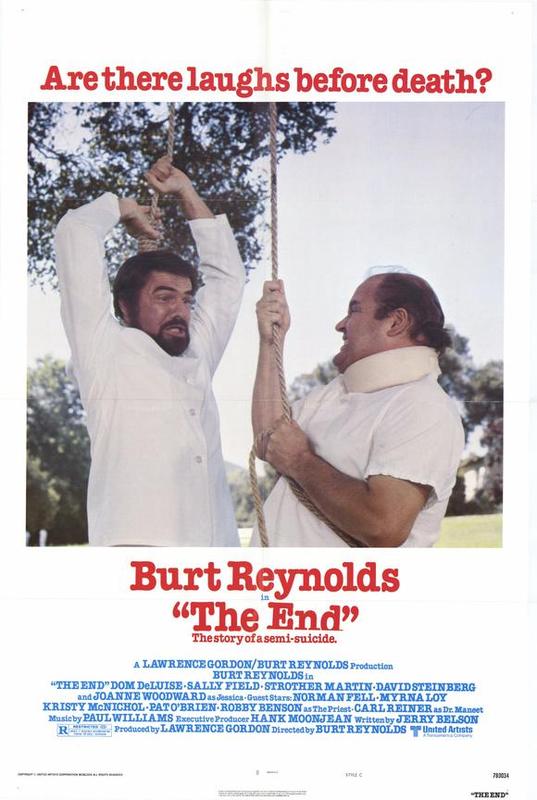
The End (1978) Poster
THE END (1978) B
dir. Burt Reynolds

Wendell (Burt Reynolds) gets bad news. Maybe the worst of his life. He’s dying. There’s something rare and incurable, lodged somewhere in the blood. The doctor gives him a year. Wendell decides that’s a year too long. Why wait around, watching Death take its sweet time? Better to call it himself. That’s right, folks: suicide. The only problem is, he’s awful at it. Every attempt detonates in his face.

Strange movie. Even for the late ’70s. A suicide comedy, directed by Burt Reynolds—America’s suntanned god of grin and mustache. It was his second time behind the camera—after 1976’s Gator. He liked the script so much he volunteered when others passed. The studio said fine, but you’ll make Hooper next. Call it a good trade for the studio. Because both films cleaned up—making around ten times their budgets. Not bad for a pair of pictures about death and broken bones.

The opening scenes are a bit tough to watch. Reynolds, sobbing on bathroom tile, begging for more time. It’s not so much that the scene’s bad, it’s just hard to buy the meltdown from a man who practically defined swagger. Watching him come apart like that is like watching a statue get a runny nose.

Wendell shifts from grief to mischief, and suddenly the movie steadies itself. It’s grim but never heavy. His botched suicide attempts stack up, as he mostly tries the usual things. He overdoses on pills, but he panics and calls emergency services. He tries carbon monoxide poisoning, but his car stalls in the garage. He tries to drown himself in the ocean, but lifeguards save him. Every one a failure. Every one also a punchline. At one point he is admitted into a mental hospital where he collides with the eminent Dom DeLuise—a one-man demolition team who can wreck scenes beyond recognition and yet somehow make them come out looking cleaner. Wendell makes the mistake of asking this maniac for help. What he gets is a man who treats murder like a parlor trick and violence like recreation. He’s loud. Needy. Gloriously unhinged. Reynolds is able to keep up with him (very much to his credit), though barely.

Sally Field shows up briefly as Wendell’s mistress—concerned, lovely, but there mostly to remind us that she was also in Smokey and the Bandit. Everything else looks too bright for the premise. Flat light. Cheerful music. Sets that feel more suited to a standard studio comedy, which makes it feel like this film dabbled into gallows humor without thinking about how it might come off. Malpractice, euthanasia, suicidal ideation—tossed out like bits in a sketch. I found it quite funny. I laughed plenty of times. But it also comes off a bit throwaway. The movie isn’t chasing meaning any more than a standard sitcom does, and it’s not especially clever either. It’s mostly just content to make death the gag. Toss off a few punchlines, make a silly face, and then saunter its merry way to the end credits.

Not everything lands. A lot of it doesn’t. But the movie never slows down—like it’s trying to brush over its own mood swings. Reynolds isn’t after prestige. Or logic. This movie is quick, cracked, and lands somewhere between a breakdown and burlesque. Oddly satisfying, though—especially if you like your comedies black as tar. A movie that might make you laugh, wince, laugh again, and then make you second-guess if you should have laughed at all.

Starring: Burt Reynolds, Dom DeLuise, Sally Field, Joanne Woodward, Norman Fell, Carl Reiner, Myrna Loy.
Rated R. United Artists. USA. 100 mins.
The Endless Summer (1966) Poster
THE ENDLESS SUMMER (1966) A−
dir. Bruce Brown

Two surfers. One camera. A dream to chase the perfect wave. Mike Hynson and Robert August leave California with their boards, passports, and the kind of casual optimism that only works when you’re too young to doubt it. The plan’s ridiculous but also kind of beautiful. His plan: to follow the sun across the planet until the seasons stop mattering. After all, it’s always summer somewhere. And wherever it’s summer, there’s another coastline waiting to be explored. They head for Ghana, South Africa, Australia, Tahiti—riding waves few outsiders have ever seen, let alone touched.

Bruce Brown, who never appears on camera, was a surfer himself, and this was his passion project. Shot on a shoestring—mostly 16 mm with no sound, the surfers paying their own way around the world—it’s as handmade as documentaries get. Beautifully filmed despite the low budget. The waters are azure, the sand golden, the sunsets a burnt orange.

Brown recorded the narration later. His voice is easy. Amused. Unhurried. The sound of someone telling a story too good to rush. Like listening to a friend relive his travels—you hang on every word. It’s infectious. He points out things that most other filmmakers doing a documentary would miss (things that happen while they’re waiting, locals looking on at the surfers with bemusement, dragging their boards through the sand). He finds humor in repetition, reverence in the mundane. The way a wave folds over itself. The way surfers can make exhaustion look like triumph.

The Endless Summer plays like a daydream—of freedom, ritual, motion, and the small joys that make it all feel endless. For surfers, this film has become gospel. Something like a creation myth for wave-chasers. But even if you couldn’t tell a shortboard from a door plank, this is hypnotic.

Not a flawless film, though. Some of Brown’s jokes hit wrong these days—in particular a bizarre comparison he makes between marine life and South African apartheid. But these are merely fleeting clangs in a film that’s otherwise characterized by irrepressible wonder.

The Endless Summer captures the best and strangest parts of mid-century American dreaming. The idea that happiness can be hunted down if you just keep moving. Not only is this film about surfing the world, it’s also about chasing youth, chasing sunlight, and chasing a dream before it disappears.

Starring: Mike Hynson, Robert August.
Not Rated. Cinema V. USA. 95 mins.
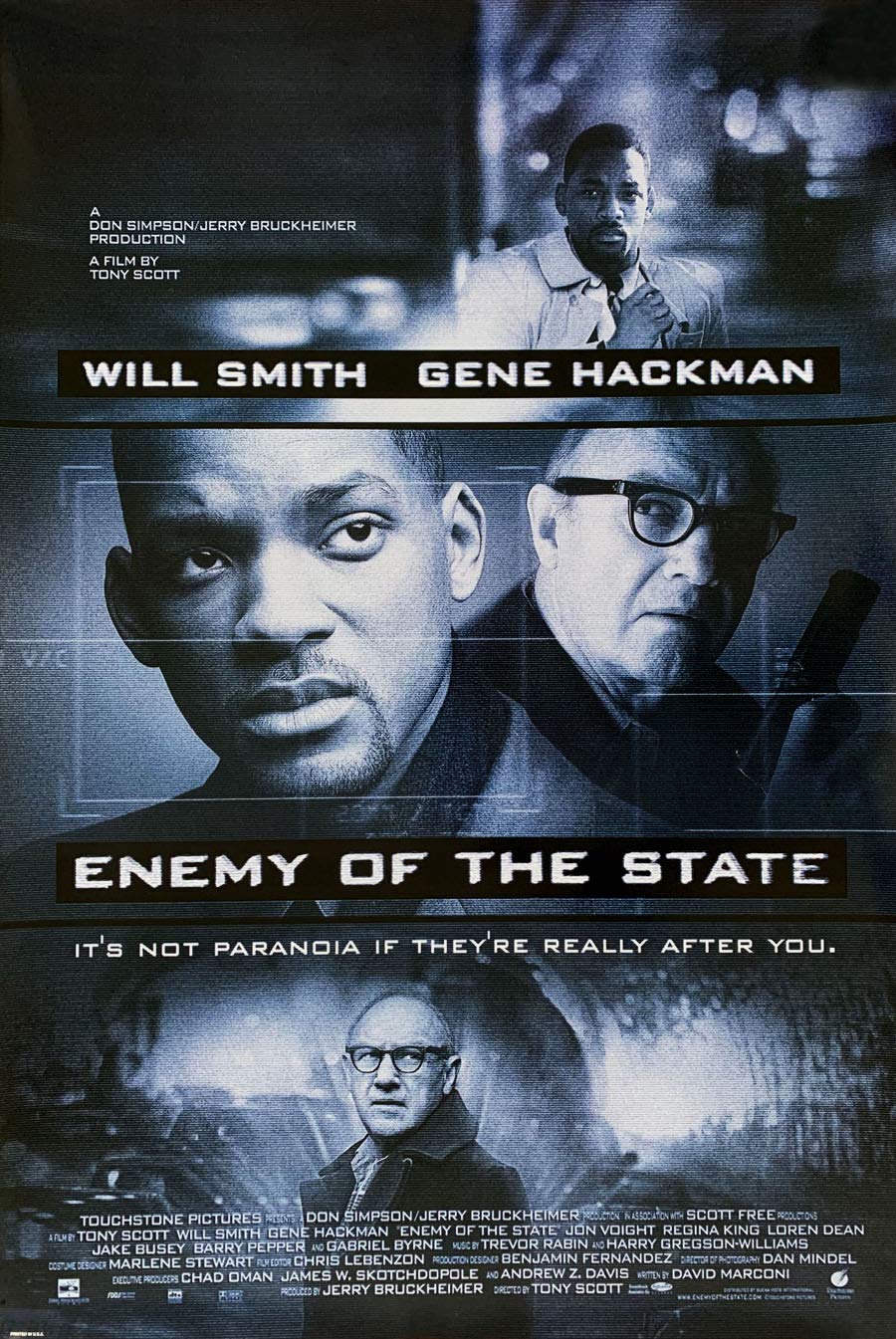
Enemy of the State (1998) Poster
ENEMY OF THE STATE (1998) B−
dir. Tony Scott

A high-gloss surveillance thriller that mistakes escalation for suspense. Enemy of the State has energy to burn. It crashes through traffic. Satellites go flinging across the screen. But the noise outpaces the tension as it keeps stacking plot on top of plot until neurally the whole thing collapses into a heap of slick, overheated nonsense. Still—I said it’s slick.

Will Smith plays Robert Dean—a D.C. labor lawyer with a good suit, a good life, and no idea both are about to vanish. One chance encounter with a man on the run (Jason Lee), and he ends up unknowingly carrying a videotape containing footage of a congressman’s assassination. Within hours, Dean’s accounts are frozen, his house bugged, his reputation torched. Then every acronym in Washington seems to come swarming in after him—through malls, alleyways, and rooftops.

The agency behind all of this is a rogue wing of the NSA (Jon Voight). He’s cool, sharp, and visibly tired of the Constitution, and his idea of diplomacy is deletion. That is, he decides Dean knows too much and must be eliminated. Even though Dean doesn’t know anything at all. Then Gene Hackman comes in as Brill—a role that immediately strikes you as an echo of his character in the classic 1974 film The Conversation. He plays a gruff surveillance ghost with a bunker full of obsolete tech and a bone to pick with the government.

Hackman gives the movie its backbone. Smith gives it pace. But the story keeps overreaching. The script can’t resist another twist, another cutaway, another faceless agent barking into a headset. The plot turns aren’t confusing as much as they’re constant. And the movie drags. There’s no reason this should cross the two-hour mark.

Still, it holds together more often than it doesn’t. The chase scenes hit. The surveillance gimmicks have flair. The cast keeps straight faces and resists the urge to oversell the tension. It’s certainly a bloated film, but it has a good pace. And in a movie this overstuffed, momentum can make up for a lot—including clarity.

What’s striking now is how much of Enemy of the State has stopped looking like fiction. Post–Patriot Act, post-Snowden, this isn’t shocking anymore. It’s more like Tuesday.

Starring: Will Smith, Gene Hackman, Jon Voight, Lisa Bonet, Regina King, Jake Busey, Barry Pepper, Jason Lee, Tom Sizemore, Jason Robards.
Rated R. Touchstone Pictures. USA. 132 mins.