THE FADED SPOTLIGHT

by Michael Lawrence

List of "G" Movies


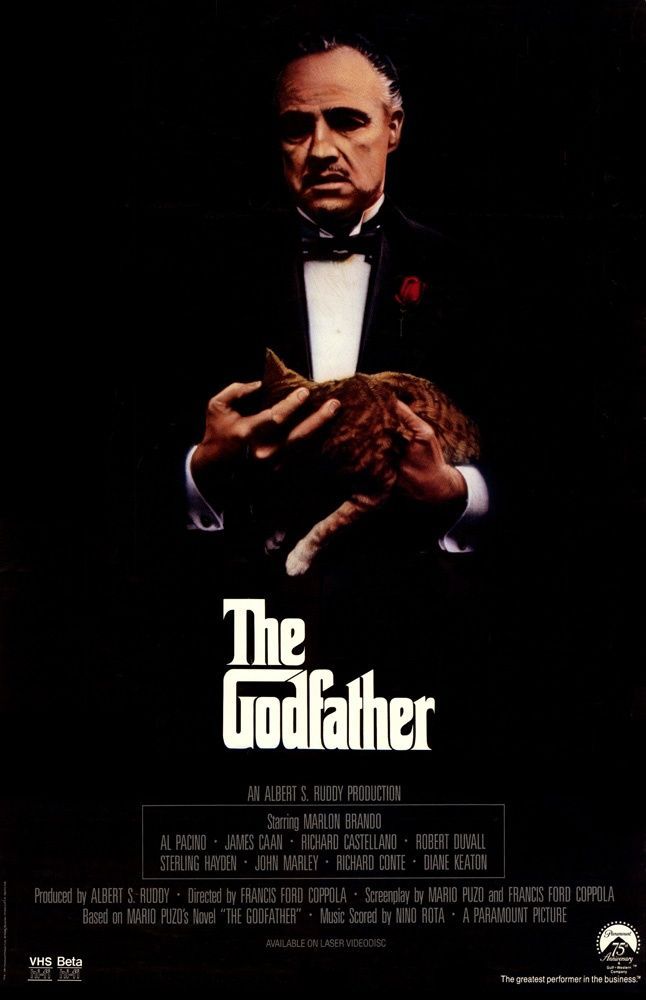
The Godfather (1972) Poster
THE GODFATHER (1972) A
dir. Francis Ford Coppola

The Godfather isn’t about a dominant crime family as much as it’s about the system that keeps the family dominant. Power in this world isn’t earned. It’s inherited. It’s passed down like a family heirloom. Maybe even a curse. Coppola takes what could’ve been pulp and strips it down to ritual. This is a study of power. About how once you hold it, even silence starts to fall in line.

Marlon Brando’s Don Corleone doesn’t project power. He absorbs it. People bend before they even realize they’re bowing. His authority is quiet, almost mournful—the voice half-gone, the words barely breathed. Orbiting closely around his gravitational pull are his children. Sonny (James Caan) is pure reaction—fast, furious, doomed by impulse. Fredo (John Cazale) fades in the fringes, a man who seems to have the word “failure” imprinted on his bones. The youngest Corleone, Connie (Talia Shire), begins the movie in a wedding gown and ends it steeped in grief. A union forged in lace but terminated in blood. Tom Hagen (Robert Duvall) plays the rational middle child—though he’s adopted. He doesn’t technically carry Corleone blood of his own, but he’s become a lawyer fluent in Corleone blood.

But the reluctant center of it all is Michael (Al Pacino). He begins the film as an outsider to his own family but ends it as their new cold-blooded leader—a clean, polite war hero who had so far been kept out of the family business. He was the Corleone who was supposed to be unspoiled and privileged—the one who’d represent the family respectably. But he becomes the only viable successor to take over the Corleone empire. He proves it at a small Italian restaurant. He walks into a meeting with the men responsible for killing one of the Corleones—men trying to extend an olive branch. But Michael chooses instead to avenge his family. Coronation complete.

Coppola builds the film like a strategist. Each scene feels deliberate. Weddings, meetings, baptisms play like rituals. Every time someone in the family moves, you can sense how the others are wondering how that might affect the endgame. There’s violence, but it isn’t for show. It’s logistics. Even the infamous horse’s-head scene, while shocking, is more like a memo written in blood. A Corleone wanted a prestige role in a film, and the horse-aficionado director was refusing. Now, he wasn’t.

One of the film’s defining moments is the baptism montage. But it isn’t meant to underline the irony of a crime family embracing religion—even if we can duly note that contrast. It completes the circle of devotion. The line between prayer and murder is one that simply doesn’t exist.

The movie’s a tragedy, but that isn’t because Michael loses his morality and turns dark and ruthless. It’s because the world gave him no other alternative. In the film’s final shot, Michael is seated and silent, the door closing on his increasingly estranged wife’s (Diane Keaton) gaze. And we realize everything we need to know about the true nature of inheritance—that it isn’t just something you take from your ancestors. It’s what decides your very nature. We don’t watch The Godfather to see a fall from grace. We watch it as an argument that grace was never built into the system.
Starring: Marlon Brando, Al Pacino, James Caan, Richard Castellano, Robert Duvall, Sterling Hayden, John Marley, Richard Conte, Al Lettieri, Diane Keaton, Abe Vigoda, Talia Shire, Gianni Russo, John Cazale, Ruby Bond, Al Martino, Morgana King, Lenny Montana.
Rated R. Paramount Pictures. USA. 175 mins.
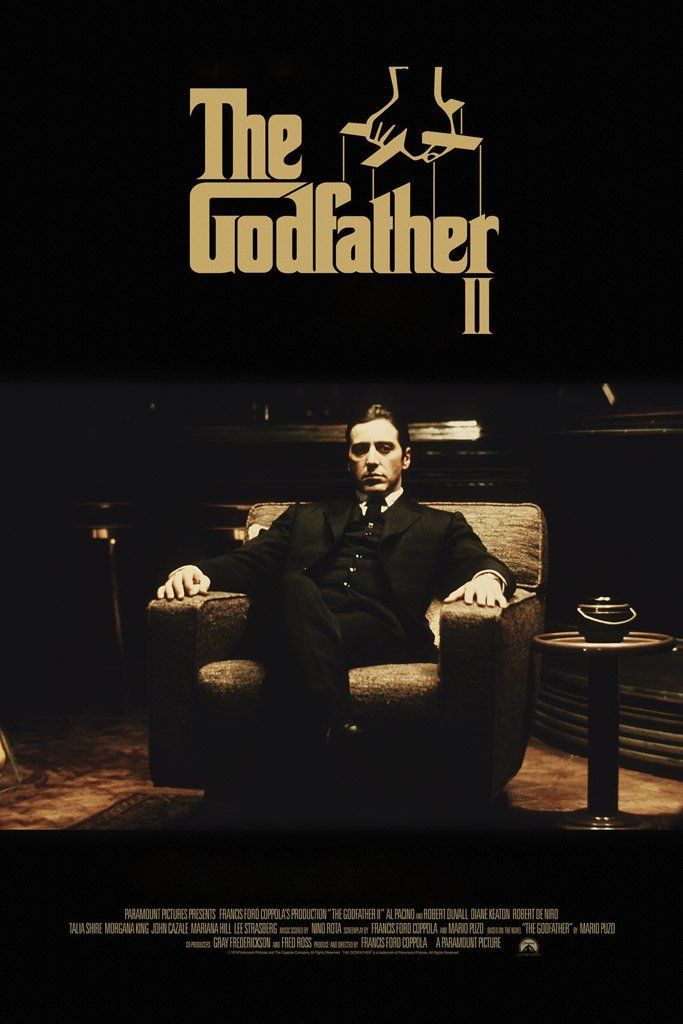
The Godfather Part II (1974) Poster
THE GODFATHER PART II (1974) A
dir. Francis Ford Coppola

Lightning doesn’t just strike twice, it digs in deeper—and leaves a wound that doesn’t quite heal. The Godfather Part II isn’t just a sequel. It’s an expansion and a descent. A widening of the lens that somehow pulls everything closer. It spans seventy years, layering memory and consequence until time itself feels corrupted. If The Godfather dissected the machinery of power, this one counts the cost.

This is a movie told in two parts—both moving in tandem like they’re chasing the same slow curse. Michael Corleone (Al Pacino) sits at the top now, trying to turn sin into strategy, blood into balance sheets. The move is westward—from New York’s cramped backrooms to the velvet glare of Las Vegas. He trades shadows for chandeliers, but the game doesn’t change. It just looks better dressed. If anything, the rules have gotten harsher and the betrayals are cutting deeper. And Michael’s stiff-backed disposition and dark, calculating eyes do nothing but harden as the film goes on. By the end, he’s more figure than man, trapped inside who he’s become and the silence that comes with it.

And then, the past. Vito’s story, unfolding like a memory Michael doesn’t even know he has. Each one of Vito’s steps forward mirrors the present, with his son’s slow unraveling.

We are taken back to New York, 1901. Vito Corleone comes to America as a frightened child. He’s alone and has nothing except his name. He doesn’t speak English. But he grows up (Robert De Niro). He’s legitimate at first, working in a small grocery. He’s quiet but observant. He sees how the mob power structure works and how he can slink into it. And his rise is methodical and efficient. Violence is not a statement but a necessity.

The first film played like a chess match. This one grinds you down. Slow erosion. Power eating through what’s left of Michael’s soul. He sits high, above everything his father built—untouchable, unreachable, already gone. The last image says it all: Michael alone, face blank, nothing human left. Just silence. The production values exceed even its predecessor, every frame so thick with detail that every shadow seems to hold a story. Certain moments feel endless, with spaces to sink into and absorb. There’s a still poetry in every shot.

While the movie isn’t as viscerally thrilling as the first, the intrigue runs deeper. The weight heavier. It’s a time investment but the kind of movie that rearranges your molecules.

Starring: Al Pacino, Robert Duvall, Diane Keaton, Robert De Niro, John Cazale, Lee Strasberg, Guiseppe Sillato, James Gounaris, Tere Livrano, Bruno Kirby, Gastone Moschin, Leopoldo Trieste, Talia Shire.
Rated R. Paramount Pictures. USA. 202 mins.
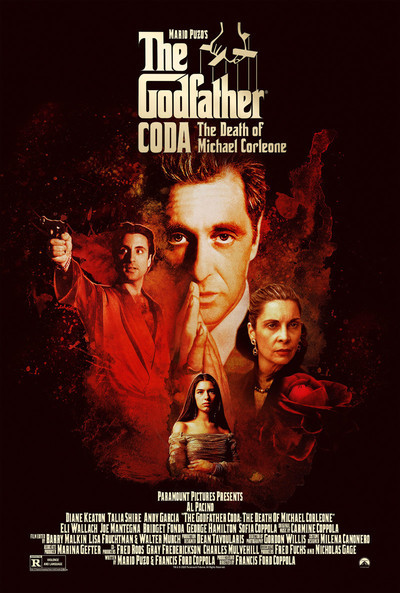
The Godfather Coda: The Death of Michael Corleone (1990) Poster
THE GODFATHER CODA: THE DEATH OF MICHAEL CORLEONE
(1990) B+
dir. Francis Ford Coppola

Everything in Coda feels like it’s fading. The faces are older. The light, colder. Even the music doesn’t swell anymore—it’s more like an echo of something that used to be divine. The Godfather isn’t about empire anymore. It’s about what’s left in the wake of its slow death. Coppola returns to this world like a man returning to an old church. The air’s stale. The dust is thick. But he’s brushing away at the old icons anyway, looking for meaning in the fragments. The third film moves slower than the first two. Maybe that’s due to a lack of style—or maybe it’s just grown weary of itself.

Al Pacino’s Michael Corleone lives between guilt and survival—neither one forgiving. His latest reach: the Vatican’s Immobiliare Corporation. It sounds like a strive for legitimacy, charity even. But the words Michael speaks about it taste false—like it’s meant to be more penance than ambition. And penance is something well out of reach for a man who’s already sold his soul. That dichotomy between sanctity and sin—between the church and the mob—has run through this trilogy, and it’s the same as it’s always been: blurred. So much so that Michael will never be able to separate the two, no matter how much he tries.

Around him, the old order continues to buckle. Joey Zasa (Joe Mantegna), who is slick but shallow, mistakes silence for weakness. He makes a mess and creates a vacuum—one where Vincent (Andy Garcia), Sonny’s illegitimate son, steps in. He’s like a spark with nowhere to land. He has his late father’s heat, but Michael’s cold calculation. Which is to say, he’s dangerous. Yet Michael grooms him anyway. As he learned long ago, compromise is the name of the game when it comes to succession.

Visually, Coda feels haunted by its own history. There’s not nearly as much gravity as the earlier two, but that fits its shift in focus. That is, the slow collapse of the old mob’s orbit. The performances are what you’d expect—great. Particularly with Pacino’s ability to light a match without even striking it.

While the film has nothing on the first two, this is a solid trilogy capper—closing things not with collapse or triumph, but with something quieter, something that feels a lot like surrender. A final prayer for a man already past saving.

Starring: Al Pacino, Diane Keaton, Talia Shire, Andy Garcia, Eli Wallach, Joe Mantegna, George Hamilton, Bridget Fonda, Sofia Coppola, Raf Vallone, Franc D'Ambrosio, Donal Donnelly, Richard Bright, Al Martino.
Rated R. Paramount Pictures. USA. 162 mins.