THE FADED SPOTLIGHT

by Michael Lawrence

List of "N" Movies


Night at the Museum (2006) Poster
NIGHT AT THE MUSEUM (2006) B-
dir. Shawn Levy

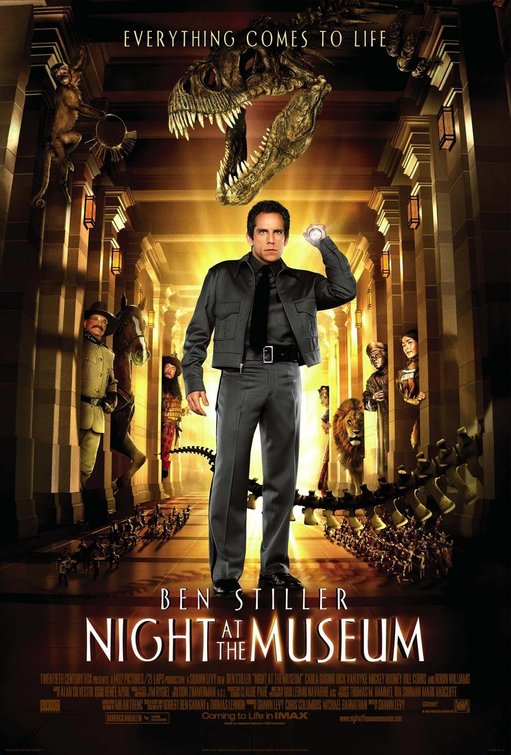
Childhood fantasies aren’t exactly scarce in movies, but this one embraces its fantasy with some decent gusto. It heads straight to the Natural History Museum in New York after closing time, when the exhibits shake loose and start roaming around. The mess that follows gives the film a good bit of momentum. But the glow ends up fading as soon as the movie settles into a limp heist plot midway through. One that never quite gains its footing.

Larry (Ben Stiller) is a professionally adrift divorcé who takes a night-guard job the way you might take jury duty or temp work. Already half-resigned, bracing for the worst ahead. His predecessors—Dick Van Dyke, Mickey Rooney, Bill Cobbs—toss him a few gnomic tips, but they leave out the tiny detail where the exhibits wake up and wreak havoc every night. Larry’s education arrives in trial-by-fire mode. Mostly in the form of things giving chase. T. rex. Saber-toothed tiger. Attila the Hun. Anything that already looked intimidating before it got mobile.

Larry does, at least, find a mentor in Theodore Roosevelt (Robin Williams), steering him through the rough patches. Teddy replies with fun-size, Hall-of-Presidents riffs on leadership and history. Riddled, of course, with a steady drip of aphorisms.

The rules of this universe stay vague, and the backstory even more porous. The reason the displays come to life is an ancient Egyptian tablet that’s apparently been animating them since 1952. Yet no one ever thought to crate it up or bury it in the desert. But of course this isn’t a film built for logic. It’s built for the set pieces. Just think of this as a movie about stampeding Huns, a mischievous capuchin monkey, Owen Wilson and Steve Coogan as bickering cowboy and gladiator miniatures locked in what feels like a buddy comedy staged in a snow globe. Et. cetera.

What keeps things lively, apart from the effects (which are top-of-the-line), is the cast. Stiller slips easily into wide-eyed exasperation. Ricky Gervais is a highlight as the museum-director who plays it as one long, irritated scowl. Van Dyke, Cobbs, and Rooney also have a blast. Especially Rooney, whose perpetual stink-eye ought to have been encased in amber.

Call this a serviceable and overall enjoyable entry in the “one for the whole family” genre. It might be light on actual story, but it’s heavy on spectacle. Overall just amusing enough to keep it all from fossilizing.
Starring: Ben Stiller, Carla Gugino, Dick Van Dyke, Mickey Rooney, Bill Cobbs, Jake Cherry, Ricky Gervais, Robin Williams, Patrick Gallagher, Rami Malek, Pierfrancesco Favino, Steve Coogan, Mizuo Peck, Owen Wilson.
Rated PG. 20th Century Fox. UK/USA. 104 mins.
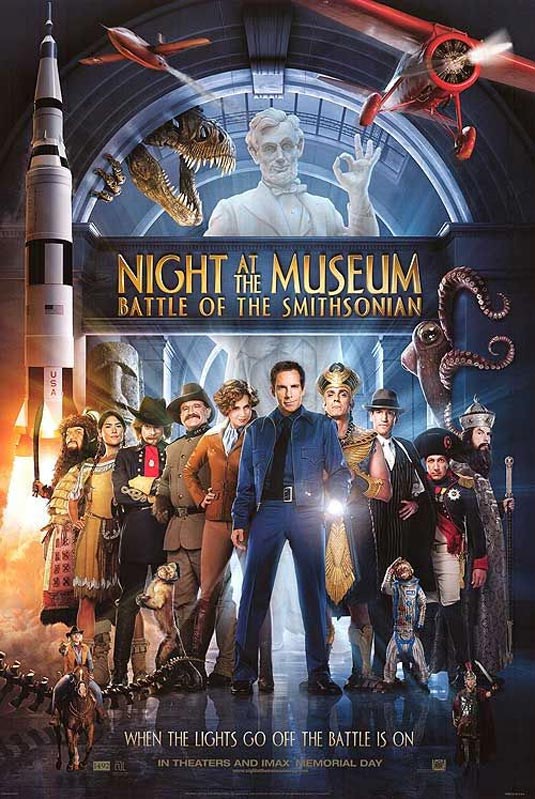
Night at the Museum: Battle of the Smithsonian (2009) Poster
NIGHT AT THE MUSEUM: BATTLE OF THE SMITHSONIAN
(2009) C
dir. Shawn Levy

A sequel to the first Night at the Museum, a film that survived on a healthy cushion of whimsy and goodwill. This time the scale balloons—we’ve gone from a single museum in peril to now the fate of the entire world being at stake. And yet somehow the movie feels smaller. Like the canvas got bigger, and the paint’s gone thin.

Ben Stiller returns as Larry—now graduated from night-guard duty and working as an infomercial entrepreneur. He gets pulled back to New York’s Museum of Natural History when its director (Ricky Gervais) decided to box up its wax-figure residents and ship them to federal storage beneath the Smithsonian. They are to be replaced with sleek holograms. The magical tablet that brings the figures to life every evening was meant to stay behind, meaning these figures would just stop coming to life. But that capuchin who has a chronic impulse-control problem slips it into the crates anyway.

This becomes a big issue fast, because buried in the Smithsonian archives is Kahmunrah (Hank Azaria, camping it up like he wants to get fired). He’s a power-drunk pharaoh eager to channel the tablet’s magic into world domination. Larry is dragged into the mess when Kahmunrah threatens to squash his miniature cowboy friend (Owen Wilson) unless he helps decode the tablet’s secrets. From there, Larry finds reasons to careens from wing to wing—Air and Space, American History, Art. Museums alive in mutiny all because of a pharaoh in eyeliner who’s convinced he deserves the planet.

The historical figures behave like classroom-poster cutouts—personalities filled in with whatever stereotype was closest at hand. Napoleon (Alain Chabat) as a pint-sized despot who takes offense at anything taller than a doorknob. Ivan the Terrible (Christopher Guest) ranting about how he wasn’t actually that terrible. Amelia Earhart (Amy Adams), who inexplicably becomes Larry’s love interest, dispensing endless aerospace puns and talking like Katherine Hepburn. Abraham Lincoln, who climbs down from the Lincoln Memorial, offering the typical sage advice in what sounds suspiciously like a British accent.

This movie noisy, overlong, and built for the under-twelve set, who likely won’t mind that the pacing is scattered and the characters are scribbled in. For everyone else, this is a hollow diorama, albeit with a few decent visual gags rattling around inside.

Starring: Ben Stiller, Amy Adams, Hank Azaria, Owen Wilson, Steve Coogan, Robin Williams, Ricky Gervais, Christopher Guest, Alain Chabat.
Rated PG. 20th Century Fox. USA. 105 mins.
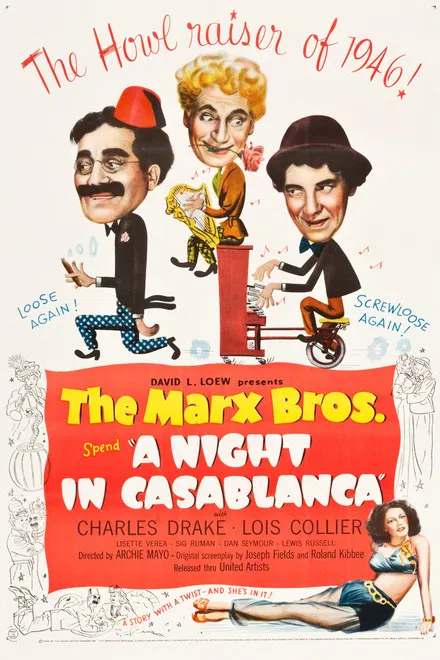
A Night in Casablanca (1946) Poster
A NIGHT IN CASABLANCA (1946) B
dir. Archie Mayo

A Night in Casablanca isn’t peak Marx Brothers, but there’s plenty of charge left in the old machinery. The Big Store had already been marketed as their curtain call. They came back partly to give Chico, who riddled with gambling debts, a financial lifeline. But also partly because they still had gas in the tank. By this point, age had taken a bit of the edge off. But the moment they start poking at the plot—even lightly—the old anarchy bubbles right back up.

What’s genuinely surprising is not just that they’re still funny—it’s that they’re sharper than they’d been in years (even if The Big Store had its flashes). A little time off seems to have eased something back into place. Call it timing, call it spark—whatever name you give it, it’s here. And it moves with that crooked, troublemaking rhythm they used to spring on unsuspecting scenes. It’s in step with the same odd, saboteur rhythm that made their old work detonate from the inside out. This is not a reinvention. It’s a reunion tour. One that actually earns its stage.

Groucho, naturally, shows up with another preposterous-sounding alias: Ronald Kornblow. He’s the newly appointed manager of a hotel situated in postwar Casablanca. He checks in expecting a paycheck and a punchline—preferably in that order, though he’ll argue either way. What he doesn’t know—and what the movie takes great pleasure in withholding from him—is that the previous three managers of that hotel were murdered. All courtesy of a Nazi fugitive (Sig Ruman) who stashed a cache of priceless art inside the building and now wants it back. As soon as a manager gets close to either the stolen art or figuring out who he really is, it’s curtains.

Harpo falls into frame next—blond mop wig, horn tucked somewhere on his person, communicating entirely through reactions that flutter between angelic mischief and unfiltered menace. Chico fares only slightly better in terms of narrative grounding. He runs a camel-cab business. But of course his job, as far as this movie is concerned, is to show up whenever the plot requires a cheerful misinterpretation.

The film’s logic is patchy, its pace elastic, and the plot could be defeated by a stiff breeze. In other words, this is exactly like a classic Marx Brothers film. All the little side dishes are here. Harpo provides his harp solo (his fingers still fly). Chico plays the piano (he still cheats the keys like he’s stealing fire). Somewhere between the harp solo and Chico’s keyboard mischief, Groucho fires off his one-liners—a good number of which cracked me up. For instance, when someone insists he’ll need a good bodyguard, Groucho quips, “What I need is a good body. The one I’ve got isn’t worth guarding.”

It isn’t quite their swan song, but the curtain’s inching downward. A definite worthwhile watch for their fans, because it’s held together by the same impulse they always had: jump into a scene, not-so-politely derail it, and keep pushing until the whole thing spins into their rhythm instead of the script’s. They’re not quite as effective at it as they were in their A Night at the Opera prime, but this remains darn well good enough.

Starring: Groucho Marx, Harpo Marx, Chico Marx, Sig Ruman, Lisette Verea, Charles Drake.
Not Rated. Universal Pictures. USA. 85 mins.
Night Moves (1975) Poster
NIGHT MOVES (1975) B+
dir. Arthur Penn

Few detective stories feel this unconcerned with detection. Not that it doesn’t have a mystery. There’s a case on the books—a runaway, clues that are lying around like dropped coins—but the film keeps edging away from it. It’s more curious about the detective’s slow internal leak.

Hackman plays the private investigator Harry Moseby mid-unravel. The marriage coming apart at home is only the noisiest symptom. Whatever used to push him forward has been thinning for years. There isn’t much of him left anymore.

The search drags him to the Florida Keys, where the light’s too bright, the docks look half-collapsed, and the heat fogs his thinking before he can even open his mouth. Hackman gives him an alert, tight-lipped kind of intelligence. He’s always watching, always bothered. Like the world keeps ignoring the script he’s trying to follow. He moves through rooms like he’s still processing the last one, and his leads don’t cooperate. The people he questions offer less than they know. Conversations double back or trail off. The case inches forward, and Harry with it. The closer he gets, the quicker the meaning falls away.

Arthur Penn directs without drawing much attention to the seams. Mirroring the way Harry works the case, scenes arrive mid-thought and leave without resolution. The pacing can feel static if you’re expecting suspense, but the inertia becomes its own kind of texture.

Griffith brings a restless kind of boldness to the girl. She steps into a scene and everything tilts her way; the movie keeps drifting toward her even when she’s not really the center of gravity.

This is not a neat film. It’s not a stylish one, either. But it leaves something behind that settles with you later, when you’re turning over the pieces in your mind, trying to decipher what all this finally amounted to. Some fans of hard-nosed detective stories might bemoan its lack of apparent interest in the mystery itself. But for cinephiles who don’t mind sinking into a murky character study, consider this a minor gem.

Starring: Gene Hackman, Jennifer Warren, Susan Clark, Melanie Griffith, Edward Binns, Harris Yulin, Kenneth Mars, James Woods, Janet Ward.
Rated R. Warner Bros. Pictures. USA. 100 mins.
Night of the Comet (1984) Poster
NIGHT OF THE COMET (1984) B
dir. Thom Eberhardt

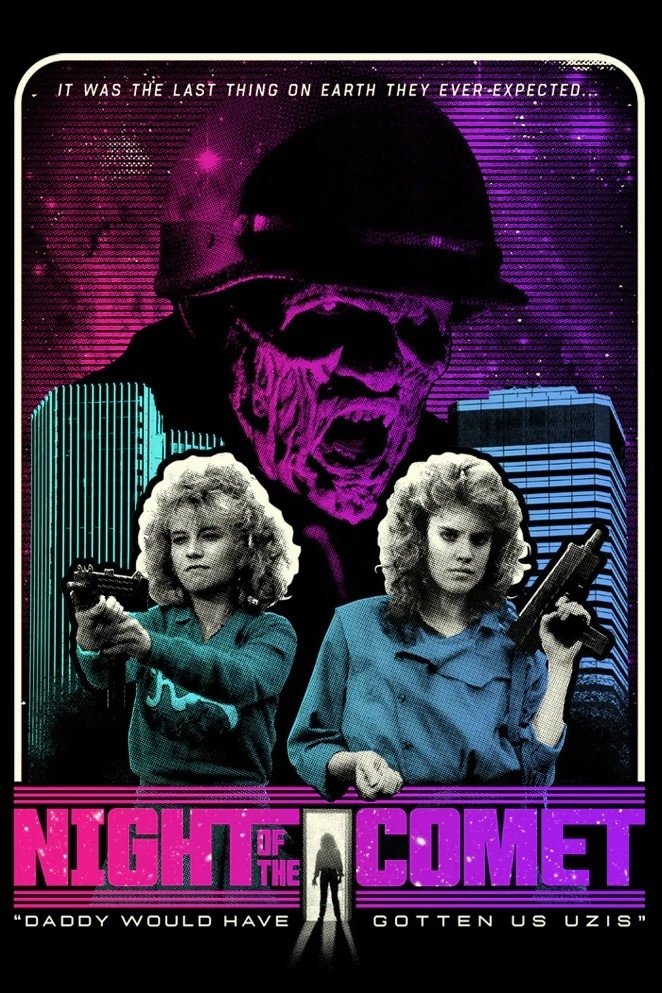
A scruffy blend of sci-fi, horror, and comedy that’s carried with a looseness that its bumps even become part of the charm. This is straight out of The Day of the Triffids. A comet comes ripping past Earth. Broadcasters chirp at the novelty and encourage everyone to step outside and take a look. Almost the whole planet obliges. But one flash, and they’re all gone. Billions of people turned into red dust and piles of clothing arranged like abandoned laundry. (Whatever did this wanted our nudes?)

The people who made it out alive are the flukes. The folks who weren’t outside when the sky did its trick. Among them are two Valley Girl sisters. Regina (Catherine Mary Stewart), a born arcade shark, and Sam (Kelli Maroney), a cheerleader with sharper instincts than her uniform would suggest. They spend the apocalypse—at first, anyway—wandering an empty, irradiated L.A. that’s still lit up like someone left the switch on. End times with the lighting budget of a fashion editorial.

The horror-shock premise burns off rather quick as the two leads engage in mischief, mall runs, and a department-store blowout set to Cyndi Lauper. This is the movie at full charge. Bright colors. Dead streets. Two sisters treating the end of the world like they’ve got the keys to the place. But then we can’t have too much fun, so the film ducks into conspiracy mode—dragging its final third into a drab government bunker stocked with vague scientists and cardboard military types.

But even then, Night of the Comet turns almost tender, in its own strange way. Not bad for a picture that clears out humanity and then trots off with a little bounce anyway. Chalk this up as a modest B-movie with a small budget and big nerve. If you want your end of the world to come with synthpop and shoulder pads, count this as a fun diversion.

Starring: Catherine Mary Stewart, Kelli Maroney, Robert Beltran, Mary Woronov, Geoffrey Lewis.
Rated PG-13. Atlantic Releasing Corporation. USA. 95 mins.
Night of the Demons (1988) Poster
NIGHT OF THE DEMONS (1988) B−
dir. Kenneth S. Tenney

Night of the Demons lives up to its VHS cover—lurid, cheap, and clearly delighted with the awful choices it’s about to throw your way. You can get a read on its personality in its first minute. Some teens decide to jump-scare an old man who is carrying a couple of grocery bags. His whole haul goes down and in the middle of the wreckage, he finds an apple cozied up to a package of razor blades. He snatches them off the pavement, mutters, “They’ll get what they deserve tonight,” and follows it with a low, sour cackle—directed at no one, unless the sidewalk counts.

And even though we never see this man again—nor for that matter do we ever see anyone bite into a razor-blade apple—the moment functions basically like the film clearing its throat. Telling us that of all the things this movie plans to serve, good taste is not among them.

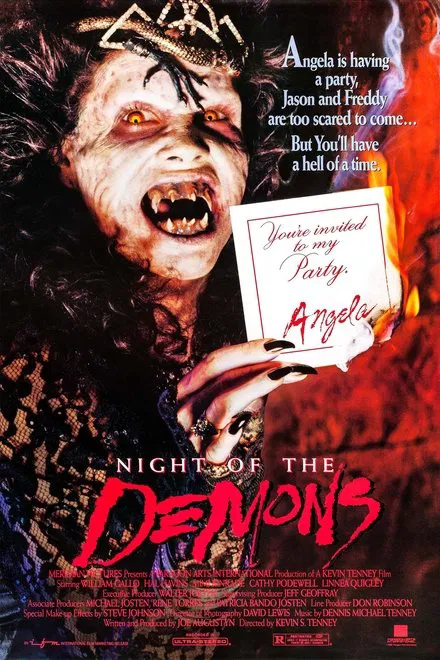
The real trouble begins when a pack of thrill-seeking teenagers descends upon a condemned funeral home to spend the night. This group proves to be quite the oddball assortment—the jock, the flirt, the know-it-all, the Final Girl (Cathy Podewell). They light candles. They crack jokes. Then they hold a séance. That’s when all Hell—quite literally—breaks loose. Whatever evil thing that’s been hiding out in the basement shadows crawls out not to hover or circle amiably around the room but to possess the first warm body it finds. And it jumps from host to host, each kid coming back glazed-over, sex-crazed, and ready to pounce.

The acting’s hit-or-miss, but everyone commits to the bit. That counts for something. But the gore doesn’t joke around. We are bludgeoned with twisted limbs, leaking mouths, faces reworked into demonic rubber sculptures. It’s surprisingly strong stuff. Including the infamous lipstick scene featuring Linnea Quigley tracing the tube halfway down her bare chest. She then slides it into a cavity that the human body simply doesn’t come equipped with. It’s a scene pulling three moods at once. Part tease, part scare, part “what am I even looking at?” And whatever your brain tries to do with that combo, it’s not graceful.

The film ultimately settles into camp, but it does it with such fierce, sloppy confidence that resistance feels like extra homework. That is, if this kind of B-movie horror-schlock-trash would ever appeal to you in the first place. This is a movie that works best if you’re watching it in a group where everyone lets everyone else interrupt the whole thing with cringe-based laughter, gasps, and the inevitable shriek from your least suspecting friend: “What did you just make me watch?” Some of it—chiefly the dialogue—is so clumsy it borders on painful. And yet the whole thing runs on such naked shamelessness that you end up going along with it. It’s junk food: you know better, you keep eating. Might as well savor the stuff.

Starring: Cathy Podewell, Amelia Kinkade, William Gallo, Alvin Alexis, Linnea Quigley, Lance Fenton, Hal Havins.
Rated R. International Film Marketing. USA. 89 mins.
Nightbitch (2024) Poster
NIGHTBITCH (2024) B
dir. Marielle Heller

Nightbitch doesn’t go heavy on gore. What it digs into instead is the slow grind of early motherhood. Where the days repeat and parts of you start wearing thin. It takes your ambition, your edges, whatever felt solid, and starts rubbing them down. And what’s left can feel like a transformation that you never consented to.

Amy Adams plays a woman with no name—just “Mother,” as if individuality were left behind with the placenta. Her husband (“Father,” played by Scoot McNairy) is always out of town on business. She’s left alone in a suburban home, improvising rituals to get her toddler to sleep. One involves play-acting as dogs: crawling, barking, even letting him curl up in a dog bed with a collar. It works. Her husband, whenever he shows up, disapproves vehemently. Tough for him.

The life “Mother” gave up—a promising art career—has been boxed, shelved, and forgotten. Her new reality is invisible labor and surface-level small talk with other moms. Women who ask how she’s doing and expect nothing more complicated than “fine.”

But then she stops pretending with them. Her answers get more vivid, more feral. Then the physical symptoms arrive. She gets strange patches of hair, she has blackouts, she gets vivid dreams—for instance, one where she’s no longer a woman pretending to be a dog, but a dog remembering that she was once a woman.

The film’s horror elements never fully blossom. They’re more suggestive than visceral. But gore and frights aren’t really the point. The film’s bite comes from its mood. It’s dislocated, anxious, and lightly absurd. It’s not always elegant, but it’s also precise about how the alienation of early motherhood feels. Where the days smear together and you start feeling you’ve gone too far into this private, shared universe with your little one.

Amy Adams is always a dependable presence and keeps this premise grounded. She doesn’t play it as a breakdown. She plays it as shedding a skin. Like a slow, strange shift that sits like an unsettling calm. While I wouldn’t call this a brilliant film, it’s a sharp and memorable one. A movie about what it’s like to look at a juice-stained living room and realize the person you used to be is no longer in the room.

Starring: Amy Adams, Scoot McNairy.
Rated R. Searchlight Pictures. USA. 113 mins.
Nightbreed (1990) Poster
NIGHTBREED (1990) B
dir. Clive Barker

A movie caught somewhere between monster tale, psychosexual vision, and full-tilt circus nightmare. Nightbreed has no interest in tidying those tones into anything neat or polite. It just lets them collide. As you watch, you might find yourself tensing up. Bracing for carnage. Only for the film to blindside you with a laugh. It keeps kicking itself between scares and jokes, then doubling back again. A strange rhythm that Nightbreed dances to.

Craig Sheffer plays Aaron Boone, a psychiatric patient haunted by visions of Midian, a necropolis buried beneath a cemetery and home to the unwanted and the unnatural. It’s Hades by way of a heavy-metal concept album. Everyone down there looks ready to be featured for the sleeve art. It overflows with human hybrids, shape-shifters, and creatures whose mouths open in confusing places. I’m afraid to say that if you’re not here for the monster-gazing, this won’t be a particularly interesting view.

Boone’s therapist is Dr. Decker (David Cronenberg—yes, the filmmaker—soft-spoken and terrifying). He’s helping Boone. Or he might be orchestrating his breakdown for reasons the movie never clarifies. Boone, dazed and over-medicated, starts to believe he’s responsible for a series of murders that he doesn’t remember committing. Murders that were actually carried out by a masked figure with a burlap sack for a head, buttons for eyes, and a carved slit of a smile. (This is one of the scariest slasher designs I can recall, by the way. And the film treats it merely as a footnote.)

Eventually Boone dies—or seems to—and finds himself in Midian for real. Apparently that’s how you get in. Maybe. The mythology has rules, or something like them. But none of them seem particularly interested in making sense. His girlfriend Lori (Anne Bobby), refusing to buy the official story of his death, tracks him down and stumbles into that wacky and frightening world below.

The plot never really finds a spine. It pushes ahead on mood as it slips from one thing to another. It’s the same way that dreams can quietly rearrange themselves. There’s a moment here where a half-dead thing hits the sunlight and its skin pulls away in slow curls. What comes out of its mouth isn’t breathing so much as a handful of tiny, miserable sounds. Lori lifts the dying creature, carries it into a tomb where a spectral woman waits. She watches in awe as it shifts into a little girl right in front of her. The logic is pure dream logic, but there’s something about it that is terribly engrossing.

The practical effects are everything here—grotesquerie unmistakably from the early ’90s—practical effects made of rubber and latex that catch the light far better than any digital recreation ever could hope to. The acting isn’t grounded, but grounding wouldn’t help much anyway. This isn’t a movie about reality. This is Clive Barker’s imagination cracked open and spilled onto the screen. It’s unruly. Lighter than his earlier classic Hellraiser by a mile (or a million), but Barker still lands a few images that lodge in your brain. The same way half-remembered dreams do.

Certainly a worthwhile pick for genre fans. Vivid, disjointed, hard to talk about without sounding a little unwell.

Starring: Craig Sheffer, Anne Bobby, David Cronenberg, Charles Haid, Hugh Ross, Doug Bradley.
Rated R. 20th Century Fox. USA/UK/Canada. 102 mins.
Nine Lives (2016) Poster
NINE LIVES (2016) D+
dir. Barry Sonnenfeld

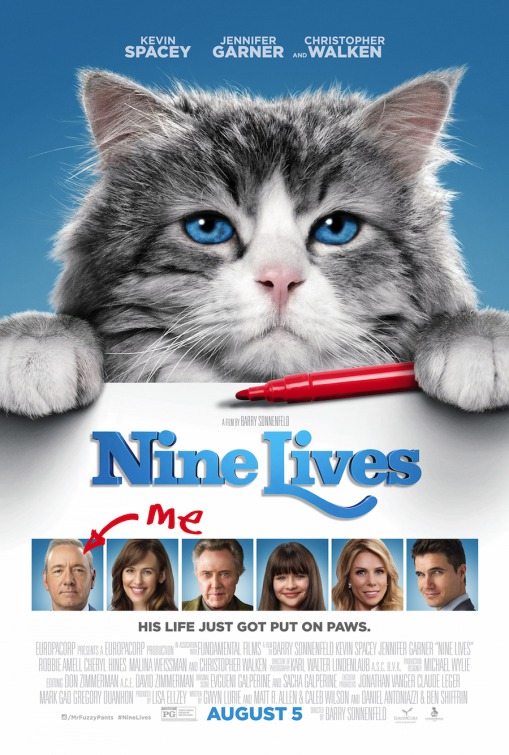
A mostly terrible family comedy, Nine Lives stars Kevin Spacey as a self-absorbed CEO more interested in mergers than birthdays. He’s not a villain. He’s just one of those dads who loses track of those fundamental basics about family and ends up paying for it over the course of the film.

Soon enough he wanders into a peculiar little pet shop run by Christopher Walken, who delivers every line like he’s in on a secret he has no intention of sharing. He’s there to make up for his lack of attention paid to his daughter by buying her a cat. Then badda-boom—something unspoken happens off-screen—and suddenly Spacey is waking up in the feline’s body. His real body is on a ventilator across town.

The daughter catches on right away—same posture, same pacing, same grumpy little huffs—and she says as much. Everyone else waves it off like she’s just storytelling. He finds ways to get people’s attention. Albeit for some reason he does distinctly cat things. The usual circuit. Pee in a corner, gnaw on a chair leg, attempt a pratfall, start over. And the movie’s big mistake is thinking his irritation over this body swap situation counts as comedy. It doesn’t. His irritation hits only one note: tiresome.

Jennifer Garner, Cheryl Hines, and Robbie Amell do what they can, but the movie keeps forgetting they’re in it. And once they fade out, the dad hits the obligatory self-reckoning—realizing he’s bungled the husband-and-father part and wondering, somewhere between the scratching and the yowling, if a do-over is still on the table. Hopefully as a human this time. A lesson that you can see coming from three blocks away.

The cat is convincingly fluffy. The CGI holds up in the quieter moments. The action scenes, less so. The film has a certain punchy visual flair—certainly hallmarks of its director, Barry Sonnenfeld. Too bad he had an atrocious script to work with. Still, the youngest viewers might not mind. It comes down to this: a cat wanders around, reacts to things, commits petty crimes. That’s the whole meal. This is such a faint, flimsy movie—even by children’s-fare standards—that you start handing out mercy points. In the end, “harmless” is the kindest word you can give it.

Starring: Kevin Spacey, Jennifer Garner, Christopher Walken, Cheryl Hines, Robbie Amell, Malina Weissman, Mark Consuelos.
Rated PG. EuropaCorp. France/China/Canada. 87 mins.
Ninotchka (1939) Poster
NINOTCHKA (1939) A
dir. Ernst Lubitsch

Garbo laughs. Believe it or not such a monumental event that the world seemed to slip a half-inch out of alignment. Her earlier roles were women, the quietly but deeply suffering kind who barely moved a muscle. Smiles were doled out sparingly. Laughter never. Her characters would sooner choke down a handful of mothballs. Yet here she is in a romantic comedy, of all things.

Not that you’d guess she was ever going to laugh in her opening scenes. That would seem about as likely as a heatwave in Siberia. She plays the title character, a classic Soviet cliché: humorless, rigid, icy. She’s part of a state envoy sent to Paris to sell off the deposed czar’s Crown Jewels and bring home money for the motherland. Their citizens need food. She’s doing important work. There’s no time for silliness.

She follows three of her comrades who arrived several days earlier. But Paris got to them fast. They arrived preaching discipline. The next moment they’re swimming in champagne, bossing around bellhops, and flirting with cigarette girls. They’ve know they’ve gone soft. But they keep ordering half the room service menu anyway.

Ninotchka comes in clipped and rigid to inspect the damage. She’s poised as if someone traced her in ruler-straight lines and filled in the rest with doctrine. Every Western convenience irritates her on sight, and her disappointment in her comrades hits like a supervisor finding the whole shift asleep at their desks. But Paris has a way of working underneath even her armor. And so does Count Leon d’Algout (Melvyn Douglas), an aristocrat who moves through life as if seriousness were a contagious disease he has no interest in catching. What follows is a quiet collision: Marxist discipline brushing up against Parisian drift.

This is an incredibly funny, freshly paced, surprisingly nuanced film—Billy Wilder’s first major script, cowritten with Charles Brackett and Walter Reisch. Scenes don’t go hunting for punchlines. They sidle up to them instead. By way of a stray look, a clipped reply, or a pause that lands funnier than anything spoken.

Garbo’s shift is gradual. It’s a slow warming as opposed to a sudden turn. She starts closed off, calibrated to efficiency, measuring everything for ideological contamination. Then Paris pushes—softly, repeatedly. A posture loosens. A line softens her further. Then she smiles at something she has no business smiling at—long before she notices it herself. The laugh that follows sounds like it’s been locked away for years.

The politics stay in the mix, never ignored, never hammered. But the film is just as interested in what happens when someone lets go of the script they’re supposed to follow. It allows curiosity to creep in. A little misbehavior. A little warmth. It’s a love story, a comedy, a sly act of cultural translation. Even today, it still feels sharp.

Starring: Greta Garbo, Melvyn Douglas, Ina Claire, Sig Ruman, Felix Bressart, Alexander Granach, Gregory Gaye, Rolfe Sedan, Edwin Maxwell, Richard Carle.
Not Rated. Metro-Goldwyn-Mayer. USA. 110 mins.
Nixon (1995) Poster
NIXON (1995) A−
dir. Oliver Stone

Anthony Hopkins doesn’t really resemble Richard Nixon. Not the sound, not the stance, not the verbal rhythms. There’s always a flicker of Britain in his delivery. He comes off more like a nervous minister than any kind of political brawler. But his performance works because he’s able to tap directly into the ache that plagued Nixon. That constant ache for approval from a country that could never warm to him.

We drop in on him right in the middle of Watergate—the mess history refuses to set down. Tape machines grinding, aides circling, Nixon murmuring to the quiet as if it still holds his trust. Always with an Old Overholt on the rocks nearby. From there, the film pulls back and traces the long road that got him to this moment. But never in a straight line.

The movie keeps circling back. First to his impoverished childhood years, then to Whittier College, then his early defeats, the debates, Checkers, Vietnam, China. It comes in shards and refuses to stay in sequence. It’s held together more by whatever mood Nixon is sunk in at that moment.

Oliver Stone has never been a minimalist, and Nixon finds him working at full voltage. The material is presented with as much volume as it is intensity. But this isn’t an anti-Nixon smear campaign. It doesn’t reduce him to a caricature, either. After all, if Stone had wanted to completely obliterate the former president, he had no shortage of ammunition. He takes a more complex route: Nixon as a political tragedy. Like a Shakespearean leftover—one where the central figure keeps forgetting that he’s supposed to be the hero of his own story. He thinks in defenses and counterattacks. Paranoia on one shoulder, ambition on the other. It’s the combination that got him up the ladder. It’s also what knocked it loose.

The movie isn’t interested in explaining power so much as showing what it feels like to sit in the blast zone of it. And Hopkins plays it with a kind of relentless magnetism—Nixon’s gravity and gloom packed into every quiet, uneasy beat.

This film won’t play for everyone. It’s dense. It’ll lose anyone who wants their history neatly explained for them. You’ll have to just sit with the noise until the full picture starts to form. But once you’re in, it gets under your skin. Not because Nixon softens. He doesn’t. It’s the way his whole mess comes into focus. What he fears, what he falls back on, the sore spots he can’t stop hitting.

Starring: Anthony Hopkins, Joan Allen, Powers Boothe, Ed Harris, Bob Hoskins, E.G. Marshall, David Hyde Pierce, Paul Sorvino, J.T. Walsh, James Woods.
Rated R. Hollywood Pictures. USA. 192 mins.