THE FADED SPOTLIGHT

by Michael Lawrence

List of "P" Movies


Phantasm (1979) Poster
PHANTASM (1979) B+
dir. Don Coscarelli

Horror usually wants to scare you. Phantasm would rather leave you disoriented first—wondering what planet you woke up on. Then it gets around to scaring you. It’s low-budget, scrappy, and just holding itself together. The acting’s rough, stiff in spots. The pacing stumbles. The cinematography—well, we can call it serviceable. (There’s a remaster now that smooths out the grain, though it sands off some of the nightmare texture.) A few effects look like they were built out back with a glue gun, hope, and maybe a lighter. But visually speaking, it works amazingly well—especially for a low-budget film.

The look alone pulls you straight into its world—a mortuary of marble halls, crypts, and impossible shadows. There are corpses that lunge from crypts, and hooded dwarves whose jaws chatter like wind-up toys. Then there’s a chrome sphere—a sort of night guard—that roams those halls. If you catch its attention, it’ll drill a hole clean through your skull turning your head into something like a busted sprinkler. Except instead of watering the roses, it’s painting the room red. And above all this madness stands the Tall Man (Angus Scrimm). He’s gaunt, yellow-blooded, apparently immortal. And smiling at you like he’s already picturing you stretched out in his finest mahogany box. Which might not be too far off if he’s smiling at you like that.

The story opens with a little graveyard hanky-panky. A man. A woman. Both alive—for now. They’re right in the middle of it when she pulls a knife and buries it in his chest. Brutal. But that’s not even the night’s biggest shock—she’s a shapeshifter. Her real form: the Tall Man. In drag.

Mike (A. Michael Baldwin) sees it all happen. Tries to tell anyone who’ll listen, but nobody buys it. Not until the funeral—when he and his brother Jody (Bill Thornbury) see the Tall Man heft a coffin into a hearse with one arm. Acting like it’s made of feathers.

From there, things get stranger. There’s a séance with a blind psychic. A finger in a box that turns into a bug. A portal behind a wall of barrels that leads… somewhere. Another planet? Hell? Something in between? Hard to say. Most of it still happens here on Earth, buried in night. Every frame mostly swallowed by black. Eerie atmosphere driven by the lack of lighting budget.

Coscarelli was barely out of college. Fresh-faced, broke, and doing everything himself—writing, shooting, cutting, all of it. And it all paid off. It grossed $22 million on a $300,000 budget but importantly, it became a minor horror staple. A jagged little nightmare about fear and loss, and the strange residue grief leaves behind.
Starring: A. Michael Baldwin, Bill Thornbury, Reggie Bannister, Kathy Lester, Angus Scrimm.
Rated R. AVCO Embassy Pictures. USA. 88 mins.
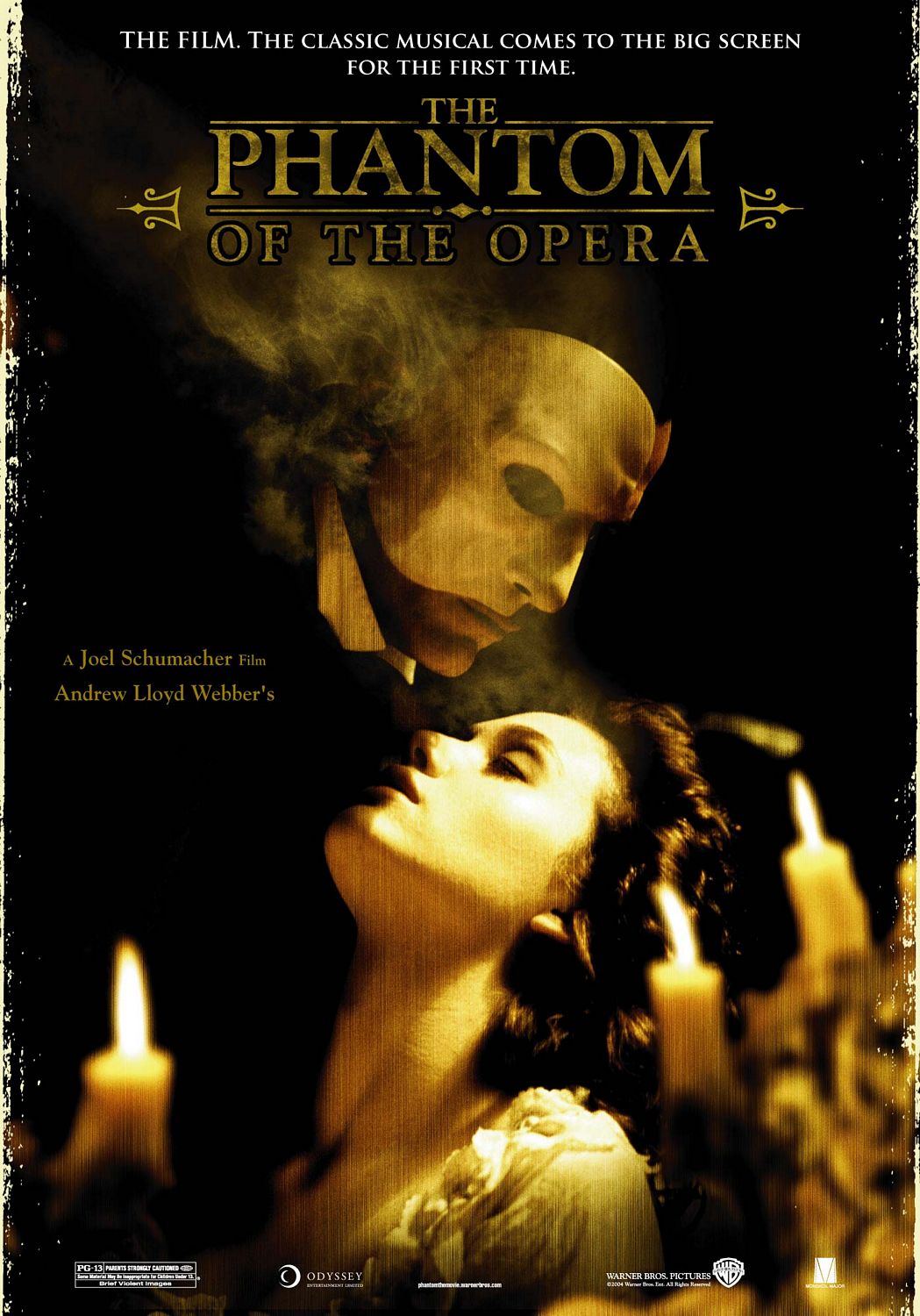
The Phantom of the Opera (2004) Poster
THE PHANTOM OF THE OPERA (2004) C+
dir. Joel Schumacher

A costume ball trapped in a snow globe, spinning to Andrew Lloyd Webber’s extravagance. Lavish. Romantic. Gorgeous to look at—and sealed off from anything that feels remotely real. Emmy Rossum makes sense of it somehow, as Christine Daaé—the soprano still learning what her voice can do. She moves through these sets like they were built for her. Through silk and fog. In a self-guided gondola through an underground lake. Like the Phantom built his own little Pirates of the Caribbean ride underneath that soggy opera house. But even through the excess, Rossum is luminous. Easily the best thing about this movie. Quiet. Looks like she actually believes the dream she’s in. And she sings, too—beautifully. But this movie is ultimately undone by its overflowing grandeur. Simply put, it forgets to breathe beneath all that glitter.

The film opens with Christine as just a chorus girl. Background noise, half-seen behind the divas, until a ghost starts giving her voice lessons through the walls. Not a real ghost, though—a man hiding a facial disfigurement who haunts the opera house, which he knows inside and out like a damp maze of his own making. He calls himself the Phantom (Gerard Butler). He thinks he’s hideous—but even without the mask, he looks like the cover of a Victorian romance. Flowing hair. Even more flowing cape. Those hands reaching dramatically for something invisible. Maybe spiderwebs. It’s a bit much, really—but that’s the show for you. Subtlety was never part of its DNA.

The Phantom’s obsessed with Christine, and for a dizzy little moment, she feels it too. But the spell breaks. She runs back to Raoul (Patrick Wilson)—childhood friend, decent haircut, not a lunatic. That’s about when the chandeliers start to tremble and the whole opera house begins to boil over. Cue the arias.

The costumes are immaculate. Maybe too immaculate. They gleam, they shimmer, they start to upstage the people wearing them. Lloyd Webber’s songs still crawl into your head and stay there, even as they loop on themselves like ghosts that can’t find the exit. (All his musicals recycle melodies; this one’s no exception.)

Schumacher keeps jumping to this gray, lifeless auction scene that stops the movie dead every time it shows up. But when the movie comes back up to gasp for air, it’s just another blast of spectacle. It’s splendiferous, but maybe all of this was too much for Butler. He gives it everything he’s got—the brooding, the reaching, the ache. But his voice just can’t seem to fight its way through that orchestra. He’s not off-key; he’s outmatched.

A movie that bit off far more than it could chew. But to the die-hards, this isn’t so much a movie as it’s a shrine caught on film. Every note gleams, every chandelier too—like the film’s showing off its reflection. But the mystery’s gone. Schumacher seems too busy arranging the spectacle to give the story life. What’s left is pretty but hollow. Too contained. Too unbreakable. Kind of like a snow globe that refuses to crack.

Starring: Emmy Rossum, Gerard Butler, Patrick Wilson, Miranda Richardson, Minnie Driver, Simon Callow, Ciarán Hinds.
Rated PG-13. Warner Bros. Pictures. UK-USA. 143 mins.
Philadelphia (1993) Poster
PHILADELPHIA (1993) A−
dir. Jonathan Demme

On the surface, this is a courtroom drama. Underneath, it’s more like a cultural reckoning. The movie dropped into a country that still hadn’t figured out how to talk about AIDS. Or if it even wanted to. But Philadelphia didn’t arrive on the scene to lecture. It just started the conversation for everybody.

Hanks is Andrew Beckett. A bright young attorney whose firm throws him out the moment they find out he’s gay and HIV-positive. The reason, they claim, is “performance-related.” But he knows perfectly well that’s not the real reason.

He turns to Joe Miller (Denzel Washington) for help—a flashy, fast-talking lawyer who’s good at winning but lousy at seeing past his own driveway. Joe is also virulently homophobic and wants nothing to do with the case at first. But then there’s something about it that gets to him. Something like a mixture of conscience and curiosity. Maybe it’s only the realization sneaking up on him: change the shape, the name, the face—it’s still prejudice. And all Andrew’s after is a little fairness. To have what everybody else is able to count on without even thinking about it—basic decency and a fair shot.

Hanks plays Beckett like a man conserving energy. He holds back, steady and deliberate, until you realize he’s been pulling you in the whole time. Washington’s the one who bends. You can feel Joe’s unease tightening into something closer to conviction throughout the film. And while he doesn’t have some kind of enormous awakening, we can at least see his armor-like exterior start to split a little. Enough, anyway, for him to start breathing through.

Demme’s directorial style here is steady, patient, and unbothered. He doesn’t go searching for emotion. He just lets it drift into frame when it’s ready. The silences often carry the story farther than the dialogue ever could. Even as Andrew’s strength fades and the courtroom hardens around him, Demme’s patience gives the story its pulse.

This is a movie that made history—but politely. Philadelphia doesn’t challenge. It coaxes. A social lubricant for society at large. With that said, the studio still played it safe. First of all with the safe and respectable casting of Hanks—a straight man. There’s some same-sex intimacy here, but it mainly hides in gestures: a look, a brush of the hand, a fleeting moment with Antonio Banderas before the scene moves on. This is a film that knows who it’s speaking to. That cautious liberal middle who weren’t hostile to the idea of gay rights, just hesitant. And in 1993, that was close enough to revolution.

Starring: Tom Hanks, Denzel Washington, Antonio Banderas, Ron Vawter, Joanne Woodward, Jason Robards Jr., Robert Ridgely, Paul Lazar, Bradley Whitford, Tracey Walter, John Bedford Lloyd, Robert Castle.
Rated PG-13. TriStar Pictures. USA. 126 mins.
The Philadelphia Experiment (1984) Poster
THE PHILADELPHIA EXPERIMENT (1984) B
dir. Stewart Raffill

Some swear that a Navy destroyer vanished off the Delaware River in 1943. It eventually came back, but it didn’t come back the same. The muckety-mucks in charge thought they were conducting an experiment in radar invisibility—but instead, they tore a hole clean through time and sent the ship right into it. Two sailors fell overboard and resurfaced—somehow—forty years later in the Nevada desert, which looks bleached out, like somebody left history sitting in the sun for too long. The war was just a ghost by then. The brass and smoke they once knew had given way to plastic and ugly cars.

The premise feels like it was torn out of a dog-eared pulp magazine. But it doesn’t deliver spectacle or cheap thrills at all—it’s something smaller, almost private. Sad as well—in a lump-in-your-throat kind of way. These are two sailors who don’t end up in the future chasing adventure. They simply manifested there. Stunned. They are fish out of water, but not for laughs. They are fish out of water who can’t breathe.

Michael Paré is the steadier half—David, dazed but determined. Navigating this world seemingly by running on the fumes of disbelief and survival. His buddy Jim (Bobby Di Cicco) doesn’t fare so well. He starts to come apart—fast. Terrified by a world that he can’t recognize. He eventually flickers out—disappears. Nineteen eighty-four rejecting him like a transplanted organ rejected by its host.

David’s path crosses with Allison (Nancy Allen) when she nearly runs him over on a desert highway. She laughs off the story at first. A destroyer, 1943, time travel—it sounds insane. But then something in David’s voice catches her off guard. He seems unwaveringly sincere, and the way he tells it feels far too precise. Then, even stranger, he starts to glow and throw off sparks. And suddenly, G-men appear out of nowhere, trying to drag him away. Of course, whenever you find G-men after you, you run.

Allen gives the movie its heartbeat as she tries—if only for a while—to help these sailors stand upright in a decade that makes no sense to them. Together they move through gas stations, desert roads, and government labs that all feel equally anonymous.

The effects are small—mostly lights, sparks, a few glimmers of energy tearing through the air—but the film uses them sparingly. This is more mood than spectacle. The kind The Twilight Zone used to master. Dread that doesn’t strike as much as it seeps in—slow and patient, like how a shadow stretches at dusk. The musical score stays low. The camera lingers longer in places than it should. The mood is effective, and this is a movie I even remember haunting me back in those days when I rented movies on VHS. But there’s also the other edge of it—this isn’t exactly vital filmmaking.

But in all, this is a strange, quiet, and quietly effective science fiction film. It doesn’t try to shock or astonish. It just leaves you unsettled—with the sense that the real horror isn’t in the vanishing, but in realizing the world kept going without you.

Starring: Michael Paré, Nancy Allen, Eric Christmas, Bobby Di Cicco, Louise Latham, Stephen Tobolowsky.
Rated PG. New World Pictures. USA. 102 mins.
The Philadelphia Story (1940) Poster
THE PHILADELPHIA STORY (1940) A
dir. George Cukor

The champagne’s chilled. The guest list’s elite. The bride’s not entirely sure who she’s marrying. All of this unfolds in a mansion. A house crowded with pride, wit, and old lovers who stand too close for comfort. It gets so wild that you can’t tell who’s fighting or flirting anymore. And if pride and champagne weren’t combustible enough, we have three titans of the Golden Age—Katharine Hepburn, Cary Grant, and James Stewart—all here. Fighting for the same oxygen.

Katharine Hepburn is Tracy Lord, raised to believe composure and perfection were the same virtue. She’s getting remarried, this time to a respectable bore (John Howard) who makes good money and won’t challenge her. The press wasn’t invited, but they came anyway. Mike Connor (James Stewart) is a reporter slumming for a story who sneaks in under borrowed credentials and a few too many ideals. He thinks he’s there to write up the idle rich, tear them down, and move on. But then he meets Tracy. Suddenly, his whole idea of her—and her family—disintegrates. It turns out, she isn’t made of marble. She’s quick and cutting. Softer in ways that throw him off his tracks.

Cary Grant plays C.K. Dexter Haven, Tracy’s ex. He also comes uninvited, but he also comes with a roadmap to her temper. He promises one minute he’s going to behave but then five minutes later, he’s poking at all the bruises. He and Tracy don’t talk as much as they duel. They circle each other, smiling too wide, words flicking like sabers, and the eyes finish the cut. But through it all, the way he watches her, you can tell that he’s counting the pieces he’ll never get back.

James Stewart drifts in as the wild card. He plays Mike Connor, who thinks he’s a serious writer forced to play gossip hound—but he’s not immune to the glow. Their chemistry happens by mistake. Feels wrong, feels right. Like neither one planned to find an equal, and now they don’t know what to do with it. Stewart plays it loose and unguarded. Curiosity keeps tripping him up. The movie’s the same way—too quick, too loud, too clever to stop and breathe.

One of the funniest screwball comedies ever made, full of speed and noise and people too quick for their own thoughts. Everyone’s talking too fast, and you just hang on, hoping not to spill your soda. The dialogue glints like glass—pretty until someone bleeds. They drink too fast too, but that only makes them quicker. They feel too much—that’s the part they can’t stand. And everyone’s too smart for their own happiness.

But then somewhere between the punchlines, the jokes suddenly start to sound too much like effort. Like the shine has worn off. Pride looks something closer to exhaustion. Their eyes are glazed, they’re a little bit drunk. Maybe they’re also wiser. Not that they would ever admit it.

Starring: Katharine Hepburn, Cary Grant, James Stewart, Ruth Hussey, John Howard, Roland Young, Mary Nash, Virginia Weidler.
Not Rated. MGM. USA. 112 mins.