THE FADED SPOTLIGHT

by Michael Lawrence

List of "R" Movies


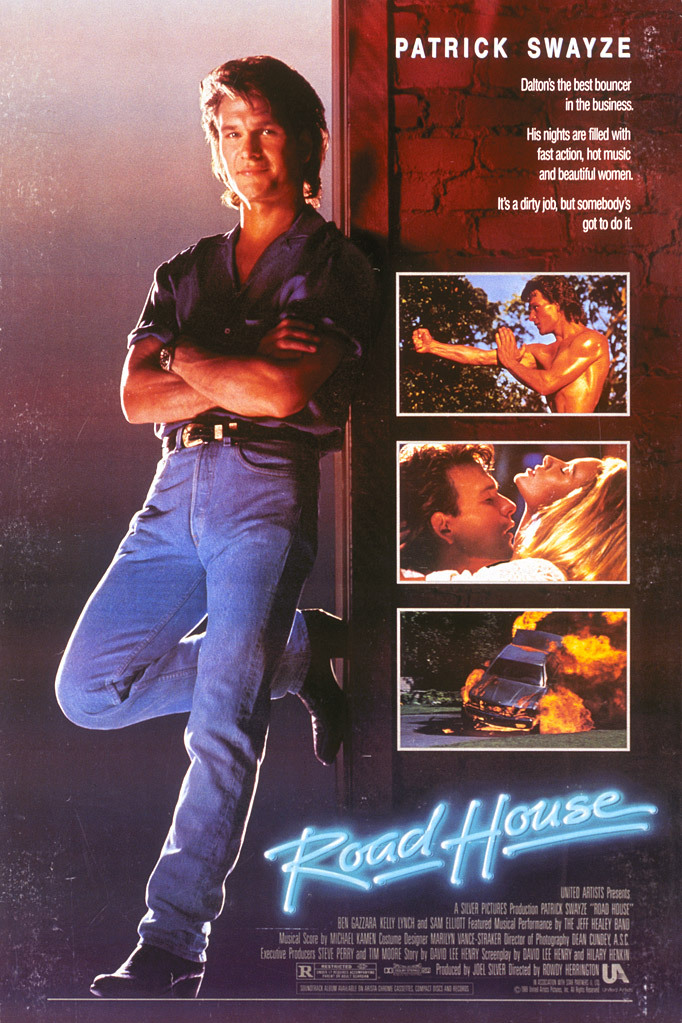
Road House (1989) Poster
ROAD HOUSE (1989) B
dir. Rowdy Herrington

In Road House, bouncing isn’t just a job. It’s a discipline—with rules and hierarchy. Violence isn’t just for show. It’s a practical tool for fending off the rabble. This is a fun movie that’s played so straight that its sheer gravity is a big part of the appeal. Well, that, and Patrick Swayze’s perpetual sheen of fop sweat.

Swayze plays James Dalton, a professional bouncer with the physical presence of a Greek statue that learned tai chi and—of all things—a philosophy degree from NYU. (Who says that major is useless?) He’s brought in to restore order at a rough bar called the Double Deuce in rural Missouri. Dalton surveys the place carefully from the moment he arrives. Minor problems get delegated to his crew. The bigger ones require his personal attention.

Sam Elliott’s mustache arrives with Sam Elliott attached, as Wade Garrett. A veteran bouncer who looks like he’s been through this movie three times already and can still land a high kick with the best of them. He doesn’t lay out the rules so much as stand there and let you infer them. Kelly Lynch plays Doc, the town doctor. Cool. Dry. One of the few people around who doesn’t immediately buy into Dalton as a walking legend. Until, of course, the movie remembers she’s the female lead in a studio action picture. Then, of course, she gets nudged into the romance slot.

After a while, it becomes clear to Dalton that the Double Deuce is only a symptom of the problem. The source is Brad Wesley (Ben Gazzara)—a rich bully with a grin and a payroll full of goons who’s had the town by the throat for years. If Dalton brings order to the Double Deuce, calm might spread to the rest of the town. So Wesley answers the best way he knows how: wholesome, old-fashioned violence.

Narrative obligation stays low. Mostly it’s a delivery system—getting you from one moment to the next of Swayze’s monk-like calm while fists and boots go feral around him. Subtlety isn’t part of this movie’s design. Sense-making gets lost somewhere in transit. What the film does have is confidence. No stalling. No checking itself. It just keeps going. And you watch.

In the end, Road House is ridiculous macho nonsense. Hypnotic in the bluntest way. Powered almost entirely by how strongly it believes in its own mission. Come for the fights. Stay for the mullet.
Starring: Patrick Swayze, Kelly Lynch, Ben Gazzara, Sam Elliott.
Rated R. United Artists. USA. 114 mins.
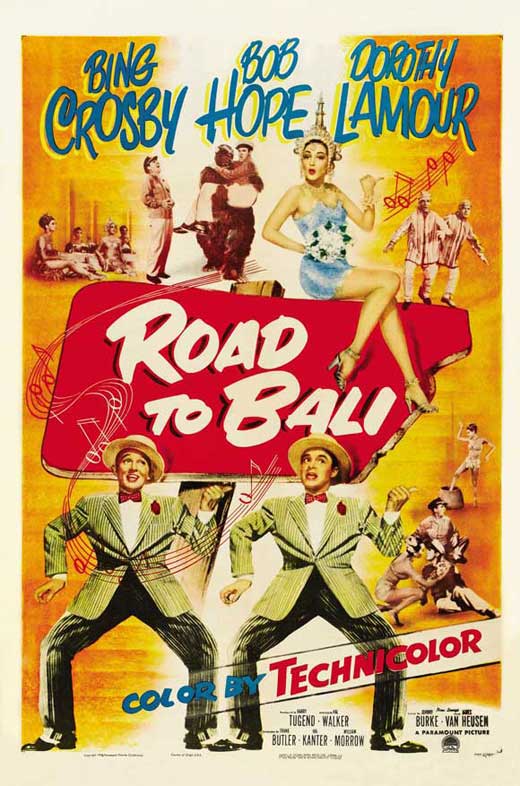
Road to Bali (1952) Poster
ROAD TO BALI (1952) C
dir. Hal Walker

Bob Hope and Bing Crosby had no interest in refining the Road formula from the start, and there was no reason for them to begin by the sixth go-around. As always, this is a movie where they just run through a series of backlot scenery to see what might rattle.

Road to Bali sticks to the familiar motions. We get tropical-centric wisecracks, fourth-wall nudging. And, as ever, the glamorous Dorothy Lamour. Once again wedged between two men-children who treat commitment something like malaria. Something you catch by accident that might also kill you.

The adventure begins with the duo stranded in Australia. Then they wander their way to Bali—or at least Hollywood’s approximation of it. Assembled from palm fronds and papier-mâché volcanoes. They get to play white savior by rescuing Princess Layla (Lamour) from being sacrificed by a Balinese cult.

Hope and Crosby still know how to work each other. That old vaudeville reflex remains intact—step on the line, glance sideways, move on to the next bit. What makes this film drag is how much it relies on dated material that would only make sense if you were around in the early ’50s. Celebrity drop-ins, pop references, its smug self-awareness.

The film ends up playing less like a joke machine than something to idle with. It tends to slide past punchlines more often than it hits them. With that said, there’s still a sense of comfort in how sealed-off it feels. Like its primary concern was amusing the people already in the frame. Anyone watching from home is welcome to jump on board with them. Or not.

For a casual viewer, the thinness shows up quickly. As an artifact of mid-century, Technicolor studio comedy, it has its curiosity value. Hope and Crosby move through it with the relaxed poise of a vaudeville team so stubborn about sticking around that they will only leave the stage in the event of a fire. Only for aficionados of vintage Hollywood.

Starring: Bing Crosby, Bob Hope, Dorothy Lamour, Murvyn Lee, Peter Coe, Leon Askin, Carolyn Jones, Michael Ansara, Harry Cording.
Not Rated. Paramount Pictures. USA. 91 mins.
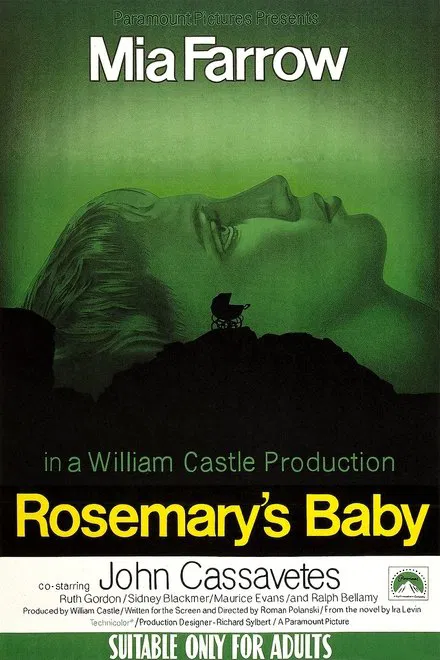
Rosemary’s Baby (1968) Poster
ROSEMARY’S BABY (1968) A
dir. Roman Polanski

Rosemary’s Baby is horror that whispers. It sidles in through ordinary things. In doctor’s prescriptions, wallpaper that seems too pink, casseroles that you didn’t want, in neighbors who always seem to be hovering over asking if there’s anything you need. In 1968, that wasn’t just an unusual approach to horror—it practically felt like mutiny. You won’t find blood on the walls or sudden lurches from the shadows. There are no beasts waiting behind the curtain. The fear dribbles in much more slowly, feeling like an itch underneath the skin. You watch this getting an unshakable sense that something off, even while everyone within the film insists everything is fine. Komeda’s score floats over it all, like a sweet lullaby that gradually curdles into something sour, as if it already knows how it’s all going to end.

Mia Farrow plays Rosemary like she’s apologizing for existing. She is newly married, newly pregnant, and moving into a Manhattan apartment. Her husband is Guy (John Cassavetes), an actor. He is ambitious, restless, and pliable in exactly the wrong ways. They meet their neighbors almost immediately—Minnie and Roman Castevet (Ruth Gordon, Sidney Blackmer). They’re friendly—in fact, unsettlingly so. They’re talkative, in a tone that seems strangely possessive and overbearing. They’re seemingly forever turning up with wine, advice, and invitations.

Polanski shoots this film like he’s screwing the lid on a jar tighter and tighter. So tight that the glass starts to crack. He doesn’t let anything hurry. The camera knows how to hold its breath. Everything looks calm until it doesn’t—silences stretch, smiles hang too long, every edge is buffed smooth just as it’s about to splinter. Farrow barely raises her voice, and that’s the horror. She listens. She nods. She gives in. When she resists, it’s a flicker—too soft for anyone to notice, too easy to smother. If she asks, she’s drowned out. Told to lie down. To trust. To leave it to the experts. The walls might as well be listening. The neighbors are always a step ahead. Even Guy starts to sound like he’s operating by a different playbook.

Rosemary’s Baby turns pregnancy into paranoia, marriage into theater, and Manhattan into a carpeted maze with no way out. The real horror isn’t in the trap that’s slowly springing shut—it’s the realization that it already did. And you missed the sound.

Starring: Mia Farrow, John Cassavetes, Ruth Gordon, Sidney Blackmer, Maurice Evans, Ralph Bellamy.
Rated R. Paramount Pictures. USA. 137 mins.
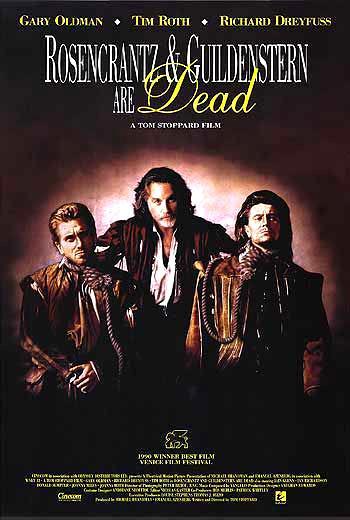
Rosencrantz and Guildenstern Are Dead (1990) Poster
ROSENCRANTZ AND GUILDENSTERN ARE DEAD
(1990) B+
dir. Tom Stoppard

Two men—possibly the most famous footnotes in all of literature—are forever bound to someone else’s tragedy, while the tragedy of their own is dispatched in a single line by an unnamed messenger: “Rosencrantz and Guildenstern are dead.” Here, their story is finally told—though it’s strictly through an absurdist lens. Tom Stoppard, adapting his own play, directs this clever side-spin through Hamlet as a kind of exasperated existential crisis.

Stoppard lifts Shakespeare’s two near-anonymous couriers out of the margins and leaves them to fret, babble, and volley logic puzzles back and forth. And they do so relentlessly until destiny remembers that it’s supposed to swallow them whole. Gary Oldman and Tim Roth—so young that you want to ruffle their hair and tell them it’ll all work out—play these doomed tagalongs like a marooned vaudeville act.

They open the film wandering through a dusty landscape, flipping coins that never land wrong and wondering aloud if choice is real or if it’s just a cruel rumor. Occasionally they stumble into Hamlet proper—a king murdered, a prince unraveling, courtiers whispering behind arras curtains—but mostly they miss the larger tragedy, too busy debating whether they exist in the first place. Richard Dreyfuss shows up as the Player, the film’s third great presence, the ringleader of a traveling troupe whose trade is make-believe and who provides amused and faintly sinister commentary on the nature of performance and fate.

The dialogue isn’t out there to solve life’s mysteries. But it punctures holes through them and lets the air hiss out in little philosophical chuckles. Wordplay becomes riddles, riddles collapse into nonsense, and the nonsense loops back to something that almost makes sense. That is, if your brain is willing to entertain such things.

The film is undeniably self-amused, but with dialogue and performances this sharp, I found myself strung along with a smirk just as tight as I’d imagine the director himself had. Shakespeare devotees will savor the echoes. Skeptics might only see a daisy chain of circles. But even viewers who don’t have a particular stake in Shakespeare ought to find some amusement in watching two nobodies poke at the cosmos with a stick, with plenty to laugh at before that inevitable end arrives, which comes exactly as the Bard promised all along: unremarked and unfair.

Starring: Gary Oldman, Tim Roth, Richard Dreyfuss, Iain Glen, Donald Sumpter, Joanna Roth.
Rated PG. Cinecom Pictures. UK-USA. 117 mins.
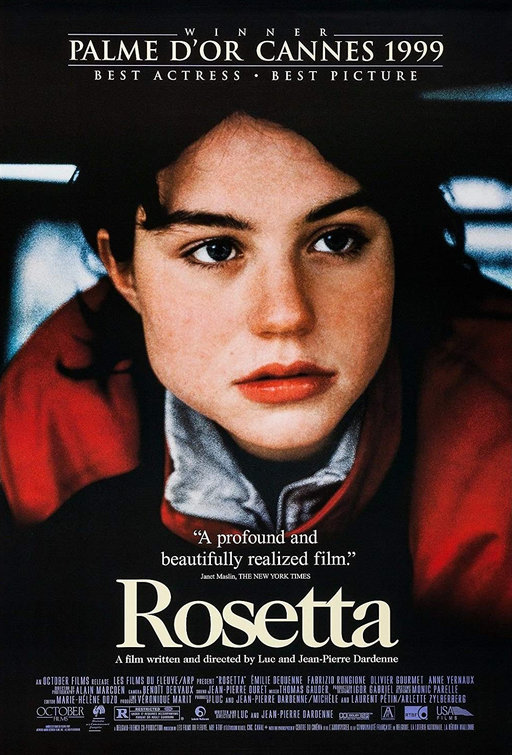
Rosetta (1999) Poster
ROSETTA (1999) B+
dir. Jean-Pierre Dardenne & Luc Dardenne

A movie shot with a restless handheld camera and no soundtrack. A movie that pushes realism so hard you can feel it scrape. Bleak, tight, unblinking. Not a film you can tune out. Cannes handed it the Palme d’Or. Émilie Dequenne also walked away with Best Actress for playing the downtrodden title character—a performance that doesn’t ask for sympathy and wouldn’t know what to do with it if it came.

Rosetta is 17, trapped in a trailer with her alcoholic mother. She drags her home from benders like it’s another chore. Food is scarce, so she fishes trout from a stream. She scours for under-the-table jobs, most of which vanish before they begin.

The film opens just as her latest job is ending: a factory drops her after a trial run. She reacts with startling violence. Later, she muscles her way into a waffle stand job and edges toward a tentative friendship with Riquet (Fabrizio Rongione). When she finds her position at the establishment is on the brink, she betrays Riquet behind his back and takes his spot. He’s stung by it, but not enough to cut her off—they continue spending time together, awkwardly but persistently.

Her mother (Anne Yernaux) refuses to admit she’s an addict, and their fights keep escalating. Rosetta’s stubbornness turns into self-harm—at one point she plunges into a river and nearly drowns. Rosetta could crawl her way out of her situation if she would take government welfare or accept charity, but she rejects both. She wants work. She wants to earn. This is the bootstrap myth brought to its breaking point.

Though this isn’t a political film, that aspect is present in the subtext—obvious and inescapable. Rosetta is ultimately only guilty of one thing: following the rules she was taught. To work hard, take nothing, and pay for everything. The folly is that nobody, not even the most successful people in society, is able to do that. This is a film that is unsparing. Far too bleak to recommend to anyone casually, but it’s rare in how it honors its subject without pity. Yet it’s a tragedy: despite everything she gives, nothing is ever enough.

Starring: Émilie Dequenne, Fabrizio Rongione, Anne Yernaux, Olivier Gourmet.
Not Rated. Cinéart. Belgium–France. 95 mins.