THE FADED SPOTLIGHT

by Michael Lawrence

List of "W" Movies


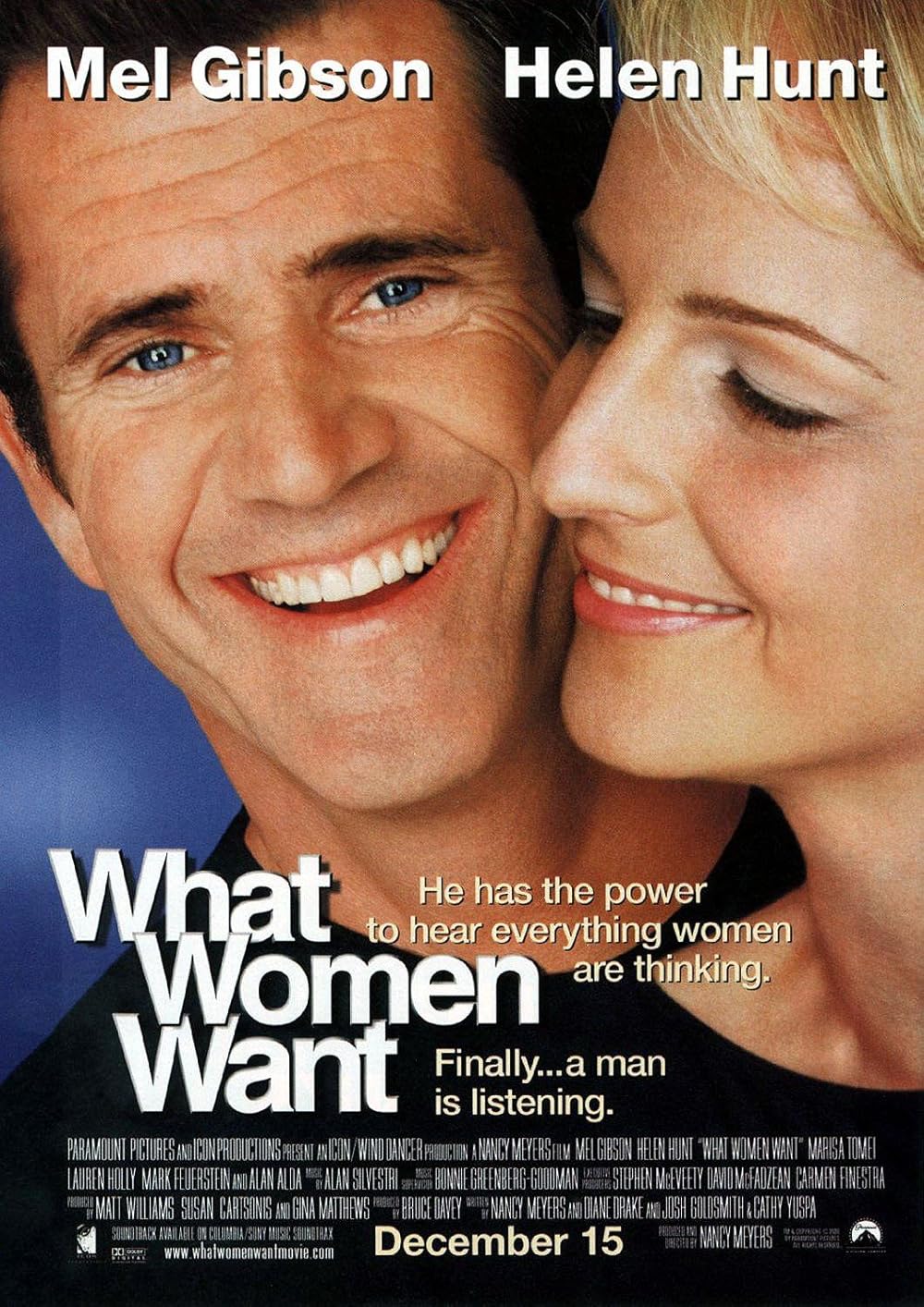
What Women Want (2000) Poster
WHAT WOMEN WANT (2000) C+
dir. Nancy Myers

Mel Gibson plays Nick Marshall. He’s a Chicago ad exec who swirls a martini in one hand and massages his ego with the other. He’s also a classic chauvinist—the kind who thinks Sinatra’s idea of romance was a life philosophy, not a lyric. One night, while testing out women’s products in his bathroom, he fries himself with a hairdryer. When he comes to, he can suddenly hear women’s thoughts. The universe thinks it’s teaching him something. But he figures out how to use it as a weapon to give him an edge at work.

What’s off putting is how the movie itself seems to cheer him on as he spies, manipulates, seduces, and plagiarizes his way through promotions. Sure, there’s a lesson he’s supposed to learn about the opposite sex by the end. But it’s not so much a reckoning as it is a rewards program. He continues to sin and smile, and—to top it all off—he gets the girl.

And not just any girl. She’s Darcy (Helen Hunt), the one woman sharp enough to keep up. Which, naturally, makes her the next casualty of affection. They’ve got the kind of chemistry two experienced leading actors are expected to generate, but it mostly feels like the kind you’d bottle and sell. Why they’d want each other, or why the universe would think they belong together—well, that’s anyone’s guess. But the real answer is “plot contrivance.”

Every so often, the film stumbles towards a sobering moment. The darkest thread belongs to Judy Greer’s character. Nick overhears that her inner thoughts are drifting toward suicide. It’s admirable when movies actually face something that raw and pervasive. But here it shows up like a truth the movie can’t absorb—a flash of sobriety in something too slick to hold it. Too proud of its sheen. The key scene of this movie, after all, involves Gibson trying on tights and getting caught by his grown daughter.

What Women Want wants to be screwball and sincere, but it mostly ends up flat. Gibson can sell that smirk in his sleep, and maybe he does. The sets look polished and expensive. These plus the slick pacing, and you’re left with a movie that’ll give you the requisite amount of surface-level entertainment. But for a movie ostensibly about a man who’s supposed to learn to listen to the fairer sex, it sure seems to love the sound of his voice.

Starring: Mel Gibson, Helen Hunt, Marisa Tomei, Alan Alda, Ashley Johnson, Mark Feuerstein, Lauren Holly, Delta Burke, Valerie Perrine, Judy Greer, Sarah Paulson, Ana Gasteyer, Lisa Edelstein, Loretta Devine.
Rated PG-13. Paramount Pictures. USA. 106 mins.
What’s Cooking? (2000) Poster
WHAT’S COOKING? (2000) C+
dir. Gurinder Chadha

Thanksgiving. The holiday that looks like harmony until families make the mistake of opening their mouths to talk in addition to opening them to eat. The movie jumps between four households—Latino, Jewish, African-American, Vietnamese-American. A microcosm of America’s so-called melting pot, reheated for the holidays. Each with its own rituals. Each with its own chestnuts. The families don’t meet, but the echoes across their conversations are the same. Love. Guilt. Hunger. All the usual suspects. What’s Cooking? depicts Thanksgiving as both a cultural kaleidoscope and as a collective migraine.

Each household has its own storm brewing. A Jewish couple trying to smile through their daughter’s coming out. A Vietnamese father furious that his son’s politics don’t match his own. A Latinx mother not only bracing for her ex-husband’s return but having to face the woman he brought along with him. An African-American family juggling secrets that seem to slip out in between blessings. The film’s tone jumps from light ribbing to domestic melodrama to soap to sincerity. Sometimes all within a single scene. This movie has it all. Maybe too much.

The cast is uniformly good, maybe better than the material. Everyone’s giving the old college try. Even when the script seems to run too hot for them as they try to cram as much material as possible in less than two hours. This is a movie that doesn’t have time to stop and pause—it just changes arguments. It gets exhausting. It’s impressive that what should’ve been a jumble feels this fluid. Four unrelated conversations, happening simultaneously, stitched into something that plays like one long, chaotic meal.

If the film has a flaw, it’s saturation. There’s so much conversation to sift through that by dessert, you’re full of feelings, not food. Still, the ambition’s hard to miss. Chadha’s juggling culture, conflict, and comfort food with both hands. There’s too much noise, too many feelings, and people do far more talking than listening. But that’s family for you. And that’s also Thanksgiving.

Starring: Kyra Sedgwick, Lainie Kazan, Maury Chaykin, Julianna Margulies, Estelle Harris, Ralph Manza, Mercedes Ruehl, Victor Rivers, Douglas Spain, Isidra Vega, A Martinez, Alfre Woodard, Dennis Haysbert.
Rated PG-13. Trimark Pictures/Lions Gate Films. UK/USA. 109 mins.
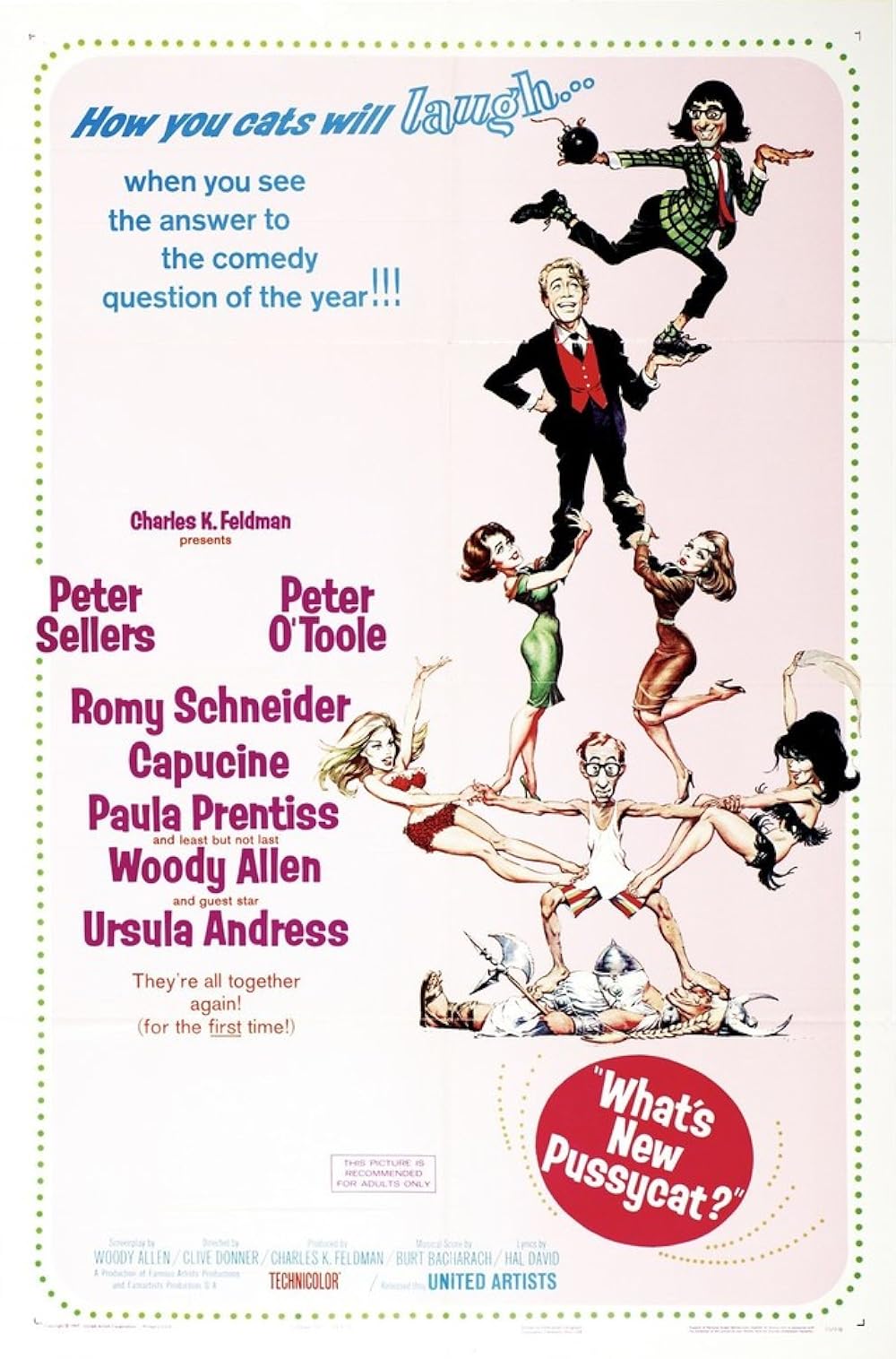
What’s New Pussycat? (1965) Poster
WHAT’S NEW PUSSYCAT? (1965) B−
dir. Clive Donner

What’s New Pussycat? is a swinging slab of ’60s farce that ricochets between the absurd and the incoherent with the energy of a martini-soaked pinball. It’s best remembered as Woody Allen’s first produced screenplay—and his last for someone else. The experience was apparently so maddening that he swore off writing for other directors entirely. Watching this, you can see why.

The film is enthralling in the sense that it never stops moving. Where it comes up short is that it never makes sense. There’s a funny idea buried in the swirl: Peter O’Toole as Michael James, a serial flirt who’s genuinely trying to quit cheating on his fiancée (Romy Schneider). His answer is therapy. But this only ushers in a bigger problem—his therapist, Dr. Fassbender (a stringy-wigged Peter Sellers). Not only is he far more unhinged and sex-obsessed than Michael, but instead of curing his patient’s lustful escapades, he joins him in the chase.

The rest unfolds like a pop-art carousel of infidelity and farce. Fast cars. Jealous lovers. Subplots everywhere—enough to fill an Advent calendar, maybe two. The film climaxes in a hotel where every room’s hiding a different affair, a Benny Hill–style chase breaks out with go-go dancers, and the cast seems to multiply faster than Tribbles. It toys with fidelity, repression, masculine vanity—and then smothers the lot in zany slapstick. It’s funny, frantic, mostly exhausting. The ’60s in full buzz—offbeat, overbright, and running on vapor of questionable origin.

It never sits still long enough to be smart—just long enough to show off. Still, you can’t quite look away. Half the fun’s watching the actors fight for balance while the camera staggers around like it’s drunk. The story barely holds together, but you stick around anyway—waiting to see whatever next lunatic thing it might hurl your way. It’s a mess. I like it that way. Maybe you won’t. But I think we can all agree on this much: that Tom Jones theme song is an absolute banger.

Starring: Peter Sellers, Peter O’Toole, Romy Schneider, Capucine, Paula Prentiss, Woody Allen, Ursula Andress, Michel Subor, Eddra Gale.
Not Rated. United Artists. France/USA. 108 mins.