THE FADED SPOTLIGHT

by Michael Lawrence

List of "A" Movies


Alan Partridge: Alpha Papa (2013) Poster
ALAN PARTRIDGE: ALPHA PAPA (2013) A−
dir. Declan Lowney

Alan Partridge doesn’t hit everyone the same way—especially not Americans. But give him a minute, let him worm in a little, and you might suddenly find you’re stuck with him. He’s a buffoon in a blazer. Serving up delusion and desperation with that unmistakably British flair.

Before this film, Partridge was already a comedy institution in the UK, going all the way back to the mid-1990s. First, there was a fake, short-lived talk show where he routinely picked fights with his guests. Then came two more series about his increasingly pathetic attempts to claw his way back on the air. His ego expands even as his career shrinks, and that—plus some very quotable, guffaw-inducing scripts—makes him one of the finest characters in modern comedy.

And now, here he is at it again. In feature form, reduced to a low-performing radio DJ in Norwich in a non-prestige time slot. When his station gets bought out, Alan offers to plead the case for his colleague Pat (Colm Meaney). That is, until he sees both their names on the chopping block. Cut to a whiteboard and the words “JUST SACK PAT” scrawled in Partridge-sized letters.

Pat gets sacked. Alan gets spared. And just when he thinks the mess is behind him, Pat returns with a shotgun and takes the station hostage. At this point, Pat doesn’t know that Alan sold him out—yet—and Alan becomes a kind of middleman. Part negotiator, part mascot, part unintentional folk hero as the hostage crisis becomes a national event. Alan, of course, makes it all about him. What all this attention might do to revive his career.

Coogan’s comic sense has real bite to it. He’s smooth here, tasteless there, usually leaves you with a quote that you’ll end up repeating. You rewatch his TV shows, and this movie, because he leaves debris behind. You’ll pick up jokes that you didn’t even notice detonating the first time. He’s not a character you laugh with. He’s a character you laugh at. And the best part is you don’t have to feel bad about it, because he is—as the British would call him—a prat, and he deserves your scorn. Partridge doesn’t get a redemption arc. He doesn’t deserve one. He is the joke. And he’s glorious.
Starring: Steve Coogan, Colm Meaney, Felicity Montagu, Simon Greenall, Darren Boyd, Monica Dolan, Tim Key.
Rated R. StudioCanal/BBC Films. UK. 90 mins.
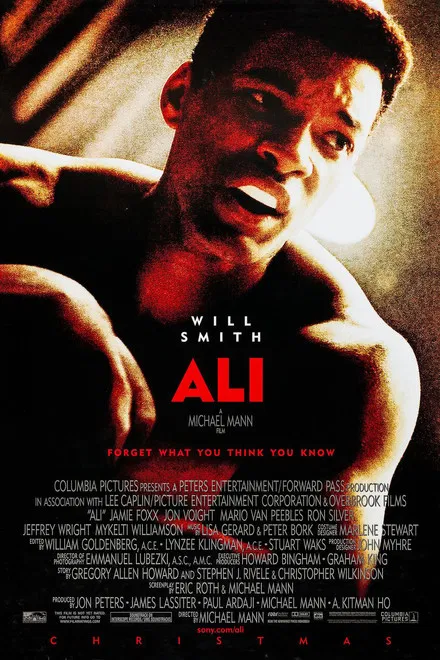
Ali (2001) Poster
ALI (2001) C
dir. Michael Mann

Michael Mann makes Ali look terrific. That’s never the issue. All the surfaces shine, the lighting behaves, the big moments—all the milestones—are slotted in the exact spots you’d assume they would be. The big chapters all show up right on time: Liston, Vietnam, Nation of Islam, Zaire. They’re staged with reverence and a kind of hermetic gloss. It all feels like a guided tour. Nothing feels discovered.

Which is disappointing, because Mann’s style is usually far sharper than this. Like Heat, for example, had a low electric pulse running just under the surface and fictional characters with complex motivations. Here, he has a ready-made charismatic and complex figure plucked from history.

And the sad part is that Ali never needed cinematic embellishment. He was already cinematic. As much as Mann understands the spectacle that surrounded him and the key events of his life, he doesn’t capture Ali’s crackle. Not the wit, not the mischief in his eyes as he talked circles around the world. For a film nearly two and a half hours long, it can’t even penetrate beyond the surface gloss.

But the real trouble might just be the casting. Will Smith is good as Ali—almost too good, in the technical ways. He nails the cadence, the shoulders, the patter. They even pinned back his ears. But there’s a carefulness to it. You can see him tending to the performance. He’s saluting him instead of playing him. It’s a respectful impression, but the role really needed someone to inhabit it.

Mann seemed too nervous about letting anything get unruly. Even the fights play like dioramas. They’re beautiful, over-finessed, choreographed to the millimeter. Motion without danger, punches that feel timed to the lights rather than the hit.

Here and there, something genuine peaks through. There is a crooked line reading, or a stray moment where Smith’s natural charm syncs with Ali’s bravado. But it’s brief. Too brief for someone who built his own mythology in real time. Right in front of audiences who couldn’t look away.

A great biopic opens a door. Ali polishes the doorknob and walks you down the hallway, past a professional, Ali-centric photo gallery. It reveres the man so thoroughly it barely wants to get near his psyche. In the end it feels like this movie keeps you at the same polite distance that you’d get from a museum piece labeled “Do Not Touch.”

Starring: Will Smith, Jamie Foxx, Jon Voight, Mario Van Peebles, Ron Silver, Jeffrey Wright, Jada Pinkett Smith, Mykelti Williamson, Paul Rodríguez.
Rated R. Columbia Pictures. USA. 157 mins.
Alice (1988) Poster
ALICE (1988) A
dir. Jan Švankmajer

In Czech.

You won’t find a gentle opening with Švankmajer’s Alice. It bludgeons you quick—like a half-rotted dream you haul out from under the bed and hit with a flashlight. This is still an adaptation of Alice in Wonderland. More or less the way Lewis Carroll left it. Except here it feels like it’s been knocked around. Warped. The angles shifted, details off-kilter, whimsy stripped out entirely and replaced by something colder. Stranger. Macabre. Enchantment and the grotesque share the same frame. Neither one giving the other any space. They end up pressed together whether they feel natural together or not.

Carroll is still in there, but Švankmajer runs the story through his own crooked logic. The White Rabbit gives the game away early. Forget the dapper vested version from the Disney cartoon—hopping through a picturesque forest, muttering something about being late. Its eyes stay frozen open in this kind of unsettling, bug-eyed glare. The belly’s split open down the middle, and wood shavings keep spilling out. Sometimes it crouches over and packs them back in with its hands. Other times it sits there eating a fresh bowl of new shavings with a spoon like it’s breakfast cereal. The pocket watch is kept in that same torn-open cavity.

The film keeps throwing you off balance. Something jumps at you, then it’s suddenly funny, then you get that little crawl up your spine. Kohoutová plays Alice with that open, unreadable stare kids have before they learn how to hide their emotions. She moves between normal and something slightly eerie. She drinks the mysterious liquid that makes her shrink but it’s actual black ink this time—not a more edible-looking elixir. She does get tiny, but only by morphing into a stop-motion doll. A kind of porcelain thing—glassy eyes, stiff little jerks of movement, everything looking ready to crack. You’d assume the thing was haunted if it stared at you too long.

Švankmajer keeps tossing out these little visual shocks. A drawer packed with writhing socks. A caterpillar, shriveled and badly preserved, sprawled on a heap of bones as if they’re souvenirs from God knows whatever it gets up to. I’m only giving up pieces of what this film is offering here. There is so much more. And the movie doesn’t slow down with the weirdness. It hits you with a kind of restless, pent-up energy. Like something that’s been held back and is suddenly allowed to run.

This isn’t Alice for kids, unless the kid is the type who thinks nightmares are worth keeping. It’s not exactly built for most adults, either. This is dark fantasy, plain and simple. For the people who laugh first at the absurd and then lean in closer to the things on the screen that look a little misshapen.

Starring: Kristyna Kohoutová.
Not Rated. First Run Features. Czechoslovakia–Switzerland–UK–West Germany. 86 mins.
Alice in Wonderland (1951) Poster
ALICE IN WONDERLAND (1951) A–
dir. Clyde Geronimi, Wilfred Jackson, Hamilton Luske

Walt Disney and Lewis Carroll aren’t exactly a natural pair. They have two different instincts. Carroll treats logic like a personal plaything, while Disney always prefers tidy through-lines with a lesson at the end. But the collision works. Carroll’s cheerful madness stays put, while Disney of course leaves his gloss all over this thing.

The film opens with Alice lying there in the grass. She’s almost asleep. Her eyes half-shut and her brain is drifting off while her sister drones on and on through a history book. Then there’s something that twitches at the edge of her vision. Alice turns. It’s a rabbit. A white one. In a waistcoat. Spectacles perched on its nose. An oversized pocket watch in hand that he’s giving the kind of look you usually reserve for a misbehaving appliance. Before she can even sit up straight, he mutters something about the time and bolts. Naturally, Alice gives the creature chase. Down the forested path and into a burrow. And then she drops into a very, very deep hole.

And she falls. Not a plunge, though. It turns gentle, almost lazy, and stretches out far longer than feels reasonable. Then finally, the floor catches up, and she’s in Wonderland. It’s not so much a destination but the world shuffled into new shapes. Where sizes of things misbehave. Clocks second-guess themselves. Cause and effect pass each other like strangers.

The animation still has the traditional Disney finish, but seems to be enjoying itself as it maintains Carroll’s whimsy. Every creature Alice meets seems to be in the middle of something before she shows up. Singing, fussing, quirky gardening. She meets the Mad Hatter and the March Hare at their tea at a party that feels like it was engineered by a gas leak. The Queen of Hearts storms through croquet matches screaming as though volume can rewrite the rule book. And the Cheshire Cat materializes whenever he pleases, leaving only the grin to explain anything. His job appearing to be to tell Alice that she’s nowhere close to getting herself home.

And the songs—of course they’re here. Pushy little things. “I’m Late,” “The Unbirthday Song,” “Painting the Roses Red.”

What holds the film together isn’t the story but a free-flowing kind of visual fever logic. Flowers with operatic voices. Cakes that shift your size. Flamingos swung like croquet mallets. Scenes pile up. Conversations skid sideways. And while this isn’t Disney at its neatest, it might be the studio at its boldest and strangest. At least among the mainline animated features. (There’s still Return to Oz.)

And when Wonderland is through with Alice, it spits her back into daylight. Not wiser, not shaken. She’s barely changed. And that follows, since Wonderland was never built for transformation. Only sensation. Maybe escape, but probably not. It’s a place you hit like a thought. It flares up, then fades. Before you can even get a hold on it.

Voices of: Kathryn Beaumont, Ed Wynn, Richard Haydn, Sterling Holloway, Verna Felton, Jerry Colonna, Bill Thompson.
Rated G. Walt Disney Productions. USA. 75 mins.
Alice, Sweet Alice (1976) Poster
ALICE, SWEET ALICE (1976) B
dir. Alfred Sole

A Catholic-soaked scare story disguised as neighborhood melodrama. It lives in a very specific Jersey Catholic gloom. Early 1960s. Parish events in the basement, neighbors who notice everything, certain that some kids come out of the womb just born bad. Alice (Paula Sheppard), for instance, gets blamed for everything short of bad weather. Even though she’s just twelve, the adults act like she’s spent the last several decades inconveniencing everyone.

But Alice’s jealousy hits a fever pitch when her sister Karen (a very young Brooke Shields) starts getting primed for her first communion. Karen already gets the bulk of affection—but now she gets the dress, the veil, the compliments, the whole shebang.

Then Karen suddenly turns up dead. And not just plain dead. Someone in a yellow slicker and a doll mask strangled her, tucked her into a pew, and left it to burn. The figure disappears fast. When Karen is discovered, it’s pandemonium. Everyone immediately suspects Alice. Not because anyone stops to think how feasible it is, but because she just rubs people the wrong way. Things get worse for Alice when their morbidly obese landlord—Alphonso DeNoble, genuinely unsettling—tries to force himself on her. She gets away only by lashing out at his pet kitten.

The movie’s full of creaking stairs and whispered church noise. The music—big, old-world stuff—keeps trying to push scenes higher than they want to go. It all plays like a Jersey take on an Italian giallo, even though Sole said he hadn’t seen any. Some moments hit harder than you expect, especially when the shot hangs just a little longer than seems necessary. Others go slack and stay there. It’s a patchy film. Uneven. But when it steadies itself, there’s a nerve to it you don’t often see in horror from the pre-Halloween stretch.

Director Alfred Sole is all-in on mood. The grain is loud, almost abrasive, and he’s always looking for a new angle to shoot from. The scenes that work tend to be the long, motionless ones—those stretches where the frame locks up and your eyes start drifting to the corners. Other times, the film just drops the tension entirely, and you’re left waiting for it to spark again. Which always comes around until the tension-filled conclusion.

The final twist doesn’t make a scene. It shows up fast and leaves you reconsidering everything. That kind of uncertainty plays in the movie’s favor. Fans of older American horror will understand why this one stuck around. It’s grainy but also eye-popping. Neat but also grimy in spots. An infectious devotion to it that isn’t easy to forget. I wouldn’t call it a masterpiece, but you can feel it reaching in that territory.

Starring: Linda Miller, Mildred Clinton, Paula E. Sheppard, Niles McMaster, Jane Lowry, Rudolph Willrich, Michael Hardstark, Alphonso DeNoble, Gary Allen, Brooke Shields.
Rated R. Allied Artists. USA. 98 mins.
Alien Trespass (2009) Poster
ALIEN TRESPASS (2009) C
dir. R.W. Goodwin

Alien Trespass plays like a tongue-in-cheek revival of ’50s sci-fi. It brings back the usual signatures. Flying saucers (and perhaps the strings) in plain view over the horizons, panicked townsfolk charging at the frame, aliens who seem human until they start moving like the jumpsuits they’re wearing are doing some of the work. But where the real ’50s pictures wore their low budgets openly, this one arrives polished to the point of looking vacuum-sealed. It’s all tidy and it gleams. The colors also come on strong. Like someone adjusted the saturation levels to satisfy a room full of preschoolers.

The story centers on Tammy, a waitress at—what else—a small diner, who crosses paths with the town astronomer. Or at least she thinks it’s the astronomer. It’s actually Urp, an alien temporarily renting the man’s body while he hunts down an intergalactic renegade named Ghota, who needs to consume humans in order to multiply.

Not a bad plot for a B-movie, but the film never finds an actual charge. Urp, as an alien piloting a human body, should be eerie the second he enters a room. Instead, nothing about him really registers.

Those old sci-fi cheapies would ricochet between nonsense and real unease, then plunge straight into their hysteria like doubt was a luxury they couldn’t afford. They had music that buzzed like stock cues recorded too hot. Lighting that let shadows fall in the wrong corners. And casts who locked into a straight face because the material demanded absolute faith. If anything sinks this movie, it’s how little of that faith survives.

The performances feel preloaded. Everyone seems stuck on the same setting. One where their tongues are planted so firmly in cheek that you wonder what’s preventing them from glancing at the camera and winking outright. The script doesn’t help a whole lot. It keeps tossing out those little “notice this” nudges at you.

As parody, it never really assembles itself. As pastiche, it’s cautious. You wouldn’t need to squint to spot this film’s direct influences. The Day the Earth Stood Still, It Came from Outer Space, to name a few. That plus the Cold War anxieties that those films packed in their subtexts like background radiation. But knowing where it borrows from doesn’t matter if the story never really takes hold of you.

The earlier films got away with wobbling sets and still played it straight. No apologies and no second-guessing. This one tips its head toward the genre and calls it a day. Fans of mid-century sci-fi might appreciate the gesture, even if the movie never gets its heart rate up.

Starring: Eric McCormack, Jenni Baird, Robert Patrick, Dan Lauria, Jody Thompson, Sarah Smyth, Aaron Brooks, Andrew Dunbar.
Rated PG. IFC Films. USA. 90 mins.
Alive (1993) Poster
ALIVE (1993) C+
dir. Frank Marshall

It begins in sunlight. Young men in matching blazers board an airplane. They’re smiling. They’re cracking jokes. They believe they’re immortal. That illusion ends fast. The plane drops out of the clouds and crashes on the side of a mountain. Suddenly those who survive are surrounded by nothing but silence and white.

The story’s true. It’s drawn from the 1972 Andes crash that nearly wiped out an entire Uruguayan rugby team. The film Americanizes it, though. Uruguay’s barely mentioned, and the cast might as well be from Denver. Half the team dies on impact. The rest are left to wait it out in the wreckage—with nothing to do but watch the skies for potential rescuers and count the hours in frostbite and hunger. When they run out of food, which doesn’t take them very long, and the mountain refuses to kill them fast enough, they resort to the unthinkable. They eat the dead.

The crash itself is surely one of the best you’ll find in cinema. Bodies are flung like paper, metal folds into itself, the air brims with shock and terror. But where the film falters is really as soon as someone opens their mouth. The dialogue sounds like it was written from far away. And it’s so hammy that you wonder if the screenwriter was subconsciously trying to feed them. Every emotion is spoken instead of felt. Nobody stammers. Nobody hesitates. You see how their breath hangs in the air, but you imagine them sitting in their heated trailer between takes. They deliver despair like they’re taking stage direction. And the film has an incessant need to keep stopping to explain its own enormity, as if afraid we can’t suss that out for ourselves. Fear is not something that needs explaining.

Frank Marshall directs with competence but no conviction. You can sense him trying to steer the horror toward something inspirational—damnation with a halo on top. Like he wanted this to be more of an uplifting testament to faith and teamwork, where hope, not hunger, becomes the focus. That icky cannibalism stuff can stay if it brings in the looky-loo macabre hounds. But even that turns into something symbolic—sin without the mess.

You come to this story expecting dirt, tremors, madness—something that leaks. Instead, everything feels packaged for survival posters and late-night cable. The story itself is immortal: people stripped of civilization until they start eating its remains. The film, less so. You feel the cold, believe the hunger, but never quite the delirium. Alive wants transcendence, but survival isn’t transcendent. It’s desperate, filthy, and human. Alive is quite watchable but it’s frustrating. A survival movie that tries to sanitize one of mankind’s most unforgivable acts.

Starring: Ethan Hawke, Vincent Spano, Josh Hamilton.
Rated R. Touchstone Pictures. USA. 127 mins.
All About Eve (1950) Poster
ALL ABOUT EVE (1950) A
dir. Joseph L. Mankiewicz

All About Eve looks classy at first glance until you realize everyone’s reaching for the same knife. Bette Davis shows up in full prowling mode as Margo Channing. A superstar stage actress and woman who’s spent decades treating the stage like a private kingdom. Backstage or out front, the air molecules in the room seem to rearrange themselves. She’s “forty,” or close enough for the number to sting. And lately she can hear the applause thinning, like someone’s nudging the volume down. She once breezed through ingénue roles without thinking. Now the parts written for women her age are drifting toward the matronly sidelines.

Eve Harrington (Anne Baxter) shows up looking fragile—soft voice, perfect tremble, a backstory you could iron. Margo buys it. She starts asking Eve for small favors, and before long Eve is kept around just for the company. And she does prove to be helpful, eager, available on command. Or at least that’s the performance. Eve’s real work is beneath the surface and is much quieter and deeper. She’s there to observe Margo. To absorb her essence. Her stance, her voice, her acting style. How the air molecules in the room seem to shift a little whenever Margo walks in.

It takes Margo a long minute to realize any of this is happening. And by the time it does, Eve’s name is already being floated for roles that—only a breath ago—would’ve gone straight to Margo.

Baxter keeps Eve cool, unruffled, almost impossibly smooth. Even Eve’s warmth feels like something she practices in front of the mirror at home before taking it outside. Davis, by contrast, doesn’t blink. She snaps off those lines so sharply you can watch the people around her pull themselves a little straighter. Her Margo is sharp and a little oversized for the room, and she knows exactly what the business does to women once they age into her bracket.

George Sanders turns up as Addison DeWitt, not quite the narrator but close enough that you start listening for his verdicts. He tosses out little observations that pass for harmless, until you circle back later and realize that it scratched you. He mostly stays in the background, wearing that dry little smirk of his, and simply watching.

Marilyn Monroe also turns up briefly. Early days for her career, when what she had on camera came more from instinct than technique. She’s in only a few scenes, but the clarity’s already there—the way she holds them. The camera keeps catching her. Like the scene had other plans, and she just quietly overruled them.

Joseph L. Mankiewicz takes his own script and lets the wit stay brisk, sharp, and unapologetically unsentimental. The dialogue comes out bright and clean, but there’s steel in it. Half of the lines get a laugh on impact. The other half wait a few seconds before they jab you in the ribs.

All About Eve is a classic, but it’s not its natural charm that gives it its edge. It’s the cut underneath. The film pinpoints the moments actors fear most—when the spotlight begins to slip away. And when that slip comes, Margo recognizes it. Graceful exits were never exactly her style, but she can still tell when a fight would accomplish nothing else except leave dents. So she steps back. On her terms. Not pushed or defeated but with her heels on and her dignity unruffled. Left with nothing else but to trust the floorboards to remember, even if her audience forgets.

Starring: Bette Davis, Anne Baxter, George Sanders, Celeste Holm, Gary Merrill, Hugh Marlowe, Thelma Ritter, Marilyn Monroe.
Not Rated. 20th Century Fox. USA. 138 mins.
American Splendor (2003) Poster
AMERICAN SPLENDOR (2003) A
dir. Shari Springer Berman, Robert Pulcini

Meet Harvey Pekar (Paul Giamatti). File clerk, professional grumbler, accidental cult hero. When we first meet Harvey, he has no voice—laryngitis from years of barking at the world. Then he gets an idea that sounds almost brazen in its obliviousness: why not turn his dead-end life into a comic book? Lucky for him, his buddy is famed underground artist Robert Crumb, who thinks it’s worth drawing. And suddenly Pekar, the file clerk who never quits his day job, becomes a cult hero. Not exactly the kind that pays the rent. But it does land him a handful of Late Night appearances, where he uses David Letterman’s stage not to play along, but to roast the host mercilessly into a pile of ashes. It’s a hit, of course.

Judah Friedlander is hilarious as Toby, a self-proclaimed “genuine nerd” whose off-kilter timing feels like it belongs in a museum of awkwardness. Hope Davis plays Joyce, Harvey’s fan-turned-partner, whose weary tenderness and sharp edges prevent her from simply disappearing into Pekar’s shadow.

And then the movie pulls off its best trick: the real Harvey shows up. Not just him, but also the real Joyce and Toby. They’re like uninvited guests breaking the fourth wall, providing commentary on themselves next to the actors who play them. Of course, it’s up to you to decide what in their portrayals is real and what’s dramatic license. This convention-defying device shouldn’t work as well as it does, but it feels like the movie tapped into a strange kind of magic.

This is documentary, reenactment, and cartoon panels all bled together. This doesn’t feel so much like a biography as it does like rummaging through Pekar’s head. And out of that clutter emerges an unexpectedly moving portrait of an ordinary life: funny, bruised, and honest. American Splendor doesn’t glamorize Harvey Pekar. After all, what is there to glamorize? It portrays him as a human. One steeped in peculiarities and idiosyncrasies, which is exactly what makes him interesting.

Starring: Paul Giamatti, Hope Davis, Judah Friedlander, James Urbaniak, Harvey Pekar, Joyce Brabner, Toby Radloff, Earl Billings, Maggie Moore, James McCaffrey, Madlyn Sweeten, Gary Dumm, Josh Hutcherson.
Rated R. Fine Line Features. USA. 101 mins.
American Venus (2007) Poster
AMERICAN VENUS (2007) C−
dir. Bruce Sweeney

American Venus seems to want to say something about mental illness, control, and the fallout between mothers and daughters. Noble ambitions, and even admirable for such a low-budget movie. But it never actually gets us there. It takes us most of the way and stalls. It refuses to come to a point—almost as if the screenwriter just decided to stop typing.

The movie opens with a meltdown. Jenna (Jane McGregor) is a highly trained figure skater who finds herself mid-breakdown before a competition. Her mother Celia (Rebecca De Mornay) barks orders at her to cut it out, as if that’s ever helped anyone calm down. Of course, it doesn’t. In the days following this incident, Jenna quits the sport entirely and leaves home.

The film then jumps ahead to Jenna’s college life. She’s studying in Vancouver, British Columbia. Celia, who lives in Seattle, decides she’s going to cross the border and drag her daughter back—into what, exactly, or why, isn’t clear in any logistical sense. Celia is having a breakdown of her own—an emotional wrecking ball—and perhaps bitter she’s not the beaming mother standing on the side of an Olympic stadium, watching as her daughter claims a gold medal.

Celia is sharp-tongued, entitled, and completely incapable of self-awareness. De Mornay is not exactly a Meryl Streep, but she is nonetheless commendable, playing Celia like a dormant volcano that’s been waiting to explode. The script, while clunky, does provide a certain bleak fascination in watching this character alienate everyone she meets and unravel so spectacularly. The only reason to keep watching is not because you sympathize with her, but because you just want to see how much worse she gets. This isn’t really watching a drama so much as it is cinematic rubbernecking.

While I appreciated its idea, this movie doesn’t seem to realize that’s what it’s selling. Some aspects feel pulled from someone’s genuine experience dealing with a volatile, mentally unstable parent. However, they get buried under a melodramatic script with characters who feel tragically underwritten. Celia’s arc doesn’t resolve so much as run out of road. The result is that whatever point the film was reaching for, it doesn’t even come close to getting there.

Starring: Rebecca De Mornay, Jane McGregor, Matt Craven, Nicholas Lea, Sheila McCarthy, Corey Sevier, Devon Weigel.
Rated R. Mongrel Media. Canada. 83 mins.