THE FADED SPOTLIGHT

by Michael Lawrence

List of "A" Movies


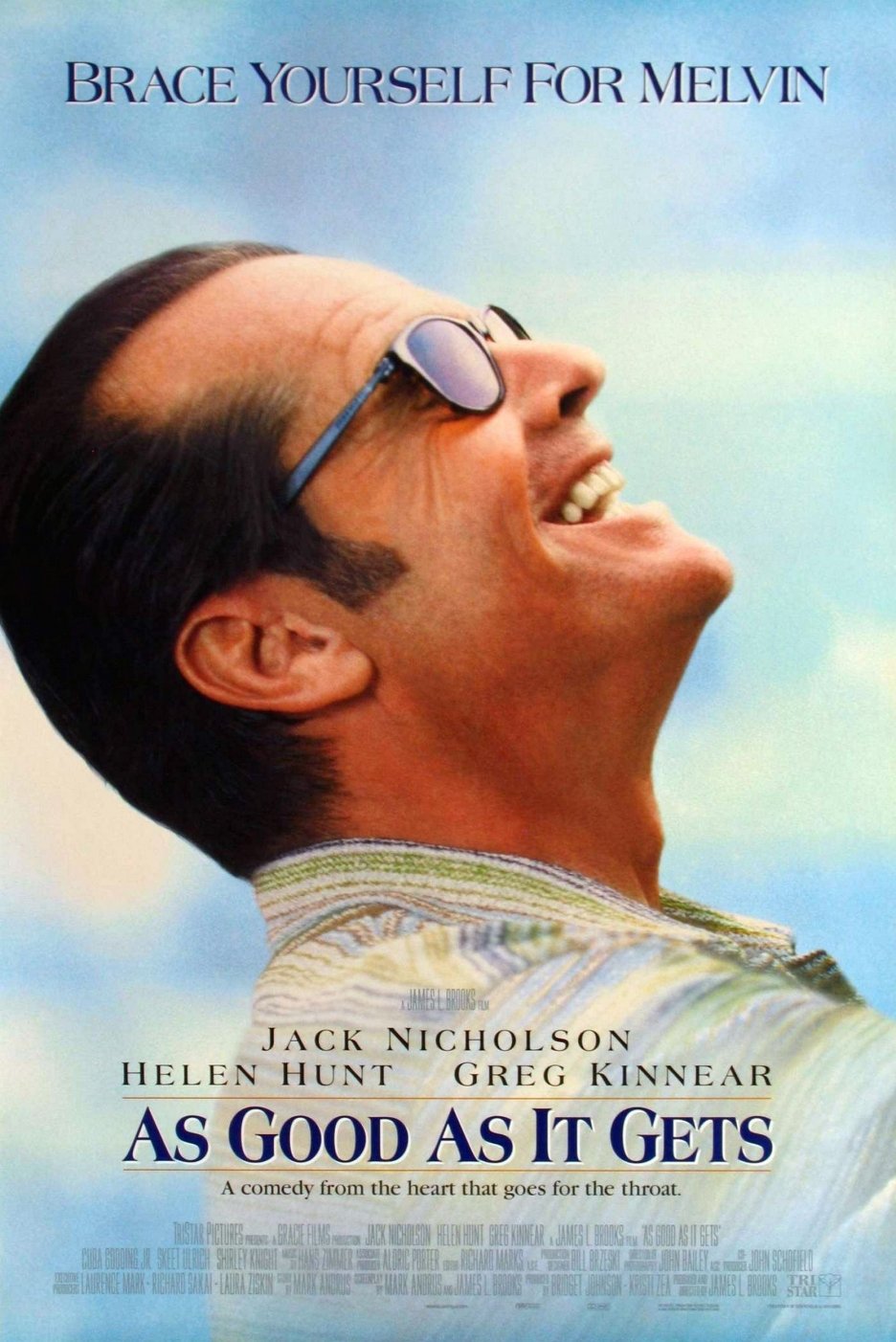
As Good as It Gets (1997) Poster
AS GOOD AS IT GETS (1997) A
dir. James L. Brooks

On paper, this is a romantic comedy. In practice, this is a barbed character piece. One that slips in and waffles between cringe and sentiment without settling into either. Jack Nicholson plays Melvin Udall, a man so proudly unpleasant that he treats decency as though it’s a personality flaw. He’s every brand of offensive: racist, sexist, homophobic, and just plain rude. And with no filter, either. Everything that slithers out of his mouth is delivered with such relish that you wonder if he’s competing with himself to find new lows.

Melvin also has other obstacles, most of them self-inflicted, while others are more hardwired. He has obsessive-compulsive disorder and lives like he’s navigating a minefield of rituals. Every step has to be rehearsed, every meal is identical. He eats breakfast at the same diner, at the same table, served by the same waitress—Carol (Helen Hunt), who happens to be the only person patient enough to tolerate him. Or maybe she’s just stubborn enough not to let anyone force her to bolt out the door. He’s clearly besotted with her, but his idea of affection is a compliment, and even those still somehow feel like a slap.

Across the hall of Melvin’s apartment is Simon (Greg Kinnear), a soft-spoken gay artist who often bears the brunt of Melvin’s hostility. But then there’s a brutal turn of events that leaves Simon hospitalized, and through a perverse twist of fate, Melvin ends up looking after Simon’s dog—the same creature that he once shoved down a garbage chute. That’s when something shifts in Melvin. Not a miracle, not even a revelation—just a fracture in the routine. Feed the dog. Walk the dog. Let it crawl into your lap and remind you, against your will, that connection isn’t optional. Melvin doesn’t transform; he erodes. Enough to let a little light through the cracks.

Jack Nicholson turns razor edges and sudden retreats into brittle charm, a performance so compelling that he earned his third acting Oscar. Hunt earned one as well, adorning her Carol with a blend of weariness and defiance—a woman who still believes in people, even when she should know better. Kinnear is gentle but never soft and finds dignity in a role that could’ve been little more than a punching bag. And then there’s Cuba Gooding Jr. as Simon’s fiery art dealer. His feet are planted so firmly in the real world that you half expect him to reach through the screen and shake everyone by the collar.

As Good as It Gets isn’t a movie about grand redemption arcs. It’s about attrition. You watch it to see someone chip away at their own armor just enough to let someone in. This is a movie that’s sharp, funny, romantic, and awkward. Infectiously watchable. As far as romantic comedies go, you might say this one is about as good as it gets.
Starring: Jack Nicholson, Helen Hunt, Greg Kinnear, Cuba Gooding Jr., Skeet Ulrich, Shirley Knight, Yeardley Smith.
Rated PG-13. TriStar Pictures. USA. 139 mins.
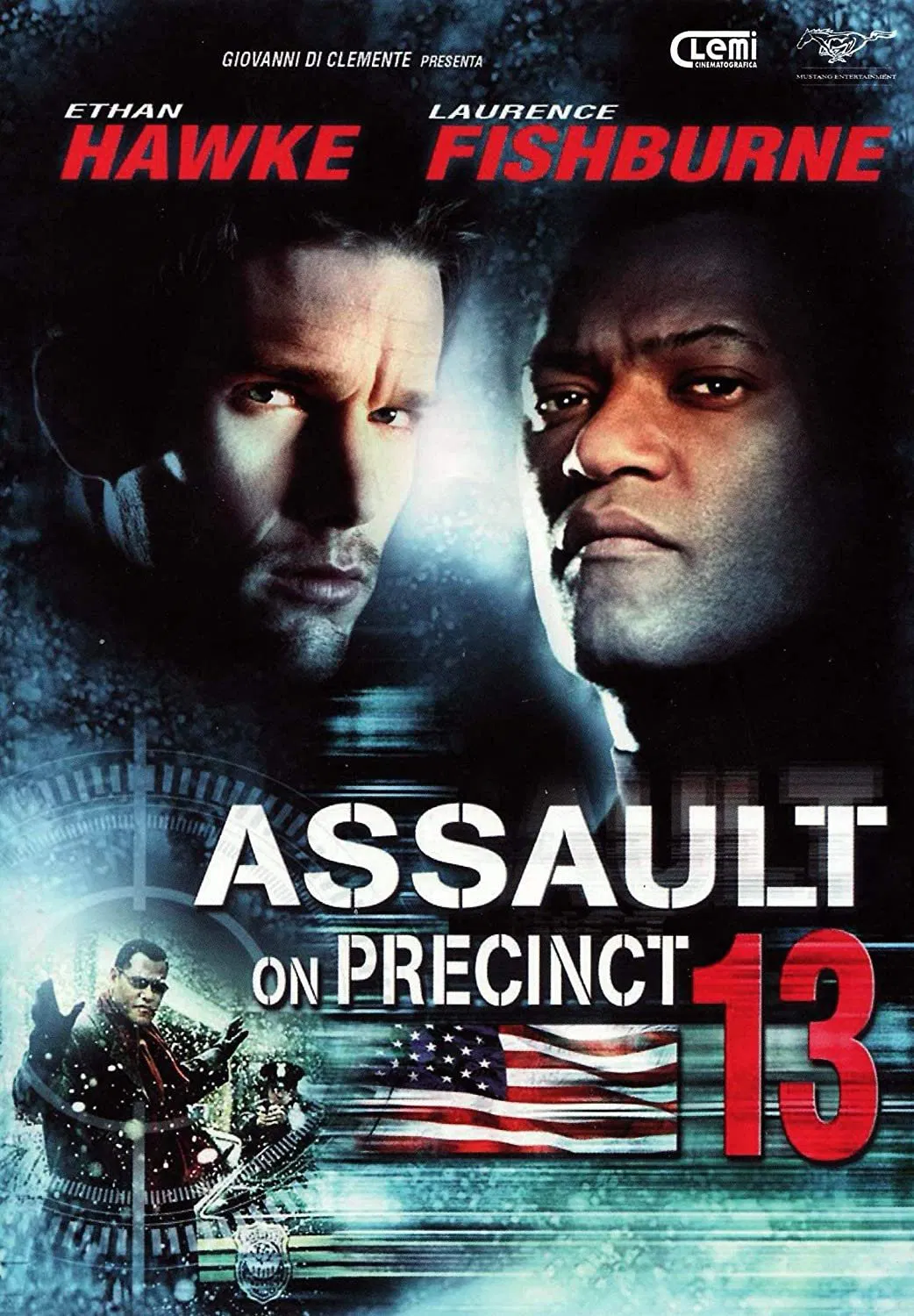
Assault on Precinct 13 (2005) Poster
ASSAULT ON PRECINCT 13 (2005) C
dir. Jean-François Richet

A reasonably polished but thoroughly unremarkable genre exercise. Assault on Precinct 13 plays like a siege thriller stripped down, then buffed so smooth that it doesn’t leave much of an impression at all. This is a loose remake of John Carpenter’s lean, nasty 1976 cult film, though you’d never guess it from the gloss. Gone is the grime, the menace. It’s been replaced with the comforting sheen of mid-2000s studio production. The result is a movie with plenty of time to kill, but nothing much to prove.

The cast at least is game. Ethan Hawke plays Sergeant Jake Roenick, a desk-bound Detroit cop with a past and a painkiller habit. It’s New Year’s Eve, and he’s babysitting a half-defunct precinct that’s just hours away from being shuttered. It should have been about as dull as evenings get, but a snowstorm outside forces a bus transporting prisoners to divert his way—its passengers getting dumped into holding. Among them is Marion Bishop (Laurence Fishburne), a crime boss with a philosophical bent and ice-water calm.

And then comes the real trouble. Masked gunmen suddenly surround the building. Not gangs but crooked cops, looking to clean up their own mess by eliminating Bishop. Bishop, it turns out, is set to testify against them, and they’ll take out anyone—guards, crooks, secretaries—who gets in the way. You end up getting the usual mechanics. Dwindling ammo, blocked exits, forced alliances. Cops and criminals working together because survival trumps loyalty. People you expect might betray you will. People who seem like they might get shot mid-sentence do. Anything that you might see coming, it comes just as surely as the counting clock ticks down. You know who’s going to make it to the final standoff.

The actors—Hawke, Fishburne, Gabriel Byrne, Drea de Matteo—do what they can, even when the script doesn’t give them much texture to work with. While the bones of a decent action-thriller are here, there’s no grit, no invention, and no real tension beyond what we’ve already seen plenty of times from better films. But to be fair, you can eat your popcorn and let it play just as well as any movie. Assault on Precinct 13 isn’t bad necessarily—it’s just entirely missable.

Starring: Ethan Hawke, Laurence Fishburne, Gabriel Byrne, Maria Bello, Drea de Matteo, John Leguizamo, Brian Dennehy.
Rated R. Rogue Pictures. USA. 109 mins.
Asylum (2008) Poster
ASYLUM (2008) D
dir. David R. Ellis

Some horror movies know they’re campy, and they wink at you. Asylum, however, takes the scenic route. It plays its premise straight just long enough to make you think it’s serious. Then it veers so hard and so suddenly into absurdity that it makes you feel like you’ve been slapped with a brick. And that’s a shame, because the premise—while nothing new for horror—might’ve worked, either as straight terror or as a horror parody. If only steadier hands had been at the wheel.

The movie opens on move-in day at a small university. A group of emotionally scarred freshmen are settling into a freshly renovated dorm that—unbeknownst to them—was once a mental asylum. And not just any mental asylum: one run by Dr. Burke (Mark Rolston), a sadistic psychiatrist with a taste for gruesome experiments. He’s long departed this mortal coil, but his ghost still lingers inside, eyeing these new trauma-ridden residents like a metaphysical all-you-can-eat buffet.

Our lead victim is Madison (Sarah Roemer), still reeling from her father’s and brother’s suicides. She barely has time to unpack before she’s strangled by her own necklace. Wild as that is, she follows horror convention and—along with her dorm-mate brethren—decides to stick around to play detective, as opposed to, of course, running for the hills.

Ensemble ghost hunting often makes for great horror, but here it’s undone by characters who come off about as deep as puddles. Their only function is to scream, run, and die. Many good horror films survive that and worse, and it wouldn’t have been so fatal here if the overall framing weren’t so amateurish. This is such a cheap and clunky-looking movie that practically none of it is redeemable. The exception is Rolston as the mad ghoul, who chews the scenery with the gusto of a man who just discovered chewing. His performance is so hammy you can practically taste the salt.

The rest only flirts with the grotesquely amusing. It’s not scary enough to work as horror, not sharp enough to be satire, and not unhinged enough to be cult-worthy trash. This is a movie that just… exists. Like a ghost that forgot what it was haunting.

Starring: Sarah Roemer, Jake Muxworthy, Mark Rolston, Travis Van Winkle, Ellen Hollman, Carolina Garcia, Cody Kasch, Lin Shaye, Joe Inscoe, Gabe Wood.
Rated R. Metro-Goldwyn-Mayer. USA. 93 mins.
At Sachem Farm (1998) Poster
AT SACHEM FARM (1998) C+
dir. John Huddles

Cinema’s roly-poly. Just like pill bugs, potato bugs, doodle bugs—this film goes by more names than it knows what to do with. At Sachem Farm is what streaming platforms seem to have settled on, but Higher Love appears on the title card, and Uncorked appears on the cover art. Some jurisdictions even call it Trade Winds. If I were to pick a completely different name, I’d go with That Agreeable Independent British Film Starring Rufus Sewell Who Goes To a Winery.

Sewell plays Ross, a young man determined to sell off his family’s prized collection of rare wines in order to bankroll a get-rich scheme involving a magnesium mine. Of course, expect him to learn that there are finer things in life than making money—yada, yada, yada. Nigel Hawthorne plays Cullen, his peculiar uncle who gets drunk and decides to destroy that entire collection. And if that weren’t bad enough, he buys a gigantic Roman column, plants it in the middle of a field, and climbs it just so he can sit on top. Meditation by way of structural beams that support nothing. Minnie Driver turns up as Ross’ cousin—a grounded counterpoint to all the winery eccentricity—adding her own quiet shrewdness to the mix.

This is a movie that doesn’t really pull you in as much as it drifts along—amiable and unobtrusive. It’s like a weekend guest who never unpacks. The editing skips and clips. It’s occasionally jarring but never aggressive.

At heart, this is a courteous little film. Its intent is on being liked while it tidily reminds you about decency, perspective, and how little material ambitions amount to in the end. Whether you buy in or not, it will have poured the wine, told the story, and sent you on your way before you’ve had time to complain.

Starring: Rufus Sewell, Nigel Hawthorne, Minnie Driver, Eric Stoltz, Amelia Heinle.
Rated PG-13. October Films. UK. 108 mins.
Atlantic City (1980) Poster
ATLANTIC CITY (1980) A-
dir. Louis Malle

Atlantic City was once a place where people came to feel important. Now they only go there to get mugged by the past. Its famed Boardwalk was once a glitzy artery that pulsed with all kinds of characters: gangsters, gamblers, the kind of dames who could make a man forget his own name. Now it’s reduced to a crumbling facade where old-timers come to sit and squint at the ocean.

That’s where we find Lou (Burt Lancaster). Lou is a man who carries himself like he once mattered. He’ll tell anyone who’ll listen that he used to be a big shot—a name people feared. But the truth is that he was never more than a footnote, even during Atlantic City’s glory days. He might have worked for mobsters who wrote the pages of the history book, but he did little more than loiter around the edges. Lou passes time in his old age running petty errands for Grace (Kate Reid), the widow of a long-dead crime boss. She treats him like the relic he is: dusty, worn down, taking up space but far too familiar to throw away. Lou endures it all because, well, what else is there?

But then, across the alleyway of his apartment, there is a flicker of vitality. A new resident: Sally (Susan Sarandon). She is young, beautiful, and methodical in her attempts to reinvent herself. She’s studying to be a croupier, practicing card flips and dreaming of working her way to Monte Carlo, where the air doesn’t smell like yesterday’s broken bets. Lou watches her from his window. She’s unaware of his gaze—too busy trying to outrun her own history, particularly that of her estranged husband, a small-time crook who stole drugs from the wrong people. But these baddies eventually catch up to her, making Sally a marked woman. This is where Lou sees his moment: to do something he’s never done before in his life and take a brave step—to help her, to step into the kind of story he’s always told himself he was part of.

If this were a different kind of movie, you’d be gearing up for the big shootout, a moral reckoning, or a sudden, brutal ending. But this isn’t that kind of movie. Director Louis Malle is after something finer, sadder, and more human. Atlantic City isn’t about a once-great gangster making a comeback. It’s about a man who was never great to begin with, grasping at a fleeting, possibly illusory shot at dignity. A movie about small lives that press against the walls of a world that’s already moved on without them. And, just for a little while, it’s also about what happens when those small lives take center stage.

Starring: Burt Lancaster, Susan Sarandon, Kate Reid, Robert Joy, Hollis McLaren, Michel Piccoli, Al Waxman, Sean Sullivan, Angus MacInnes.
Rated R. Paramount Pictures. France/Canada. 104 mins.
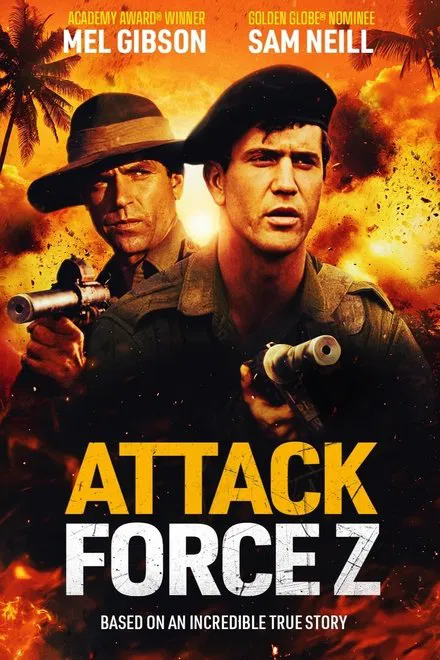
Attack Force Z (1981) Poster
ATTACK FORCE Z (1981) C–
dir. Tim Burstall

Z Special Unit was real. It was an Australian World War II outfit in the Pacific Theater that was trained for sabotage and suicide runs—the kinds of missions that you didn’t come back from. Attack Force Z is loosely cribbed from Project Opossum. Their mission: reach a Japanese-occupied island, locate survivors from a downed transport, and get them out before the locals stop smiling. One of those survivors happens to be a defecting Japanese official who has a plan that—supposedly—will end the war.

That’s a set-up that sounds like it could be turned into a taut and action-packed war picture, but the execution drifts. The movie opens at dawn with calm water, folding canoes gliding toward an ominous jungle that looks like it might shoot first. That’s the first and last time this movie feels like it stays on mission.

All this movie ever does is wander. Shots inside war offices where officers bark strategy in stiff bursts. The unit takes side errands that not only distract but drain the film’s pulse. Japanese patrols circle. Intel shifts hands. Geography dissolves. The movie’s rhythm settles into a flat march: skirmish, meeting, march, repeat. A jungle ambush. Offshore gunboat skirmishes. A few moments when the squad’s cover is about to blow. It should be exciting, but it isn’t.

Then comes a romance that’s needlessly stapled right down the middle. A commando and a local woman who do nothing but trade limp conversation and hesitant smiles. The action scenes fare better—because they’d better—but only barely. They’re competent in that “second unit knows its job” way.

Unless you’re actually interested in watching a film about this obscure World War II outfit, there’s only one reason most people would even glance at this film: a young Mel Gibson on the cover. He wasn’t yet a star, though. He’s more of a dutiful soldier waiting on orders than an action hero. Sam Neill is also in this film, also not yet broken out as a star. He brings a quiet authority as the pragmatic second-in-command, except most of his dialogue merely amounts to map directions. These two actors bring steady presences, but the film didn’t know what it had with them, and didn’t know what to do with them either.

Attack Force Z isn’t a disaster. It’s worse—vague. The mission this movie was based on was sharper, stranger, and more decisive. I’m convinced that if someone were to make a straightforward documentary about the mission, it would feel tauter and perhaps even weirder than what we get here. All we get with this version is haze. Patrols blur. Objectives blur. And even if you’re watching closely, you can never be entirely sure what you’re watching. This is a war picture without edges. Something you see once, file away, and forget you even saw. Even if you’re just plugging a gap in your Gibson shelf, I’m not sure I’d bother with it.

Starring: Mel Gibson, Sam Neill, John Phillip Law, Chris Haywood, Sylvia Chang, John Waters.
Rated PG. Tis Films/Roadshow Film Distributors. Australia. 93 mins.
Attack of the 50-Foot Woman (1958) Poster
ATTACK OF THE 50-FOOT WOMAN (1958) B
dir. Nathan Juran

For a movie about a woman ballooning to skyscraper height, Attack of the 50-Foot Woman spends most of its time on small, petty people. It pitches itself as space-age spectacle, but most of it plays like a sunbaked soap opera with a UFO tossed in for good measure. That all this culminates in a very large woman who can stomp on the men who have wronged her (whether or not she actually does), well, that’s just where the fun comes in.

Of course, Nancy Archer (Allison Hayes) starts the movie a fairly normal, Hollywood-average woman. She has money but absolutely no grip on her life. Her husband, Harry (William Hudson), is a third-rate philanderer who treats her as little more than a roadblock between himself and her bank account.

Then one night she hits the desert and finds a glowing sphere that’s large and bright enough to light up half the county. Beside it is a giant who reaches toward her with a hand that looks like a stiff papier-mâché thing built for a high-school play. She bolts home in a panic—because that’s what one would do, no matter who you are. Harry, naturally, dismisses her story as hysteria. It turns out Nancy has a history with mental illness—having just returned from a sanitarium. Harry is all too happy to use her condition as cover for dismissing her fears and for whenever he wants to slither off with his barfly mistress (Yvette Vickers).

But Nancy is insistent this time. She drags Harry back out there, and the giant shows again—this time close enough to grab her and expose her to whatever alien nonsense the movie uses as its growth serum.

The transformation takes its time. The prophecy of the movie title doesn’t fully show up until the final reel. And that’s when she’s towering over the town in a nightgown the size of a sail—stalking through the streets with eyes that look carved out of pure grievance. It’s not subtle, and the effects look like they were held together with little more than good intentions, but that’s just par for the course for aficionados of classic, cheapie sci-fi.

It wastes a good chunk on the sleazy triangle, but it all pays off in the finale: a woman who has long been dismissed, gaslit, and talked over finally taking up the space she’s owed. All fifty feet of it.

Starring: Allison Hayes, William Hudson, Yvette Vickers, Roy Gordon, George Douglas, Ken Terrell.
Not Rated. Allied Artists Pictures Corporation. USA. 66 mins.
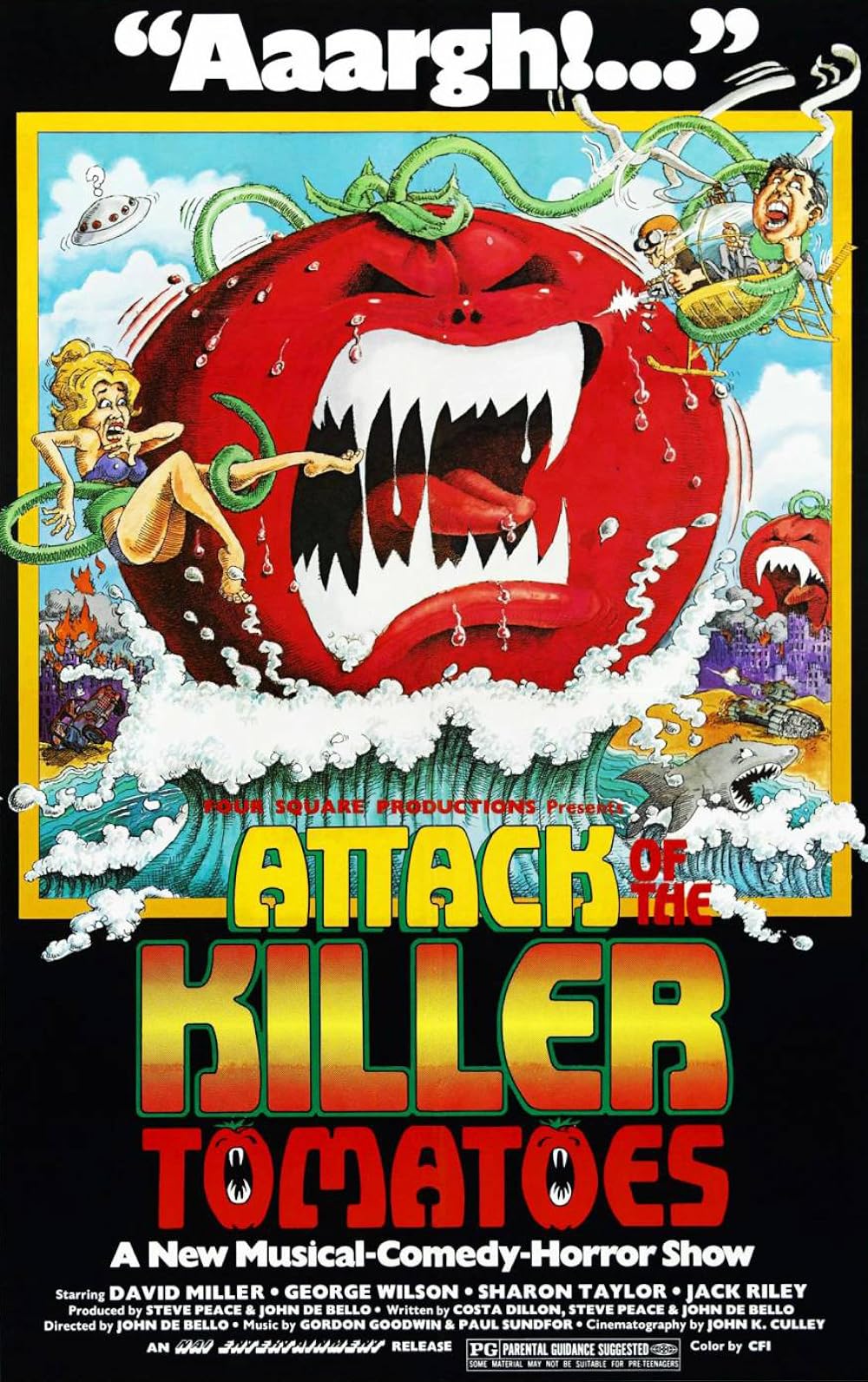
Attack of the Killer Tomatoes! (1978) Poster
ATTACK OF THE KILLER TOMATOES! (1978) B
dir. John De Bello

Plenty of films waste their breath trying to pass for clever. Attack of the Killer Tomatoes! sprints the other way. It’s riffing on the kind of cult-monster junk that clogged drive-ins in the ’50s, and it does it by going proudly stupid and aggressively cheap. No shame anywhere. It doesn’t really parody the old monster junk as much as it just hops into the mud with it and enjoys the mess.

The “plot” amounts to a nationwide panic over tomatoes. Indeed, those soft, squishy fruit blobs that can barely roll across a floor. It seems they’re trying to take over the world. Some can be seen bobbing lazily in backyard pools, surprising women à la Jaws. Others roll down streets, either causing explosions or just withstanding the military lobbing explosives at them. Sometimes they eat a guy. Sometimes they just stalk a guy.

The government does what the government does and throws together a task force of misfits. Mostly washed-out military types, but there’s also a so-called “master of disguise” who zips himself into a giant tomato suit so that he can—as he claims—infiltrate the tomato forces. He ends up blowing his cover when he asks for ketchup at a hotdog roast with the other tomatoes. Whoops.

The jokes come fast and weird. A paratrooper crashes through a roof of a car and mistakes a black man dressed as Hitler for the real thing. There’s a postcard shot of San Francisco labeled “New York City.” An aged beauty queen seen wandering around wearing a sash that reads Miss Potato Famine 1922. The movie occasionally drops into musical numbers without reason or rhythm. Logic is not part of this movie’s mission. Just gleefully stupid momentum.

The tomatoes themselves pose roughly the threat of decorative throw pillows, but the movie commits to the gag with a straight face. No one on Earth would be convincingly killed by a tomato, and nothing is aware of that more than the movie itself. By the finale, people are tearing around a grocery-store lot, stomping tomatoes into marinara like a half-organized community-theater revolt. That’ll teach those red round balls of seed and drippy flesh to mess with humanity.

This is a movie that barely hangs together. But to its credit, it barely tries. The punchlines have that bleary 2 a.m. quality like they were written half-asleep, and then committed to film before anyone had their coffee. The plot barely even holds a shape. And the bargain-bin effects are in the so-bad-they’re-good column. Then there’s the theme song. Goofy, sticky, sounding like it wandered out of the crates Dr. Demento keeps in his basement. You’ll forget the story long before that chorus lets go. If this movie is for you, you probably already know who you are. I probably didn’t even have to write this.

Starring: David Miller, George Wilson, Sharon Taylor, Jack Riley, Eric Christmas.
Rated PG. NAI Entertainment. USA. 83 mins.
Austin Powers: International Man of Mystery (1997) Poster
AUSTIN POWERS: INTERNATIONAL MAN OF MYSTERY
(1997) B
dir. Jay Roach

Austin Powers (Mike Myers) walks through the ’60s in a loud velvet suit and carries himself like he’s battery the entire decade runs on. The second he steps foot on London’s famed Carnaby Street, the whole place breaks into a musical. Music spilling in from nowhere. Dancers pouring out of storefronts. Strangers twirling around him. And Austin doesn’t flinch. He marches through it all as if this is just how cities greet him.

But the decade wraps up far sooner than Austin would have liked. His arch-nemesis, Dr. Evil (also Myers), decides that the ’60s aren’t ripe enough for his world-domination schemes, so he cryogenically freezes himself for later use. Austin follows suit, not about to let Dr. Evil stroll off into the future unchecked.

Jump to 1997. New decade. New rules. None of them written with Austin in mind. Free love is long past its sell-by date. Political correctness has set up shop. Austin’s groovy routine and sexual innuendos get the kind of welcome you’d give a mime at breakfast.

And that’s basically the bit. Less fish-out-of-water, more blast-from-the-past trying to find footing in a decade that’s finished with him. A setup built for goofing around. And yes, it does goof around. Sometimes very much so. Sometimes too long, sometimes too loud, sometimes past the point where the joke’s corpse can be legally identified. Here, Myers leans on repetition like it’s a comedy insurance policy. A failed gag is treated the same way some people treat broken appliances: they keep hitting the button until something lights up. There are some gags that stretch until you can practically hear the film run out of breath. A particularly egregious offender is a running bit where Dr. Evil keeps silencing his fed-up son with an escalating barrage of “shh” and “zip it” noises.

But every now and again, as the movie keeps messing around, it throws off a moment that’s unexpectedly tight. For example, a full-on nude lap around a hotel suite—Austin bobbing past furniture and room service, staying “covered” only because someone always manages to move a prop into frame. That has Blake Edwards (who directed The Party and the Pink Panther movies) written all over it. Of course, every movie like this needs a smouldering female lead—here taken on by a particularly seductive Elizabeth Hurley as Vanessa Kensington, a fellow British spy who is thoroughly unamused by Powers’ badly dated demeanor.

If you skim over the gags—whether clunkers or keepers—you can also tell the movie has a soft spot for those worn-out spy flicks. The doomed henchmen. The villain schemes that collapse the second they’re explained. Rooms outfitted with stylish mid-century furniture that no one in their right mind would ever try to use.

So yeah, it’s uneven. But it also taps into the old spy silliness with enough conviction that you stay with it. Austin Powers—as imperfect a spoof as it is—even ended up taking a slice of ’90s pop culture and became its own little cultural touchstone.

Starring: Mike Myers, Elizabeth Hurley, Michael York, Mimi Rogers, Robert Wagner, Seth Green, Fabiana Udenio, Mindy Sterling, Paul Dillon, Will Ferrell.
Rated PG-13. New Line Cinema. USA. 89 mins.
Austin Powers: The Spy Who Shagged Me (1999) Poster
AUSTIN POWERS: THE SPY WHO SHAGGED ME (1999) B
dir. Jay Roach

The sequel kicks off like it rolled out of bed still wearing yesterday’s costume. The beginning of the film shows Austin Powers (Mike Myers) strutting through a series of setups and gags that you’ve already watched him conquer in the first film. For instance, Austin parading around nude with a complete rehash of that conveniently placed–prop routine. The routine was hysterical and fresh the first time. Here it slackens. Like the movie still remembered the routine but didn’t practice it.

But it isn’t long after that when the film finds its footing again—right around the moment Dr. Evil (also Mike Myers) rolls out his latest creation: a creature he calls Mini-Me (Verne Troyer). He’s mute, yet he steals the whole movie—a gremlin-sized lieutenant with the obedience of a pet and the instincts of a brawler. Supposedly a clone of Dr. Evil that went horribly wrong, Mini-Me still turns him into a puddle every time he so much as twitches. Keep watching and the movie’s real love story snaps into place—and Austin’s nowhere near it. Scott Evil (Seth Green) sees it too, standing off to the side with that exhausted glare he now brings to every scene. Dr. Evil’s actual biological son has even more reason to ramp up his resentment.

A less successful new character is Fat Bastard—with Myers buried under so much latex that he could legally qualify as a sculpture. His character is loud, sweaty, and built around one joke—the joke being that he’s a fat bastard. He gets one decent moment: an attempted Mini-Me abduction in which he repeatedly shouts, “Get in my belly!” The moment is twisted enough as it is, but Mini-Me’s bewildered freeze at the spectacle is what really sells it. Troyer owns the entire film just from that look.

The story kicks in once Dr. Evil grabs hold of Austin’s mojo. Apparently mojo isn’t just the essence of your being. It’s an actual non-replenishing chemical in your body that can be siphoned off into a glass vial. Once Austin is sans that stuff, he goes bumbling from mission to mission, flirt to flirt. Then Felicity Shagwell (Heather Graham) walks in, bringing a real ’60s cheesecake-spy glow to the proceedings. The kind that Graham makes look like second nature. There’s yet another side character that outshines any of the ones Myers plays.

Dr. Evil’s big scheme this time is to point a giant laser at Washington, D.C. and demand the ransom of $100 billion. But then Number Two (Robert Wagner) steps in and reveals that he’d bought Starbucks stock decades ago, and it had taken off so wildly that Dr. Evil is already sitting on billions. So what’s the point of threatening cities when he’s already rich? That makes this quite possibly the first villain scheme in movie history to be undone by responsible investing.

As a whole, this movie isn’t quite as tight or as quick on its feet as its predecessor. More jokes sag, others continue Myers’ pattern of stretching gags out long after they should’ve tapped out in hopes that they might be funny the eighth time around. But I hang in there, mostly because even when a sequence drops like lead, the movie usually tosses something funny in the frame a beat later. An uneven film, but it’s bigger and weirder than the first movie—and more of it ends up striking gold than you’d expect.

Starring: Mike Myers, Heather Graham, Michael York, Robert Wagner, Rob Lowe, Seth Green, Mindy Sterling, Verne Troyer, Will Ferrell.
Rated PG-13. New Line Cinema. USA. 95 mins.
Austin Powers in Goldmember (2002) Poster
AUSTIN POWERS IN GOLDMEMBER (2002) B+
dir. Jay Roach

The first two Austin Powers movies had their highs and lows—bits that hit like a confetti cannon and others that thudded like a damp sponge. Goldmember is the one that actually keeps the laughs steady. The movie starts with this big, ridiculous musical splash that outdoes the earlier ones just by being more pleased with itself. And once that’s out of the way, the pacing clicks in. Quicker, cleaner. Like somebody finally tightened a few screws.

Even the scraps left over from The Spy Who Shagged Me get reworked. Fat Bastard, especially. He was previously insufferable, but here he somehow manages to land a few solid jokes. The cameos, which were sometimes a lazy crutch in lesser comedies, are actually clever here—particularly a scene pulled straight out of the 1967 Bond spoof Casino Royale, where an undercover spy (played by Beyoncé) feeds lines to Austin through Nathan Lane (at his hammiest) as a conduit. Lane lip-syncs every word she’s saying beside him. Who knows what spies are lurking around that this act is fooling, but it’s a gleefully silly sequence.

But the real MVP of the film, once again, is Mini-Me (Verne Troyer), who gets his best arc yet—abandoning Dr. Evil and joining Austin Powers. Naturally, the little guy doesn’t know how to switch sides except by committing to a total rebranding, donning oversized glasses, a shaggy wig, and a velvet suit to transform into a pint-sized Austin Powers. His silent, physical comedy is miles funnier than some of the film’s actual dialogue.

Meanwhile, Michael Caine arrives as Austin’s long-lost father and slides into this madcap spy series with the ease that only Michael Caine can. He hands over one of the film’s killer lines: “There are only two things I hate in this world: people who are intolerant of other people’s cultures and the Dutch.” And yes—there’s a very specific wound behind that one, something to do with a stolen baby.

Not everything works in this movie—Mike Myers’ newest character, the titular Goldmember, is far more creepy than funny—but overall, the good outweighs the bad to a strong degree. And if sheer belly laughs weren’t enough, the film even tacks on a surprisingly sweet conclusion.

Goldmember isn’t built to stand on its own. Half the jokes assume you’ve lived through the first two films. But this is easily the smoothest and most purely entertaining of the bunch. A series that has always lived somewhere between brilliance and nonsense, but finally, by this third entry, the nonsense becomes well-oiled.

Starring: Mike Myers, Beyoncé Knowles, Michael York, Michael Caine, Robert Wagner, Rob Lowe, Seth Green, Verne Troyer, Mindy Sterling, Fred Savage, Brian Tee, Masi Oka, Clint Howard.
Rated PG-13. New Line Cinema. USA. 94 mins.
Autumn in New York (2000) Poster
AUTUMN IN NEW YORK (2000) C
dir. Joan Chen

Autumn in New York reaches for the romantic swoon, but what we end up with is a mournful drift. Easy on the eyes, faint on feeling, running on the sort of warmth you’d get from a candle that’s been burning too long.

Will Keane (Richard Gere) is forty-eight. Silver hair, too many exes to count, a Manhattan restaurateur, the bedside manner of a marble countertop. Charlotte Fielding (Winona Ryder) is twenty-two, fond of oversized hats, fragile in every direction, living with a terminal heart condition. Dying. She’s also the daughter of one of Will’s old flames. (Ew.)

And the whole setup is wrapped in that early-2000s idea of “romantic” that now feels a little quaint in a way. Disturbing in another way. Back when age-gap romances were pitched as stylish instead of suspicious. The movie tries to frame it as something complicated with Gere lowering his guard, and Ryder all but evaporating. And it’s mostly convincing. Just not absorbing. They edge toward each other in these small, hesitant steps. The kind you might take when a train rolls in and you’re not quite sure it’s yours. This is what the movie calls love.

The drama comes with Will, who treats commitment like a contagion, and whether he’s going to stay long enough to see her through her misty-eyed tragedy. Of course, what he ends up doing isn’t exactly a cliffhanger. He might start the film being a total cad, but this film won’t let him go out as one. We all know that. There’s talk of Will trying to secure a last-ditch transplant—a raising of the stakes in the final third. But Charlotte resists, and the tragedy continues to idle politely offscreen.

Visually, at least, the film earns its title. Cinematographer Changwei Gu gives New York the full golden-hour treatment: Central Park dressed in autumn gold, lovers framed against a dying light. But the prettiness is ornamental once you notice the frame isn’t giving you much to hold onto. And the themes—love fading, life bruising, time evaporating—are just the usual greeting-card pessimism, played at a slower tempo.

This movie isn’t offensive. It isn’t foolish, either. It’s a long fade-out. A romance negotiated in advance. Each gesture sending off faint signals of where it’s all going in the end, which isn’t pretty. There are bleaker ways to spend two hours. Funerals.

Starring: Richard Gere, Winona Ryder, Anthony LaPaglia, Elaine Stritch, Sherry Stringfield, Jill Hennessy.
Rated PG-13. MGM. USA. 103 mins.
Avalon (1990) Poster
AVALON (1990) A-
dir. Barry Levinson

You don’t sit down expecting to want to hug a movie, but Avalon makes that idea feel oddly reasonable. This is a movie that settles in next to you, telling you its memories. And it’s so easygoing that—before you know it—you find yourself leaning toward it. Levinson builds it the way memory actually works. You circle back. Certain stories get told a few times. Some details fall through the cracks. Other things that once felt insignificant suddenly matter.

Sam Krichinsky (Armin Mueller-Stahl) meets America in the 1910s with not much beyond nerve and a suitcase. The film sticks with him as he tries to make a place for himself. America, a place he could grow into. He specifically builds a life in Baltimore, joining the family trade in interior finishing.

The film isn’t feeding us a postcard version of the American Dream. Levinson knows how families really move through the decades. People scatter. The houses keep getting bigger. Rooms get quieter. Traditions vanish, though not in a single moment. They get skipped over once or twice until suddenly no one remembers when they stopped.

Things shift further when television shows up. Flickering in the corner like a small household deity someone forgot to pray to. It doesn’t shatter the family. It just rearranges them without asking. Conversations thin out. Dinners shrink. People start staring straight ahead instead of at each other. Which is a shame because when this family actually talks the whole thing turns into a rapid-fire circus of affection and bickering. Everybody correcting everybody. Every memory disputed. Every story retold as if it’s official record.

Sam can still remember how the room used to sound. How stories used to be traded back and forth like playing cards. How voices used to overlap amidst the clicks of silverware on porcelain. What keeps Sam upright in his later years is his grandson—Elijah Wood still small, watching the whole room with that alert, taking-it-all-in way kids have. Sam tugging the kid’s collar straight. A quick look across the table to let him know he’s in on the joke. Nothing dramatic. Just those little family tics that develop over time.

And when loss comes it arrives quietly. People take longer to answer. The room feels different. A missing place at the table. A gap in the usual noise of the room. Everyone knows why. It’s painful to acknowledge. Life goes on.

By the end, Avalon leaves you with memories that aren’t your own, yet you catch yourself wanting to hold onto them anyway. It settles you into that in-between mood. That space between joy and grief where old memories usually wind up. The film is quiet and steady, but it hits harder than you might expect. It’s about time. How it doesn’t flip anything overnight. Rather, it nudges people into new shapes. Shapes that you only notice after enough years pass and your house is quiet enough to allow your brain to wander.

Starring: Armin Mueller-Stahl, Aidan Quinn, Eve Gordon, Elizabeth Perkins, Lou Jacobi, Leo L. Fuchs, Joan Plowright, Elijah Wood, Israel Rubinek, Kevin Pollack, Grant Gelt, Moishe Rosenfeld.
Rated PG. Tri-Star Pictures. USA. 126 mins.