THE FADED SPOTLIGHT

by Michael Lawrence

List of "B" Movies


Beach Blanket Bingo (1965) Poster
BEACH BLANKET BINGO (1965) B
dir. William Asher

Of all the Beach Party movies, Beach Blanket Bingo rides the smoothest wave. There isn’t really a plot so much as a stack of subplots fastened on top of one another with nothing but sand and saltwater. There are skydiving antics, a dopey beach bum who falls for a 300-year-old mermaid (and she doesn’t look a day over 21!), Don Rickles riffing at unsuspecting audience members in a nightclub, and of course Frankie Avalon and Annette Funicello supposedly hopelessly devoted to one another.

I say supposedly because Frankie gets wandering eyes—at one point with a blond singer he halfheartedly chases, and later with a daredevil stunt girl who swoops in to stir things up. Meanwhile, Funicello spends most of the movie as the watchful, loyal, slightly exasperated girlfriend—trying to remind everyone (including the film itself) that she matters.

There’s plenty of dancing. Lots and lots of dancing. Dancing on the beach, in clubs, wherever and whenever there’s space for the kids to do the twist, the mashed potato, or whatever newfangled moves they could squeeze in. It’s all fun to watch, of course—the movement, costumes, the tropical resort locales. But the songs they’re set to are unfortunately forgettable. While this film might be the best entry in the Beach Party cycle, the tunes merely bounce along like jukebox filler.

Where the film surprises is everywhere else. The editing is spry, the jokes (while cheesy as cheese can be) land far more often than not, and the cast is as photogenic and game as ever. The movie might be insubstantial, but it’s not hollow: absurdity, flirtation, and just enough camp to keep things lively without causing you to groan.

Beach Blanket Bingo plays like a cocktail with a paper umbrella. It won’t convert the uninitiated, but for the curious, this is the one that actually holds together—girls in bikinis, boys on surfboards, tans and tambourines, and all.

Starring: Frankie Avalon, Annette Funicello, Deborah Walley, Harvey Lembeck, Don Rickles, Paul Lynde, Linda Evans.
Not Rated. American International Pictures. USA. 98 min.
Beaches (1988) Poster
BEACHES (1988) C
dir. Garry Marshall

I liked the idea of Beaches more than I liked being stuck inside of it. It’s certainly a thoughtful film, though, that traces the lifelong friendship between two women who come from entirely different worlds. They first meet as children under a boardwalk in Atlantic City and—over the ensuing decade or so—keep in touch as pen pals.

There’s C.C. Bloom (Bette Midler), a scrappy woman with big hair, a big voice, and bigger ambition who was raised from the cradle to be a performer. And then there’s Hillary Whitney (Barbara Hershey), the daughter of an upper-crust lawyer who grew up privileged, honing that studied air of self-possession.

They don’t actually meet face-to-face again until Hillary turns up years later at a rundown bar where C.C. is performing for glazed-over tourists. Hillary is feeling leery about her preordained path—a law career, a marriage into a prestige family—but she wants something real. Or maybe just to recapture whatever spark she felt during that childhood encounter with C.C.

From there, the story oscillates. The two cohabitate, there’s a stretch of career envy, some romantic overlap, followed by icy estrangement, and finally a reconciliation scored with enough swelling sentiment to drown out the devil’s whispers. And then comes tragedy—the kind that leaves you to wallow on the sofa, either bawling your eyes out or wondering why you’re not.

To me, the ending feels far too overwrought, so I was firmly in the latter camp. Beaches is just too bleachy for my tastes. But I wouldn’t say the film doesn’t have its moments. Midler is funny when she’s allowed to be caustic. Hershey is luminous, giving her side of the story far more grace than what was allotted in the script. But the movie’s ultimate shortcoming—and why that finale feels more manufactured than earned—is that their friendship often plays like shorthand.

You can see the script sketching an outline of something tender and complicated between them, but the texture isn’t there. Too many months and years pass between scenes, leaving inadequate time to let their bond accumulate any real complexity. This is a friendship told in episodic form.

And, boy, those emotional signals are relentless. Cue the strings, cue the tasteful tear. Midler belts out “Wind Beneath My Wings” like a eulogy. The movie reaches for catharsis but settles for mucus.

In the end, this is a film that wants to be about love in its least romantic form—the kind that endures through the years, through thick and thin, through life and death. And maybe, in flashes, it succeeds. But overall, it’s coated in too much gloss and scored to the rafters. Any moment that might have landed with sincerity instead slides right past.

Starring: Bette Midler, Barbara Hershey, John Heard, Spalding Gray, Lainie Kazan, Mayim Bialik, Grace Johnston.
Rated PG-13. Touchstone Pictures. USA. 123 mins.
A Bear Named Winnie (2004) Poster
A BEAR NAMED WINNIE (2004) C
dir. John Kent Harrison

A Canadian made-for-television drama with a gentle tone and a premise adapted from a historical footnote. That is, it’s about the famous bear in the London Zoo that inspired British children’s author A.A. Milne to create Winnie-the-Pooh. Specifically how Winnie even got there.

The first thing: The real Winnie is a female. The second thing: The real Winnie wasn’t particularly obsessed with honey. She was just a normal bear. The clue to her origin lies in her name. Winnie is short for Winnipeg, where many Canadian and British troops mobilized at the onset of World War I. One of them—veterinary officer Harry Colebourn (Michael Fassbender)—purchases a black bear cub for $20 from a trapper at a rural train stop, the trapper claiming that its mother was killed, and brings her along as the unofficial mascot for his regiment. She’s cute, loyal, and also happens to be extremely inconvenient. As you’d probably suspect, the higher-ups aren’t particularly thrilled with the idea of a bear cub sharing their quarters. Expected threats of separation follow.

The film leans into sentiment. And just when you think it should take a break and stop leaning into sentiment, it leans some more. The result is a movie that is sweet, sometimes disarmingly so, but it also sags. Everything is cushioned to the point of weightlessness. There were also some stylistically bizarre choices employed here—periodically, the movie dropping into slow-motion, choppy shots—as if someone stitched together stills rather than proper slow motion.

While there’s nothing offensive about the film, it’s thoroughly forgettable. It rides on the charm of fur and khaki without ever convincing me why I should care about any of it. Though to be fair, the film itself probably doesn’t care if I care, either. It’s perfectly content at just being about a real bear a writer would eventually gaze at and be inspired to create a much more famous fictional bear. Animal-loving children might enjoy it. Adults, perhaps less so—except for those with a particular interest in black bears, seeing Michael Fassbender in uniform, or enjoying lightly fictionalized history that’s careful not to trouble anyone too much.

Starring: Michael Fassbender, David Suchet, Gil Bellows.
Not Rated. CBC Television. Canada. 90 mins.
Beast (2022) Poster
BEAST (2022) C+
dir. Baltasar Kormákur

Beast is a film that has trouble deciding if it wants to be a grim survival saga or a cheerfully dumb excuse to watch Idris Elba punch a lion square in the jaw. It flirts well with B-movie glory, but then it acts like it’s too mature to actually enjoy itself. Elba plays Dr. Nate Samuels, a widowed dad who decides to guilt-trip his two teenage daughters (Iyana Halley and Leah Sava Jeffries) into going on a South African safari with him. He swears that this trip will bring them closer. But instead of the expected giraffes and photo ops, they get a lion who has become so fed up with poachers that it has practically sworn revenge on all bipeds.

Whenever this film sticks to the simple mechanics of allowing the lion to stalk, maul, and rearrange humanity on the food chain, it’s great. The lion is rendered well enough in CGI to be believable, and director Baltasar Kormákur has that ability to drag out dread just long enough to make you squirm. These early attacks create a snap that’s like a well-set trap. But then the film keeps stopping dead in its tracks so that the dad and daughters can keep arguing about their feelings. Is this a psychology course or a murder safari? And maybe that formula wouldn’t have been a horrible idea if these characters truly came off human. Their so-called problems might as well have been extracted from a paint-by-numbers kit of father-daughter estrangement. A sullen teenager, a fragile kid sister, a dad with more unresolved guilt than ammo. The best character of the film might just as well be the one played by Sharlto Copley as a game warden, who shows up to explain things no one asked about and then nobly volunteers to be lion chow.

When Elba finally squares up for the inevitable man-versus-lion bare-knuckle brawl, it does finally deliver what this film should have been for its entire ninety minutes. Big, dumb, glorious nonsense. Instead, Beast wants to both whimper and roar—the whimpering courtesy of the soulful family drama, the roaring from its pulpy, late-night creature feature angle.

Starring: Idris Elba, Iyana Halley, Leah Sava Jeffries, Sharlto Copley, Naledi Mogadime.
Rated R. Universal Pictures. USA/South Africa/Iceland. 93 mins.
Beautiful Girls (1996) Poster
BEAUTIFUL GIRLS (1996) C-
dir. Ted Demme

Beautiful Girls is an ensemble dramedy that pretends to have sage, worldly wisdom to share about the nature of men, women, and missed chances. But mostly, this is just a bunch of guys circling each other with the same stale conversations they should’ve exhausted a decade ago. They spend their time haunting bars, half-drunk, pontificating about life and love and the kinds of women they don’t have but insist they deserve. And to be fair, this almost works for a while. The talk feels easy, the cast is lively, and their lines occasionally seem profound—until you stop to think about them for more than five seconds and realize their thoughts are as empty-calorie as what’s in their mugs.

These guys pine, they reminisce. Then they show how despicable they are when they dissect the bartender’s cousin (Uma Thurman)—who has newly wandered into town—like she’s some kind of philosophical fable who only exists to remind them they peaked young. Rosie O’Donnell, in a brief appearance, slices through some of this nonsense with a blistering monologue about how unbearable they all are. But all it does is throw a little cold water on the bonfire. It steams, it’s gone, and then they just go on sulking.

And I didn’t even talk about the worst part of this film. Its central character is Willie (Timothy Hutton). He spends an unsettling amount of time in soul-searching conversations with a 13-year-old girl played by Natalie Portman. They’re meant to be wistful—an innocent stand-in for the idea of the ideal woman. However, they play more Lolita-lite. A grown man seemingly on the verge of pausing his life to indulge in something inappropriate. At least Portman, even in these very early stages of her career, radiates onscreen presence, even if she’s squandered as a rehearsal middle-school dream girl. This is essentially her Garden State character in a training bra.

Overall, chalk this up as a clunky failure. A talky film with the occasional sharp line or flicker of genuine feeling, but nothing new and certainly not worth the smoke it blows. The performances are all fine, but this comes off as the cinematic equivalent of listening to some guy at last call trying to explain the psychological flaws of his ex-wife to the bartender. The guy thinks he’s fascinating, but all the bartender really wants to do is close up shop and get home to watch late-night I Love Lucy reruns.

Starring: Timothy Hutton, Matt Dillon, Noah Emmerich, Annabeth Gish, Michael Rapaport, Mira Sorvino, Lauren Holly, Uma Thurman.
Rated R. Miramax Films. USA. 112 mins.
A Beautiful Mind (2001) Poster
A BEAUTIFUL MIND (2001) A−
dir. Ron Howard

Movies tend to depict schizophrenia at one of two extremes, neither of which treats the illness with much respect. It usually swings to extremes. Either we get the haunted-house version with shrieking strings to signal when reality cracks. Or we get something softer and mystical. Where the madness passes for a kind of untapped genius. A Beautiful Mind manages to sidestep both approaches. It treats the disease like an actual illness, and it puts us inside John Nash’s headspace without warning us when something slips.

The film quietly misleads you. Not everything you see is real, but it isn’t announced as such. The people and events seem pleasant enough, easy to accept, and there’s no urgency to question them. Delusions drift through ordinary places—classrooms, offices, mid-conversation—and settle in like part of the scenery. For a while, they even seem like they belong. Then, without much ceremony, they start to feel like contagions.

The film does take liberties. It bends the details. For instance, Nash’s hallucinations were auditory, not visual. But it gets close to what I imagine living with them felt like.

But all things considered, Russell Crowe is really the one who sells the illusion. He plays Nash with a kind of physical resistance. Early on, his arrogance comes easily, because he trusts his own mind without question. He moves through rooms—and through equations—like he’s already ahead of everyone else. And, for the most part, he is. As the film goes on, that confidence erodes. Crowe lets the change wear him down over time.

Alicia is the one who stays. Nash’s long suffering wife, played by Jennifer Connelly. A character written with far more room than you’ll typically find in these “supporting spouse” roles. The movie doesn’t polish her into a saint. Nor does it ask her to stand in for anything larger. She’s resilient. But she’s also clearly worn down. Her patience has limits. The fatigue often shows on her face. Her relationship with Nash isn’t organized around crises. It also doesn’t rely on big declarations—ultimatums or grand declarations of love—to keep it going. They settle, simply, into the long stretch of staying. Years continue to pass. She’s still there. Refusing to let the illness decide their fate.

Ron Howard directs with restraint. That steadiness helps smooth things over. Makes it more palatable for mass audiences. Which isn’t always a bad thing, since effective films about mental illness are quite rare. While this film is gentler than Nash’s life actually was, it never mistakes schizophrenia for a gift or a metaphor. It isn’t romanticized. It doesn’t elevate Nash, nor does it grant him special insight. What it does is wear him down. Slowly. Relentlessly. It’s a hindrance. And for all the Hollywood gloss heaped onto the film, that grind stays in view. That might even be the whole point of this thing.

Starring: Russell Crowe, Jennifer Connelly, Ed Harris, Christopher Plummer, Paul Bettany, Adam Goldberg, Josh Lucas, Anthony Rapp.
Rated PG-13. Universal Pictures. USA. 135 mins.
Beauty and the Beast (1991) Poster
BEAUTY AND THE BEAST (1991) A
dir. Gary Trousdale & Kirk Wise

Watching Beauty and the Beast is less like sitting through a movie than moving through something illuminated. It’s dense, ornamental, carefully packed, and it has music that swells up at you from below in the orchestra pit. The first animated feature nominated for Best Picture. It’s also handily one of the finest films in the Disney canon.

The setup is pure fable, but the characters resist simplification. Belle (Paige O’Hara) reads, so she gets called “bookish.” What matters more is how alert she is. Sharp, resistant to settling, openly unimpressed by the limits of the place she’s stuck in. She notices everything.

The Beast doesn’t have much of a mask. His thick coat of fur might be the costume, but it isn’t the cover. His anger and his embarrassment keep slipping out ahead of everything else. This makes love a nonstarter—at first. What finally shifts him is time spent doing the same small things over and over again. Tiny attempts to get better. He does it badly at first. Then a little less so.

The familiar fairy-tale outline is still here. The Beast—now a horned, furred, anthropomorphic disaster—was once a normal looking, human prince. His story took a drastic turn when a disguised enchantress appears at his door asking for shelter. He refuses. And she responds with that cruel curse. One that even comes with a deadline attached. Somewhere in the castle sits a rose under glass. Its petals drop at their own pace, indifferent to excuses. When the last one falls, the door closes for good. The transformation is permanent.

Romance takes its time. It comes together badly at first. It begins of course on a sour note. Belle stays because her father—taken prisoner first—can’t. The exchange is quick, unfair, and final. Hardly a meet-cute. (The best romances, incidentally, tend to be those that start by convincing us why two people don’t belong together. Then of course spending the rest of the movie convincing us they do. This dynamic almost couldn’t be more extreme.)

The enchanted furniture and dinnerware serve as memorable side players. (Angela Lansbury’s maternal teapot is the emotional center.) They were also all human once. Staff of the Beast’s household that were also caught in the same curse. Their encouragement is partly self-interested. They want the spell broken. But they also want these two to figure it out. Because anyone can see they truly belong together.

The music doesn’t sit on top of the film—it moves it. Menken’s and Ashman’s music let scenes pass through song the way other movies use spoken narration. “Be Our Guest” is pure showbiz gluttony, silverware flinging jazz hands. “Gaston” barrels in like a tavern chant—boots on tables, mugs in danger. The title song takes another route, quieter, steadier, letting the moment breathe. Big melodies. The kind of material that already knows how it would play on a stage such that the eventual Broadway adaptation was inevitable is mainly because the film itself had already done most of the legwork.

Beauty and the Beast threads a fine needle. Grand without slipping into camp. Tender without turning syrupy. It isn’t propped up by memory—because you remember the time your mom brought home the VHS from the supermarket. It holds because the machinery underneath still runs smoothly—story, character, rhythm. The spell stays strong. It has an uplifting ending. A real cheer. While you can leave plenty of your childhood movie favorites behind. This is one that doesn’t let you go.

Voices of: Paige O’Hara, Robby Benson, Angela Lansbury, Jerry Orbach, David Ogden Stiers, Richard White, Bradley Pierce, Jesse Corti, Rex Everhart.
Rated G. Walt Disney Pictures. USA. 84 mins.
Because of Winn-Dixie (2005) Poster
BECAUSE OF WINN-DIXIE (2005) C
dir. Wayne Wang

Because of Winn-Dixie has all the pieces of a tender coming-of-age story, and it arranges those pieces with an almost excessive amount of care. It’s a careful film. The movie is more interested in holding onto a specific warmth than seeing what happens when it’s pushed.

Opal (AnnaSophia Robb) shows up in a small Florida town already fluent in solitude. Her mother is gone. Her father (Jeff Daniels) is present but emotionally distant. A preacher who’s far more comfortable speaking in parables than dealing directly with his daughter. That distance is what the film plans to resolve. The catalyst for that is, of course, going to be a dog.

Opal first meets the dog at a Winn-Dixie supermarket, as it is tearing through displays and knocking over clerks. The dog gets caught and likely slated for the pound. But Opal saves him, claiming he’s hers, on impulse. She names him after the store.

That scene, and others early on, are more whimsical than the soft goo the movie eventually douses itself in. There’s a bath montage. A gruff landlord threatening eviction. A procession of townspeople, each introduced as though they’re carrying a lesson waiting to be shared. Cicely Tyson, Eva Marie Saint, and Dave Matthews drift in and out. They offer Opal small, contained fragments of sadness and reassurance. These moments are pleasant, even soothing. But they’re also pre-softened and never allowed to gather friction or surprise.

Midway through, the movie settles into a rhythm it never breaks. Someone admits a hurt. Someone else responds with patience and understanding. The scene fades out before anything can shift. This happens again and again, until the film starts to feel less like a story unfolding than a series of gentle check-ins. The repetition. Quietly dulling what little tension there was to begin with.

The problem isn’t that Because of Winn-Dixie is sweet. It’s that it assumes sweetness will do the work on its own. Coming-of-age stories this modest need a spark. Some mischief or a wrong turn. Something that throws the balance off. But this movie prefers reassurance over things getting messy. Nothing collapses. Nothing even really shifts. It just fades, content to have handled everything gently.

Starring: AnnaSophia Robb, Jeff Daniels, Cicely Tyson, Dave Matthews, Eva Marie Saint, Harland Williams.
Rated PG. 20th Century Fox. USA. 106 mins.
Becket (1964) Poster
BECKET (1964) A−
dir. Peter Glenville

“Will no one rid me of this meddlesome priest?” It’s a line most people recognize from the history books, and it’s spoken here. But Becket isn’t really interested in teaching history. It’s more concerned with what happens when one man gains authority the other assumed he’d always control.

Peter O’Toole plays Henry II as someone used to being answered before he’s finished speaking. Power has always shown up for him. Limits, not so much. Richard Burton plays Thomas Becket, the man Henry keeps beside him without quite knowing why. At first, they get along easily. Their friendship fueled by wit, wine, and a shared kind of arrogance. They are friends who spar for pleasure. Who agree because agreeing is fun. And bask in their loyalty to one another, because at this stage, loyalty asks for very little.

Then Henry appoints Becket Archbishop of Canterbury. A role historically positioned against the crown. Henry figures that the friendship he and Becket enjoyed over the years will carry over into such a professional arrangement. It turns out he’s mistaken. Becket takes the role seriously. He’s now answering to something larger than friendship, larger than favor, larger than even the king himself. God. The obligations of the clergy never bend, and Becket won’t let them start. At least under his watch. And all of a sudden, the conversation between Henry and Becket loses its friendliness. Positions harden. Henry’s authority is no longer capable of making Becket move.

You can feel the film’s theatrical roots, and that’s part of the strength. The dialogue isn’t decorative. It’s where the force of the film lives. Where things break. It’s where people get their fingers burned. Every exchange feels charged, like two men arguing over the same soul from opposite ends. Henry grows more frantic as control slips. It’s the kind of theatrical franticness that O’Toole always excelled at playing. Burton, by contrast, tightens inward. He plays Becket as a man who chooses stillness over persuasion.

What gives Becket its heft is how little it rushes. Silence gets room, and it changes the shape of the scenes. The famous line comes late, uttered almost offhand. Less an order than a lapse. Something Henry says without stopping to hear himself.

At nearly two and a half hours, Becket never feels sluggish. The tension builds through language alone, and the performances do the rest. A deliriously entertaining film about two men drifting apart, with no effort made to close the distance.

Starring: Richard Burton, Peter O’Toole, John Gielgud, Donald Wolfit, Martita Hunt, Pamela Brown, Felix Aylmer.
Rated PG. Paramount Pictures. UK. 148 mins.
The Bed Sitting Room (1969) Poster
THE BED SITTING ROOM (1969) B+
dir. Richard Lester

Civilization is destroyed. Mostly. Britain has been wiped out by a bomb. Or a few of them. What’s left is rubble and a small population who still act like anyone’s in charge.

This is an absurdist satire from Richard Lester, best known for A Hard Day’s Night and The Knack… and How to Get It, films that fizzed with pop energy. The Bed Sitting Room, by contrast, is so dry and depleted that the only reason you’d think any of this is funny is by process of elimination. Because whatever it is, it certainly isn’t serious.

Society might have vanished, but people’s routines remain. No television signals anymore, but one man turns on his set anyway. A set that’s hollowed out, just large enough for a physical broadcaster to stick his head inside and read the news. Where he actually gets the news is anyone’s guess. But what’s more important in this world, it seems, are gestures more than reason.

Authority also seems to matter here. Dudley Moore ends up overhead in a gutted Volkswagen attached to a hot-air balloon, shouting orders through a megaphone. But hardly anyone below knows what he’s screaming about. Peter Cook plays a police inspector—serious and unloving. Still repeating rules no one remembers. Spike Milligan moves through the rubble with a clipboard to carry out civil-service duties. Michael Hordern plays Captain Bules Martin, still in uniform, reciting Army protocol to civilians who barely react.

“God Save the Queen” is no longer sung. In its place is “God Save Mrs. Ethel Shroake of 393a High Street, Leytonstone.” She’s next in line for the throne. A song less about unity than about keeping the idea of authority from disappearing entirely.

At a certain point, The Bed Sitting Room stops checking whether its ideas make sense. Metaphor turns literal. No explanations given. The film keeps going anyway.

A woman transforms into a wardrobe. Literally. An actual hollow piece of furniture where you hang up your clothes. Another man believes he’s going to turn into an entire bed sitting room. It isn’t played for a laugh. It’s simply treated as a condition, as identity gives way to function and the people left behind absorb the shapes of whatever once defined them.

The Bed Sitting Room is strange, stubborn, and depleted. The comedy stays bone-dry, aimed squarely at viewers who appreciate the farthest edges of absurdism. It earns its authority not by explaining itself, but by refusing to. I didn’t always understand what I was watching, but I never lost interest—even when confusion lingered. And God help me, I liked it.

Starring: Rita Tushingham, Ralph Richardson, Peter Cook, Dudley Moore, Michael Hordern, Spike Milligan, Mona Washbourne, Arthur Lowe, Marty Feldman, Roy Kinnear.
Rated PG. United Artists. UK. 90 mins.
Bedazzled (1967) Poster
BEDAZZLED (1967) A−
dir. Stanley Donen

A tightly wound, dry-as-dust riff on Faust filtered through the sour optimism of 1960s London. The comedy duo Dudley Moore and Peter Cook wrote and star in it—and it’s probably the clearest argument for why they worked at all. Moore plays Stanley Moon, a lonely, self-erasing fry cook with a crush so terminal that he can barely look at the waitress he loves. Never mind speak to her. While Margaret (Eleanor Bron) exists in the same room as Stanley, he feels so distant to her that she might as well be on another planet.

Stanley’s despair eventually inspires him to end it all. But before he can commit, he’s intercepted by George Spiggot (Cook), a well-dressed man with excellent manners and no interest in hiding the fact that he’s the Devil. Why he goes by George Spiggot must have something to do with liking how it sounds.

The deal Spiggot proposes to Stanley is simple enough: seven wishes in exchange for Stanley’s soul. Stanley agrees without much pause, or much understanding of what he’s giving up. The soul, after all, feels abstract. He’d probably trade it for better posture. Each wish is granted exactly as asked. Each turns out to be useless, humiliating, or quietly punishing. Stanley wishes for intelligence, and he gets it. But what that doesn’t come with is tact, warmth, or any sense of when to stop talking. Which makes him exhausting company. Every subsequent wish—whether it’s wealth, sex appeal, or domestic bliss—doesn’t so much go wrong as arrive pre-ruined.

Cook plays the Devil like a civil servant with deadlines. He seems more worn out by the work than pleased about adding another soul to the books. Moore, meanwhile, gives Stanley a kind of clumsy hopefulness. His sincere frustration at times builds into something almost touching. Their timing immaculate.

Spiggot’s cruelest gag sends Stanley into a convent as a nun. A place where smiling gets you looks, and laughter is basically treason. And they all like to jump on trampolines for some reason. Stanley’s escape mechanism—blowing a raspberry to cancel a wish—fails here. Leaving him trotting through the convent making rude noises while everyone else remains stone-faced.

A visit to the Devil’s lair nudges the film into more surreal territory. This is where Stanley is introduced to the Seven Deadly Sins—each rendered with varying degrees of menace or boredom. Raquel Welch, as Lust, stands out the most, for obvious reasons. She barely speaks. She just dances. And she walks away with the sequence so decisively that she might as well be featured on most of the film’s poster art.

Bedazzled works as character comedy and as social satire. Poking at class anxiety, Catholic guilt, male fantasy, and the basic problem of wanting the wrong thing very badly. A couple of sketches fall a bit flat, but the movie is quick enough to shed them before they have a chance to become a problem. Moore and Cook were never more perfectly aligned than they are here. The result is a comedy that’s sharp, controlled, and quietly, deliciously vicious.

Starring: Peter Cook, Dudley Moore, Eleanor Bron, Raquel Welch, Barry Humphries.
Not Rated. 20th Century Fox. UK. 103 mins.
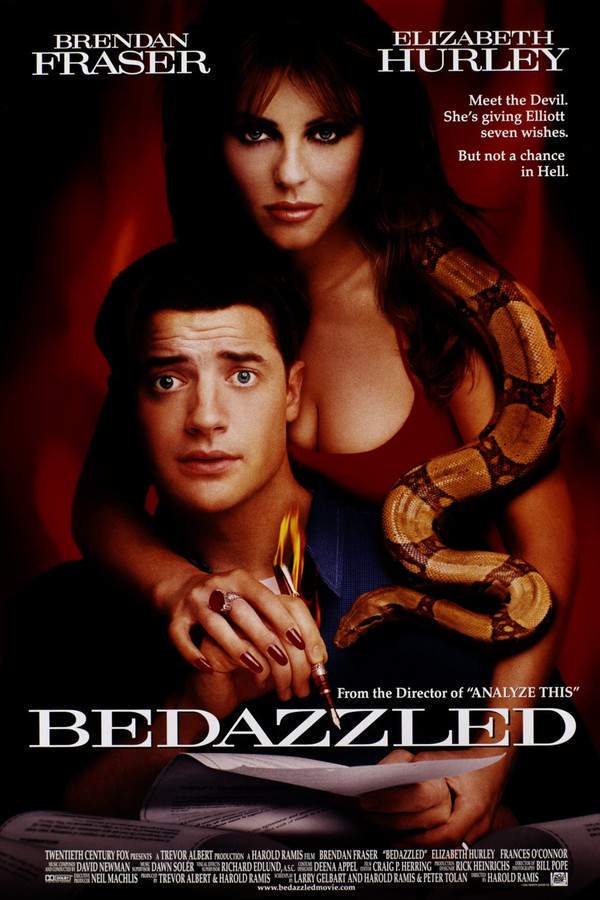
Bedazzled (2000) Poster
BEDAZZLED (2000) D+
dir. Harold Ramis

The original Bedazzled (1967) was such a dry film that eternal damnation didn’t seem to bother anyone all that much. This remake takes the opposite approach with everything getting louder and cruder. Complete with genital jokes, lazy caricatures of queerness, and then a joke about the Abraham Lincoln assassination that’s so terrible it makes me want to go “too soon.”

Brendan Fraser remains watchable even as the script gives him very little help. He plays Elliott Richards, a socially stunted IT worker with the personality of a damp paper towel, hopelessly fixated on his coworker Alison (Frances O’Connor). She’s a woman he barely speaks to, but somehow considers his destiny. When the Devil appears—Elizabeth Hurley, gliding through the film in a rotating wardrobe that looks assembled by a men’s magazine—Elliott barely hesitates. Seven wishes for his soul. And he signs away his eternity the way people sign away whatever they sign away in those Terms and Conditions they never read.

What follows is a parade of personality and occupational overhauls: a drug lord, a basketball star, a mogul, a sensitive poet. Each comes with a fatal flaw. Fraser goes all in on every version, bending himself to fit whatever the wish turns him into. It’s not a lack of effort that sinks it. The problem is that none of it is funny. The result is Fraser stranded inside the joke. Hurley’s Devil looks right. She vamps, poses, smirks—but she never seems especially involved. She’s more fashion spread than temptress. The Devil should enjoy the work, or at least take it personally.

The moral—that Elliott never needed wishes, just confidence—is pure greeting-card territory. Not that such a conclusion would be surprising considering how soulless the film seemed as it was cycling through its gags. If damnation is supposed to cost something, Bedazzled barely even charges interest.

Starring: Brendan Fraser, Elizabeth Hurley, Frances O’Connor, Miriam Shor, Orlando Jones, Paul Adelstein, Toby Huss, Gabriel Casseus, Brian Doyle-Murray, Jeff Doucette.
Rated PG-13. 20th Century Fox. USA/Germany. 93 mins.