THE FADED SPOTLIGHT

by Michael Lawrence

List of "B" Movies


Blink Twice (2024) Poster
BLINK TWICE (2024) B
dir. Zoë Kravitz

A Get Out for the MeToo era, only here it’s dressed in resort wear. Two women accept an invitation from billionaire tech mogul Slater King (Channing Tatum) to his private island and the sleek mansion that sits on it. A place where cocktails flow freely, the food is plated like sculpture, and parties stretch past dawn. But things, as you might assume, aren’t quite what they seem.

Frida (Naomi Ackie) is a nail artist and cocktail waitress who convinces her best friend Jess (Alia Shawkat) to accompany her to the island. Her argument is that it’ll be a once-in-a-lifetime opportunity to hobnob with celebrities and live in luxury. But then the warning signs start to creep in. Frida notices that the staff seem to hover too closely and are all branded with the same snake tattoo. They also seem strangely familiar with her—even calling her pet names she’s never heard before, like they’re speaking to her from a different lifetime.

Jess, for her part, starts to realize that whole hours of her time on this island seem to go missing. For instance, she wakes up in rooms she doesn’t remember entering. Frida also notices that the conversations around them are starting to sound rehearsed, as if everyone else was handed a script she never saw.

Director Zoë Kravitz doesn’t tighten the screws in the mystery/horror nearly as well as Jordan Peele might, but she nonetheless keeps you off balance. Scenes angle, cut, and drift, as if the floor underneath the movie is giving way.

Ackie plays her role with an intelligence and watchfulness that allows the audience to view these experiences through her lens. Shawkat lends the film a kind of peppiness thanks to her ability to thread humor through growing unease. And Tatum, for his part, slides from genial host to a kind of dead-eyed gatekeeper who can make even a compliment sound like a threat.

The film’s ultimate reveal doesn’t hit so much as a twist as it does a confirmation of what you were suspecting early on: that these women, once they entered the island, weren’t going to leave it—without a fight, that is. And fight they do—making this an entertaining and stylish, if hardly groundbreaking, horror-sci-fi hybrid.

Starring: Naomi Ackie, Channing Tatum, Alia Shawkat, Simon Rex, Adria Arjona, Haley Joel Osment, Kyle MacLachlan.
Rated R. Amazon MGM Studios. USA. 103 mins.
Blithe Spirit (1945) Poster
BLITHE SPIRIT (1945) B+
dir. David Lean

Adapted from Noël Coward’s 1941 play, this is a screwball comedy with a spectral edge. Brittle, elegant, and lightly mocking, it turns death itself into drawing-room entertainment.

Rex Harrison is drier than sandpaper as Charles Condomine, a smug novelist who invites an eccentric local medium (Margaret Rutherford) to his country house for a séance. Ostensibly he’s doing research for his next book, but what he ends up with is an afterlife visitation from his late wife Elvira (Kay Hammond). She materializes as a ghost with a smile and a mischievous determination to meddle. She’s only visible to him, of course, which makes her constant interference with his current wife Ruth (Constance Cummings) all the more exasperating.

Charles, however, was already the kind of man to regard life as something to be endured with a cocktail in hand. He takes the haunting in stride. At worst it’s an inconvenience to him, like the gardener pruning too noisily outside his study. Ruth is far less amused. She assumes he’s pulling some kind of joke in catastrophically bad taste. That is, until Elvira’s mischief becomes too disruptive to ignore.

The real pleasure of Blithe Spirit is in the dialogue. Noël Coward wrote the script with a duelist’s precision—with quick verbal jabs. And the cast—many of whom originated the role on stage—parries every line with the sort of gusto that makes you feel like you’re watching all this unfold live on stage. Harrison’s clipped aloofness provides the perfect contrarian counterweight to all the supernatural shenanigans surrounding him. Rutherford, by contrast, is an utter delight, an unstoppable eccentric. Her performance as the medium is done with an owlish certainty—a confidence that suggests the spirits should be considering themselves lucky she’s even bothering to notice them at all.

What makes this movie so much fun is the delicate balance that it strikes. On one side, there’s domestic irritation. On the other, spectral nonsense. Each element is delivered with such crisp timing that you’ll be hard-pressed to find a moment here where you are not grinning.

Many films have cribbed the idea of a man trapped between the living and the dead. But few have nailed the comic rhythm and brittle precision that make Blithe Spirit such a peculiarly infectious little comedy.

Starring: Rex Harrison, Constance Cummings, Kay Hammond, Margaret Rutherford.
Not Rated. United Artists. UK. 96 mins.
Blithe Spirit (2020) Poster
BLITHE SPIRIT (2020) D
dir. Edward Hall

Noël Coward’s Blithe Spirit has been revived so many times you’d think the thing was unkillable. But this version proves otherwise. This attempt at fizzy supernatural screwball plays like a séance gone wrong. There’s noise and flickering lights, but the spirit is missing. This should have been the sprightly farce that the original play and the 1945 film was, but instead it drags its feet. Flailing substituted for effervescence.

Dan Stevens plays Charles Condomine, a novelist with writers’ block who hires a fraudulent clairvoyant (Judi Dench) for inspiration. But then somehow she did something right when her séance manages to cough up the ghost of his first wife (Leslie Mann). And she has a few things to say, particularly about Charles’ replacement wife (Isla Fisher).

I have a few things to say as well about screwball comedy. That’s a form that depends on precision. The cues need to hit, lines need to ricochet off the cast. When it works, it’s golden. But here, where every beat seems to arrive a half-step too late, rendering what should be a snappy comedy into a state that is barely even tolerable.

Stevens does what he can, but he’s stranded in dead air. Fisher plays “long-suffering” as straight irritation, and the role is flattened as a result. Mann, meant to be a mischievous ghost, never finds a tone—seductive in one scene, sitcom-shrill the next. The most well-played gag in Coward’s play—Charles talking furiously to someone nobody else can see—gets muffled here, played so timidly that you almost miss it.

And then there’s Dench. She can still command a scene in her sleep, though here you wonder if that’s what happened here. She has nothing on Margaret Rutherford in the 1945 film. Rutherford was an eccentric showstopper. Dench seems barely present—a sideshow in a movie that’s already short on spark.

Blithe Spirit was meant to be a featherweight confection. This version is all lead. A ghost that was better left at rest.

Starring: Dan Stevens, Leslie Mann, Isla Fisher, Judi Dench, Emilia Fox, Julian Rhind-Tutt, Adil Ray, Michele Dotrice.
Rated PG-13. Sky. UK. 95 mins.
Blood and Bone (2009) Poster
BLOOD AND BONE (2009) C+
dir. Ben Ramsey

For a direct-to-DVD slugfest, this goes down easy enough. Comfort cinema here means watching a man built like a brick wall end fights quickly. Sometimes with a single roundhouse kick.

Michael Jai White moves through back alleys like something heavy already set in motion, cracking bones the way other movies crack jokes. He dismantles men so efficiently that you start to feel bad for them. Bad enough, at least, to briefly consider sending over a sympathy card and maybe a $10 bouquet of daffodils.

Dante Basco—who might as well change his professional name to “Rufio from Hook”—is the one running the underground fight circuit. Organizing matches in graffiti-stained lots. Keeping the money he collects close, so he can count it out by hand in small, dirty stacks.

Then comes a quiet, self-contained boxer named Bone (White), with no backstory worth bothering yourself about. He fights. And he collects winnings. He fights some more. More winnings. Not so that he can buy a cottage by the sea, but all for the grieving widow of his slain friend. Had the film stayed with the fighting and the general idea of that motive, it would’ve been best for everyone involved.

But instead, this movie wanders off to fuss over that widow’s drug addiction and her volatile relationship with a boyfriend who radiates trouble from every pore. These scenes stretch and go murky. It feels like the movie tapping the brakes, as if it’s worried that too much punching might wear us down. And maybe they were right—but these scenes are even harder to sit through.

The movie even spends more downtime with White, who performs slow-motion tai chi against city skylines. Flexing and holding poses just long enough to show off the architecture of his body. Which does almost nothing except remind the rest of us why we’re all shaped like couch cushions.

But then the movie comes around again to the fights. And when they come back, they come back hard. Cleanly staged. Brutally clear. Every elbow, knee, and roundhouse kick dispatching his enemies onto the pavement with a painful-sounding thud.

Almost needless to say, if you come to this movie for the fights, you’ll get enough out of it. And anyone hoping for a sensitive melodrama about addiction probably already knew to walk away from this.

Starring: Michael Jai White, Eamonn Walker, Julian Sands, Dante Basco, Nona Gaye, Bob Sapp, Matt Mullins.
Rated R. Sony Pictures Home Entertainment. USA. 93 mins.
Blood Diamond (2006) Poster
BLOOD DIAMOND (2006) B
dir. Edward Zwick

This movie’s message isn’t subtle. That sparkle on your wedding ring might have cost someone a hand, a family, or a generation. This is a morally indignant thriller that wants you, in one part, to mourn the atrocities of the often violent and brutal African diamond trade, but on the other, to be entertained by high-octane action, explosions, and Leonardo DiCaprio sprinting through the jungle in a tank top. Conscience and eye candy, all bundled together.

But all in all, it’s a fine movie, especially as it’s carried firmly on the shoulders of Djimon Hounsou. He plays Solomon Vandy, a fisherman ripped from his village and dumped into a rebel diamond pit, where he finds a pink stone the size of his survival instinct and risks everything to hide it before being tossed into a government cell. That’s where DiCaprio slithers in. He plays Danny Archer, a smuggler and scavenger (with a Rhodesian accent that holds about half the time) who is convinced he’s the smartest rat in the jungle. He smells a payday in Solomon’s secret rock and talks him into one suicidal return trip into the war zone after breaking him out of jail.

The path is the usual detour, and Zwick directs like he’s clearing his throat between explosions. Mercenaries, double-crosses, well-timed gunfights. DiCaprio, to his credit, sells the swaggering despair, but Hounsou is the one who looks like he’s been ground down by the continent itself. He sweats, shouts, and claws with such raw conviction that the film’s moralizing feels like an afterthought next to him.

There’s no shortage of good intentions, but there’s also no surprise. By the thirty-minute mark you’ve already guessed every beat. If you didn’t know blood diamonds were real, the movie has a pamphlet’s worth of information ready for you—along with two hours of men bellowing over AK-47 fire. It’s watchable, even gripping in bursts, but the revelations are prefab. Read an article, or watch DiCaprio squint heroically through a civil war. Either way, cubic zirconia looks better every day.

Starring: Leonardo DiCaprio, Djimon Hounsou, Jennifer Connelly, Arnold Vosloo, David Harewood.
Rated R. Warner Bros. USA. 143 mins.
Blood Simple (1984) Poster
BLOOD SIMPLE (1984) A
dir. Joel Coen

It’s almost rude that Blood Simple is the Coen Brothers’ debut. Most directors spend a film or two clearing their throats. Testing angles, fumbling with tone, or tripping over their influences. The Coens show up already fluent in blood and panic. And how one bad decision often spawn new problems instead of resolve old ones.

The setup is noir built out of suspicion and cheap beer. Marty (Dan Hedaya) owns a bar in Texas, looking like a man who’s about to shed his skin. He’s gotten himself in a tizzy, suspecting that his wife, Abby (Frances McDormand), and his bartender, Ray (John Getz), are snogging on the side. The suspicion festers so badly that he hires a private detective (M. Emmet Walsh) to go poking around.

Things only get more rotten from there when the detective realizes he can profit more from the situation if he were to nudge it there himself. Through violence. And while people do get hurt, it’s just not in how he planned it.

Abby is the one left reacting to all of this. Cornered by decisions she didn’t make. Forced into cleanup that she barely understands. And survival becoming a matter of staying one step ahead of somebody else’s bad information.

The tone is merciless but never showy. Death arrives, but the real damage happens afterward. When the body needs moving. When a plan needs revising. When someone realizes too late that they picked the wrong solution to the wrong problem. No one is steering. Not the lovers. Not the detective. Not even the narrative. Like any good noir, you’re just watching a house of cards fall in very slow motion.

Barry Sonnenfeld’s cinematography gives the film its texture. Light gleams off beer bottles. Sweat beads and lingers. Shadows stretch and snap back. Violence is filmed close and mean, without operatic buildup or a relief valve. All we get is impact and silence. Then the uncomfortable stretch that follows.

Blood Simple works as noir, but it also sketches the shape of what the Coens would often return to. Control as an illusion. Irony with teeth. People who don’t just dig their own graves, but keep digging beyond that. Convinced the next shovelful will fix everything.

Starring: Frances McDormand, John Getz, Dan Hedaya, M. Emmet Walsh.
Rated R. Circle Films. USA. 97 mins.
Blood Tide (1981) Poster
BLOOD TIDE (1981) D+
dir. Richard Jefferies

A horror movie with a plot that keeps threatening to start. Supposedly about an ancient sea monster, but you’d be forgiven for thinking it’s about algae.

Some of the casting feels excessive. James Earl Jones, in particular, gets top billing as a chain-smoking treasure hunter named Frye, growling his way through most of his scenes. Also veteran actor José Ferrer shows up just long enough to deliver an ancient prophecy with the energy of a sedated stage actor. Maybe his lack of passion there is why it takes so long for the sea monster to finally show up.

Whatever semblance of a plot there is hinges on Martin Kove (pre–Karate Kid villainy). He arrives on a remote Greek island with his wife (Mary Louise Weller), supposedly looking for his missing sister (Deborah Shelton). But what they end up doing in practice is wander around looking confused while occasionally someone disappears into the sea. (And then bubbling up again as a corpse, stewing in what looks like tomato broth.)

The island is photogenic, at least. Wind-beaten churches, goat paths, crumbly, sunbaked ruins. All pretty wasted in a movie that treats pacing as optional. As for the monster, it’s shown so briefly that the film never quite figures out what to do with it. And when it does appear, it looks weirdly like one of those bleached skeleton Koopas from the Super Mario games. Impressive, I guess, considering those games didn’t exist yet.

It’s not that Blood Tide lacks material. What it lacks is commitment. Ideas introduced, then abandoned. Images and moments that should carry some narrative heft instead left to drift. Villagers muttering cryptic things. They run across a submerged chapel and underwater crypts. James Earl Jones blows up a wall with dynamite for reasons that remain unclear. And yet the movie never wakes up.

Starring: James Earl Jones, José Ferrer, Martin Kove, Mary Louise Weller, Deborah Shelton, Lydia Cornell.
Rated R. New Line Cinema. UK. 87 min.
Blood Work (2002) Poster
BLOOD WORK (2002) B
dir. Clint Eastwood

Clint Eastwood brings his slow, unimpressed head turn to Blood Work. It’s a mystery thriller, technically, but nothing around him seems to be in much of a hurry. Eastwood, who directs and stars, doesn’t push it to be. It finds one rhythm and pretty much stays put there.

He plays Terry McCaleb, a veteran FBI agent who is finally taken out of the force when he suffers a heart attack on the job—right in the middle of an on-foot chase of an unidentified serial killer. An event that marks the end of McCaleb’s professional life. A transplant keeps him alive. Retirement follows, whether he wants to or not. And he retreats to a houseboat. Where he plans to spend his twilight years. But trouble seems to follow him.

He gets a visit from a woman named Graciela Rivers (Wanda De Jesus). She is convinced that her sister’s murder was never properly solved. Why McCaleb should care about that isn’t too complicated. The heart that saved his life used to belong to her sister. Which means the least he can do is find out who killed her.

His ensuing investigation favors persistence over propulsion. Doors get knocked on. Files revisited. Questions asked, then asked again. Information arriving slowly. Eastwood reacting measuredly and efficiently.

Around McCaleb, familiar faces show up—not all of whom make things easier for him. Paul Rodriguez plays a local cop whose help always comes with hesitation. Jeff Daniels appears as an affable neighbor and casual companion—the quasi comic relief. And then Anjelica Huston plays McCaleb’s cardiologist—steady and unsentimental about how dangerous all this running around is for him.

The movie keeps things plain. Sunlit Los Angeles streets. Quiet rooms. Looks and pauses doing more of the work than tension does. More often than not, though, it all works. This is a movie that feels comfortable in its own skin. Though sometimes that sensibility has the opposite effect—of slowing things down. A decent mystery where the clues line up the way you expect them to. Misdirections never wander far. The reveals arrive, do their job, and move on. Nothing is sloppy. Nothing really digs in, either.

But it all ends up fine. Competent. Held together by the steady confidence of Eastwood the director. And that familiar, withering stare of Eastwood the actor.

Starring: Clint Eastwood, Jeff Daniels, Anjelica Huston, Wanda De Jesus, Tina Lifford, Paul Rodriguez, Dylan Walsh, Mason Lucero.
Rated PG-13. Warner Bros. Pictures. USA. 110 mins.
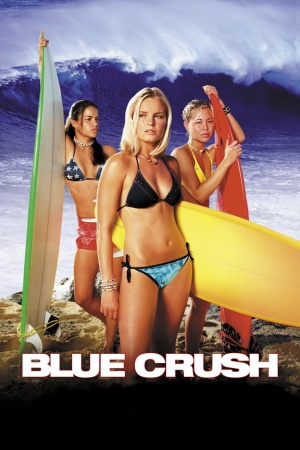
Blue Crush (2002) Poster
BLUE CRUSH (2002) B
dir. John Stockwell

A sun-kissed daydream with salt in its hair and a sports-movie heart. Blue Crush treats surfing less like a narrative engine than a daily condition. Everything revolves around the water. Most of it is waiting. Some of it is falling hard. The rest is deciding whether you’re willing to risk it again. Winning exists, but it’s secondary. Staying out there is what matters.

Kate Bosworth plays Anne Marie, a surfer who already knows how quickly the ocean can take something away. She can surf. That isn’t the question. The question is whether she wants to put herself back in that position again. Her days now are spent mostly cleaning up hotel rooms and taking care of her kid sister (Mika Boorem). She lives with her two friends (Michelle Rodriguez and Sanoe Lake)—also surfers and don’t see much reason to slow down. But Anne Marie was an especially talented surfer. Good enough to win major competitions. But she needs coaxing to get back into the water at all. She has a low-key romance with a visiting quarterback (Matthew Davis). Not as a major distraction. More like a reminder that he’s temporary and the water—whose beckon she ultimately can’t resist—isn’t.

The movie is at its best where you want it to be. When it stops worrying about plot and stays with physical detail. Wax softening underfoot. Skin burned raw. The way sound thins out when you collapse underwater. The surfing sequences are the main event. They’re filmed fast and up close, with very little margin between control and collapse.

Away from the water, the dialogue and the cast do enough to keep the movie from feeling hollow. The friendships feel casual and unforced. The conversations are sharper than you’d expect from a movie built on such familiar sports movie beats. Blue Crush has no interest in reinventing the formula, content instead to execute it cleanly. Held together with fabulous sports footage.

Starring: Kate Bosworth, Matthew Davis, Sanoe Lake, Mika Boorem, Chris Taloa, Kala Alexander, Ruben Tejada, Kaupena Miranda, Asa Aquino, Faison Love, George Veikoso, Shaun Robinson, Paul Hatter.
Rated PG-13. Universal Pictures. USA. 105 mins.
Blue Jasmine (2013) Poster
BLUE JASMINE (2013) A-
dir. Woody Allen

A social x-ray in a cashmere cardigan. Blue Jasmine stays close to its title character. Cate Blanchett plays Jasmine—née Jeanette. A former Manhattan socialite who turns up in San Francisco with a suitcase, prescription pills, and a way of speaking that hasn’t adjusted to her circumstances. Her husband (Alec Baldwin) is a smooth-talking financier whose fortune turns out to be built on fraud. All their money—gone.

Jasmine moves in with her sister, Ginger (Sally Hawkins). A step she would never have dreamed of taking. Ginger’s blue-collar life is something Jasmine once looked down on from a considerable height. And now that she has nowhere else to turn—she still looks down on it. Humility doesn’t come naturally to Jasmine.

The setup hints at A Streetcar Named Desire, but the movie avoids the big gestures. Preferring to let things grind down instead. No heavily dramatic build-up toward collapse or catharsis. The movie prefers to let things wear themselves down. Blanchett drains the role of sentiment and lets it sit cold and exposed. Raw nerves and denial.

The two sisters were adopted from different families—Jasmine got the so-called good genes, a detail she brings up often. But what constitutes “good genes” goes deeper than that. Ginger is warm, pragmatic, unlucky in men. Jasmine is already coming apart when we meet her. Restless. Unfocused. Talking past people instead of to them. She circles the same stories again and again, repeating details that no longer impress anyone. Less conversation than rehearsal.

Her memories arrive in fragments. Parties. Money. A life built on avoidance. The flashbacks don’t soften anything. They show how much work went into not asking certain questions. About the money. About who was really paying for it.

She lands a job as a dental receptionist, and it falls apart almost immediately. The dentist crosses a line. Makes a pass at her, and Jasmine locks up. She doesn’t get startled so much as stalled. She’s unsure how to respond without the old protections of money and status. The rules she used to rely on aren’t much help anymore. Yet she keeps reaching for them anyway.

Blanchett keeps her a half step off. She reacts a little late, misses cues that everyone else seems to catch. Nervous and proud, rarely in step with the people around her. Jasmine waits for things to reset—still assuming her old life will come back if she just holds on long enough. Most of the damage comes from that waiting.

As writer and director, Woody Allen doesn’t rush to rescue her or punish her. He keeps his distance. He lets her unravel in plain view, without commentary or relief. Blue Jasmine isn’t a redemption arc. It’s a portrait of unraveling.

Blanchett doesn’t build a performance so much as let it fracture. Early on, Jasmine controls the conversation. By the end, she’s lost everyone. No one left to talk to except herself on a park bench. She’s spent her entire life being an awful person. She probably knows that. And yet her slide into the nadir still feels tragic.

Starring: Cate Blanchett, Sally Hawkins, Alec Baldwin, Bobby Cannavale, Peter Sarsgaard, Andrew Dice Clay.
PG-13. Sony Pictures Classics. USA. 98 mins.
Blue Miracle (2021) Poster
BLUE MIRACLE (2021) B-
dir. Julio Quintana

There isn’t much of a story. You can feel that almost immediately. But there’s plenty of sun and goodwill. And a marlin tournament. Not terribly inspiring or surprising, but enough.

Jimmy Gonzales plays Omar Venegas, who runs an orphanage in Cabo San Lucas that’s barely getting by. Then a hurricane rolls through and makes a bad situation worse. With no other option, Omar is left with an idea that sounds reckless until you say it a few times. Enter Bisbee’s Black & Blue marlin fishing tournament. Long odds, but if he can win the big prize, the doors can stay open.

One problem, though. Omar doesn’t have a captain.

That’s where Wade Malloy (Dennis Quaid) comes in. A fisherman and former champion. His name still carries some heft in the tournament, even if the results stopped showing up years ago. He can’t afford the entry on his own. Locals get a break, though, but he’s one of them.

Wade doesn’t want a crew or responsibility. He absolutely does not want a boat full of kids. He needs the entry. And the entry needs bodies.

From there, the film settles into a pattern you already recognize. A gruff adult. Skeptical, world-weary kids. Resistance, then friction, then the thaw you can see coming from well offshore. The movie doesn’t hurry any of it or press too hard. Scenes are allowed to play. Nobody stops to spell out a lesson.

The film’s finest moments are the fishing sequences. Shot close to the action and edited cleanly. The fishing scenes focus on the physical effort it takes to bring a marlin in.

Blue Miracle is a small movie, and it wisely doesn’t try to grow past that. It hits the targets it sets for itself and then moves on. Nothing urgent. Nothing sharp, either. But as a family picture with fine intentions and a few solid stretches of real work, it holds together. It’s a Netflix movie. Easy enough to try.

Starring: Jimmy Gonzales, Dennis Quaid, Anthony Gonzalez, Raymond Cruz, Nathan Arenas, Miguel Angel Garcia, Isaac Arellanes, Dana Wheeler-Nicholson, Bruce McGill.
Rated PG. Netflix. USA. 95 mins.
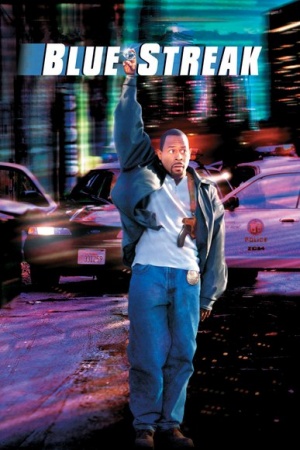
Blue Streak (1999) Poster
BLUE STREAK (1999) B−
dir. Les Mayfield

Martin Lawrence isn’t just starring in Blue Streak. He’s commandeering it. Whether that’s for better or worse is beside the point. But if you’re going into this knowing you’re watching a Martin Lawrence vehicle, you’ll have to expect him to come in hot and never really cool off.

He plays Miles Logan. A jewel thief. Just before getting arrested, he hides a stolen diamond in an unfinished building. Two years later, he’s out and back for it. Only to find the place has turned into a police station. With the diamond sealed inside, he realizes there’s only one way to retrieve it. To bluff his way onto the force.

That’s basically the movie. A criminal posing as a cop and getting away with it longer than anyone should. But then Luke Wilson shows up, and it’s suddenly a buddy-cop movie. He plays it straight, with that quietly baffled but bemused look he’s made a career out of. He mostly observes while Lawrence barrels through interrogations and crime scenes on pure impulse and volume. And still gets results. His colleagues start regarding him as a genius. Dave Chappelle pops in throughout the film as Miles’s actual criminal accomplice. Of course he’s not going to let Miles accidentally become an effective cop without at least a few insults lobbed his way.

While nothing in Blue Streak is especially sharp or surprising, I won’t deny it. I laughed. More than I thought I would. Especially at the ridiculous pizza-delivery disguise Lawrence uses to sneak into the police station early on. Blue Streak might not be much, but it knows how to move quickly, stay loose, and keep pace with Lawrence at full volume.

Starring: Martin Lawrence, Luke Wilson, Dave Chappelle, Peter Greene, Nicole Ari Parker, Graham Beckel, Robert Miranda, Olek Krupa, Saverio Guerra, Richard C. Sarafian, Tamala Jones.
Rated PG-13. Sony Pictures Releasing. USA. 93 mins.
Blue Velvet (1986) Poster
BLUE VELVET (1986) A
dir. David Lynch

Lynch doesn’t simply expose the rot under suburbia. He yanks it up by the roots and holds it in front of your face, squirming. Blue Velvet opens on the American dream at peak saturation. A fire truck rolls through town. A man tends his immaculate lawn. The colors are so bright they almost buzz. Then the man collapses, and the camera sinks into the grass. Suburbia gives way to insects chewing underneath.

Jeffrey Beaumont comes back to town to see his father. He goes on a walk that turns into a find. A severed ear, already rotting, already crawling with ants. He takes it to the police. Detective Williams (George Dickerson) hears him out.

That should be the end of Jeffrey’s involvement. But it isn’t. He keeps poking. Asking questions that aren’t his to ask. Sandy (Laura Dern), the detective’s daughter, helps without quite calling it help. She smiles. She talks. And information spills.

Jeffrey finds Dorothy Vallens (Isabella Rossellini), a nightclub singer with bruises she won’t explain, who might have answers. He breaks into her apartment. Dorothy finds him hiding in the closet. Before long, she’s holding a knife to him, coercing him. Begging him to punish her. Asking for abuse she’s learned to mistake for intimacy. Calling him her “special friend.”

Frank Booth (Dennis Hopper) arrives without subtlety. Dorothy’s boyfriend. Hopper storms into the movie vibrating with menace, powered entirely by appetite. He doesn’t posture or tease. He takes. His rages, his perversions, his need for control are extreme. Hopper plays him without softening any of it, and the effect is chilling. From his first appearance on, the movie never quite recovers.

Jeffrey isn’t just a victim here. He starts out curious. Eager, even. Drawn toward danger with the confidence of someone who thinks looking isn’t the same as touching. He becomes involved beyond what he initially intended. Curiosity pulls him closer than he planned—until he’s no longer observing the darkness. He’s inside it.

Sandy talks like the world still follows rules and rewards good behavior. Dorothy only knows the opposite—trapped with violence on one side, dependence on the other. All she wants is to survive. Nobody in this film ever gets sorted into neat moral bins, just like the town itself. Made of white fences and neat lawns, but bad things happen anyway. Violence seeps into sex. Passion curdles into threat. The lighting softens. The music swells. Nightmares get dressed up as romance.

Lynch leaves us with a mechanical robin, chirping in a bed of roses, a worm wriggling in its beak. Order restored. Or maybe we’ve just moved outward to a new illusion layered on top of the mess. It cuts to Jeffrey living a Norman Rockwell life—probably where he should have stuck all along. Maybe all of us, if we can afford it.

Lynch doesn’t explain any of this. He never does. Like a magician who refuses to acknowledge the trick, Lynch prefers to leave you staring at it.

Starring: Isabella Rossellini, Kyle MacLachlan, Dennis Hopper, Laura Dern, Hope Lange, Dean Stockwell, George Dickerson, Priscilla Pointer, Frances Bay, Jack Harvey.
Rated R. De Laurentiis Entertainment Group. USA. 120 mins.
The Blues Brothers (1980) Poster
THE BLUES BROTHERS (1980) A−
dir. John Landis

It began life as a Saturday Night Live sketch, but it doesn’t stay small for long. The Blues Brothers quickly outgrows its origins. Charging forward recklessly, scene for scene, like it was born with a suspended license. It takes what it’s gathered, stuffs it into a confetti cannon, and fires without bothering to worry about where the pieces land.

It all starts with Jake and Elwood Blues (John Belushi and Dan Aykroyd) insisting they’re on a mission from God. The Chicago orphanage that raised them owes $5,000 in back taxes. So they take off across the region, hunting down old bandmates wherever they’ve washed up. The plan is to put on a one-night show at the Palace Ballroom in Chicago to raise the money.

But the longer they travel, the more they also collect a horde of people who want the brothers gone. The cops. A country-western band. Illinois Nazis. Carrie Fisher, who is apparently funding her own private arms race. The wreckage just keeps mounting.

The big feature here—arguably the biggest reason to tune into it—is the musical performances. They aren’t just dropped in as decoration. They’re the movie’s heartbeat. James Brown testifying in a church. Aretha Franklin bringing a diner to a halt. Ray Charles running a music shop with a sawed-off shotgun. Even more surprisingly, amid all these titans of soul, Belushi and Aykroyd never try to outshine them. How could they? Nor do they play it as a joke. They slide in quietly—deadpan, locked-in—until you start to accept them as part of the same musical world as Ray Charles. They step up when needed, then fade back out.

The comedy runs on two tracks at once. Tightly controlled and completely unhinged. One minute they’re onstage at a country bar, realizing too late that “both kinds of music: country and western” isn’t a joke. After that, it’s all bets off. They’re in a police chase. Sirens, smashed cars, hubcaps skipping across the pavement.

There isn’t much logic here. Or maybe there is, but it’s the kind that Lewis Carroll smuggled into Wonderland. It’s a bundle of reckless joy. Jokes flying and getting lost in the wreckage. And the film doesn’t bother slowing down to sort any of it out.

Starring: John Belushi, Dan Aykroyd, James Brown, Cab Calloway, Ray Charles, Aretha Franklin, Carrie Fisher, Henry Gibson, John Candy, Kathleen Freeman.
Rated R. Universal Pictures. USA. 133 mins.
Bob Roberts (1992) Poster
BOB ROBERTS (1992) B+
dir. Tim Robbins

This was a satire when it came out. Now it feels uncomfortable. Tim Robbins plays the title character. A folk-singing senatorial candidate whose songbook includes “Retake America,” “Drugs Stink,” “This Land Was Made for Me,” and “Times Are Changin’ Back.” They’re campaign jingles, tuned to the key of resentment and nostalgia. One video borrows wholesale from Dylan’s Subterranean Homesick Blues. Only this time the cue cards preach discipline, morality, and the virtues of laissez-faire economics.

Shot as a mockumentary, the campaign slowly stops being about ideas and starts orbiting Bob Roberts himself. Most of what it’s mocking have become standard features of the campaign trail. Right-wing populism, media distrust, and nostalgia-based nationalism. The film depicts a grassroots uprising (underwritten, of course, by corporate dollars), the press-baiting slogans, the promise to restore some sepia-toned version of the past. It’s all here. And, amazingly, a several decibels lower than what would followed.

Jack Black is notable here, in his screen debut, plays a young supporter who is more taken with Roberts’ aura than anything resembling policy. Not that he has much policy to take in. Roberts mostly talks in free-market slogans, repeating them like they’ve never been tested on anything real. People in his orbit quietly contradict what he’s saying. But the campaign machinery keeps humming anyway.

There are laughs. Good ones. But they sit on top of something tighter and less comfortable now. What used to feel like satire doesn’t feel especially funny anymore. Bob Roberts doesn’t always hold together cleanly. Its smirking tone can wear thin. But it remains a bold, prescient piece of political commentary.

Starring: Tim Robbins, Giancarlo Esposito, Alan Rickman, Ray Wise, Gore Vidal, John Cusack, Peter Gallagher, Susan Sarandon, James Spader, Fred Ward, Brian Murray, Rebecca Jenkins, Jack Black, David Strathairn.
Rated R. Paramount Pictures. USA. 104 mins.