THE FADED SPOTLIGHT

by Michael Lawrence

List of "L" Movies


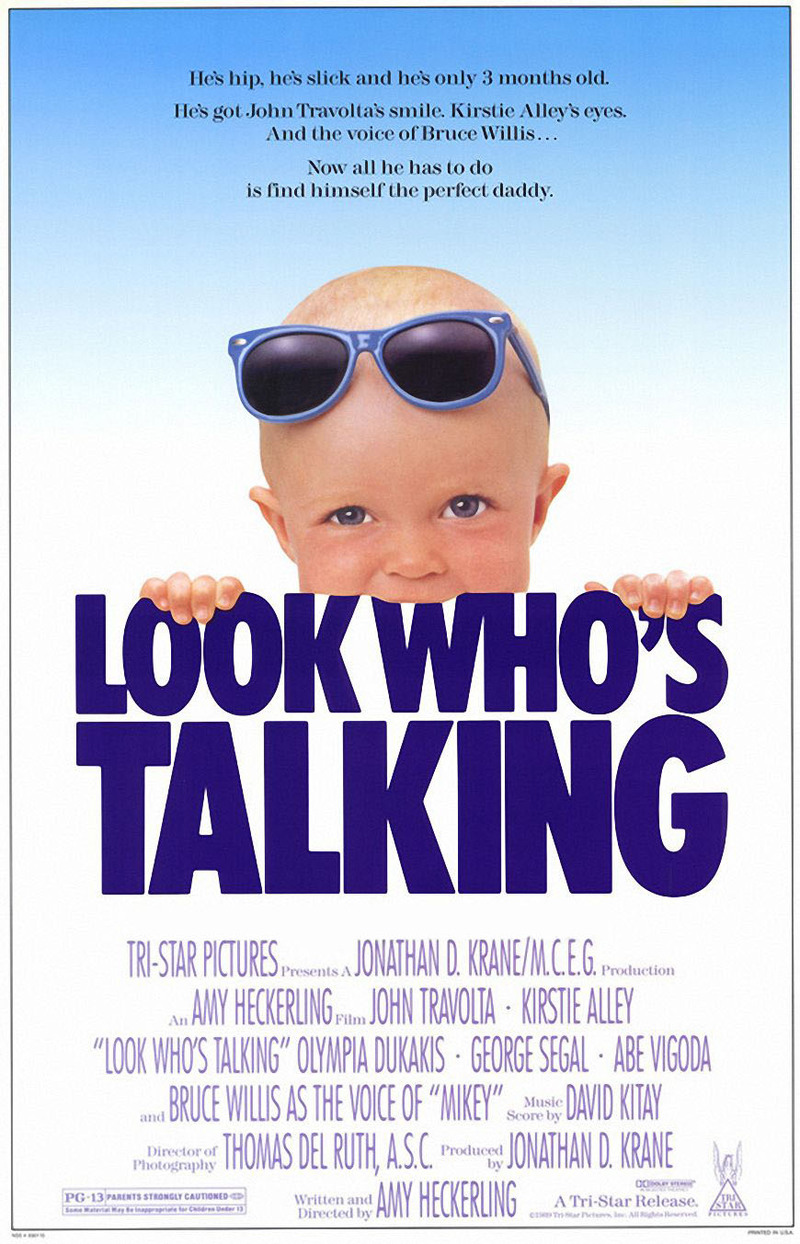
Look Who’s Talking (1989) Poster
LOOK WHO’S TALKING (1989) B
dir. Amy Heckerling

A cute-baby movie where we hear its thoughts courtesy of wisecrack-riddled voiceovers from Bruce Willis. That’s the kind of idea that ought to have you heading for the hills. But Look Who’s Talking works anyway—not through accident or innovation, but for simpler reasons. Turns out, the movie is actually funny.

Kirstie Alley plays Mollie—an accountant who is hopefully better at managing numbers than she is her love life. Her married boyfriend (George Segal) gets her pregnant and then promptly dumps her for another mistress. The usual thing—someone younger, simpler, and with fewer opinions to manage. Mollie doesn’t crumble, though. She just shifts gears. She starts dating again—aggressively. It’s like she’s conducting interviews. Minimum qualifications: steady income, basic decency, a trustworthy face. Maybe not already married this time.

Then James (John Travolta) shows up. He’s so far off her list he shouldn’t even be allowed to say the word “list.” He’s a cab driver with a grin made out of trouble and a mouth that can’t stop itself from jabbering. He jokes through everything—even with Mollie. But after a while, he slows down. Maybe he’s finally found someone worth getting right.

Call it what it is—a romantic comedy based on what should be an irredeemably cutesy gimmick that ends up walking straight anyway. Not gracefully, not even evenly, but it does its job and delivers its fair share of laughs. Heckerling keeps the film restless. No sentiment long enough to curdle, no setup that gets time to show its seams. It stumbles once or twice. No big deal. It quickly brushes itself off and keeps rolling—like it’s in on its own hustle. Even all the usual stops—meet-cute, argument, reconciliation—seem fresh here on the presentation.

Credit the cast, too. Alley stays tight. She’s bright one second, bristling the next. Travolta’s her opposite, of course. Loose, smooth, running on rhythm, nerve, and that grin that’s been buying him time ever since the disco years. Meanwhile, baby Mikey keeps the commentary running in Willis’s gravelly drawl, like a stand-up act delivered from a high chair. Chalk this up as a fun, breezy time with its fair share of real chuckles. Pop entertainment that might actually be worth your time.

Starring: Kirstie Alley, John Travolta, Olympia Dukakis, George Segal, Abe Vigoda. Voice of: Bruce Willis.
Rated PG-13. Tri-Star Pictures. USA. 96 mins.
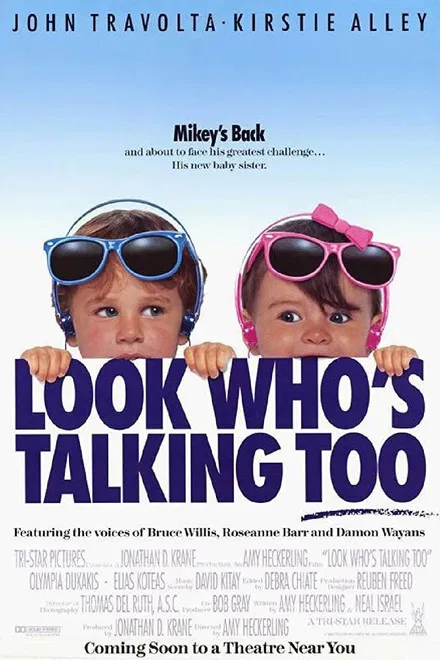
Look Who’s Talking Too (1990) Poster
LOOK WHO’S TALKING TOO (1990) C–
dir. Amy Heckerling

The baby’s not only still talking, but now there’s another one. Smaller, shriller, voiced by Roseanne Barr, who sounds like she’s trying to outshout the smoke alarm. The first film had its gimmick and knew when to quit. This one doesn’t. It overplays the bit so hard it’s like going to see the Glenn Miller Band in concert, but all they do is repeatedly play “String of Pearls” out of tune at 100 decibels.

The talking kid was a side act in the first film, but here it’s louder, longer, and far less funny. Mikey (still Bruce Willis, still quipping) is now a toddler with a jealous streak. His new sister, Julie (Barr), shows up in pink and already sounds like she’s been through two divorces. Mikey immediately takes her presence as an act of war.

Things on the parental front aren’t rosy, either. Mollie (Kirstie Alley) and James (John Travolta) are worn out, older, and snappier. They fight—about money, diapers, or nothing at all. Whichever shows up first. James moves out for a while, and Mikey blames Julie for that. And within minutes, he’s dismembering her favorite stuffed penguin, Herbie, like a mob warning in felt.

This sequel has none of the original’s easy, consistent charm. A big reason for that isn’t just because the gimmick is overdone, it’s because it isn’t nearly as much fun watching Travolta and Alley on the outs as it was watching them charm their way into each other. Still, the movie isn’t without its flickers of life. A few of Willis’s asides still hit, and Heckerling hasn’t completely lost her touch for how to pace these movies. But what’s missing badly this time is the heart. The first Look Who’s Talking managed to find truth in the madness of new parenthood. This one, we mostly just find clutter.

Starring: John Travolta, Kirstie Alley, Olympia Dukakis, Elias Koteas, Twink Caplan, Gilbert Gottfried, Lorne Sussman, Meg Milner. Voices of: Bruce Willis, Rosanne Barr, Damon Wayans, Mel Brooks.
Rated PG-13. Tri-Star Pictures. USA. 82 mins.
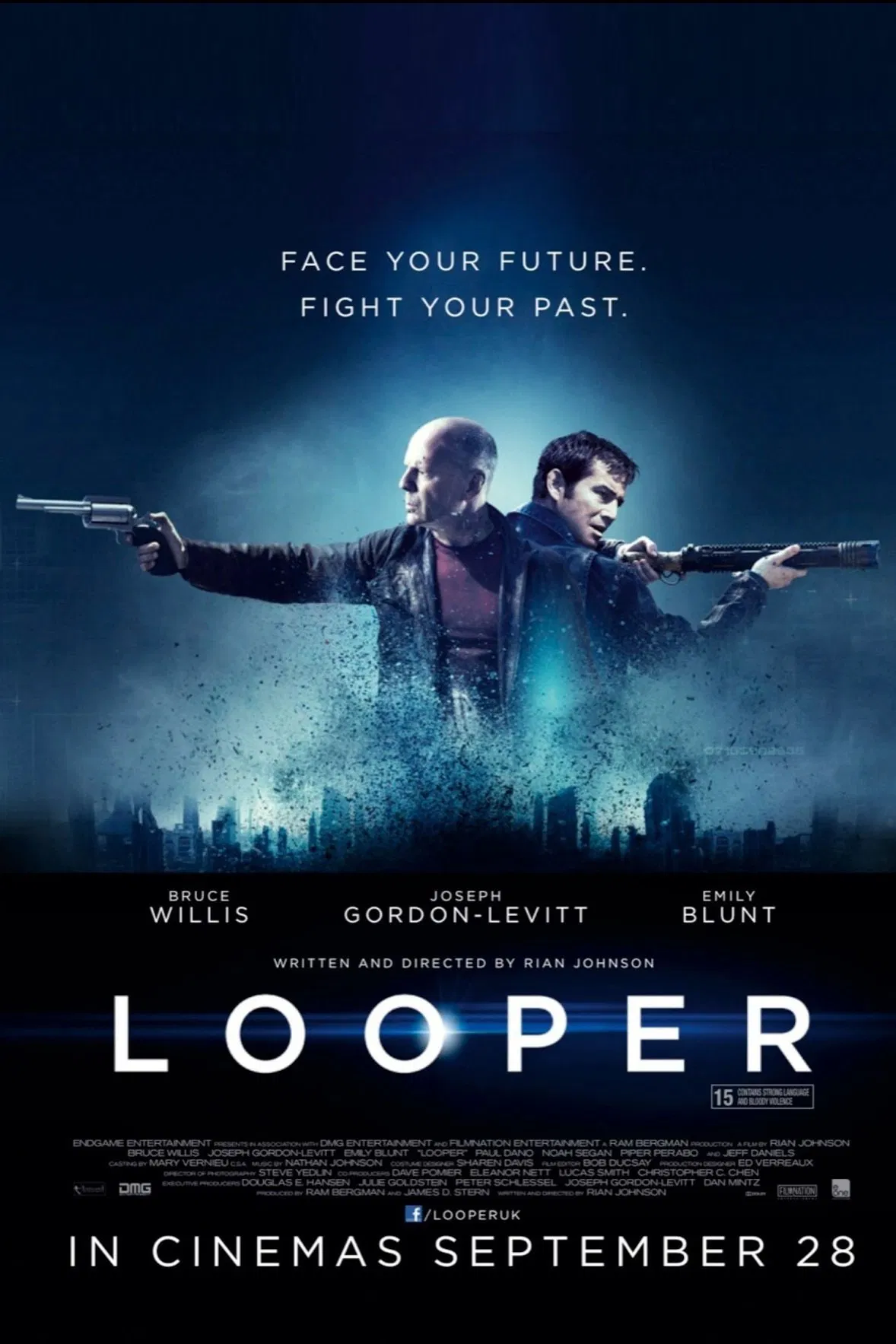
Looper (2012) Poster
LOOPER (2012) A–
dir. Rian Johnson

Time travel doesn’t exist. Not in 2044, anyway. Give it thirty years, though, and someone in 2074 will crack it. It’s a massive breakthrough, of course, but nobody has a real practical use for it. Except for the mob.

Joe (Joseph Gordon-Levitt) works for them. He’s a Looper. He stands in a field. Waits. A body drops out of time, bound, gagged, silver taped to its back. Joe immediately shoots the person, drags the body off, pockets the silver, and goes back to waiting. Clean work, if you don’t think about it too long. For the people sending those bodies back, it’s simpler than hiding them in their own decade.

Every Looper knows what’s coming. One day the target will be you. “Closing the loop,” they call it. You kill your future self, take the gold, and retire early. Try your hardest to forget your life has a specific expiration date, and you were the cause of it. Joe’s fine with that, though. Or at least he thinks he is. Then comes the day he’s face to face with his older self, Old Joe (Bruce Willis). Same eyes, same scar. Thirty years older. He was sent back to die. Only he doesn’t. He bolts.

Old Joe isn’t running because he doesn’t want to die, though. He’s running to fix something. His wife was killed in a raid orchestrated by a ghost that they call the Rainmaker. Nobody knows exactly who he is, only that he started young. Also, Old Joe managed to narrow his identity down to three possibilities. One turns out to be Cid (Pierce Gagnon), a quiet kid tucked away on a farm with his mother, Sara (Emily Blunt).

Cid’s not a villain yet. Maybe he never will be. For now, he’s six, gifted, and terrified. When fear hits him, things move—furniture, doors, entire rooms, entire cornfields. His power runs on panic. Or anger. Sara does what she can to keep him close and calm. She prays that’s enough.

At this point, the film has gotten smaller and more cornered. Three people caught in unfinished business and a cornfield. A mother with a secret, a man with a past, and his younger self trying to reconcile both.

Rian Johnson shoots the film lean—dust, rust, bruised daylight. The time loop logic holds long enough for the emotion to stick. A film about cause, effect, and the mess people make trying to tell them apart. This is a sharp film and wonderfully written, but it’s also human. You actually care about these characters, the rare ones that feel real in a genre that usually tries to forget what real looks like.

Gordon-Levitt gets the rhythm right. The prosthetics, though, make him look like a wax figure that’s been swollen a bit. Willis gives the kind of performance that reminds you he could always act. Here, he is haunted, flinty, and just a little bit vulnerable—one of his final great appearances. And I also have to mention Gagnon, who is remarkable: a small, serious face that flickers between heartbreak and apocalypse.

This is a movie that gets its hooks in you quick and doesn’t ease up until that final jolt. When the loop finally closes, which is a spellbinding moment that leaves the air still for a second, and then it sticks with you for weeks afterward. Chalk this up as remarkable sci-fi noir—one that knows how to think and knows how to hit you where it counts.

Starring: Joseph Gordon-Levitt, Bruce Willis, Emily Blunt, Jeff Daniels, Paul Dano, Pierce Gagnon.
Rated R. TriStar Pictures. USA. 113 mins.
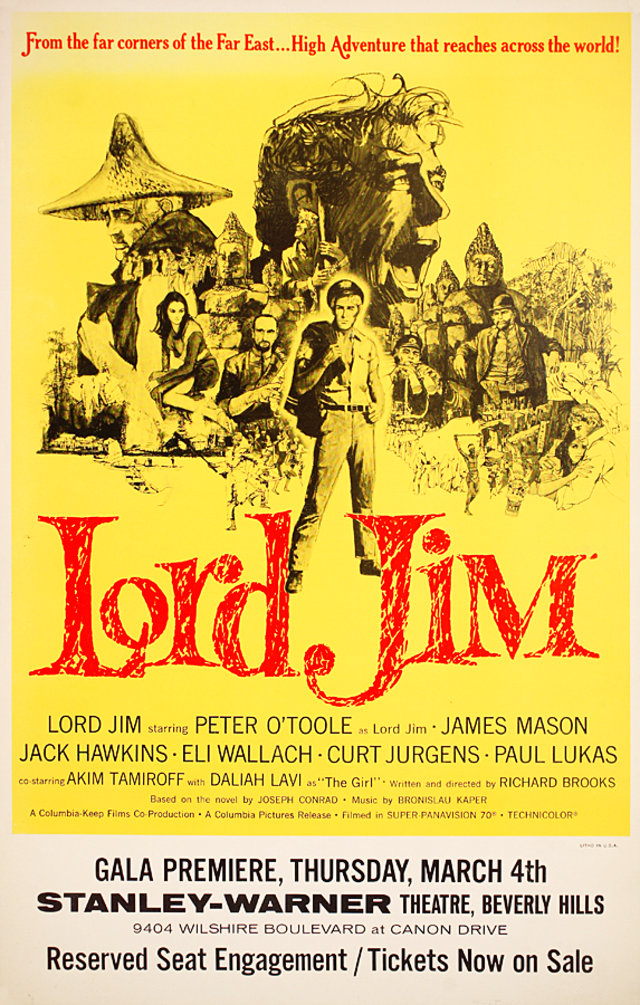
Lord Jim (1965) Poster
LORD JIM (1965) C
dir. Richard Brooks

Somewhere between moral reckoning and jungle fever sits a troubled former British officer named Jim (Peter O’Toole). (Neither the movie nor Conrad’s novel finds a surname necessary.) He disgraced himself after he abandoned a ship that he believed was sinking. Hundreds of passengers left to die. Only it didn’t sink. Everyone survived. The lone casualty being Jim’s dignity. Jim’s been spending his days drifting through Southeast Asia for years chasing redemption—or something like it. Or maybe it’s more like penance. By way of sweltering heat, sleepless nights, and the threat of malaria.

Eventually he washes up in Patusan, a remote trading station run by a company. James Mason plays its velvet-voiced middleman who signs Jim on as an emissary. “To keep the peace,” officially. Though unofficially to make profit pass for goodwill.

The place is already tight with trouble. The villagers have had their fill: bribes pushed at them, threats whispered close, promises delivered by white men who never stick around long enough to make good on anything. They meet Jim with suspicion, understandably so. But after he helps them resist the warlord Sherif Ali (Tatsuya Saitō), they begin to see something messianic in this pale, poetic drifter. Jim takes up their cause. Maybe to see how far guilt will carry him. Maybe to become the man he once pretended to be.

The film keeps reaching for stateliness. Sometimes it gets there. Other times it presses so hard that it flattens itself. Even the danger feels like it’s a step removed. Eli Wallach, for instance, turning up leading a mercenary crew. Great actor, of course, but he radiates the kind of easy patience you expect from a man who would slow play dominoes with you in the park. Not exactly a man hired to terrorize a jungle outpost.

O’Toole plays Jim like he’s reading his own legend aloud. He’s magnetic as always but ultimately unable to breathe life into a film this puffed-up and air-starved. We get broad themes about guilt, rebirth, and decency, but each concept feels marooned. Big ideas but they rarely connect in ways that you can feel.

Daliah Lavi appears as Jim’s native love interest. She glows, though the film keeps her tethered to his guilt, as the woman expected to absorb everything he can’t face. And that’s really the problem with the film in miniature. It focuses on Jim. On his transformation. In most movies, that’s not a bad thing, but here it is. The sole reason being that Jim doesn’t transform as much as self-mythologize. Everything he encounters, he keeps folding straight into his own legend. And still that isn’t enough to break a movie. But the trouble is here that the film never lets us truly see the cost. That is, whose story is getting thinned out so that Jim’s legend can stay standing. And what that means exactly.

Starring: Peter O'Toole, James Mason, Curd Jurgens, Eli Wallach, Jack Hawkins, Paul Lukas, Daliah Lavi, Akim Tamiroff, Juzo Itami, Tatsuo Saito.
Not Rated. Columbia Pictures. USA. 154 mins.
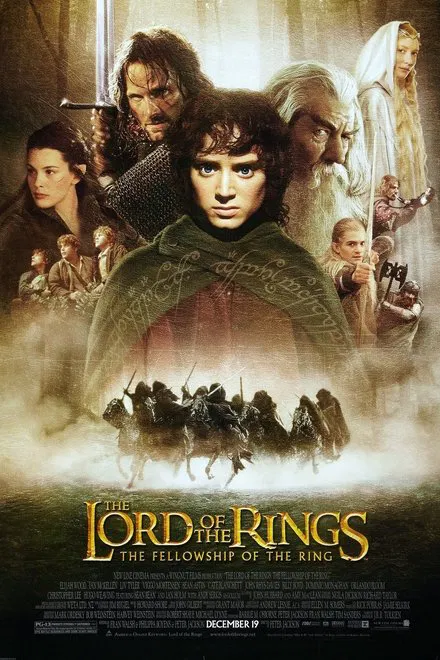
The Lord of the Rings: The Fellowship of the Ring (2001) Poster
THE LORD OF THE RINGS: THE FELLOWSHIP OF THE RING
(2001) A
dir. Peter Jackson

The movie opens soft, like a legend spoken in half-tones. The kind of story meant only for a listener who is willing to lean in. But stillness only gets a moment here, and the film quickly expands into a fantasy epic that’s so sweeping it makes others feel pocket-sized by comparison. This isn’t just the beginning of a trilogy. It’s the opening of an entire world. Here called Middle-earth. And it’s so thoroughly imagined that it stops feeling invented.

We start in the Shire, a green, rounded, and safe corner of the map. It’s home to the hobbits. Creature half the size of humans, woolly feet, a blissfully narrow sense of what matters. But that won’t last. At least for some of the hobbits.

Because the world is about to have a dark shadow cast over it. Gandalf (Ian McKellen), gray hat, gray moods, wanders back into the Shire with a worry he doesn’t name at first. Something’s off. Something old. And it all comes down to a ring—small, unassuming, currently rattling around in Bilbo Baggins’s (Ian Holm) waistcoat pocket. Bilbo picked it up ages ago on one of those adventures he calls a “holiday.” Wrote a book about it, too. He’s spent years slipping it on for party tricks, utterly unaware that the thing has a history, and worse, an owner.

The ring is power. Power corrupts. A harmless hobbit had been its caretaker, but creatures far darker are hunting for it now. The ring has to be destroyed. There’s no other way. And there’s only one place the ring can be unmade: in the fire inside Mount Doom. Across the dead wastes of Mordor.

That’s the task. Quick to summarize, grueling to attempt. Three enormous films exist just to walk it there. Frodo (Elijah Wood)—Bilbo’s nephew, gentle as they come—winds up holding the ring. Too earnest for the task, you’d think. And somehow that’s exactly why it falls to him. Frodo’s always been curious about adventures, but he was never exactly built for them. No hobbit is. Hobbits are creatures that thrive on quiet corners and second breakfasts. But Frodo, at least, isn’t going to have to walk it alone.

His circle forms piece by piece. Sam Gamgee (Sean Astin) falls in beside him before the journey even has a name. Gardener by trade, guardian by instinct, carrying a worldview that’s built partly on potatoes. Merry and Pippin (Dominic Monaghan and Billy Boyd) tumble in soon after—drawn toward trouble the way restless kids gravitate to whatever’s behind the closed door. Then come the bigger shapes. Aragon, Gimli, Legolas, all with Gandalf keeping pace behind. Trying to move the line forward as far as he can until the darkness gets too overbearing.

Because shadows are coming. The evilest force in the history of Middle-earth, Sauron, suddenly appears as a great lidless eye atop a distant tower. He’s the one who wants the ring back. He needs it back. You might even say he’s its rightful owner. Acquiring the ring is his only path to be restored to physical form. Which, I assume, would be bad.

While Sauron has yet to inhabit a body, it doesn’t mean he isn’t powerful. He can still move pieces. He influences wizards to lean his way—most notably Saruman (Christopher Lee). He sends the nine Ringwraiths—cloaked knights made out of black air—on horseback to seek out the ring. Cause entire orc armies rise out of the ground. The longer time goes on, the more difficult this trek is going to be.

And so, the Fellowship travels. Forest light. Mountain ice. The molten glow of mines. The hazards keep reinventing themselves, and then comes a betrayal from the last place they’d look. But the ring gnaws at Frodo the most. It’s slowly claiming him. Corrupting him.

The extended editions are also worth mentioning. They widen the story without puffing it up. They’re rather like doors in a castle that you didn’t notice at first—side quests, extra corners, scraps of folklore someone left lying around. None of the added scenes is required for a fulfilling adventure, but it deepens Middle-earth for anyone willing to go. These editions make the trilogy feel less like films and more like a world that you walk into.

Peter Jackson keeps the pace taut. Never stuck, never too safe. Even the lighter moments aren’t free of their darker threads. And when the Fellowship breaks, the air of the story changes—cooler, thinner. First you notice it, then the cold moves in. It isn’t laying groundwork for the next installment. It’s marking a shift in the journey itself. The road ahead—still long, is now darker, more treacherous. And yet Frodo keeps walking.

Starring: Elijah Wood, Ian McKellen, Viggo Mortensen, Sean Astin, Orlando Bloom, John Rhys-Davies, Billy Boyd, Dominic Monaghan, Sean Bean, Cate Blanchett, Ian Holm, Christopher Lee, Hugo Weaving, Liv Tyler.
Rated PG-13. New Line Cinema. USA/New Zealand. 178 mins.
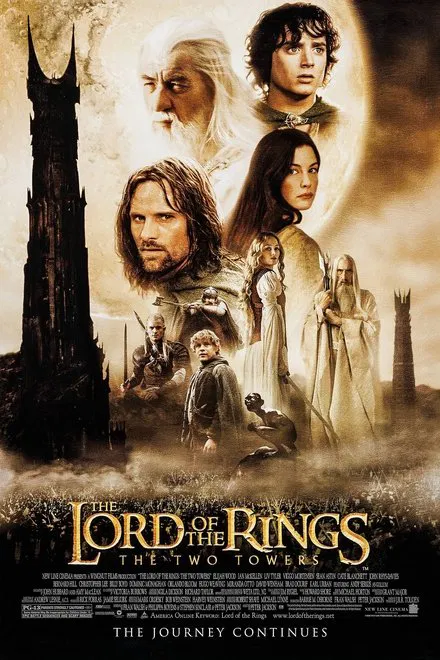
The Lord of the Rings: The Two Towers (2002) Poster
THE LORD OF THE RINGS: THE TWO TOWERS (2002) A
dir. Peter Jackson

Many trilogies treat their second entries like one long inhale. But The Two Towers walks in without bothering to clean up first. It sets its pieces down quickly and pushes the story into motion. Heroes, kingdoms, creatures with too many teeth.

They all get thrown across Middle-earth with the casual flick of someone sliding cards on a smooth table. No lallygagging on the sidelines this time, moaning about second breakfasts, or gentlemanly speeches. This is story kicking forward, down and dirty. Taking us through open ground and dimmer reaches.

High above, as always, in that black, narrow tower is Sauron’s eye drifting across the horizon. The world seems to draw tighter in its wake. And yet Frodo Baggins (Elijah Wood) keeps moving anyway. Pale, beat down, and running on whatever little strength’s still in him. Sam Gamgee (Sean Astin) stays close, offering small words when they help, cooking what he can, doling out rations like he’s measuring out hope itself. The Ring isn’t coaxing him anymore. It’s grinding him away. A little here, another there. There’s less of Frodo for every mile they trek.

Their journey jolts sideways when Gollum (Andy Serkis) crawls back into the open—dragging centuries of ruin behind him. He’s a wiry, miserable creature: stringy hair, scraps of cloth, eyes always darting, a grin that probably carries whatever half-alive thing he last swallowed. (He once bragged about fish wriggling down his throat. You believe him.) He’d once been Smeagol, a hobbit like any other living his small life, but then the Ring found him. Years under its pull reshaped him. His frame stretched and twisted, his voice narrowed. Even his thoughts split into two competing selves. One part (the Smeagol half) tries to help. The other (the Gollum half) plots around every corner. The Ring stretched his life far beyond its limit. Once Bilbo walked off with it, he never stopped plotting how to reclaim it.

Across the map, the story widens out. Merry and Pippin—once the troublemakers of the group, now fugitives by accident—push their way into Fangorn Forest, where the trees drift through thought the way old men drift through stories. The hobbits do their best to prod them into motion, urging them toward the growing trouble outside the forest. But to trees that predate the map, the danger looks small, almost passing.

Aragorn, Legolas, and Gimli reach Rohan and find a place run ragged by attacks and a stretch of poor leadership. Its king, Théoden (Bernard Hill), sits with a blank, tired expression, not involved in much of anything around him. And the reason why isn’t exactly subtle. Gríma Wormtongue (Brad Dourif) stays by his side whispering poison into his ear and manages who can talk to the king and how their words arrive. By the time the king issues actual decrees, they sound suspiciously like they’ve been shaped by Saruman. And now, since Rohan can’t hold the plains anymore due to the orc raids and horrid mismanagement, the people head for Helm’s Deep. A fortress carved into a mountain that’s the last place sturdy enough to keep them alive.

Saruman doesn’t give them much time there. The siege on Helm’s Deep hits like bad weather rolling in layers: rain, torches, iron, mud. The walls breathe once, shudder, and then break. Jackson films the battle so you feel trapped inside it. Tight rooms, slick stone, blades cutting through places too cramped to breathe in. The battle runs long, nearly a full hour, and it’s as grand as the genre gets. But it remains gripping nevertheless, because the camera always knows to sticks with the characters we care about. At no point does it feel like they’re only playing second fiddle to the spectacle itself.

The battles might be huge, but the film also doesn’t drop the smaller turns. Merry and Pippin are no longer comic relief tag-alongs. They carve out a part of the story that’s theirs. Gandalf storms back into the frame like weather breaking in the right direction. And, as always, out on the far edge of everything, Frodo continues his trek—Sam staying beside him with steady hands, quick words, doing whatever he can to keep them moving in the same direction.

By the end of this part of the story, everyone’s worn out and backed into tight spots. The finish here has more light in it than Fellowship’s did. Steadier. Not optimism, exactly—just something closer to readiness. Things that were once scattered are starting to shape themselves again. And everything is pulled toward the reckoning it’s been building since the start.

Starring: Elijah Wood, Ian McKellen, Viggo Mortensen, Sean Astin, Andy Serkis, Orlando Bloom, John Rhys-Davies, Billy Boyd, Dominic Monaghan, Bernard Hill, Miranda Otto, Karl Urban, David Wenham, Brad Dourif, Hugo Weaving, Liv Tyler, Cate Blanchett, Christopher Lee.
Rated PG-13. New Line Cinema. USA/New Zealand. 179 mins.
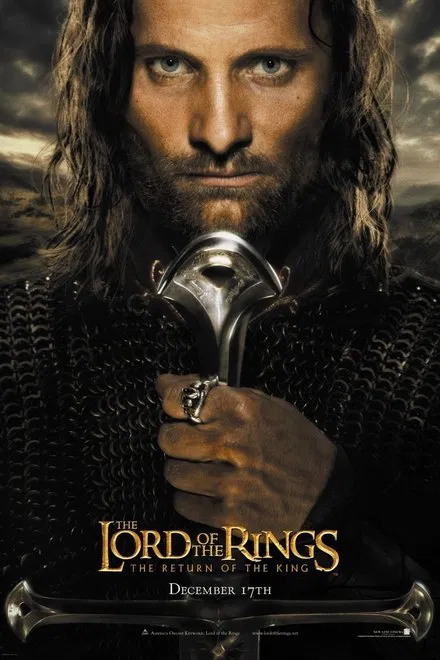
The Lord of the Rings: The Return of the King (2003) Poster
THE LORD OF THE RINGS: THE RETURN OF THE KING
(2003) A
dir. Peter Jackson

Now is the endgame. Middle-earth is shaking like it’s been holding a strain it can no longer manage. Rohan’s unlikely victory at the end of The Two Towers is already fading in the rearview. One win, nothing more, in a war the free peoples of Middle-earth still look poised to lose.

Trouble’s taken root in the east. And Minas Tirith, which still looks solid as carved stone from miles out, tells a different story once you pass through its gates. You can feel how much strain it’s under. Denethor (John Noble) occupies the king’s chair, but losing his son Boromir has thrown him off course. It shows fast. The generals hesitate. The defenses take shape in fits. Mordor continues to amass impossible troops two horizons away. Gondor keeps glancing toward Denethor for direction, but nothing comes. Gandalf (Ian McKellen) moves through the city, trying to keep it pointed toward sense. It’s a tough job, though, when the man meant to lead it has gone missing inside his sorrow.

Then Aragorn (Viggo Mortensen) appears. Not as a wanderer anymore, but as the figure the city’s needed all along. The true heir of Gondor. Standing at last in the place that was built for him. And the city senses the shift almost instantly. Like a reflex. And the city finally stirs. Pulling itself together for the fight for its life.

Meanwhile, Frodo (Elijah Wood) looks worn down to the thread. Each step he takes looks like something he has to negotiate with himself first. The ring has worn him down into a quiet, unsettled state. Sam Gamgee (Sean Astin) stays tight at Frodo’s side, steadying him as the road climbs. Gollum (Andy Serkis) prowls just behind, testing the seams in their bond, pushing wherever he finds a give. He’s still chasing the only ending he’s ever wanted: the Ring returned to him.

The fight for Minas Tirith tears open wide. It’s huge and messy—the kind of spectacle that would normally swallow a film whole. But here, it sits just off to the side, and everything funnels back to the mountain where Frodo is reaching the last stretch. No more detours left. Only the decision that’s been rising behind him this entire time. Heat wavers ahead, the ground trembles, and the ring that’s bent his thoughts faces its final reckoning. When the moment comes, it’s not triumph at all. It looks more like someone running out of strength after running a marathon they weren’t quite prepared for. The body gives up long before the will does.

Getting back to normal isn’t simple. It comes in fragments, and not always when they want it. The places they return to feel familiar, but the fit is different now. Unease moves in to fill the space where innocence once sat.

People still argue about the movie’s many endings, but they feel right for a tale this size. You don’t shake off three films’ worth of miles in a single breath. The film wisely doesn’t pretend that you can. This is an epic that takes its time to settle. Slow and uneven, but it effectively recreates the sensation of getting at the end of a hard road and finally being able to stand still. And what you’re left holding isn’t the victory alone. They are also the aches, the farewells, the bits of the journey that stay in your psyche and refuse to shake loose. While peace does arrive for Middle-earth, it’s not the kind that forgets what it cost.

Starring: Elijah Wood, Ian McKellen, Viggo Mortensen, Sean Astin, Andy Serkis, Orlando Bloom, John Rhys-Davies, Billy Boyd, Dominic Monaghan, Bernard Hill, Miranda Otto, Karl Urban, David Wenham, Brad Dourif, Hugo Weaving, Liv Tyler, Cate Blanchett, Christopher Lee.
Rated PG-13. New Line Cinema. USA–New Zealand. 201 mins.
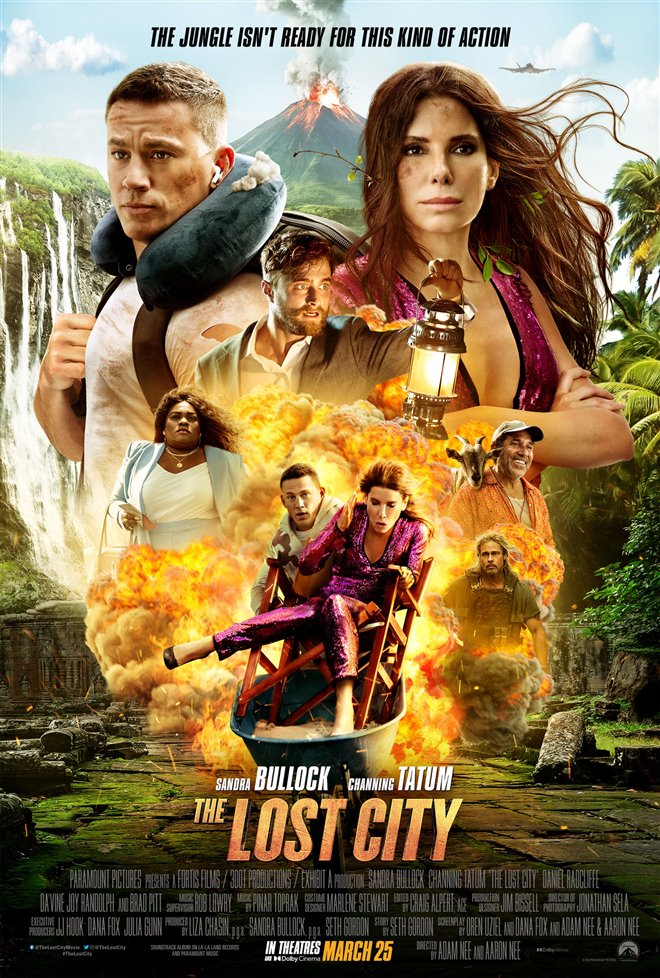
The Lost City (2022) Poster
THE LOST CITY (2022) D+
dir. Adam Nee and Aaron Nee

Sandra Bullock is miscast in this film, though not in the expected way. She plays Loretta Sage, who writes the kind of paperbacks you see piled next to the supermarket gum racks. The film presents her like she’s some kind of shut-in with frayed nerves. The type who would eat her meals over the kitchen sink. But onscreen she looks like the type of “recluse” who travels with her own private stylist crew. Even deep in “jungle peril,” she looks photo-ready. Like a Vogue cover model.

The movie loses its footing the minute it starts pretending Bullock and Channing Tatum—who is the male model on her novel covers—are some kind of improbable romantic pair. True, she’s the brains and he isn’t, but if you were to spot them holding hands at a mall, you sooner assume they share a skincare routine than think they don’t belong together.

What she needed was real wear and a little desperation. At the very least, she shouldn’t be pretty. Usually the old glasses-and-loose-jeans trick Hollywood does would’ve been plenty. Or better yet, cast Melissa McCarthy doing a sideways riff on her Can You Ever Forgive Me? persona. At least then the setup wouldn’t feel mismatched from the ground up.

The plot kicks into high gear when Daniel Radcliffe barrels in as a billionaire brat who is forever parked emotionally at the age boys are when they discover loafers and entitlement. He kidnaps Loretta and drags her to a private island because he’s convinced her paperbacks are coded treasure maps. (She throws in just enough pseudo-history to keep his delusion tidy.) And before they know it, Loretta and Alan are slogging through “danger” in what feels like a thrift-store Romancing the Stone. The kind designed by people whose idea of peril is when they lose a phone signal. Other than, I guess, the obligatory leech scene. There always has to be a leech scene.

Brad Pitt drops by early, dressed like a jungle-ready superman. He flashes the grin everyone came for, looks like he’s about to rescue everyone, but then evaporates before you can blink twice. This is the film’s big meta joke—more startling than funny. And unfortunately the only time I chuckled.

The real trouble here is tone. And not just in the characters. It’s baked into every choice the movie makes. The movie flirts with parody, but it stops committing to it when suddenly it wants you to take the romance seriously. It plays at danger, but it’s undone by set pieces that seem based on someone’s fuzzy memory of a trip to Animal Kingdom. Even the dialogue sounds like it came from writers who read about humor in books but never encountered it in the wild.

Bullock can certainly play nerdy, frumpy, emotionally ragged, but this movie prefers to treat her more like a brand asset. She’s kept prim and polished and never for a second looks like an actual human. She needed to get really wrecked by the jungle. And look like who can stumble into the arms of the muscle-headed boy-toy hardly believe her luck. The worst she ever gets here is her hair lightly windblown. Or her sequined dress gets fashionably frayed. And she gets the guy would’ve swiped right anyway. No forced jungle bonding required.

Starring: Sandra Bullock, Channing Tatum, Daniel Radcliffe, Da'Vine Joy Randolph, Hector Anibal, Thomas Forbes-Johnson, Oscar Nunez, Patti Harrison, Brad Pitt.
Rated PG-13. Paramount Pictures. USA. 112 mins.
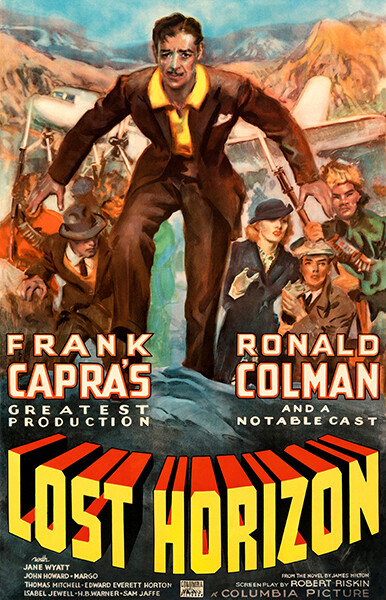
Lost Horizon (1937) Poster
LOST HORIZON (1937) B
dir. Frank Capra

Fresh off two Oscars, Capra took a swing at Shangri-La instead of another hometown fable—swapping his usual easy populism for something closer to mysticism and big, searching ideas. A bold move, and it shows. The film turns into this odd, ambitious hybrid. Lavish in places, earnest in others, coasting on fantasy. And you keep watching because Capra applies his full, earnest machinery to material that—let’s face it—is far thinner than he treats it.

It opens with a passenger plane crashing in a Himalayan drift. Snow presses around the wreckage while five passengers climb out slowly, still trying to understand what happened. Robert Conway (Ronald Colman) finds his footing first, quiet and composed while the rest can hardly do anything else than blink at the cold, dazed by the shock of it. Then the wind shifts, and shapes appear through the white. They’re porters, bundled in furs, unhurried and sure-footed there to shepherd the survivors to sanctuary.

And the sanctuary has a name. Shangri-La. What hits you first about it is the grandeur. Part Aztec pyramid, part mountain estate. Rows of garden beds that stand straight, broad staircases polished to a glossy sheen. It has a funereal air about it, but it’s wrapped in enough comfort that you could mistake it for a generously funded retirement home.

But the grand marble halls aren’t all that makes this a utopia. It’s how time itself seems to stretch. The years just behave differently here. The place is run by the High Lama (Sam Jaffe), who claims to have lived two centuries there and still hasn’t turned to dust. He wants Conway to see the appeal of their way of living.

Their longevity isn’t just mountain air, though that helps. It comes from how they move through the days—slow, steady, without strain. Shangri-La doesn’t hurry. People talk, wander, and think. Even the smallest decisions move slow there. Like they need time for their thoughts to stretch before they take shape. And this sort of thing isn’t just indulgence. It’s how they operate. Everything is about moderation for them. Don’t exert yourself. Be kind but not evangelical. Have possessions but don’t be materialistic. Live by a philosophy built around pleasant sufficiency.

Conway adapts quicker than anyone else in the group, exuding a kind of worn-in calm that comes from years of cleaning up trouble he never caused. Shangri-La resident Sondra Bizet (Jane Wyatt) sticks close by—patient and watchful. though the film rarely gives her more than a glint of personality. The rest of the party wanders the valley like guests afraid of scuffing a freshly refinished floor. And maybe they should be, because the film never answers the practical questions. Like who cleans that floor? Who grows the food? What does serenity cost, and who pays it?

Capra isn’t trying to map out a workable paradise, though. He’s reaching for the itch beneath it—the fantasy of a place where the noise of everything else falls away and time loosens its grip. It keeps pausing for these gentle, drifting talks—big themes delivered in small voices. People trade thoughts about meaning and time and getting wiser, but the conversations are spoken so gently they vanish almost as soon as they arrive. Serenity may shape the valley, but it also flattens the film’s emotional register.

Starring: Ronald Colman, Jane Wyatt, Edward Everett Horton, Isabel Jewell, John Howard, Thomas Mitchell, Sam Jaffe.
Not Rated. Columbia Pictures. USA. 132 mins.
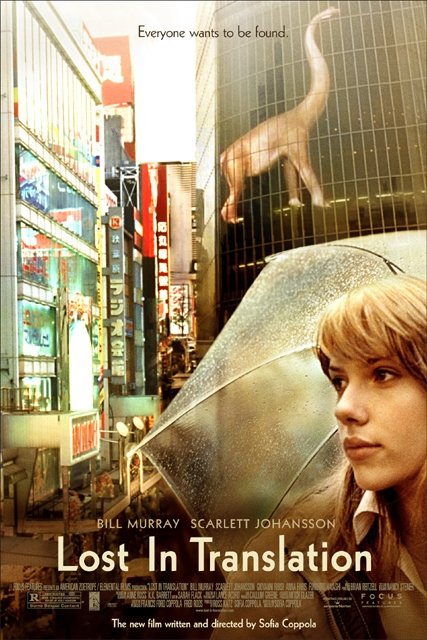
Lost in Translation (2003) Poster
LOST IN TRANSLATION (2003) A
dir. Sofia Coppola

It’s two a.m. in Tokyo. You’re up again. Tired and jet-lagged. You’ve got a name people know. Just not in this city and especially not at this hour. The only thing speaking your language is the vending machine humming down the hall. You’re sitting in a crowded hotel bar that glows blue—like an aquarium. Light jazz slides under the room’s soft chatter. Despite people all around you, you couldn’t feel more isolated. Then you catch sight of her. She’s sitting by herself. Her thumb circles her wedding ring like she’s still getting used to it. Then she glances up. Your eyes meet. She recognizes you. That’s all it takes for you to start talking.

Murray plays Bob Harris, in Tokyo to film a whiskey ad. They asked for a rugged American, and Bob was the one who picked up the phone. On set, he poses, he mumbles, he points at the label and takes his check. Then he spends the early mornings jet-lagged—drinking in the hotel bar just to let his mind go numb.

Scarlett Johansson plays Charlotte, recently married and already fading out of her own life. Her photographer husband’s in Tokyo shooting bands, barely aware she’s there. He leaves her to puzzle out whether she chose a partner or a persona. Charlotte is drifting. Bob is dissolving. But once they meet, they start wandering the city with more purpose. Even, at times, a little joy.

They don’t fall in love. Not romantically, at least. This isn’t that kind of story. They orbit instead. They murmur. They eat lunch in bathrobes and stare out hotel windows. They share heat. Their glances stretch a beat too long. Silences pick up meaning. They walk through the city with a new steadiness, as if the fog around them finally thinned.

Murray falls into step with it, carrying the movie with a gentle, worn-in grace. He tosses off the jokes without thinking, but allows the gloom to keep following right behind him. Johansson falls into step beside him, her performance edged with a type of melancholy that she doesn’t try to tuck away.

Coppola keeps the film held back a little, like she’s hesitant to let it exhale. Scenes wander off before you realize they’re leaving. Light slides across the frame in odd, drifting streaks. Some conversations fall apart mid-sentence. Others dissolve into the room’s quiet. The film lands in this beautiful, gently tilted place. A movie that’s like jet lag mixed with a swallow of whiskey and then turned itself into emotion.

Lost in Translation doesn’t tell you what to feel. It barely tells you anything. But it gets you. It’s about that rare moment when someone sees you clearly, without any reason to. And that loneliness you get when the city’s spread out under you thirty floors down, looking close but feeling miles away.

The ending rests for a moment, loose and already slipping through. A hand brushes the shoulder. A faint goodbye. And that’s all.

Starring: Bill Murray, Scarlett Johansson, Giovanni Ribisi, Anna Faris, Fumihiro Hayashi.
Rated R. Focus Features. Japan/USA. 102 mins.