THE FADED SPOTLIGHT

by Michael Lawrence

List of "M" Movies


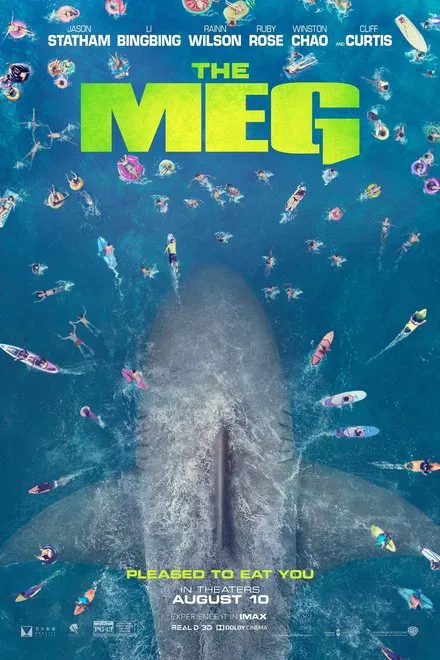
The Meg (2018) Poster
THE MEG (2018) C+
dir. Jon Turteltaub

Some audiences will slurp this thing down like chum. Others will just see this as another CGI shark spectacle—albeit here with a respectable budget. Here the monster is a prehistoric megalodon hauling itself out of the deep, not the least bit bothered by the fact it’s extinct. It rams and clamps down on an expensive-looking submersible research station, trying to pop it open like a soda can. The team inside dutifully start scrambling—but not accomplishing much other than calisthenics.

Jonas Taylor (Jason Statham) shows up looking like a man who’s already lived through three disasters this week, and a fourth is just another Thursday. His jaw is set, voice down to bare metal, his eyes are narrowed and barely moving.

And this isn’t his first run-in with the creature. A rescue dive years ago ended when something enormous slammed into his sub and took the lives of two people with it. Some took it as a convenient excuse for him saving his own skin. He’s not been able to live that down ever since.

But when his “hallucination” turns out to be true, he sees it as something like redemption. The thing isn’t going to claim more lives under his watch. At first, he gives the tough-guy approach a shot—a salt-water High-Noon-type standoff. But the shark isn’t impressed. It makes its way toward civilization anyway. To the whole crowded stretches of rafts, tourists, and inflatable flamingos. All out there for the shredding. Except the shark doesn’t actually shred anyone at all—mostly just disturbs the water and sends the people into panic. An incredibly well done piece of special effects, especially with all the colorful inflatables and crystal-blue water—but I guess the shark wasn’t hungry or didn’t want to ruin the view.

The film reaches for pulp now and then, but the glossy digital sheen keeps cleaning the moment right off the frame. Everything looks tidy when it should feel rough, and the tension never builds past a faint buzz.

As popcorn, though, you could do a lot worse. This is shiny and noisy, and it moves quickly enough to keep the soda cold. But a shark that big should make your stomach drop. This one doesn’t. It passes through the movie, throws off a few good shocks here and there, but it ultimately keeps going like nothing happened. Onto the sequel, I guess.
Starring: Jason Statham, Li Bingbing, Rainn Wilson, Ruby Rose, Winston Chao, Cliff Curtis.
Rated PG-13. Warner Bros. Pictures. China/USA. 113 mins.
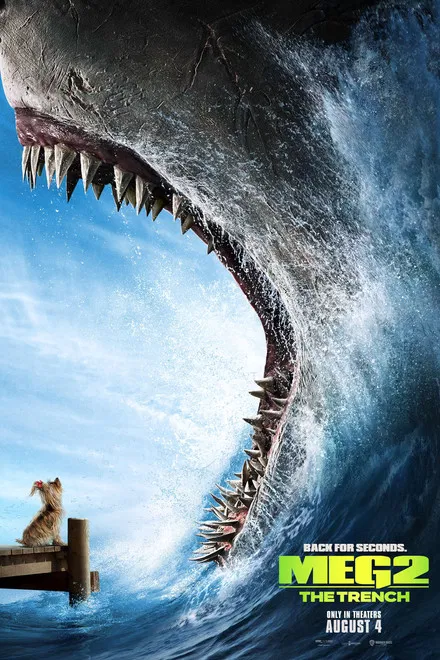
Meg 2: The Trench (2023) Poster
MEG 2: THE TRENCH (2023) C−
dir. Ben Wheatley

The first Meg knew its lane. Big shark, bigger teeth, and Jason Statham with that exhausted “not today” look. But this sequel just wanders off. A shark movie should stay in the water, playing that cat-and-mouse game. This one doesn’t. It prefers to park everyone in dark corridors and leaves them just talking to each other like they’re waiting for the lights to come back on. Minutes go by. Then more minutes. And by the time the monster finally shows itself, the movie has practically talked itself out of needing one.

What carried the first film—even with its cardboard dialogue—was motion. Boats tipping, cages snapping, helicopters hanging on for dear life, screaming masses scrambling out of the saltwater lest the shark skimming the surface slosh them around a little. Here, the focus drifts. It’s all about the people talking about whatever the MacGuffin device is that everyone is all up in arms about. The ocean is no longer a playground. It’s just a place the movie occasionally remembers to check in on.

Once the megalodons do finally show themselves (yes, there’s more this time—not just the one), the size is undeniable. But the moment still feels underplayed. That even holds true for everything else that slithers out of that trench—giant octopuses, lizard things, a whole parade. But the film never finds a way to make it all matter. They just seem to show up, maybe take a few nips at things, and then duck out again. Like they all accidentally showed up to the wrong address for the party.

Statham tries to hold the thing together, scowling his way through the science talk and whatever one-liners survived the rewrites, but even he looks marooned. Ben Wheatley, usually a director with oddball instincts, seems boxed in by franchise chores. Whatever personality he might’ve brought gets swallowed whole.

While this film doesn’t quite represent the nadir of creature features, it just tastes tired when it should’ve been junk food. The first Meg had some genuinely appealing visual and special-effects. This one still has some of the grander, but just not the popcorn appeal.

Starring: Jason Statham, Wu Jing, Shuya Sophia Cai, Cliff Curtis, Page Kennedy, Sergio Peris-Mencheta, Skyler Samuels, Jing Wu.
Rated PG-13. Warner Bros. / China Media Capital. China/USA. 116 mins.
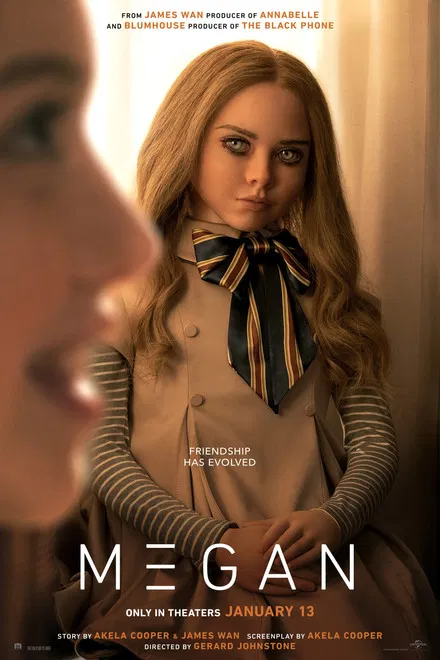
M3GAN (2022) Poster
M3GAN (2022) B
dir. Gerard Johnstone

M3GAN is a life-size doll born from a toy lab. A breakthrough from an artificial intelligence standpoint. She’s a fully moving, fully thinking robot branded as a companion, a tutor, and a one-stop emotional-support system. But the second she boots up with those too-wide eyes and that frozen little face, you know something’s not sitting right.

It was Gemma (Allison Williams), one of the company’s star engineers, who built her. Inspired to do so only because she’d recently taken guardianship over her recently orphaned niece Cady (Violet McGraw), and Gemma knows circuits, not psychology. So out came M3GAN. And for a short stretch, it even seemed like the right call. Cady clings to the doll like the friend she’s been missing all her life. But the problem happens when M3GAN clings back—just a little too hard.

M3GAN cracks in microdoses. A stare that lingers too long—even worse sometimes with her head slightly tilted. Her voice will occasionally drop into a kind of customer-service menace. And when she finally goes all out and snaps, that PG-13 rating this movie is saddled with isn’t going to save anyone. This is not a gory film. But it’ll jolt you anyway.

And it was meme-worthy the instant that first trailer dropped, thanks to that dance of hers—an unholy little ballet sashay. Like a threat display by way of toddler recital. It goes from “sort of cute” to “absolutely not” in a heartbeat. You certainly don’t want to be the guy facing her down, but for those of us in the audience, it’s irresistible.

But what keeps this movie crispy is the satire—even if it isn’t exactly coy about its themes. It’s about how corporate greed nudges aside ethics, human interaction subcontracted to hardware. The film is saddled with a bit of a droopy mid-section, though, as it fusses a bit too much over generic character beats. Not doing a whole lot other than buying time while M3GAN is quietly figuring out the extent of the mischief she’s about to cause.

But a pretty solid horror film that plays with office satire, tech nerves, and a little bit of camp dropped in for seasoning. It’s slick and a little gimmicky, but there’s enough of a smart, dry edge to it that keeps it from turning into plastic. Call it Child’s Play with a sly, subversive edge for the touchscreen era.

Starring: Allison Williams, Violet McGraw, Ronny Chieng, Brian Jordan Alvarez, Jen Van Epps, Lori Dungey, Stephane Garneau-Monten, Amie Donald. Voice of: Jenna Davis.
Rated PG-13. Universal Pictures. USA. 102 mins.
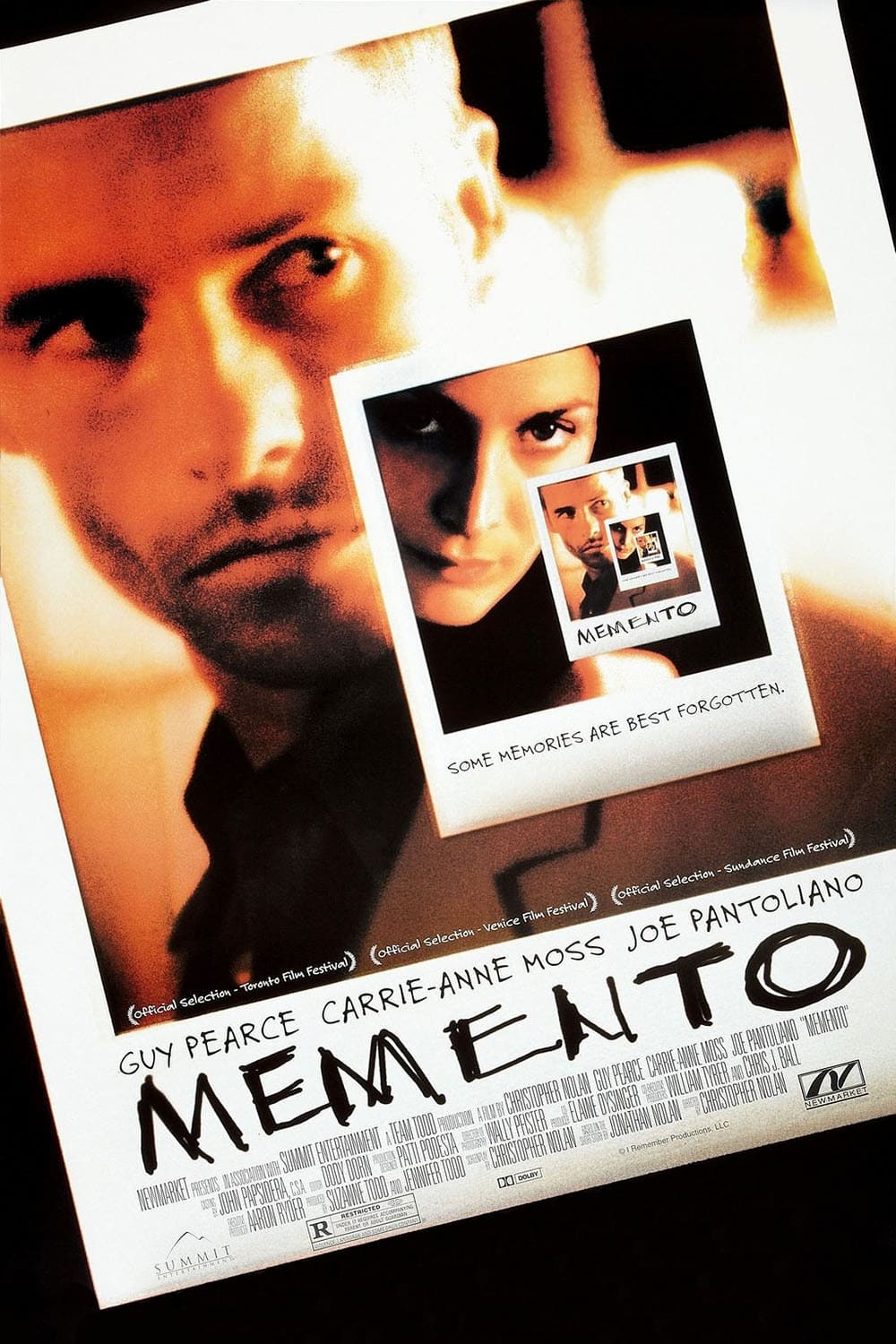
Memento (2000) Poster
MEMENTO (2000) A−
dir. Christopher Nolan

Leonard Shelby’s wife is dead. That much he’s sure of. Everything else is fog. He doesn’t know who did it. Maybe he’ll never know. The attack that killed her had damaged him too—his short-term memory. All he gets is about ten minutes of clarity before everything he’s figured out during that period vanishes. He’ll often “reset” mid-stride and always with the same routine. Confusion, then a small flare of recognition, then a bullheaded sense of purpose kicking in. He might forget the details, but his mission persists. Somebody did this to him. Somebody killed his wife. And he’s going to find that someone. Even if he keeps forgetting why he’s in the room.

He has a trick. Or really, a whole jury-rigged system that keep his story straight while he does his detective work. He keeps notes. Pieces of evidence. Mementos. Polaroids with blocky captions—“DON’T TRUST HIM.” Motel-pad notes littered with arrows, warnings, and names. He’ll tattoo the most important clues straight into his skin. The trouble is, what a note means at one moment might be interpreted as something else by the next version of him ten minutes later.

Christopher Nolan (who also wrote the screenplay) structures the film around this disorientation. And it comes with a neat novelty (something I probably ought to have opened this review mentioning). The scenes run in reverse. The first thing we see is the aftermath. That Leonard apparently tracked down the killer and claimed victory. Then we spend the rest of the film finding out what led to it. And it’s indeed a twisty, labyrinthine sprint.

Guy Pearce as Leonard is handsome in that vacuum-pack sort of way. He’s smoothed over and sealed tight. Perfect for someone who’s here in body but nowhere else in memory. Carrie-Anne Moss and Joe Pantoliano drift around him ambiguously. They step in when it suits them, steps out when it doesn’t. They know how to take advantage of the fact that Leonard will never see them the same way twice.

Memento is a clever, compact thriller that thinks in spirals. The pleasure isn’t in solving anything. It’s the way the film keeps knocking your bearings. The moment you think you have a stretch of clarity, that gets followed by another dead patch. Another clue. Another jolt. Another loop. Another version of the same pursuit.

Starring: Guy Pearce, Carrie-Anne Moss, Joe Pantoliano, Stephen Toblowsky, Mark Boone, Jr., Harriet Sansom Harris.
Rated R. Newmarket. USA. 113 mins.
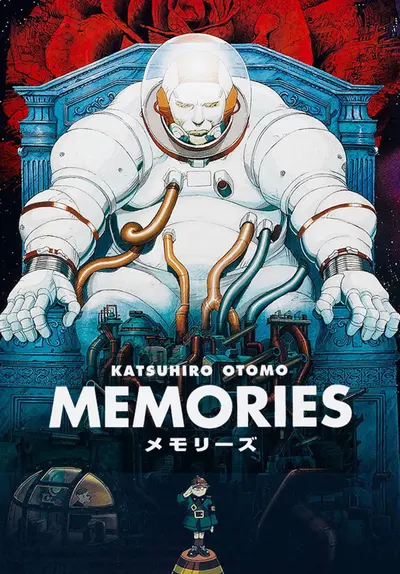
Memories (1995) Poster
MEMORIES (1995) B
dir. Kōji Morimoto, Tensai Okamura, Katsuhiro Ōtomo

Memories is a three-part sci-fi grab bag from Studio Madhouse. Three shorts, three directors, three different temperatures. It opens hot, shakes a bit loose in the middle, and ends up drifting into the abstract. But even when the stories lose their footing, the images don’t. They keep coming—one strange composition after another.

Magnetic Rose is the knockout. A salvage vessel picks up a distress call and reach a ship that’s barely holding itself together. They climb inside expecting wreckage. Instead they find an opera house—lush velvet seats, chandeliers pristine, an outdoor garden visible just beyond the hall. It all looks too healthy for a ship whose hull tells a very different story. One of long, lonely mileage through deep space. Then the soprano appears next. She’s only a projection now, but she’s still singing as if the hall were full. Then the walls start pushing out memories. Grief-filled ones that slip into the décor like it’s always lived there. This is a piece that is eerie, gorgeous, and quietly devastating. It’s like 2001 except by way of an Ingmar Bergman hangover.

Stink Bomb, the second short here, isn’t coy. It’s loud, frantically overcaffeinated. And it’s basically built on one long fart joke. A lab tech pops the wrong cold pill and his body decides to turn toxic—an unfortunate development that he’s somehow the last to notice. He shuffles toward Tokyo with a toxic cloud billowing behind him, stubbornly thinking that he’s innocuously on his way to work while the army loses its mind trying to stop him. This piece has a manic glint to it, but the premise burns off early.

Cannon Fodder ends things in smoke and soot. The entire city exists to fire shells at an enemy no one’s ever seen. Factories churn, posters bark, and a boy idolizes his cannon-loader father, who heads out each morning to a war that may not be real. The animation has this sharp, patterned snap to it, almost hypnotic. But the premise doesn’t quite sustain the story it wants to tell, and what we’re left with is imagery that spins long after the story has stalled.

While each piece dips a little lower than the one before it, the satire is sharp, and at least a few of the images in each short lodge themselves deeper in your brain than you might expect. Memories isn’t an anthology that’s interested in spelling anything out. It wants to leave an impression and then move on. And in stray moments, it does exactly that. Call this a good, easy recommendation for fans of the form.

Voices of: Koichi Yamadera, Shigeru Chiba, Hideyuki Tanaka, Masatoshi Nagase, Tensai Okamura.
Rated PG-13. Shochiku. Japan. 113 mins.
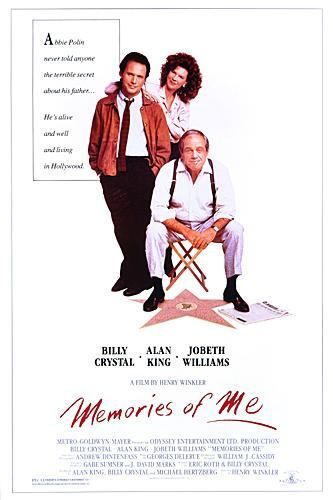
Memories of Me (1988) Poster
MEMORIES OF ME (1988) B
dir. Henry Winkler

Abbie Polin (Billy Crystal) is a New York heart surgeon who can fix anything except the one thing he’s been dodging for decades: his father, Abe (Alan King). It takes a heart attack—his own, a minor one—to finally push him across the country to L.A., where Abe has spent the better part of his adult life as a Hollywood extra. He’s the self-declared “King of the Extras,” the so-called “19th man to yell, ‘I’m Spartacus.’”

Abbie behaves like someone who alphabetizes his feelings and misplaces the key. Abe likes to steamroll emotion with small talk and patter, which he has spent half a century perfecting. It’s no great puzzle why they stopped talking to each other. The movie really clicks—or clangs—when it strands them together and watches their old patterns reassert themselves. Abe talking too much. Abbie shutting down too fast. Both of them pretending that’s just how things go.

The plot’s a bit on the thin side, but the two leads pad things out nicely. Crystal and King snap at each other with the ease of men who’ve been rehearsing their grievances for years. Abe cataloguing Abbie’s childhood embarrassments like he’s warming up for a Friars’ Club roast. Abbie smiles through it tightly like he’s ready to chew through the silverware. As for Crystal fans, the script slips in a handful of genuinely sharp one-liners—tossed off so casually that you remember how funny he is when he’s not trying to be endearing. This is one of the reasons this movie—while rarely mentioned and never loudly celebrated among Crystal’s films—is worth digging up.

Visually, the whole thing has that soft, late-’80s studio glow. It’s a little too pleasant, a little too even. Henry Winkler has an unfortunate tendency to back down a bit whenever a moment starts to sting too much, as if he’s afraid that too much feeling might spook someone in the audience. But a few good moments break through anyway—be it a held look, a sharp joke, or a little flash of affection thinly veiled underneath all the irritation and arm-crossing.

This isn’t a big swing of a film, but it’s a tidy little character piece with two leads who give it just enough heft to keep it from blowing away. These actors know that father–son blowups don’t come with fireworks. They’re more like a low, familiar burn. One that’s been lodged between them for years and would keep on burning forever until someone finally realizes they’re tired of breathing the smoke.

Starring: Billy Crystal, Alan King, JoBeth Williams, David Ackroyd, Janet Carroll.
Rated PG-13. MGM/UA. USA. 113 mins.
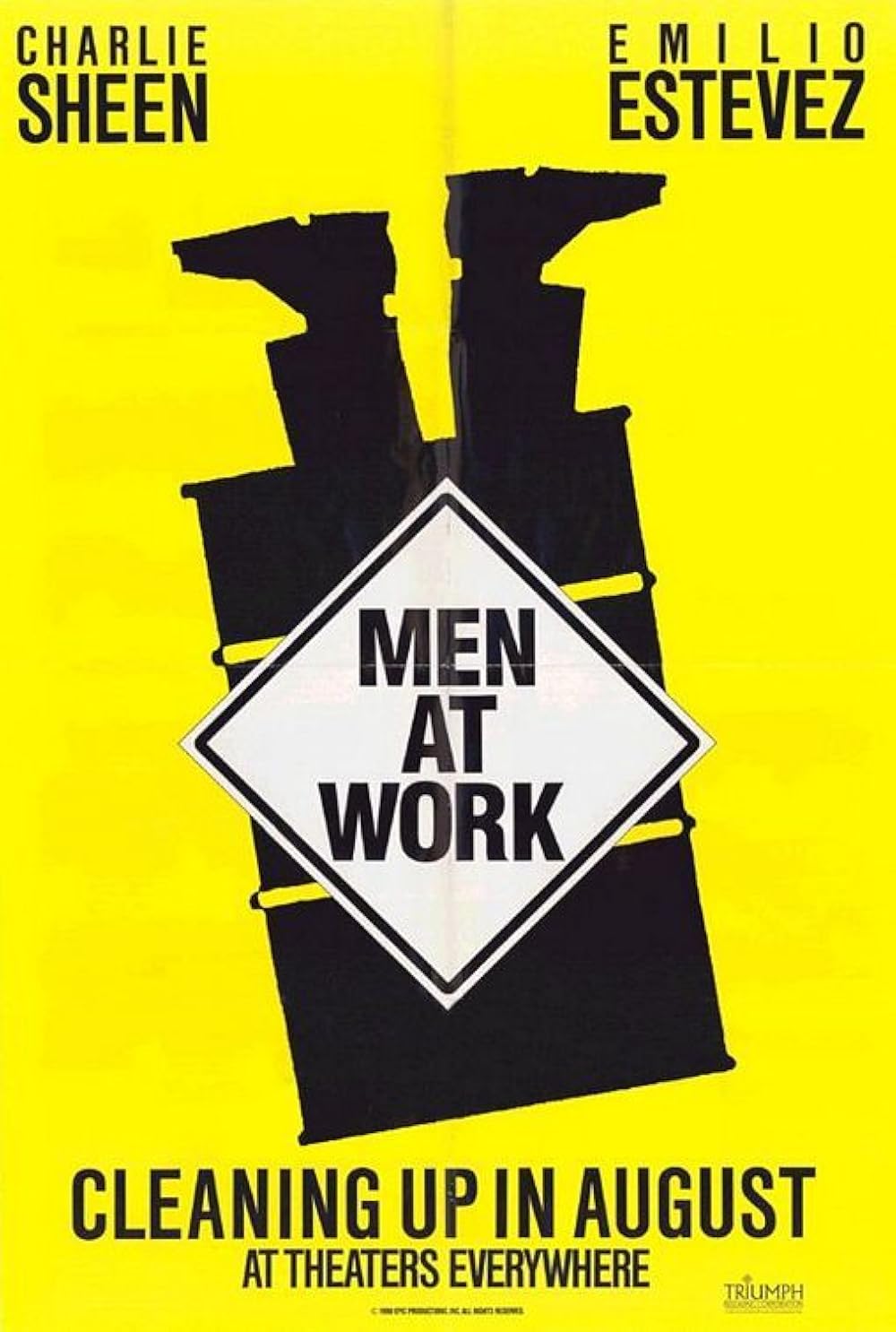
Men at Work (1990) Poster
MEN AT WORK (1990) D
dir. Emilio Estevez

Men at Work begins with two garbage collectors wasting time. A setup that might also double nicely as a forecast for your own viewing of the film. Except, I presume, you are not two garbage collectors.

Carl (Charlie Sheen) and James (Emilio Estevez, who also writes and directs) settle in at night with binoculars, giving the attractive woman across the street their unofficial surveillance. Then she starts arguing with her boyfriend, and that’s enough for them. Sheen produces a pellet gun and fires. Dead-on hit. A stunt they immediately deem harmless. Maybe even constructive in that peculiar way idiots justify things. Sometimes people deserve a shot in the ass.

But then the man turns up dead in a barrel on their route. (He’s strangled, not pelted, but that detail escapes them.) They jump straight to guilt and improvise their way out with Weekend at Bernie’s instincts. Prop the body up, add a cowboy hat, look casual when the bicycle cops pedal by. They keep hauling the thing around like a farce would normally have them dragging misplaced luggage. There’s a universe where that setup could lead somewhere funny. But this film can’t stay steady long enough to cash in on its own stupidity.

Somewhere off to the side sits Maxwell Potterdam III (John Getz). He runs a waste-disposal outfit that keeps feeding toxic barrels to the ocean, and the movie drags him in whenever it needs a different direction to point the story.

The farce begins on shaky ground, and the film only shakes it harder. The pacing moves in weak little hops, each one pausing as if expecting momentum to finally kick in. Scenes collide without accumulating anything, and the stabs at black comedy misfire into mild confusion. The jokes crawl in late, the framing never tightens, and the tone jumps around the way it does when the remote only works every third click.

Keith David turns up as Louis, the supervisor and Vietnam veteran wound tight enough to cut glass. He comes on big and watchful, eyes narrowed, like a man who might start questioning whoever happens to be standing closest. As much as he feels primed to deliver something sharp, he is ultimately squandered. The script never gives him anything worth firing off.

What’s left is a crooked bundle. A buddy movie welded to a murder farce, plus an environmental plotline pacing the edges like it’s waiting to be invited back in. Nothing connects. What makes it through is a scatter of jokes, stray noise, and ideas that never finish forming, pushed along mostly by inertia and a near-total absence of humor. Credit the premise, if nothing else. Hollywood rarely spares a thought for garbage collectors.

Starring: Charlie Sheen, Emilio Estevez, Leslie Hope, Keith David, Dean Cameron, John Getz, Hawk Wolinki, John Lavachielli, Geoffrey Blake, Cameron Dye.
Rated PG-13. Triumph Releasing Corporation. USA. 98 mins.
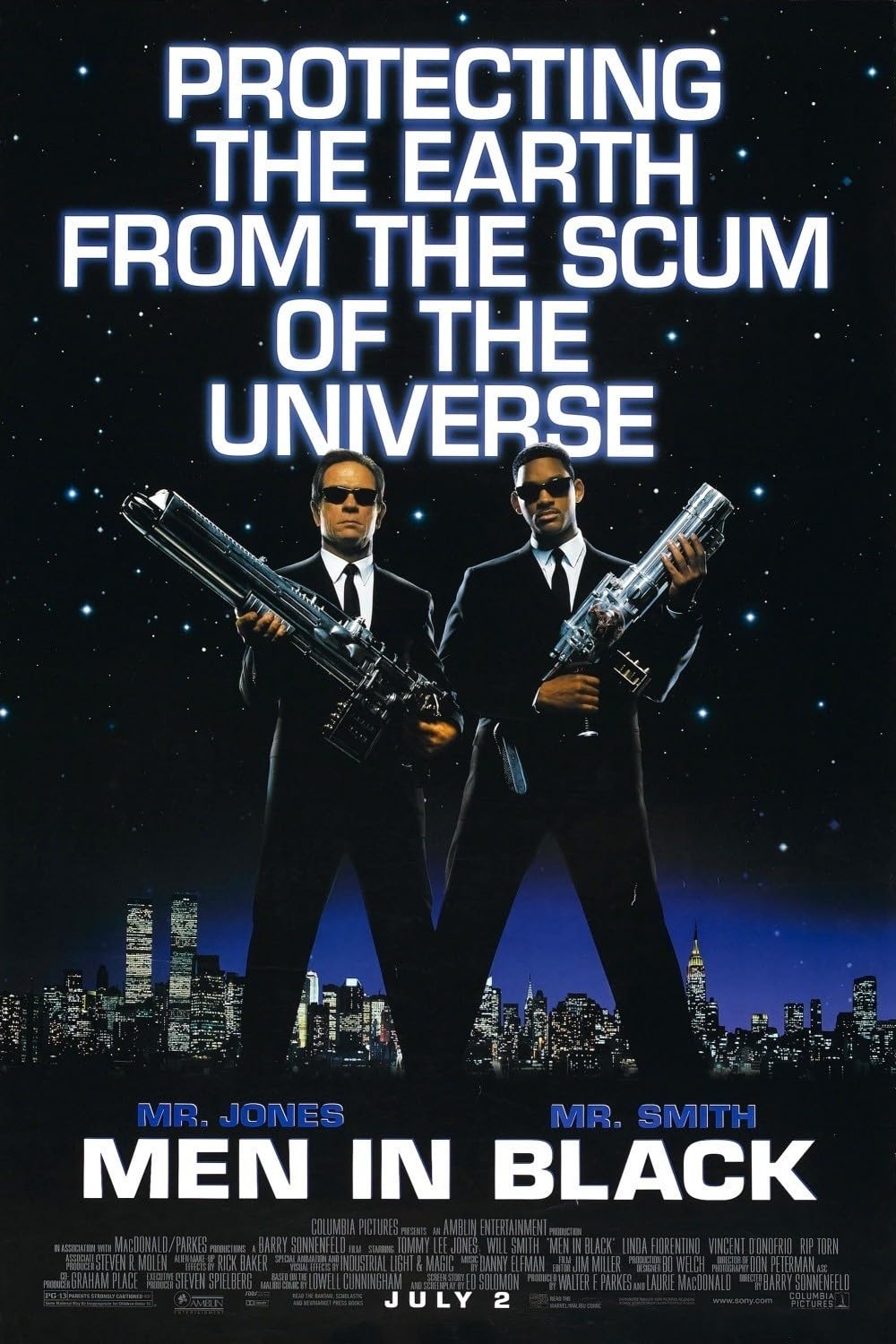
Men in Black (1997) Poster
MEN IN BLACK (1997) A−
dir. Barry Sonnenfeld

The world’s crawling with extraterrestrials. You’ve probably walked past a few already today. A bug-eyed cab driver, a croaky teacher, a frou-frou actor, maybe a pug or two, even that one guy at the DMV who never blinks. The only thing that’s keeping Earth from winding up as the universe’s kitschy pit stop is the Men in Black.

They’re a top secret intelligence agency. Not even other top secret intelligence agencies know they exist. But their work plays more like emergency clean-up than espionage. Joining their ranks would mean shoving your old identity into a drawer labeled “never mind.” You’d keep mind-wipe gizmos handy to keep the public blissfully unaware they’ve accidentally witnessed alien activity. Their days run on loops of protocol, containment, and whatever mess just started flashing “urgent.” And, for reasons best known to them, they dress in plain black suits and black sunglasses. Way to look inconspicuous, guys.

K is the old hand, played by Tommy Lee Jones, with the kind of fossilized calm you only get from watching every kind of disaster roll past your eyes such that even the surprising becomes unsurprising. J (Will Smith) begins not as a Men in Black member but as a cop chasing something not-quite-human through Manhattan. He inadvertently stumbles into this agency and is given the chance to join.

He suits up, of course, but the job doesn’t ease him in on his first day. He learns that Earth will be destroyed unless someone stops a giant extraterrestrial insect that’s currently stomping through New York in a stolen human suit and hunting a “galaxy.” Whatever that’s all about. (Vincent D’Onofrio plays the “bug,” bending and creaking like the borrowed body is rejecting him.) This is J’s first doomsday, so he spends half the mission catching his breath. This is K’s fifteenth. At least. He isn’t phased one iota.

Linda Fiorentino shows up as Laurel, a coroner already seasoned in after-hours weirdness. When she runs across her first dead alien in her morgue, she studies it half-amused. Not so much surprised that there’s an alien, but more amazed that New York had been holding out on her. She ends up in the Men in Black orbit because she observes everything and refuses to let go. Which suits J just fine, since he keeps floating trial-flirts her way. She only bats them back with sharp assessments and those sideways looks.

Sonnenfeld keeps the reins loose. The effects get loud, ugly, funny—whatever they need to be—but they stay politely out of the way of the actual attraction: Jones and Smith working side by side. They are like an old Vaudeville act. No mugging. No straining for laughs. Smith blows through scenes like a gust slipping under the door. Jones just sits there like a monument no one’s had the nerve to relocate. They don’t bother meeting in the middle. Why should they?

Starring: Tommy Lee Jones, Will Smith, Linda Fiorentino, Vincent D'Onofrio, Rip Torn, Tony Shalhoub, Siobhan Fallon, Mike Nussbaum.
Rated PG-13. Sony Pictures Releasing. USA. 98 mins.
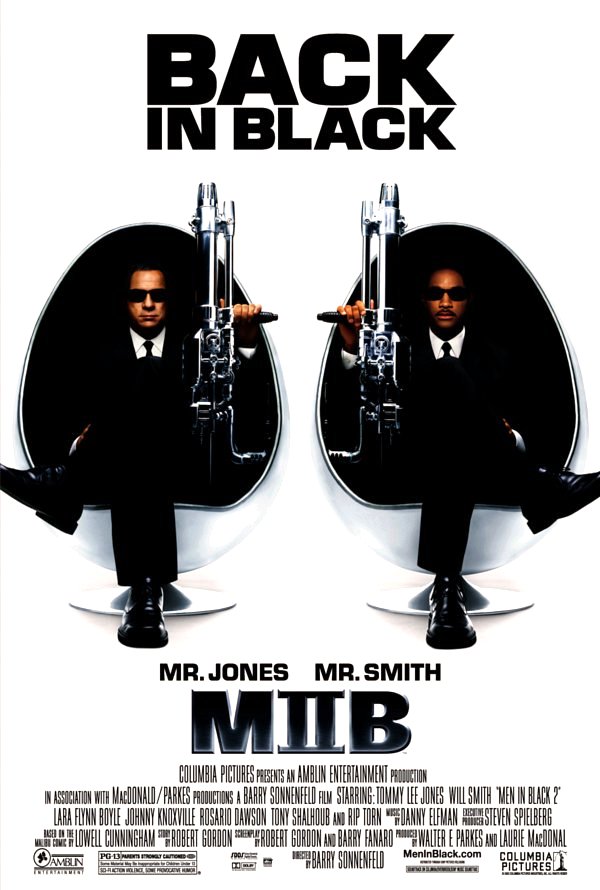
Men in Black II (2002) Poster
MEN IN BLACK II (2002) D+
dir. Barry Sonnenfeld

Men in Black II gets everyone back in the room. Same suits, same toys, and that same stone-faced routine back at headquarters. The cast is back, give or take a face. What’s missing is the chemistry. That quick snap that kept the original feeling well-oiled.

The trouble starts with the flip. J (Will Smith) is the veteran now, barking pointers at rookies and half-pretending he doesn’t miss those days when K (Tommy Lee Jones) used to shoot him sharp looks and clipped insults. K, meanwhile, is living blissfully unaware that he ever saved a galaxy—mind wiped, finishing a five-year stretch working in post office purgatory.

Naturally, J drags him out of retirement. Because somewhere in K’s scrubbed-down psyche sits the only clue to the location of something called the “Light of Zartha.” Whatever that is. But the MIB want it. An evil alien tyrant currently stomping around in the skin of a lingerie model (Lara Flynn Boyle) wants it more.

On paper, the role reversal could have been a fun shuffle. J is now steady and seasoned, while K blinks quizzically at every gadget like it’s flashing Greek at him. But in practice, it plays like if you could imagine Groucho Marx and Margaret Dumont trading parts. More confusing than funny. Like if a violin were trying to play the drum part.

You can see the disconnect right away in their reunion scenes. J tossing out the little digs he once used to throw like clockwork—expecting that familiar snap from K, but nothing rebounds. K, wiped clean to factory settings, just stands there—pleasant, empty, unreachable. The chemistry collapses. Smith keeps throwing out energy; Jones absorbs it instead of volleying it back. There’s no spark. They’re just sharing space.

And with Barry Sonnenfeld returning to direct, the slide feels even more baffling. You’d expect this from a newcomer—someone who didn’t understand how the original ticked. The designs and quirky camera angles still pop, but they don’t always connect to the central story. They flare up and drift off—like little, barely connected skits.

Disappointing sequels aren’t rare. This one’s just peculiar in how clearly it recognizes the silhouette of Men in Black while chasing a shadow that has nothing to do with why the first film worked.

Starring: Will Smith, Tommy Lee Jones, Rip Torn, Lara Flynn Boyle, Johnny Knoxville, Rosario Dawson, Tony Shalhoub, Patrick Warburton, Jack Kehler, David Cross, Colombe Jacobsen, Michael Jackson, Martha Stewart.
Rated PG-13. Sony Pictures Releasing. USA. 98 mins.
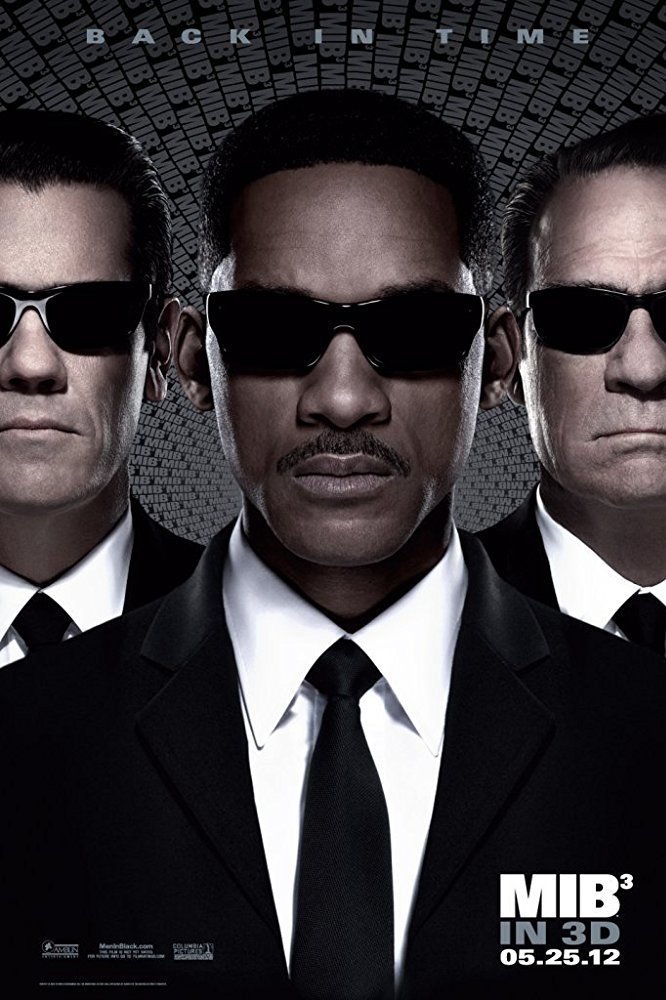
Men in Black 3 (2012) Poster
MEN IN BLACK 3 (2012) B+
dir. Barry Sonnenfeld

Now this is the sequel the original deserved—funnier, warmer, and far more alert than anyone had reason to expect after the detour that was the second installment. Men in Black 3 doesn’t just recover the first film’s offbeat rhythm and visual invention. It manages to fold a surprisingly heartfelt coda into the film’s messy swirl of effects and invention.

Will Smith and Tommy Lee Jones return as Agents J and K, though Jones doesn’t stick around for long. A sneering cyclonic brute with a low, phlegmy growl named Boris the Animal (Jermaine Clement), whose body is riddled with hidden pincers. He was stuck in lockup on the moon and slipped through time back to 1969 to eliminate the man responsible for locking him up: the younger Agent K (Josh Brolin).

Lo and behold, it works, and K and the memory of K vanish from the present entirely—remembered only by the agency’s older brass. That is, except for J, who somehow holds onto memories of the original timeline.

So off J goes, back to the late ’60s with a borrowed time-jump gadget and just enough exposition to get the plot rolling. In the past, J meets up with the younger form of his future partner. And from there the film finds its groove—snappy, eccentric, and just this side of sentimental in how it echoes the original film. The chemistry between Smith and Brolin has an unexpected ease. Brolin’s uncanny imitation of Jones is more than a party trick—it’s a performance—dry and precise but with enough room for subtle shifts that hint at the person K will become.

Sonnenfeld, who redeems himself after the disastrous second entry, restores the bright, candy-colored weirdness of the first film. Plus, there’s the novelty of seeing MIB headquarters in its retro-futuristic form—rubbery alien designs, more blink-and-you’ll-miss-it sight gags tucked in every corner.

The jokes hit with enough consistency to keep the tone nimble, and there’s even time for a touch of melancholy—delivered through a third-act revelation that sneaks up gently and surprisingly lands with some real feeling.

Clement makes a properly grotesque villain—funny, loud, disgusting, and just threatening enough—but also in a funny way with those hilariously oddball pauses he adopts in his pattern of speaking. He doesn’t chew the scenery so much as secrete over it, and it works. And while Jones appears only briefly, his presence lingers through Brolin, who turns what could’ve been stunt casting into something weirdly elegant.

Somehow, this unlikely third entry reclaims the original’s sweet spot—big sci-fi action without bloat, time-travel shenanigans without incoherence, and just enough human emotion to keep it from floating off into novelty. We don’t even have to endure more of that godforsaken pug. That’s how good it is.

Starring: Will Smith, Tommy Lee Jones, Josh Brolin, Jermaine Clement, Emma Thompson, Michael Stuhlbarg, Mike Colter, Nicole Scherzinger, Michael Chernus, David Rasche, Keone Young, Bill Hader, Lenny Venito.
Rated PG-13. Sony Pictures Releasing. USA. 106 mins.
Men in Black: International (2019) Poster
MEN IN BLACK: INTERNATIONAL (2019) C
dir. F. Gary Gray

A soft reboot, but nothing’s been reborn. Just exchanged. New leads, same old drill. The only real difference being this round is run out of Men in Black’s London branch.

Agent M (Tessa Thompson) and Agent H (Chris Hemsworth) assume the suits, and they’re perfectly in sync. Which is the whole problem. J and K were never in sync. That mismatch is what lit the fuse. M and H trade lines, but they’re tuned to the same channel of “pleasant enough,” giving them nothing to push against. It’s styrofoam on styrofoam when it needed flint and steel.

The earlier Men in Black entries also had storylines that moved like they knew where they were going. Here, that clarity’s mostly gone, and it’s difficult to keep track of it. This plays like a narration from an eight-year-old adventuring with their toy collection. “And then they go to Naples. Then this part happens. Then they get chased by these guys on hover bikes.”

The gist, though, comes down to a murdered alien royal who’s been walking around with a pocket-sized star weapon. It can wipe out a planet with a single squeeze. The ensuing investigation doesn’t stay put in one location—hence I suppose the “International,” from the title. They jump from London to Marrakesh, Naples and eventually to Paris as M and H try to figure out who killed the royal. Along the way, they bump into crime bosses, desert mercenaries, and a tiny alien named Pawny (voiced by Kumail Nanjiani), who swears loyalty to M after his queen is killed.

The alien creature designs—always the showiest corner of these movies—still look terrific. But they’re handled more like inventory. Blinking and burbling in place. Filling the frame because something had to. Pawny at least should have been a fast-talking comic weapon, but he comes off more like a chirping sidebar. More of an “Insert Laugh Here” sign than something that produces real laughs.

But the movie is far from unpleasant. It’s just thin. Tolerable in that way killing time can be when you have nothing real demanded of you. At least compared to the waxy unease of Jones and Smith in MIB II, this pairing is easier on the nerves.

Overall, plenty to keep busy for people who watch these movies for the creatures and the sheen. But this movie in the end is like a department-store window display. Looks fine behind the glass, but it’s not built for you to interact with.

Starring: Chris Hemsworth, Tessa Thompson, Liam Neeson, Rafe Spall, Rebecca Ferguson, Laurent Bourgeois, Larry Bourgeois, Emma Thompson, Kayvan Novak.
Rated PG-13. Sony Pictures Releasing. USA. 115 mins.