THE FADED SPOTLIGHT

by Michael Lawrence

List of "M" Movies


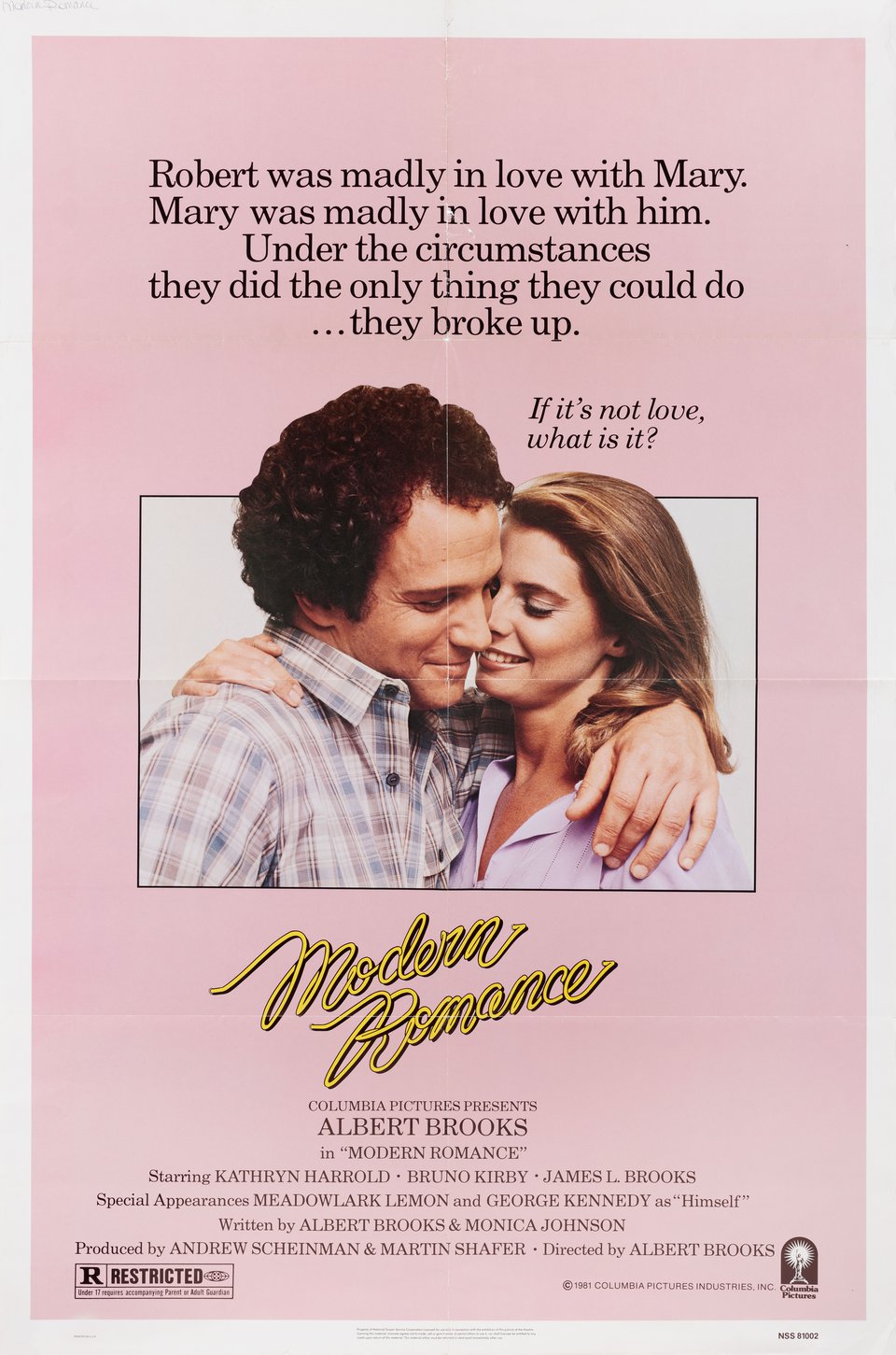
Modern Romance (1981) Poster
MODERN ROMANCE (1981) A−
dir. Albert Brooks

Albert Brooks plays Robert Cole—a man coming apart in real time. Not with fireworks but with sighs, backpedals, and half-apologies. He edits movies for a living—taking little cut-up moments gathered in a film shoot and reassembling them in optimal ways. But when he goes home, the cuts don’t line up. He can’t trim the mistakes, can’t reshoot the scene. What he—or any of us—wouldn’t give just for a rewind button?

Early on, Robert breaks up with his girlfriend—calmly, clinically, as if the pain will hurt less if he controls the incision. He’s decided no one should have to deal with him, least of all her. So he’s doing her a favor. It’s the mature thing to do. But that conviction lasts maybe five minutes. After that, he’s at war with himself—jealousy, guilt, regret, projection—on rotation. It’s like watching someone reread their own bad diary entries in real time. And he drags everyone within reach into it. Especially his ex-girlfriend. Or his ex-ex-girlfriend. Whatever version of their relationship he’s decided they’re in at that particular moment.

There’s a moment in this film when he drops a fortune on a full home gym. He’s convinced this will be the thing that fixes everything. The reset button his life’s been waiting for. And maybe it could’ve been. But he quits before breaking a sweat. Robert isn’t lazy. He’s just hooked to the fantasy of quick fixes.

When Robert is not spiraling romantically, he’s holed up in his editing room, cutting a cheap sci-fi flick while dispensing smug advice to the director. I particularly enjoy these scenes—at least as a film buff. They are partly satire but also provide some real insight into the film editing process. These scenes are little miracles—tweaking sound effects, splicing reels, fussing over insignificant detail. It’s a rare peek into the guts of post-production.

Modern Romance isn’t a breakup story. It’s more like a slow-motion autopsy in self-sabotage. While every decision that Robert makes has its own logic, it’s that accumulation of decisions that kills him. What Brooks nails here is a kind of masculine neurosis that most films aren’t willing to touch—something he doesn’t just make watchable here, but makes very, very funny.
Starring: Albert Brooks, Kathryn Harrold, Bruno Kirby, George Kennedy, James L. Brooks.
Rated R. Columbia Pictures. USA. 93 mins.
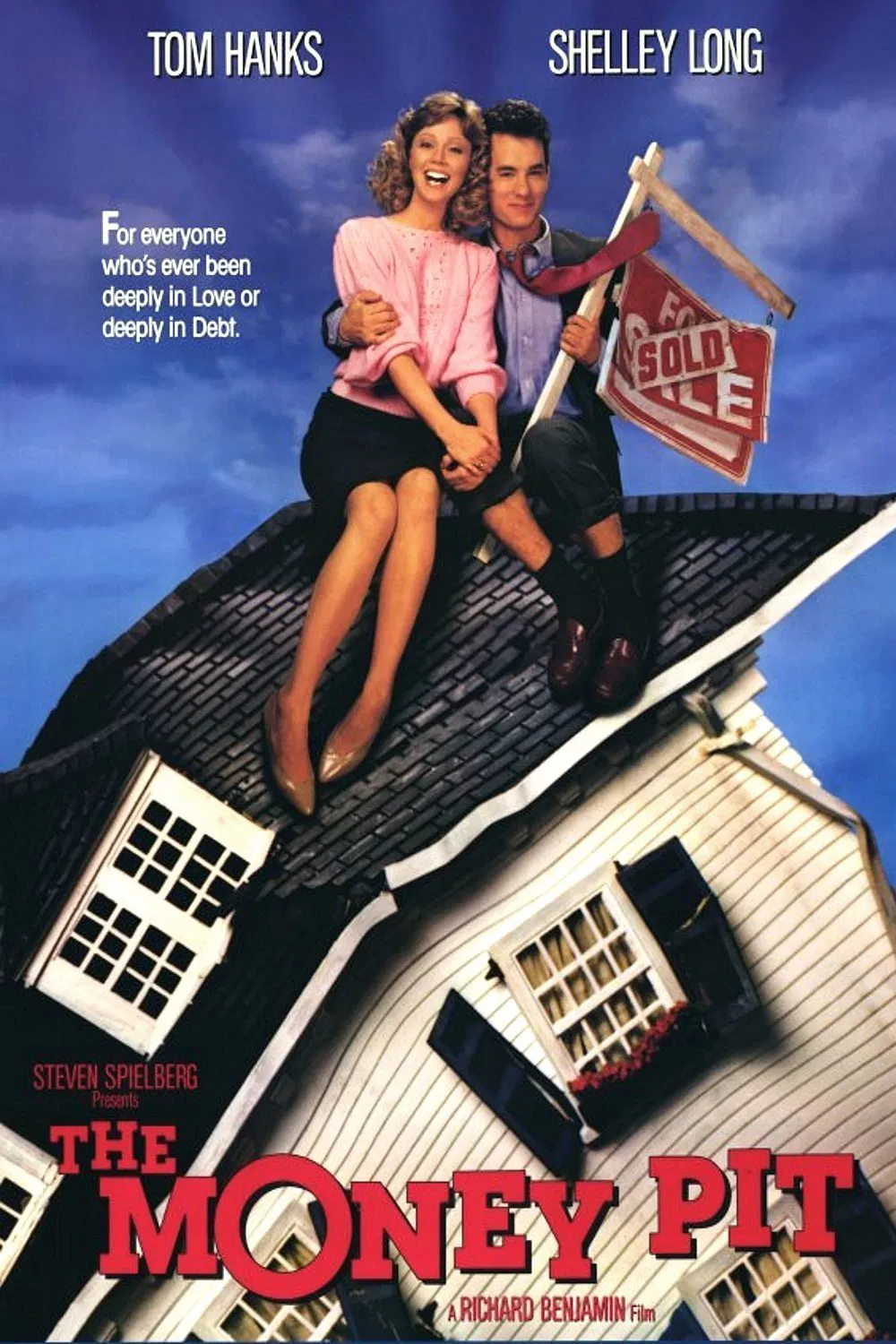
The Money Pit (1986) Poster
THE MONEY PIT (1986) C−
dir. Richard Benjamin

Tom Hanks and Shelley Long play Walter and Anna, a well-meaning but overextended couple who are looking to buy their dream house. And they think they’ve found it in a mansion they find from a jittery widow who is eager to unload it. They swoop in thinking they’ve found a steal. And they do. For about five minutes. Then the house starts to eat itself. Like it’s been holding its breath and now finally able to exhale.

Staircases collapse. Bathtubs crash through floors. Doors give up on hinges. Paint peels. Pipes burst. Even the walls themselves seem to shiver off all their fixtures. Every repair they try to make spawns three new disasters. It would seem this place doesn’t need fixing as much as it needs a priest.

This movie should be funny, and now and then it is. But mostly it wears you out. The pratfalls and the things breaking go on and on. Maybe you start out laughing. But then gradually you stop—because you notice something about these butts of the joke that you’re never supposed to notice. You start identifying with them. You start feeling their ache. Somewhere in your back. These aren’t clowns. They’re casualties of optimism. They’re two hard-working adults who are hemorrhaging their money and sanity in equal measure.

There’s a sharper satire buried somewhere in this wreckage. A story about American optimism and the way people convince themselves that if you just give it enough effort, anyone can pull their lives together. But if earlier drafts of the script ever had an idea to pursue it, they were hammered flat here with routine slapstick.

Hanks and Long are the saving grace. They sell the panic. They sell the exhaustion. And whatever’s left of the love story—they sell that too. They deserve a better comedy. Or at least a refund. The Money Pit sets out to make disaster funny, but what it ends up doing is documenting it.

Starring: Tom Hanks, Shelley Long, Alexander Godunov, Maureen Stapleton, Joe Mantegna, Philip Bosco, Josh Mostel, Yakov Smirnoff.
Rated PG. Universal Pictures. USA. 91 mins.
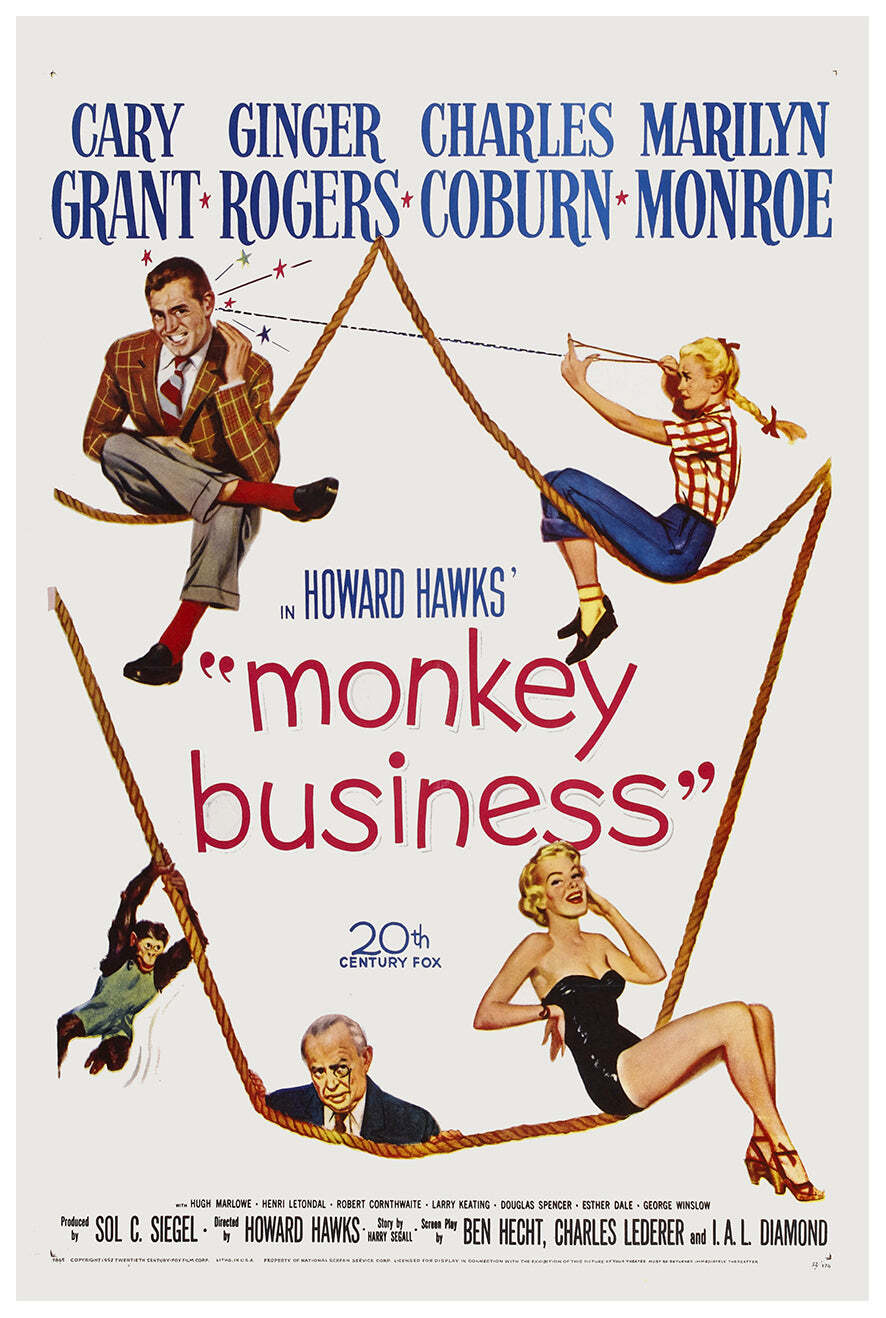
Monkey Business (1952) Poster
MONKEY BUSINESS (1952) B
dir. Howard Hawks

The search for youth doesn’t begin with a Spanish conquistador or a scientist full of theories. It begins with a monkey who dumps a bunch of chemicals into the office water cooler. Cary Grant plays Barnaby Fulton, a chemist who might’ve bottled youth by now if he didn’t keep losing his pen. He’s been laboring over a rejuvenation formula for months, with little progress. The monkey gets there first. Mixes the batch, dumps it in the cooler, wanders off. Barnaby drinks it without a clue. Minutes later, he’s zipping through the office like a college kid with bad impulse control. He’s jumping desks, revving sports car engines, flirting with his boss’s secretary (Marilyn Monroe in an early role here—all breath and sparkle).

His wife Edwina (Ginger Rogers) clocks the new attitude, doesn’t buy it, and eventually takes a drink herself. That’s when things really start to slide. Soon, both are bouncing off the walls, trading adult restraint for teenage impulse. Every swig knocks a few years off their behavior. First it’s adolescence. Then childhood. By the time they’re out in the woods playing Cowboys and Indians, the film’s gone full regression therapy. (Grant shows up in brownface, a joke that now plays like an artifact and a flinch, but you have to watch these films and expect these types of things.)

The premise is nonsense, but Hawks builds on it anyway—like he’s trying to stack jelly and call it architecture. Monkey Business doesn’t build—it just sort of comes apart, piece by piece. One scene slips into the next, chaos passing itself off as polish. Grant moves through this like he’s been rewound and slightly misaligned. He’s somehow graceful and absurd all at once. Rogers trails close behind, timing each of her moves with a kind of unflashy snap that she makes look effortless—even in a non-dancing role. And Monroe. She doesn’t have to do anything. Just walk through a doorway and exist, and she commands the screen.

Hawks isn’t chasing the speed of His Girl Friday or the delirium of Bringing Up Baby. Hawks may be idling here, but even when he’s at half-speed, he keeps the machinery running smooth. The laughs come easy enough, even when the joke itself has worn thin. The movie stretches its one good joke until it’s see-through. But thanks mainly to the dedication of the stars, it still holds shape when all is said and done.

Monkey Business is minor Hawks, but it’s not negligible. A comedy about grown-ups who behave like children that doesn’t talk down to either. The formula works just long enough to remind you that maybe immaturity isn’t the problem—it’s pretending you ever outgrew it.

Starring: Cary Grant, Ginger Rogers, Marilyn Monroe, Charles Coburn, Henri Letondal.
Not Rated. 20th Century Fox. USA. 97 mins.
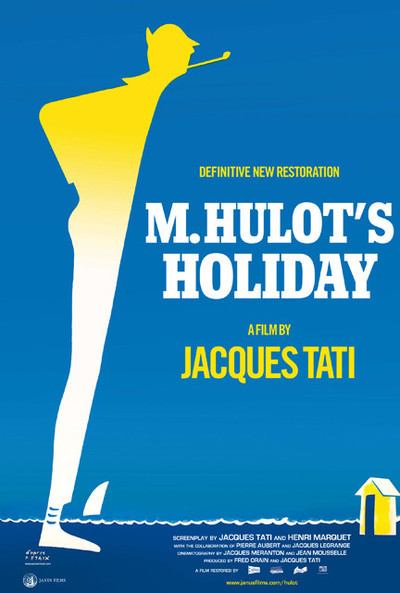
Monsieur Hulot’s Holiday (1953) Poster
MONSIEUR HULOT’S HOLIDAY (1953) A−
dir. Jacques Tati

Hulot walks like curiosity’s got him by the shoulders. Upright but awkward, leaning a bit forward, caught between hurry and hesitation. A pipe hangs off him somewhere—mouth, hand, whichever’s free. His felt hat never sits straight. And he squints like he’s trying to read a train schedule from across the station. Even words seem dangerous to him. You can almost see him weighing how each one will come out before he lets it escape. And when it does, it booms. He moves through the world a half beat behind it. Or maybe he’s a half beat ahead. Who keeps track. He turns up at a seaside resort. On the French Atlantic coast. No plan that we know of. Maybe just the quiet hope that showing up might count as rest. And relaxation, too, if available.

He’s a tourist, maybe. A ghost, possibly. He stumbles through doors, tangles with beach chairs, sends tennis balls off on existential journeys. A horse gets spooked. A few umbrellas revolt. A chair collapses. A hinge sighs. Nothing breaks for long. Tati’s comedy runs not on punchlines, but on rhythm—tiny missteps that turn into melody. Small hesitations and repetitions that turn daily motion into choreography. A door that refuses to close. The soft percussion of a window hinge.

The image that sticks with me the most, somehow, isn’t even of Hulot himself. Well, sort of. He opens a café door and a strong gust of wind comes billowing in. A diner sits perfectly still at his table while his thin, floppy (and very fake) mustache whips against his face. That in a single, absurd shot says everything you need to know about Tati’s humor. Nothing’s forced. Things just unfold awkwardly until they cross some kind of invisible line into being funny.

Alain Romans’ lilting jazz score seems to seep up from the floorboards, giving every shuffle and stumble a bounce. The whole movie feels buoyant. It’s like an unhurried dance of people who are moving slightly out of rhythm. But never out of step.

Hulot’s Holiday floats. It’s not about the beach. Not the blunders. Not even the man. It’s about the fragile grace of people trying to enjoy themselves while life, quietly, almost politely, rearranges their plans. By the end, you feel like you’ve drifted along with Mr. Hulot. Carried off by a light wind, salt in the air, no destination in mind.

Starring: Jacques Tati, Nathalie Pascaud, Louis Perrault, Valentine Camax, André Dubois.
Not Rated. Les Films Corona. France. 87 min.
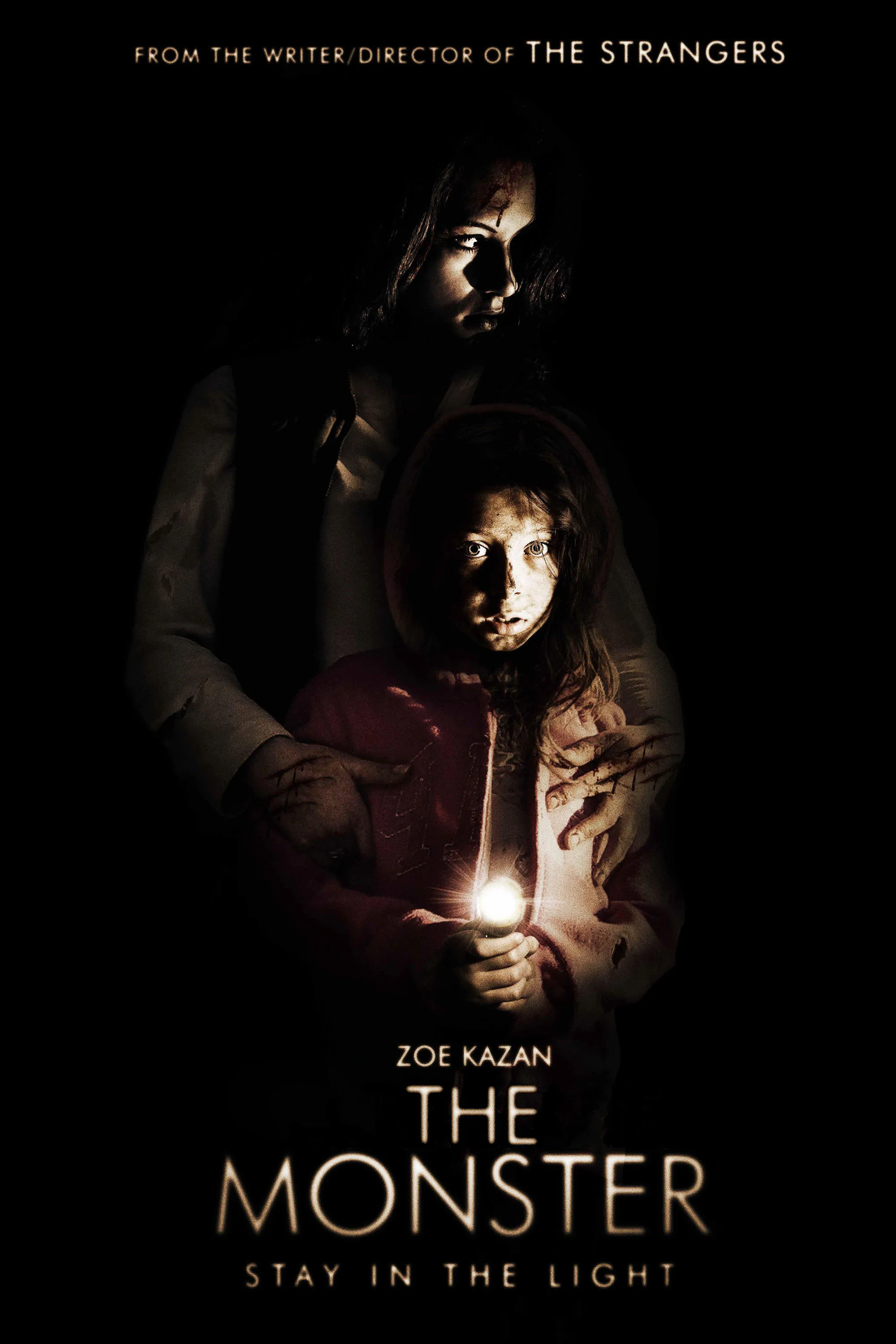
The Monster (2016) Poster
THE MONSTER (2016) B+
dir. Bryan Bertino

A horror film stripped to the studs. Two people. One road. Something in the dark that won’t stay there. Kathy (Zoe Kazan) drives a slick two-lane road, hands locked at ten and two. Her daughter Lizzie (Ella Ballentine), ten and already old in the eyes, watches the rain slide down the window like it’s trying to leave first. They’re headed to Lizzie’s father. This time it’s supposed to stick. Kathy—hungover, brittle, a ghost of a mother—has decided the kid deserves better. No argument. Just surrender.

Then the car hits a wolf. The impact is sudden, jarring, total. The engine dies. The road becomes a trap. Kathy gets out. Checks the damage. The wolf’s body is shredded, ribs showing, fur slick with rain. Not her doing. Something else got there first. Claws longer than a hand. Whatever did it is still close.

A tow truck crawls up out of the dark. Headlights cut through the mist. For a moment, it feels like rescue. Then the driver’s gone—yanked into the trees. The lights stay on, humming against the rain. The glow flickers, shrinks, fades. Lizzie was supposed to be heading home. Now the only plan left is survival.

What follows is a lean, sharply focused monster movie. It’s stripped of gloss but rich in tension. The creature, rendered with practical effects, doesn’t always look convincing. But it’s there. It shares the frame with the actors. That counts for far more than polish.

Kazan is terrific in this. She’s raw and scraped down to nerves. Ballentine matches her. She’s sharp and watchful. A kid who already seems fluent in disaster. Not just the monster in the woods but the monster festering between them. They might hear a nasty snarl outside, but it seems to mirror a much nastier, unheard one inside.

Bertino builds the movie from wreckage—grief, guilt, instincts that don’t know when to stop. The creature keeps the plot moving, but the story’s in the pauses. In those rare moments when Kathy and Lizzie stop running and finally see each other.

Starring: Zoe Kazan, Ella Ballentine, Aaron Douglas, Christine Ebadi, Marc Hickox, Scott Speedman.
Rated R. A24. USA. 91 mins.
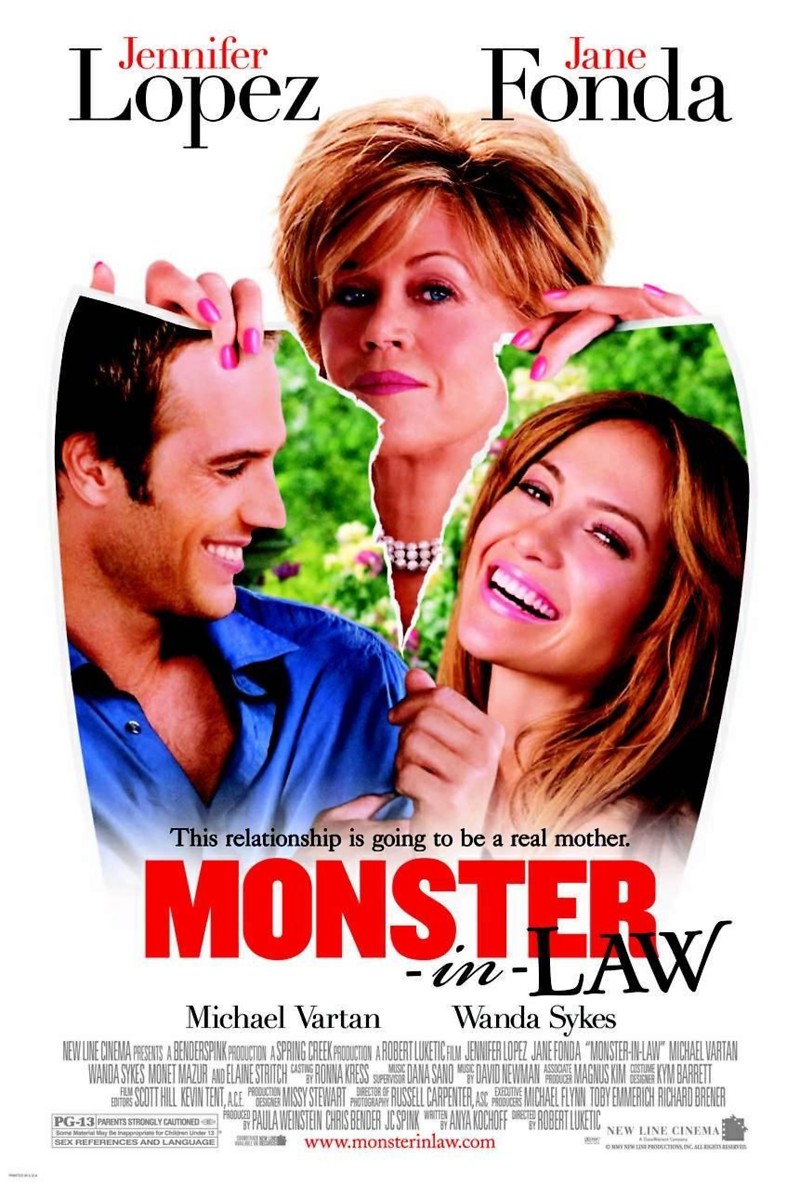
Monster-in-Law (2005) Poster
MONSTER-IN-LAW (2005) D+
dir. Robert Luketic

The monster isn’t under the bed. It’s hosting dinner. It’s wearing pearls. It answers to “Mother.” Jane Fonda—returning to movies after a fifteen-year hiatus—plays Viola Fields, a talk-show icon unceremoniously fired from her own show, and she doesn’t do humility. An inopportune time, then, for her son (Michael Vartan) to announce he’s engaged to Charlie (Jennifer Lopez). Now Viola has nothing better to do than sabotage it.

Of course, as any decent sitcom will tell you, no mother believes anyone could ever be good enough for her son. But to Viola, nobody could be worse for her flesh-and-blood than Charlie. First of all, her name is Charlie. What’s up with that? Further doesn’t have a career to speak of. She works as a temp. Picking up receptionist gigs and sometimes caterers. She’s also a dog walker. How undignified! But most of all, Viola just doesn’t like the way Charlie looks. That fixed rom-com brightness. The agreeable smile straight out of a toothpaste commercial. Because good dental hygiene can only mean one thing. That she brushes her teeth. And if a woman is brushing her teeth all the time, how could she ever find the time to take care of her son?

I like movies about petty people trying to indiscriminately ruin lives as much as the next person, but Monster-in-Law doesn’t stoop to warfare so much as it preens for the cameras. Viola’s schemes are mostly interruptions disguised as breakdowns—panic attacks, fainting fits, psychological drive-bys. She tosses coded (and not-so-coded) insults Charlie’s way and smiles while doing it. Charlie meets it all with a kind of juvenile decorum—trashing closets, switching pills, and occasionally letting Viola’s sabotage play out so everyone can see how awful she is. She’s even willing to risk an allergic reaction just to make her point. Because nothing says “toxic in-law” like attempted homicide over dinner.

This tit-for-tat between them—let’s be generous—is limp. The insults don’t sting. The slapstick barely shows up. Just a few timid flails, like the movie’s terrified to muss its hair. A comedy where even the meltdowns seem blow-dried.

The one person who seems to realize what movie she’s in is Wanda Sykes as Viola’s assistant, Ruby—dry, unbothered, allergic to the nonsense around her. She talks like a woman stuck in a meeting that could’ve been an email. Even as the movie caves in around her, she finds a rhythm no one else does.

Monster-in-Law wants to be a screwball revival—a Meet the Parents for the bridal set. What it ends up as is a glossy stalemate: two stars, one premise, and a director who forgot to pick a tone.

Starring: Jennifer Lopez, Jane Fonda, Michael Vartan, Wanda Sykes, Adam Scott, Monet Mazur, Annie Parisse.
Rated PG-13. New Line Cinema. USA-Germany. 101 mins.